How to See Seven Magic Mountains near Las Vegas
At the far southern end of Las Vegas Boulevard, placed in the Ivanpah Valley like a colorful mirage in an otherwise desolate desert, an art exhibit…
Disclosure: This post contains affiliate links. If you make a purchase through these links, I may earn a small commission at no additional cost to you. I only recommend products or services that I believe will add value to my readers.
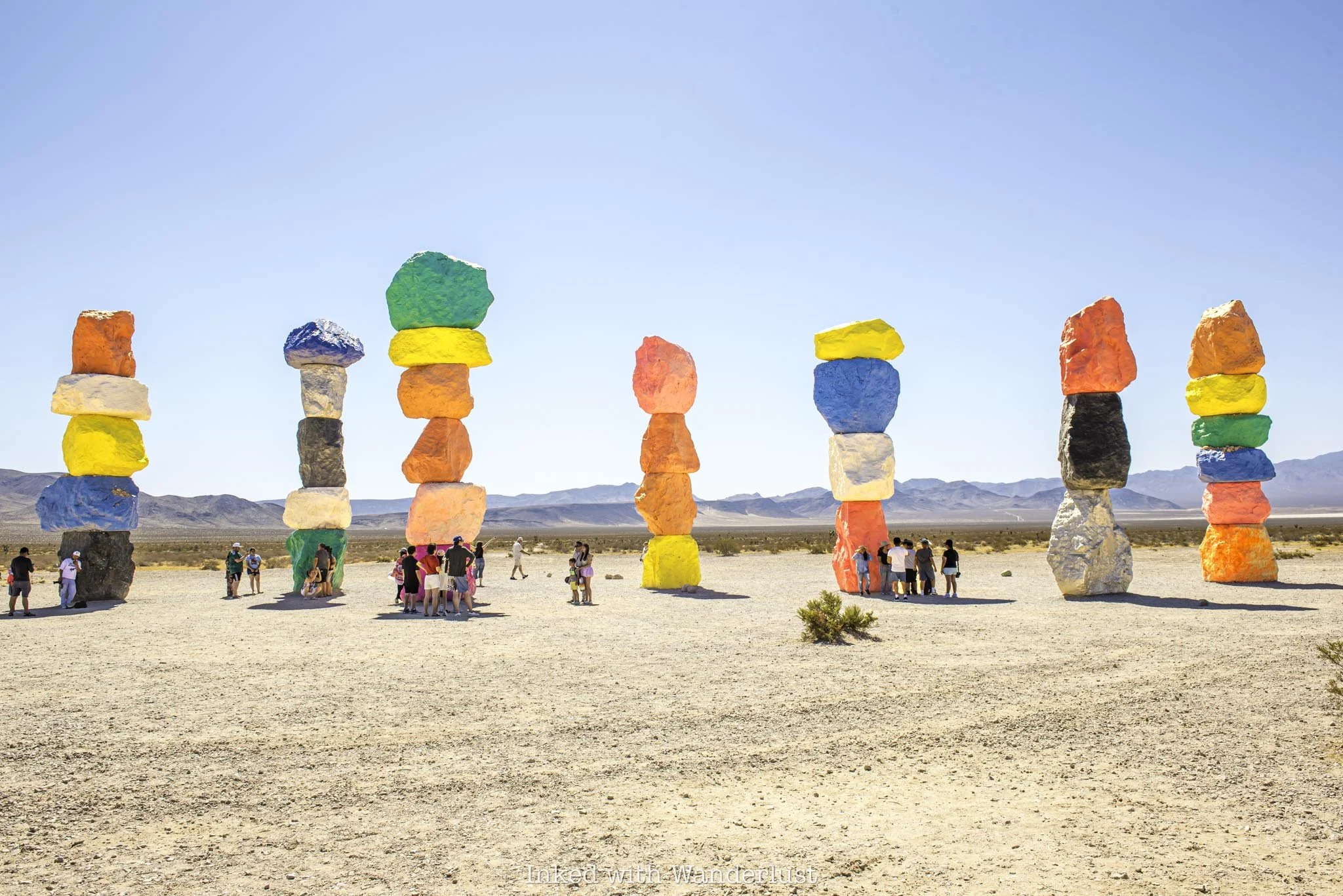
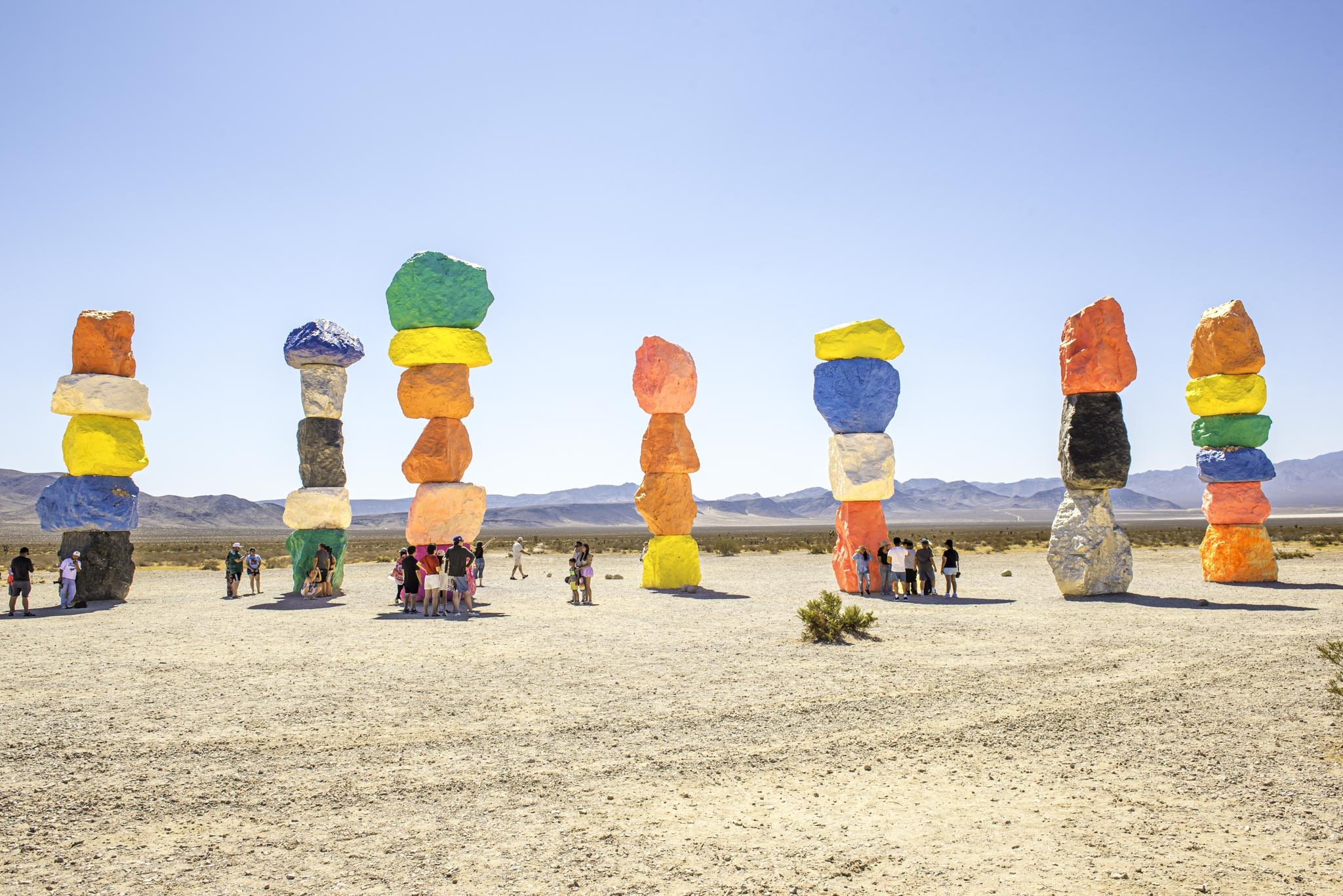
At the far southern end of Las Vegas Boulevard, placed in the Ivanpah Valley like a colorful mirage in an otherwise desolate desert, an art exhibit unlike anything else draws visitors to it like a beacon of light.
That beacon is Seven Magic Mountains, a public artwork by famed Swiss artist Ugo Rondinone. It’s a series of seven, 30-35 foot high dayglow totems comprised of painted, locally sourced boulders.
In the post below, I will cover several topics about Seven Magic Mountains, including how to get there, the parking situation, fees, the artist’s inspiration to create it, and more. Let’s get into it!
*If you’re finding my website helpful, please consider leaving a tip through the “Buy me a Coffee” button below. These tips help with ongoing costs such as parking fees, entry fees, meals, etc. Thank you!
Seven Magic Mountains Location and Parking
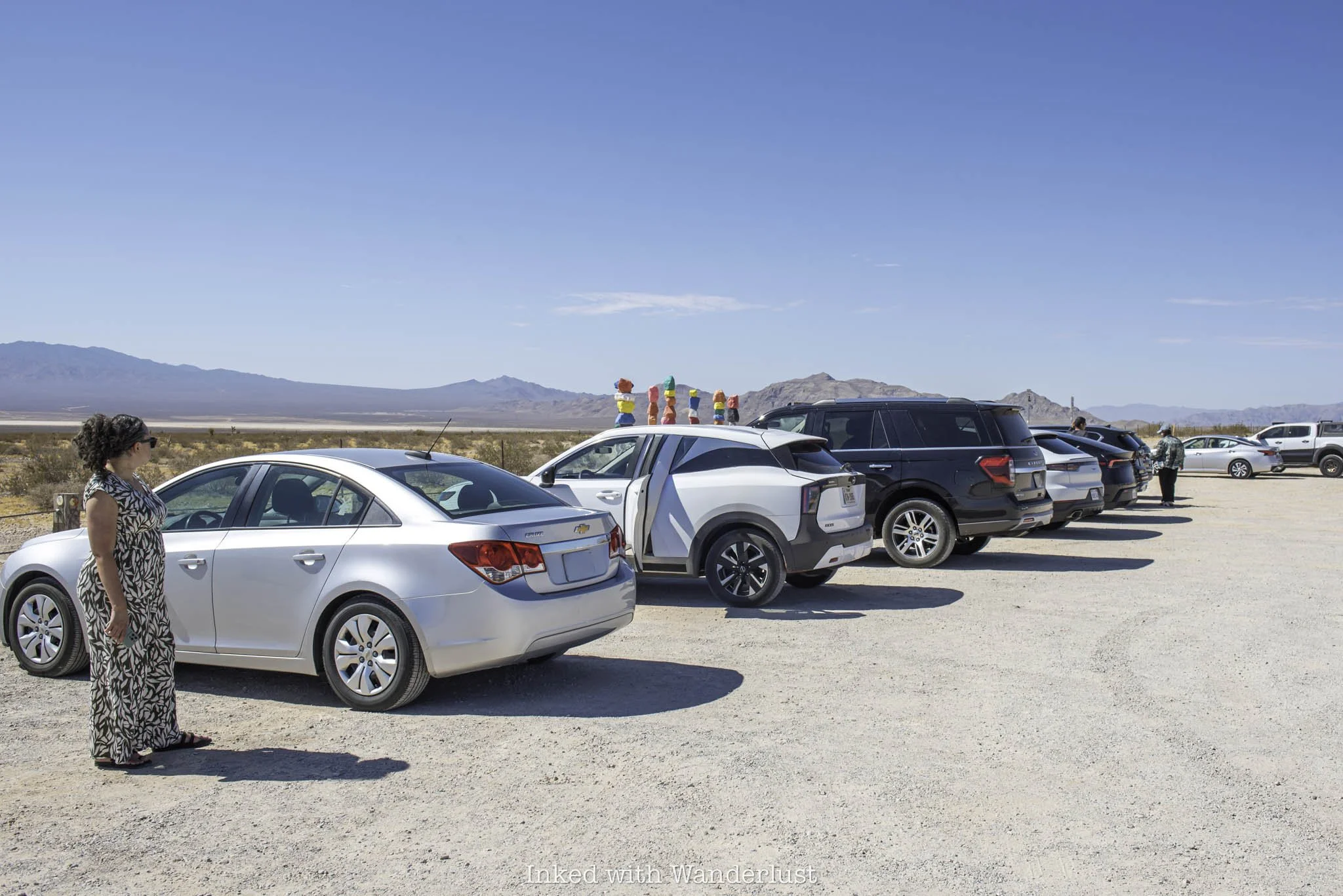
Contrary to popular belief, Seven Magic Mountains is not located in Las Vegas. It is, however, just an easy 25-30 drive away along Interstate 15. Coming from Vegas, you’ll take the Sloan Road exit, go left to the other side of the freeway, and turn right on Las Vegas Boulevard.
You’ll follow this road for several miles for what seems like an eternity. Eventually, Seven Magic Mountains will reveal themselves out in the distance on your left. You can’t miss them as their bright colors contrasts with the desert landscape nicely.
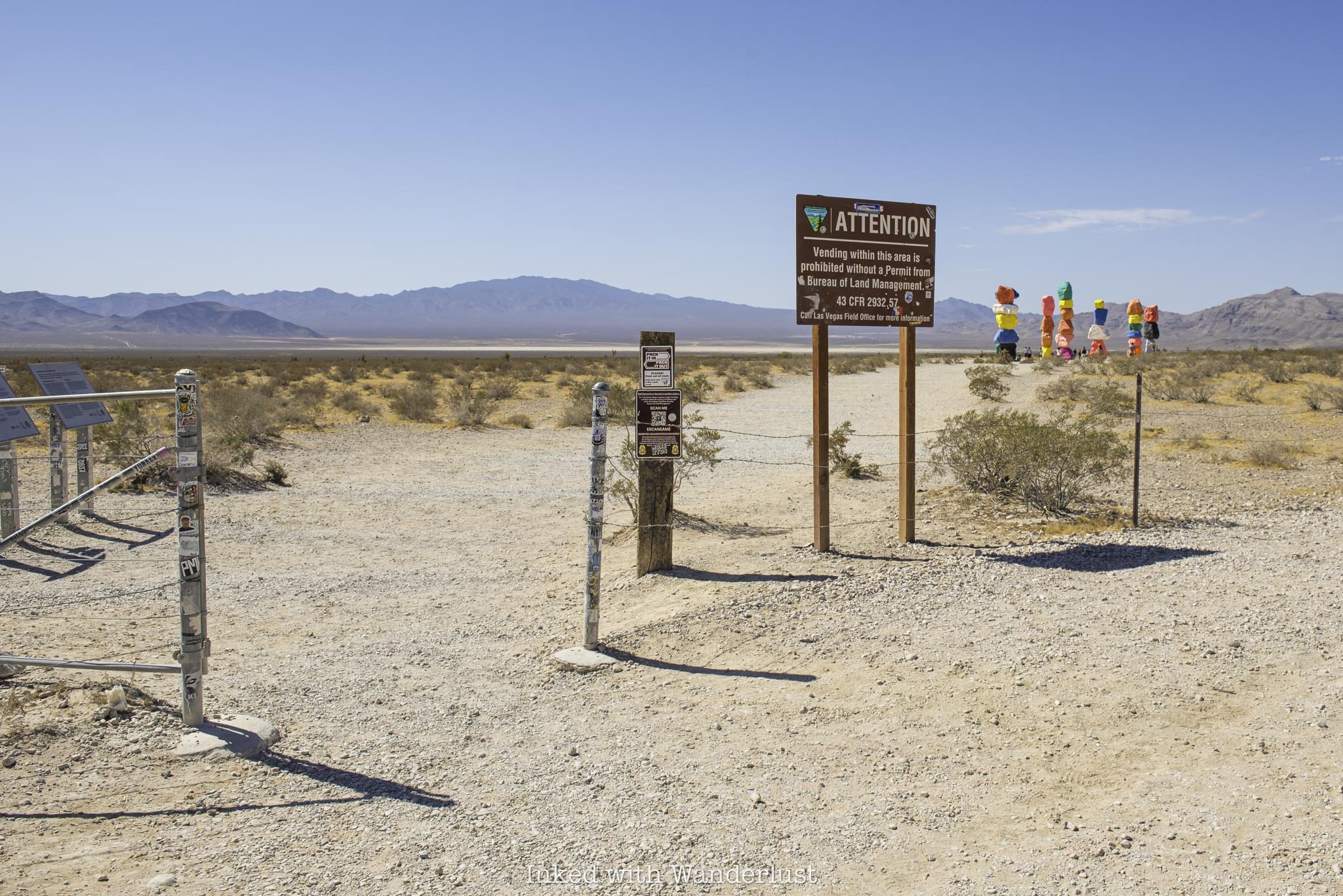
You’ll pull into a semi-large, dirt and gravel parking lot that’s absent of any marked parking spots. Simply use common sense when parking and try not to block anyone in. Parking and entry into the art installation is free of charge.
Furthermore, there are no restroom facilities or drinkable water at the site. Nearest restrooms are located five miles down the road in Jean, further down the freeway in Primm, or at local businesses at the intersection of St. Rose Parkway and Las Vegas Boulevard.
Welcome to Seven Magic Mountains
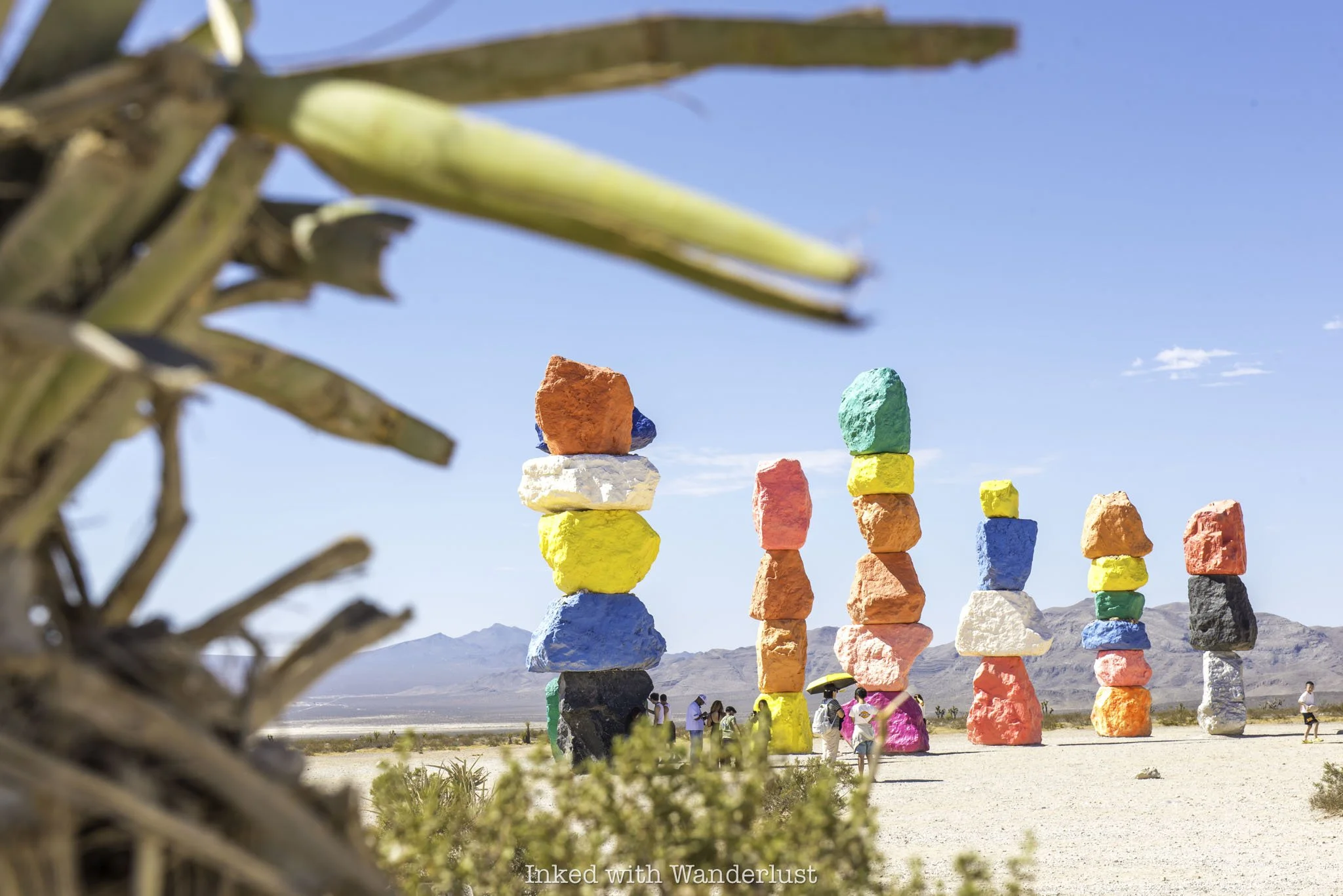
The first thing you’ll need to know about Seven Magic Mountains is it’s 100% sun exposed. Aside from the shadows of the pillars cast by the sun, there is no shade to speak of. If you know anything about the Las Vegas area, you’d know that isn’t ideal.
Thankfully, you can see the pillars from the parking lot and it’s just a short walk to them along an obvious unpaved path. Still, I advise checking that day’s heat advisory and avoid going if extreme heat is forecasted.
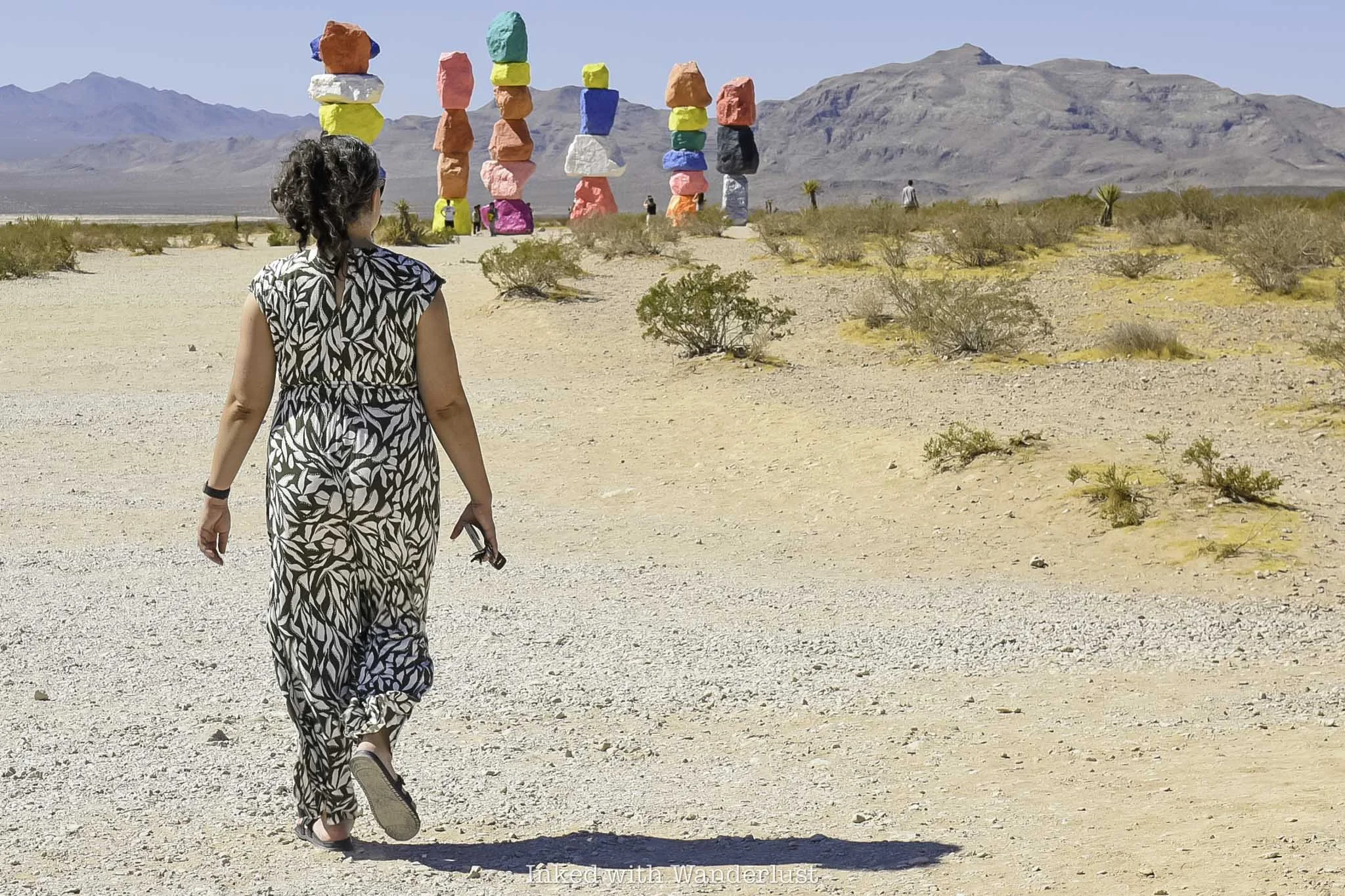
Seven Magic Mountains was meant to present a creative critique of the superficial environments of places such as Las Vegas. Its location is symbolic and deliberate, in that it’s placed between the natural and artificial.
The natural element is represented by the mountains, desert foliage, and Jean Dry Lake. Conversely, the adjacent interstate, the constant flow of traffic between Los Angeles and Las Vegas, and the near-by Vegas strip itself, represent the artificial.
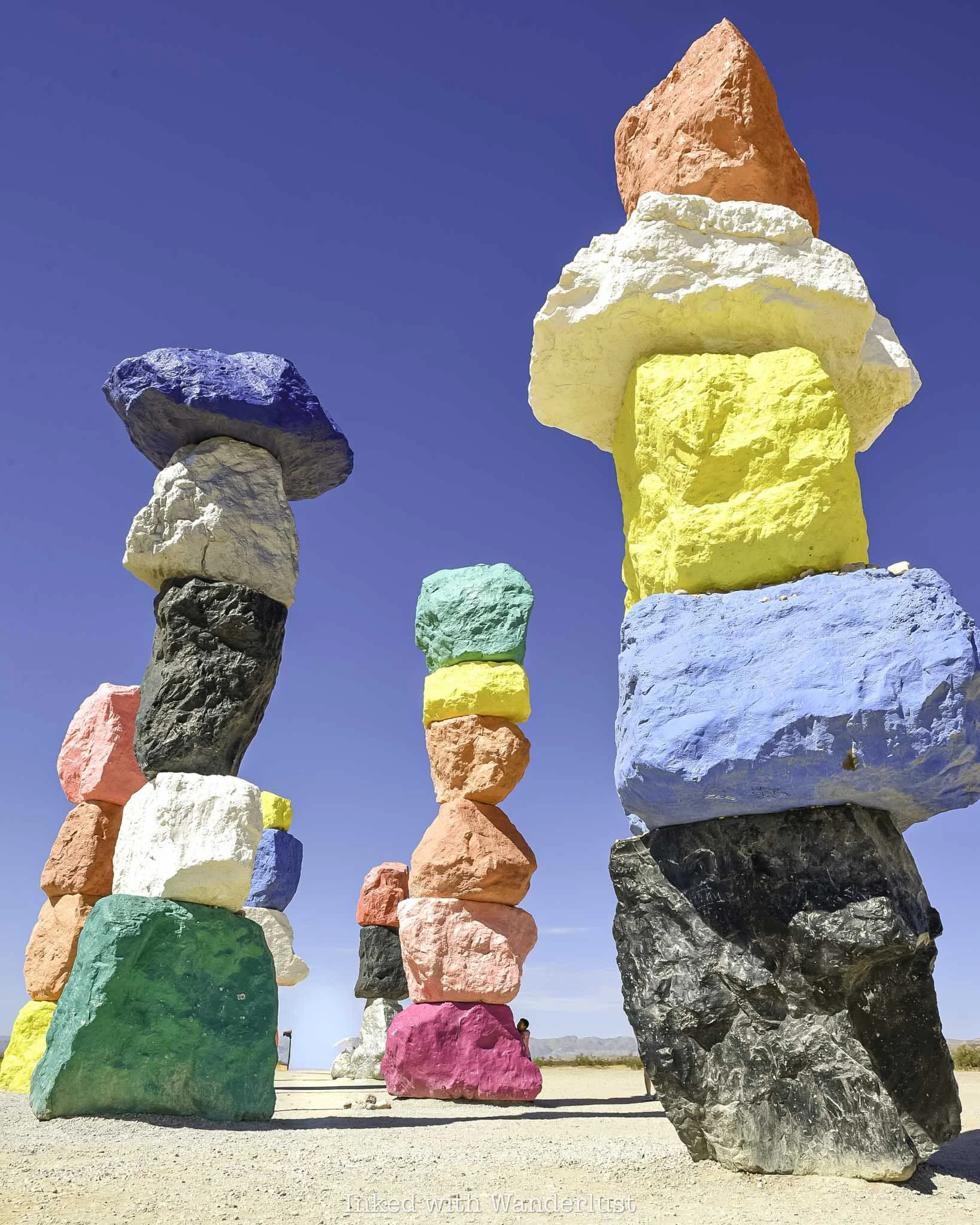
It’s an open exhibit, meaning you’re permitted to wonder about at your leisure and get as close as you want. It’s ok to touch the pillars, but please refrain from vandalizing or climbing on them.
There’s been talk in recent months about putting barriers around the base of the pillars due to ongoing vandalism. Hopefully that doesn’t become a reality as their appearance of being “naturally” positioned in the desert gives it more intrigue.
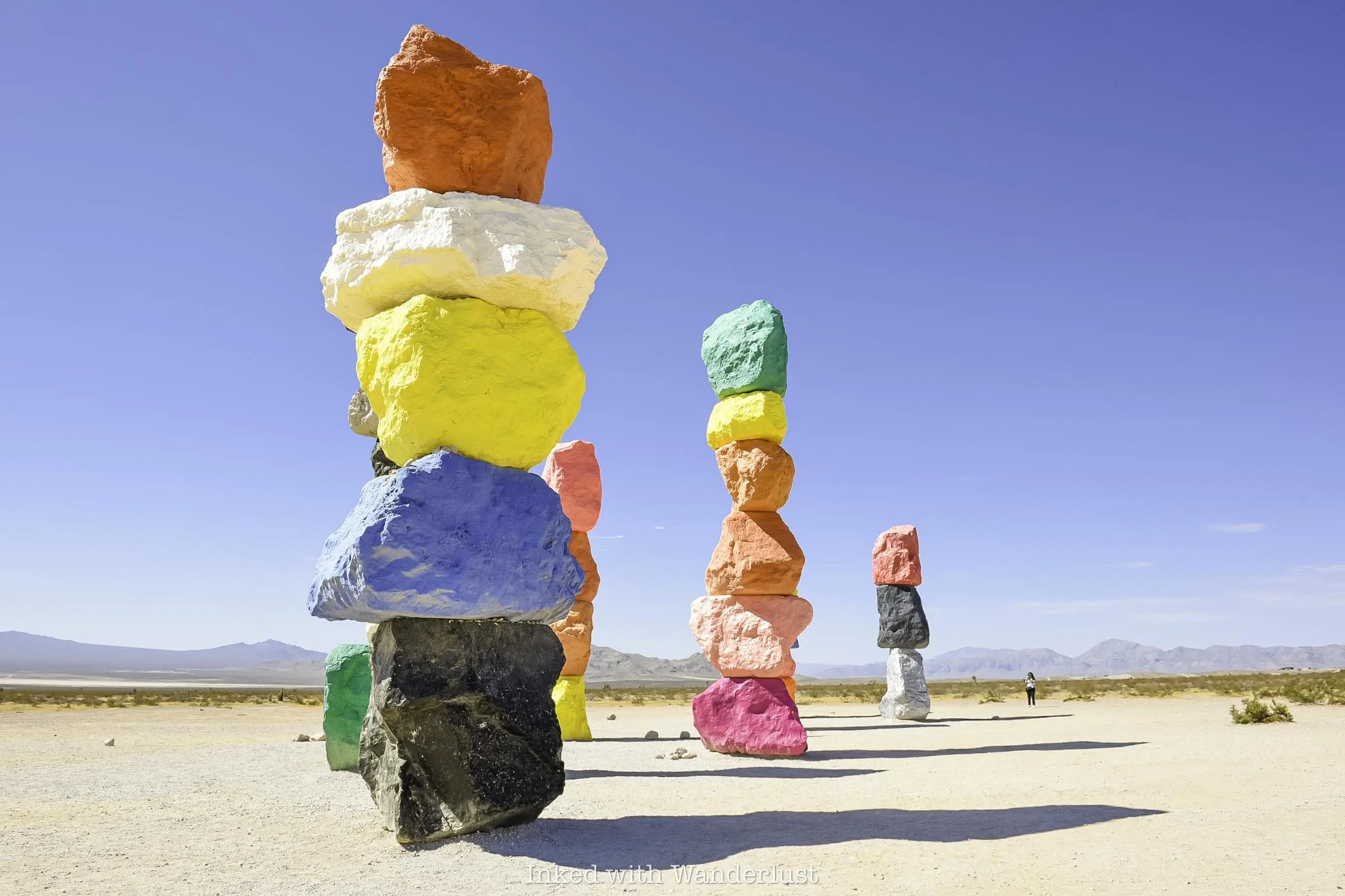
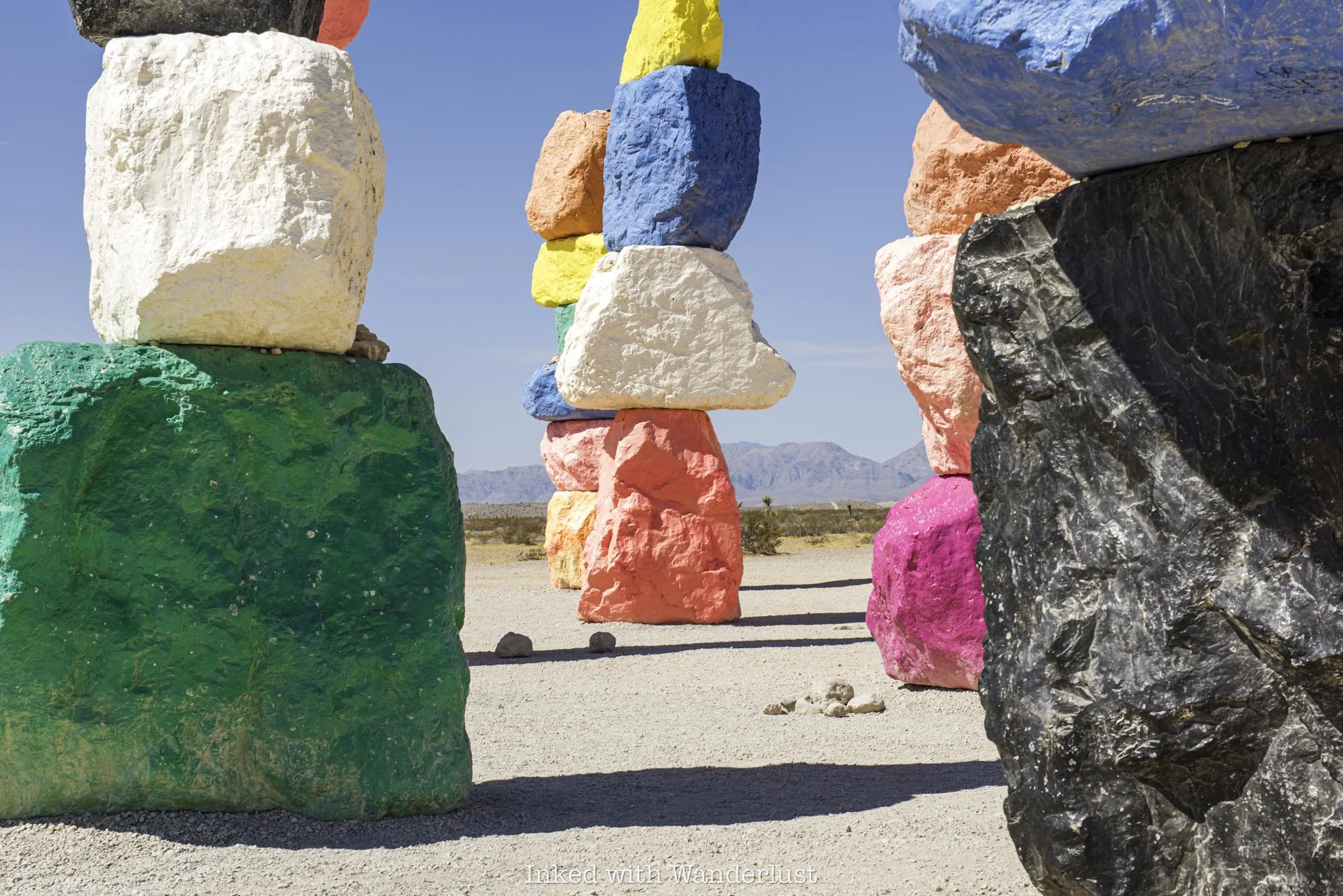
Another discussion involved moving them up north to Reno due to its association with the Nevada Museum of Art, Reno. Seven Magic Mountains first opened in 2016 and was initially meant to be a temporary exhibit.
However, artist Ugo Rondinone has full authority over the artwork and decided against the move. His reasoning being the landscape in its current location represents much of the artwork’s deep meaning.
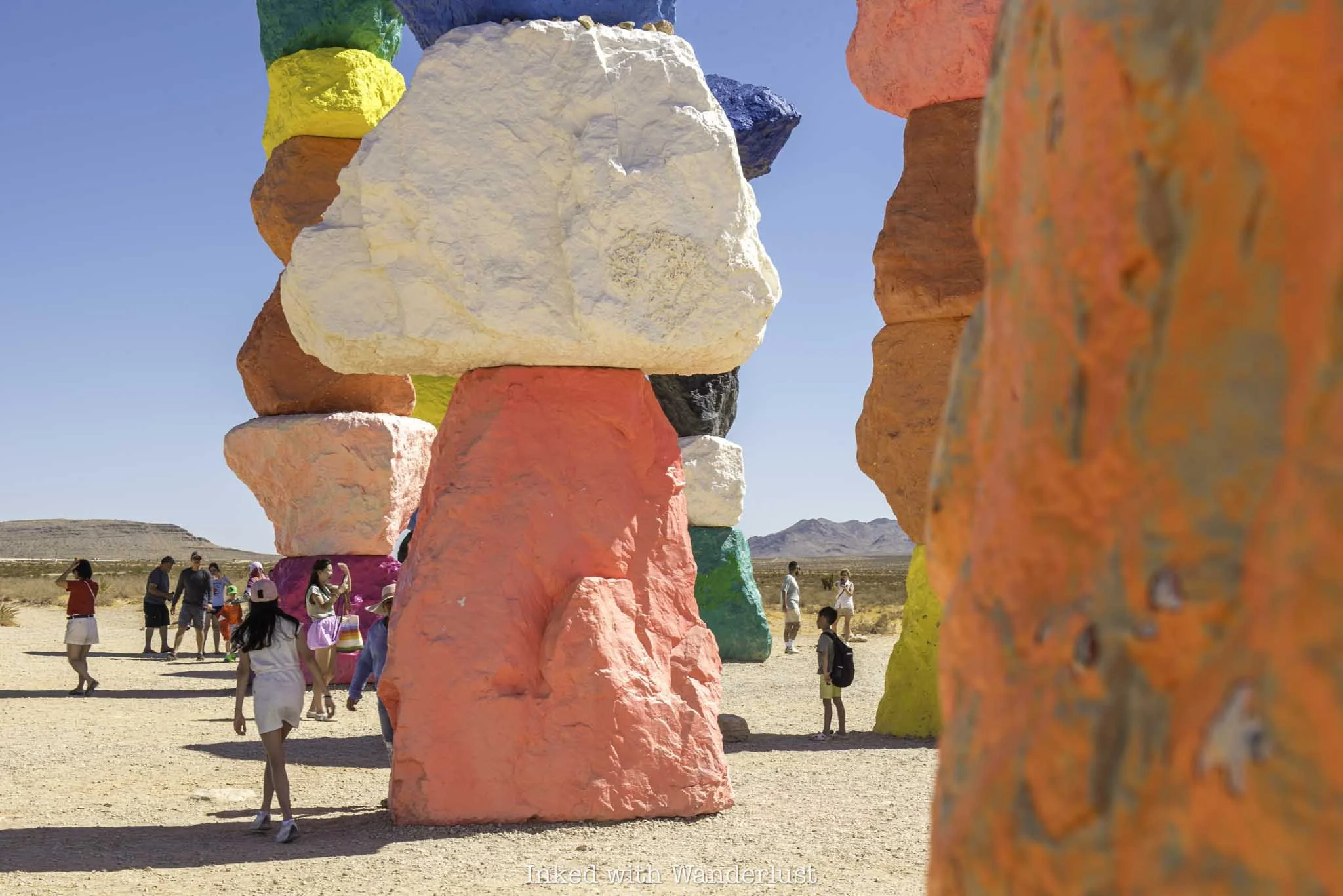
If you want to do more than just look at them, there are interpretive signs at the installation at the start of the path near the parking lot. Furthermore, there’s a free “Guide-by-Cell” option, offering a deeper look at the pillars.
Simply call 702.381.5182 and select your language of preference (currently, only English and Spanish are offered). By following the prompts you’ll learn more about the artist, the land, and the artwork.
Best Time to Visit Seven Magic Mountains
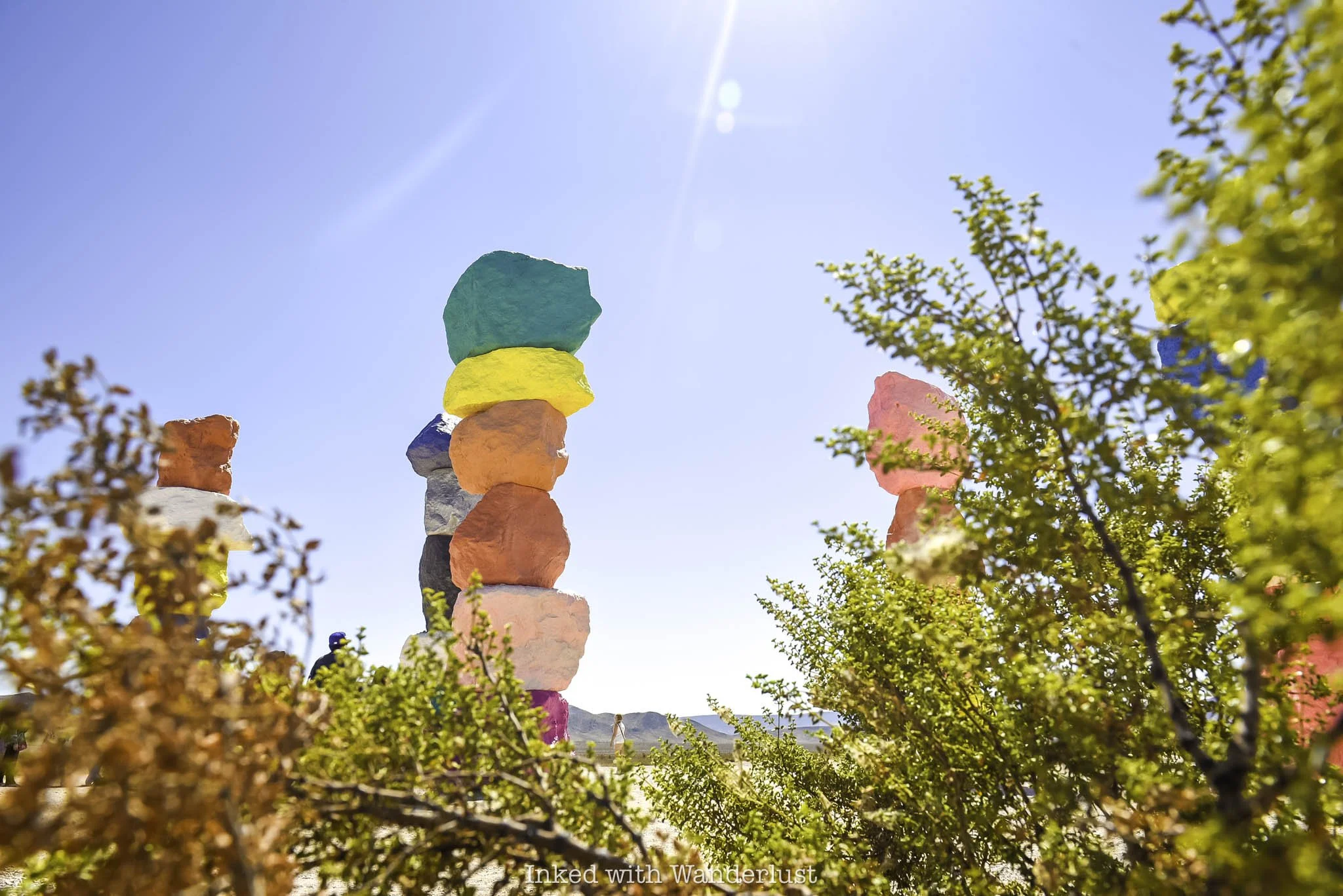
The answer to this question entirely depends on your goals and preferences. During my visit, I was here during the late morning hours (right around 10am) on a Tuesday in August. For context, it was already over 100 degrees when I got there.
As you can see in the photos in this post, there were quite a few others already there and more who showed up after me, but it wasn’t too bad. I was able to take many photographs without others in them, though it took some effort.
That said, it wasn’t ideal timing. To be honest, I was on my way to see the Bonnie and Clyde death car in Primm when I saw signage for Seven Magic Mountains. I had completely forgotten they were there and stopped on a whim.
Sunrise/Early Morning: It’s a good option for thin crowds, cool temperatures, and soft light. You’ll mostly find photographers at this time.
Midday: Harsh shadows, scorching heat, and heavy crowds. If you can help it, avoid this time of day.
Late Afternoon/Sunset: Best time to see warm, vibrant colors on the pillars. Again, this is another favorite for photographers and Instagrammers. But it could also still be too warm.
Know Before You Go
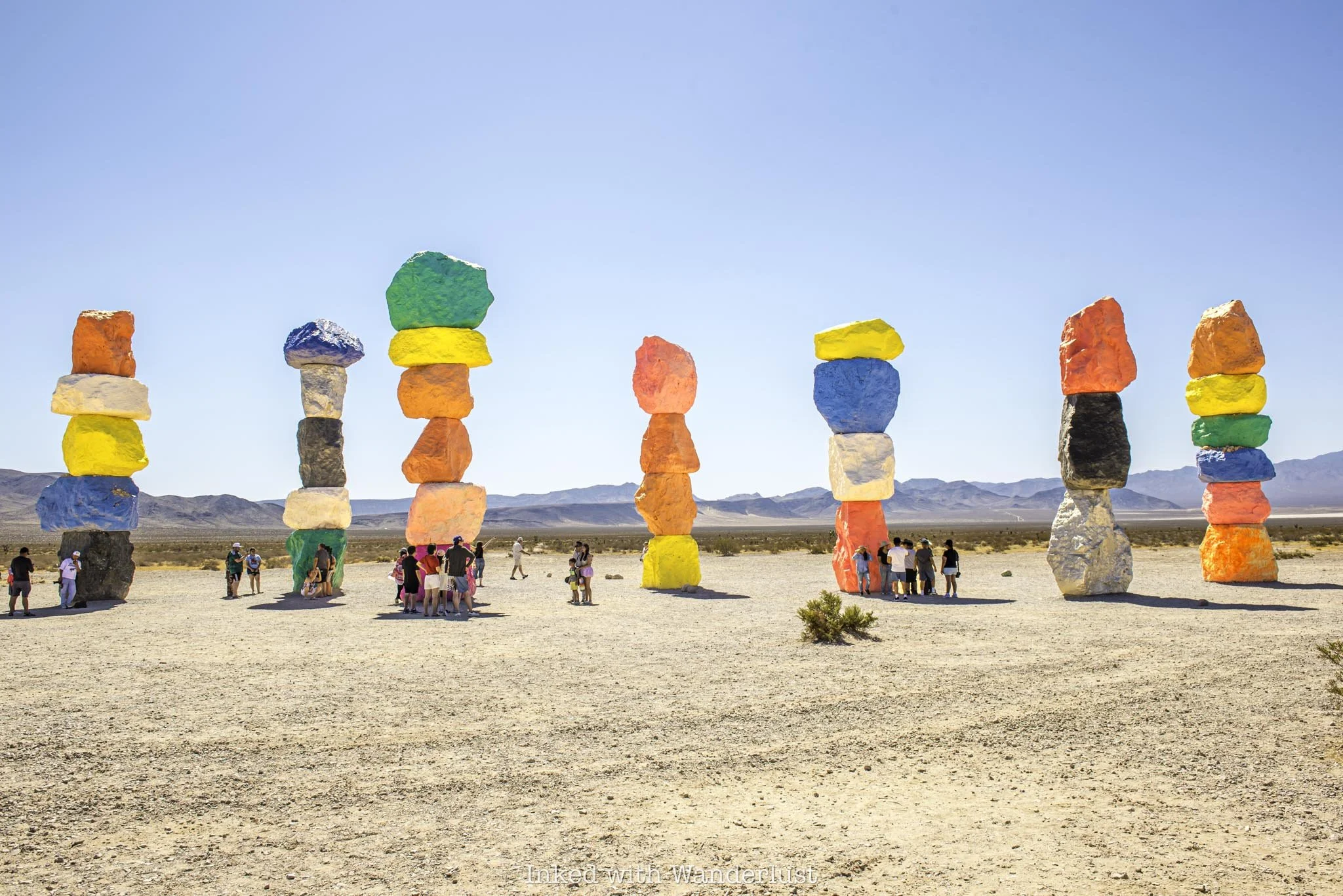
There is no shade. Be sure to wear sunscreen, a hat, and sunglasses, especially if you’re coming midday.
Open during daylight hours. The installation is open between sunrise and sunset daily.
There is no cost. Both parking and admission into the installation is free of charge. Don’t let any scammers tell you any different and don’t pay for unofficial “tours”.
Cell reception is good. I have Verizon and had no issues with connectivity there.
No bathrooms on site. You’ll need to travel further down to Jean or Primm, or closer to Vegas at one of the local businesses off the freeway.
If you’re looking for more to do after exploring Seven Magic Mountains, consider a trip to nearby Primm and checking out the Bonnie and Clyde death car! Additionally, if you’ll be in Las Vegas, here are a few recommendations:
Mob Museum (post coming soon)
*If you’ve found this post helpful, please consider leaving a tip through the “Buy me a Coffee” button below. These tips help with ongoing expenses such as parking fees, entry fees, meals, etc. Thank you!

Bonnie and Clyde Death Car Location (Where to Find It)
For nearly a two year period from early 1932 to May 1934, Bonnie Parker and Clyde Barrow (primarily now known as simply, Bonnie…
Disclosure: This post contains affiliate links. If you make a purchase through these links, I may earn a small commission at no additional cost to you. I only recommend products or services that I believe will add value to my readers.
For nearly a two year period from early 1932 to May 1934, Bonnie Parker and Clyde Barrow (primarily now known as simply, Bonnie and Clyde) ran an intense, and often violent multi-state crime spree across Texas, Oklahoma, Iowa, Missouri and more.
Throughout this 21-month timeline, Bonnie and Clyde committed multiple crimes, including countless auto thefts, multiple robberies at banks, grocery stores and gas stations, and thirteen confirmed murders, a few of which were of law enforcement officers.
It took many months of hunting and planning but finally, on May 23, 1934, on a rural road just outside Sailes in Bienville Parish, Louisiana, Bonnie and Clyde’s crime wave, and lives, met an incredibly violent end in a stolen 1934 Ford Model 40.
A six-man posse made up of local police and marshals ambushed Bonnie and Clyde after they pulled over to check on a motorist they recognized (a ruse by the posse). They fired over 130 rounds into the Ford, striking the couple upwards of a couple dozen times each.
That Ford Bonnie and Clyde were killed in was preserved by the original owner after being returned to her, bullet holes and all. It’s changed hands and locations over the years, but now resides inside a small Nevada casino. Find out exactly where, and more, in the post below!
*If you’re finding my website helpful, please consider leaving a tip at the “Buy me a Coffee” button below. These tips help with ongoing costs, such as parking fees and meals, and help to keep the site running. Thank you!
Bonnie and Clyde Death Car Location - Primm, NV
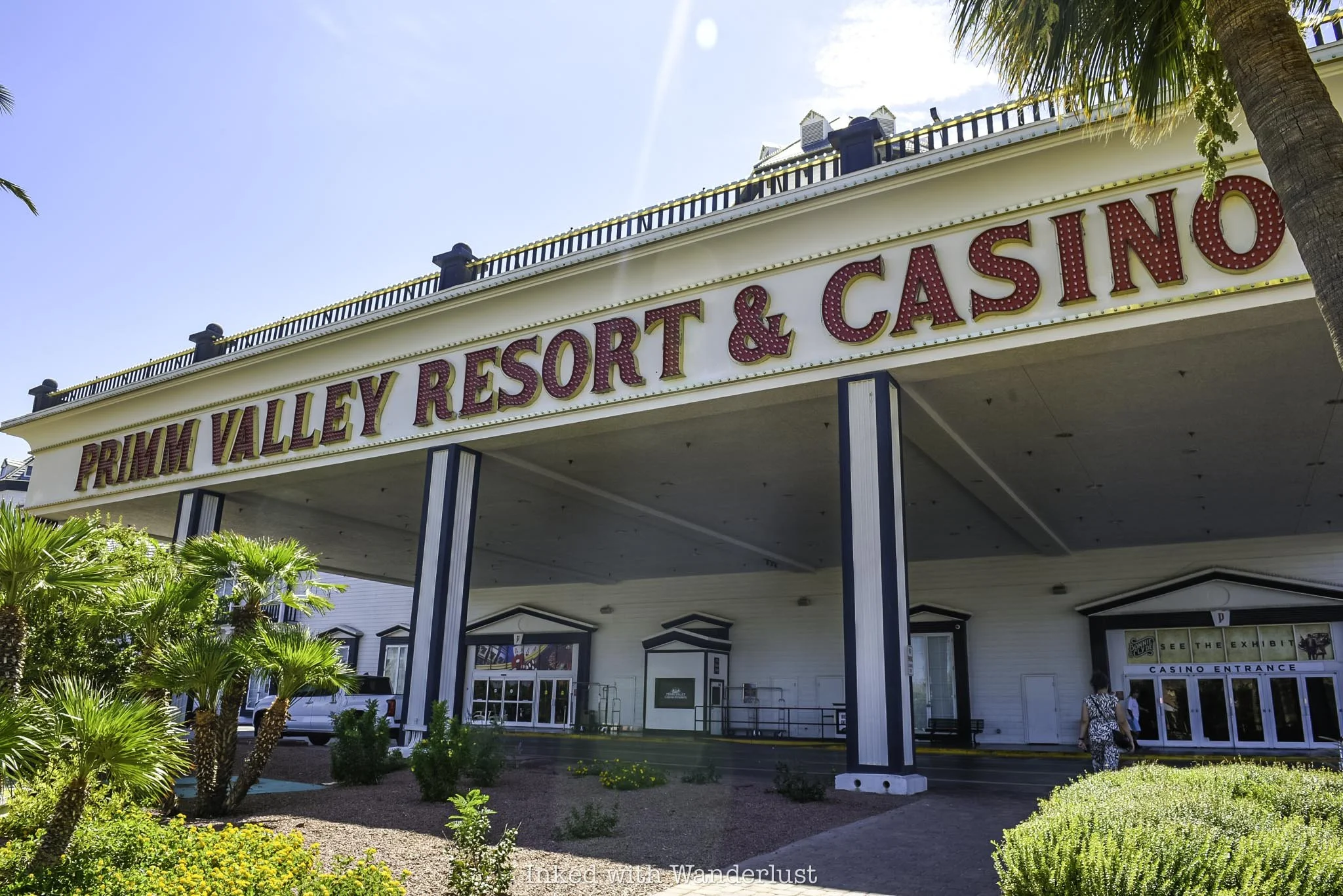
The Bonnie and Clyde death car can be found on display inside Primm Valley Resort and Casino, located in the tiny town of Primm, Nevada, a prominent roadside pit stop off of Interstate 15 near the Nevada/California border.
If you’re driving into Las Vegas from the Los Angeles area, you’re just a quick stop away as it’s right off of the freeway. Coming from Las Vegas, you’re looking at an easy 40-45 minute drive to reach the death car.
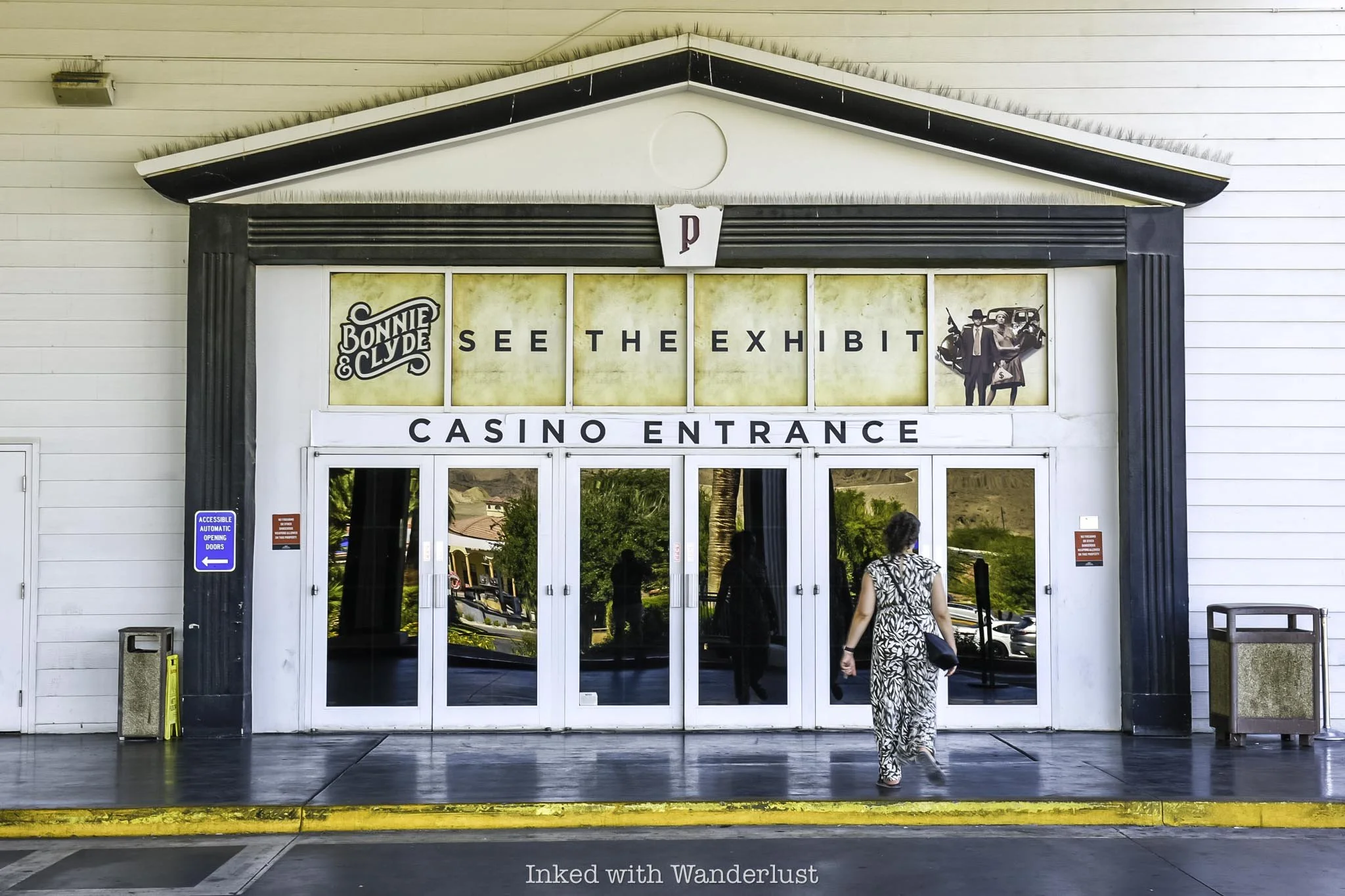
Parking is free at Primm Valley Resort. The most direct way to the death car would be from the parking lot directly in front of the casino. From there, walk towards and enter through the front doors. You’ll see a Bonnie and Clyde banner hanging above the entrance.
Shortly after walking into the casino, turn right past the maze of slot machines and you’ll immediately see the exhibit roughly twenty yards away. Much like parking, there is no fee to view the exhibit.
Bonnie and Clyde Death Car Exhibit
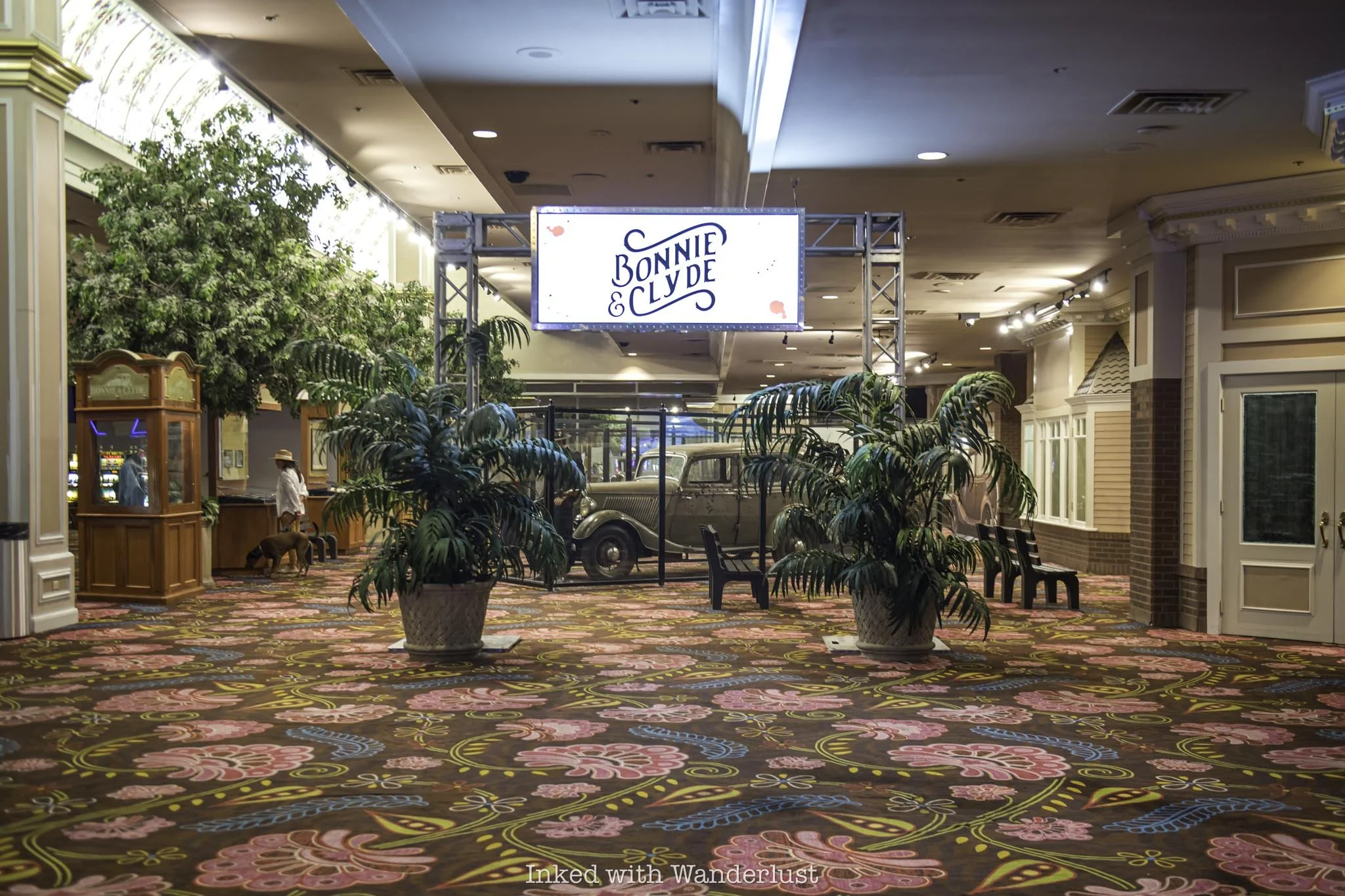
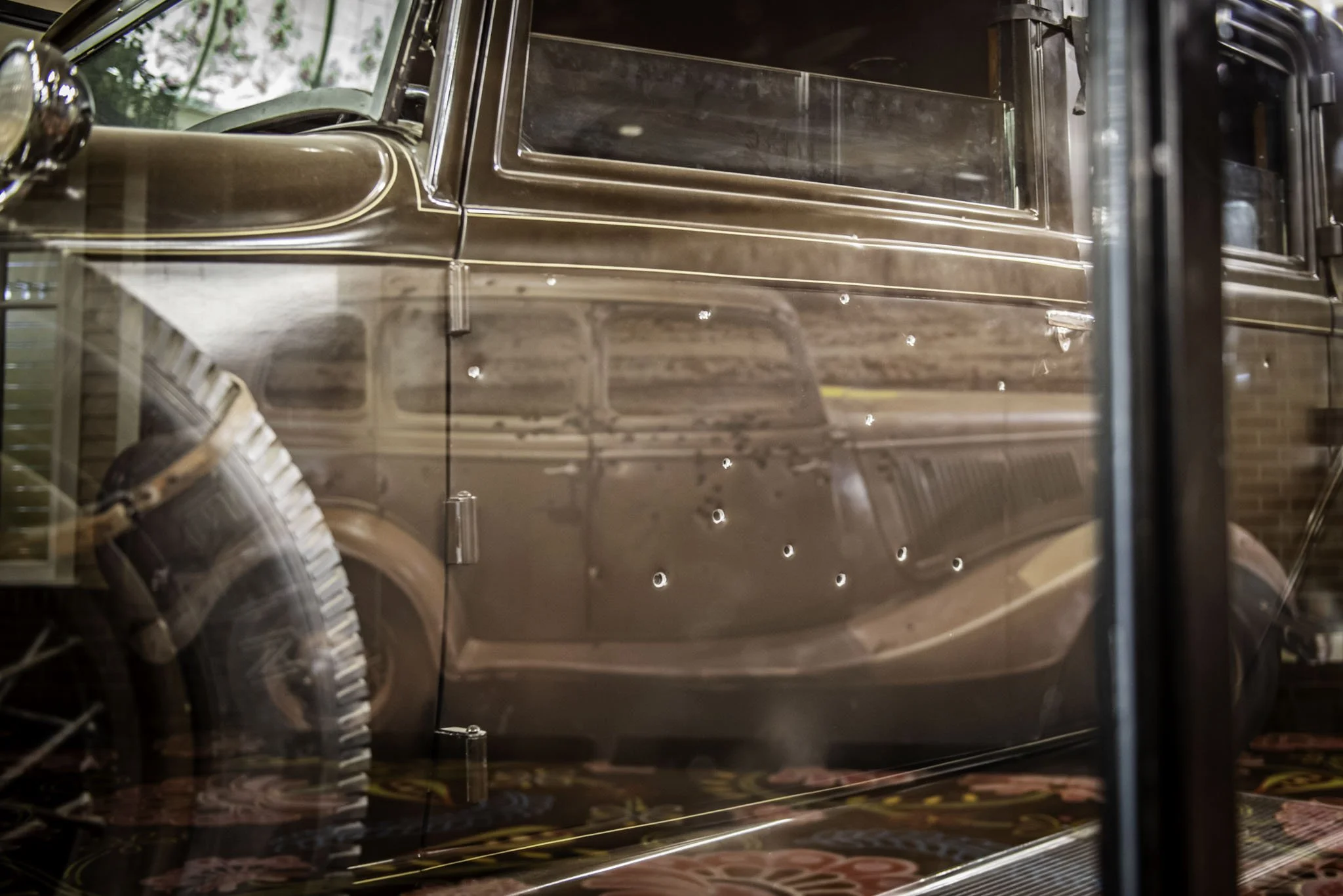
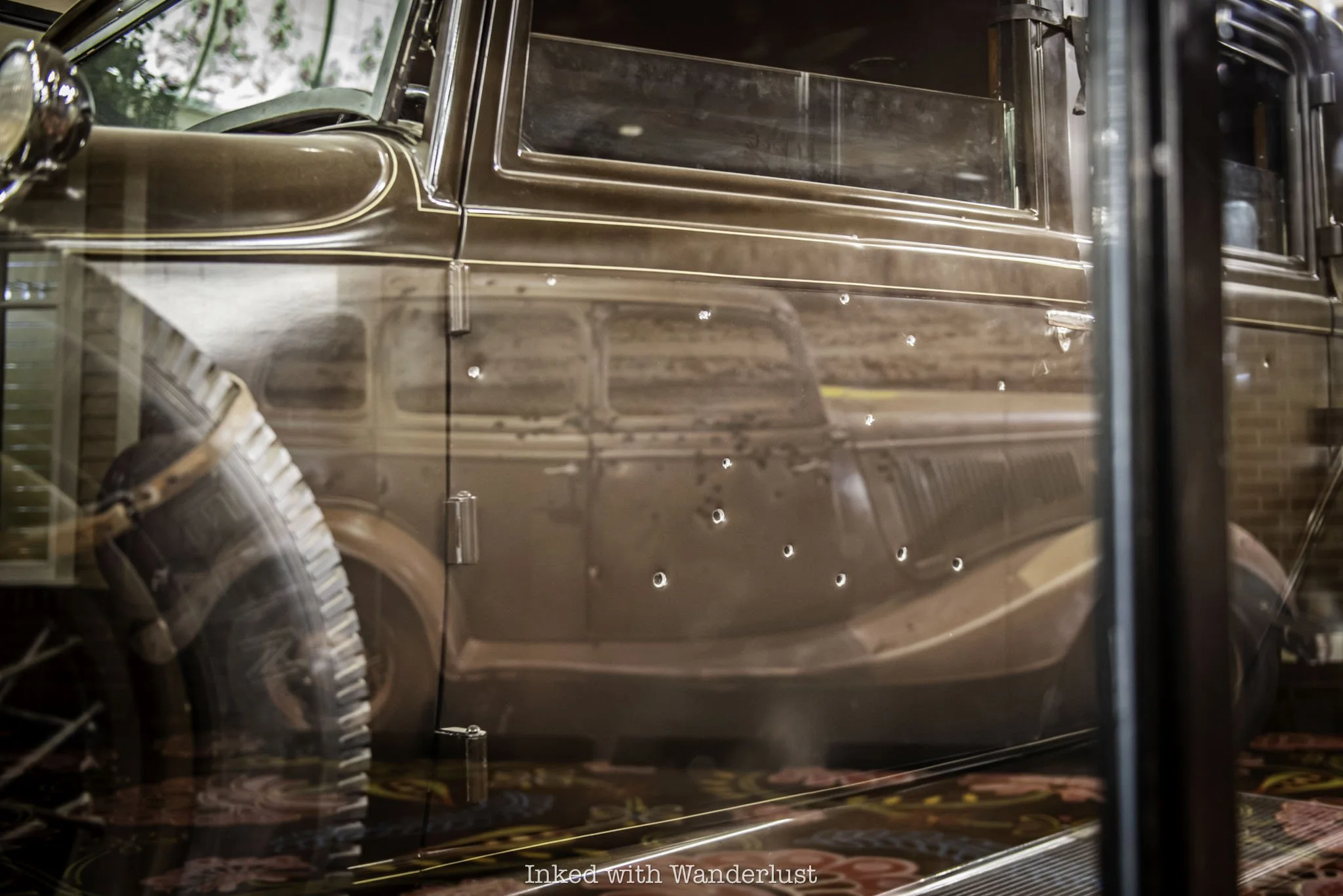
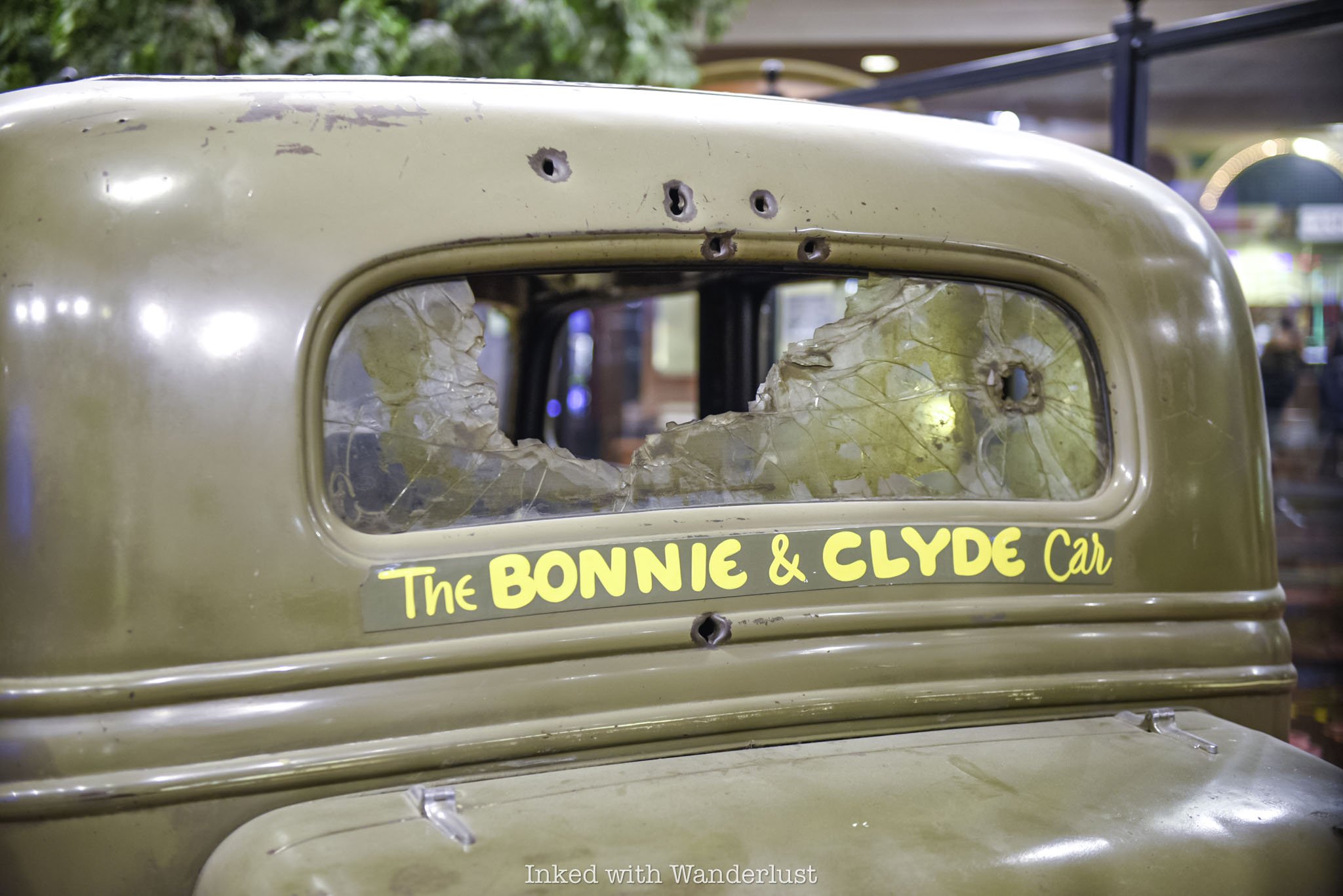
As stated in this post’s introduction, over 130 rounds of ammunition were fired into the Ford by the law enforcement posse. When seeing the bullet holes in person for the first time, it’s a striking visual.
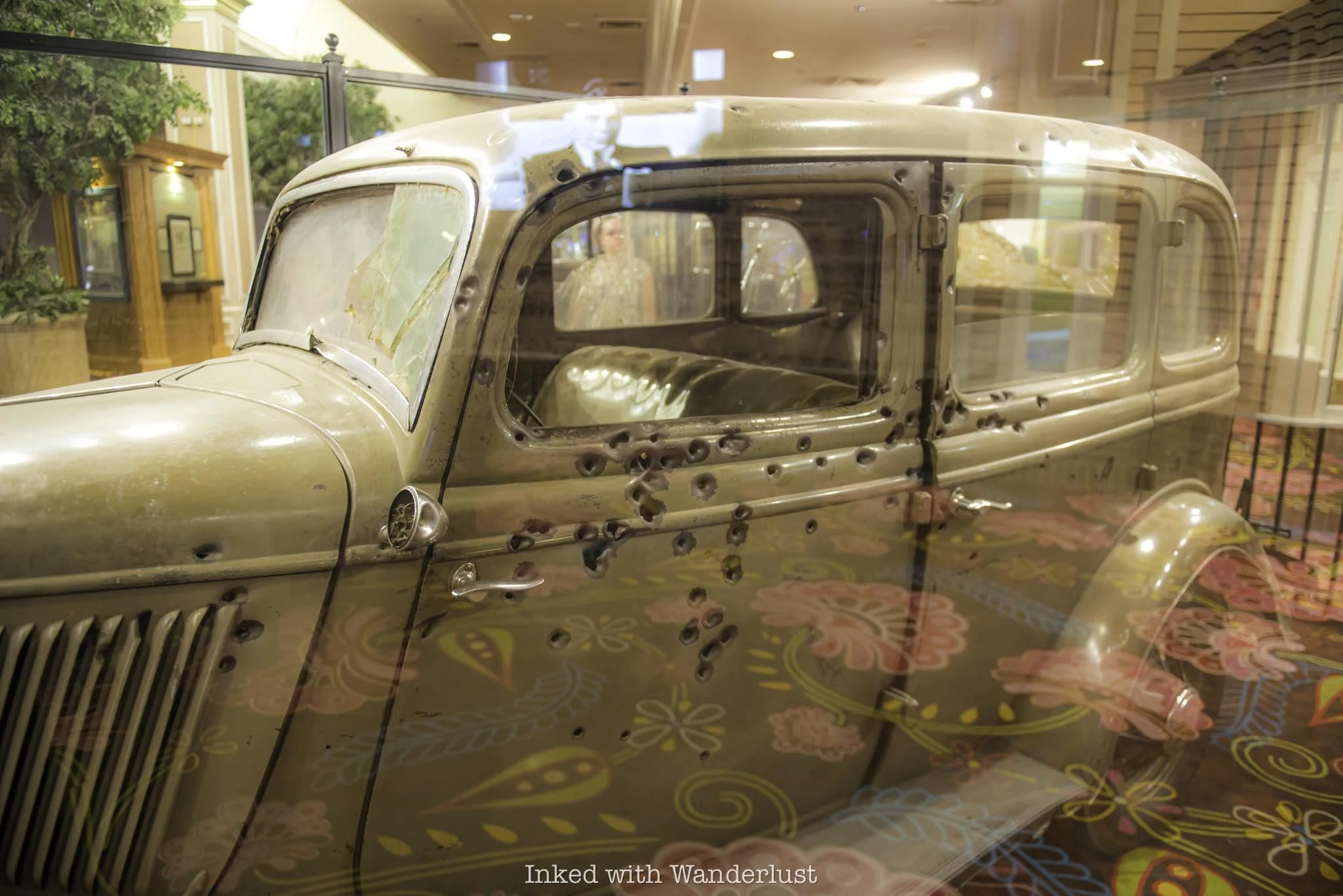
Clyde Barrow was driving when the ambush occurred and that is the side which sustained the bulk of the gunfire. In fact, many of the bullet holes on the passenger side are exit holes. Not sure if it was due to the posse perceiving Clyde as more of a threat, as Bonnie was considered just as ruthless as he was.
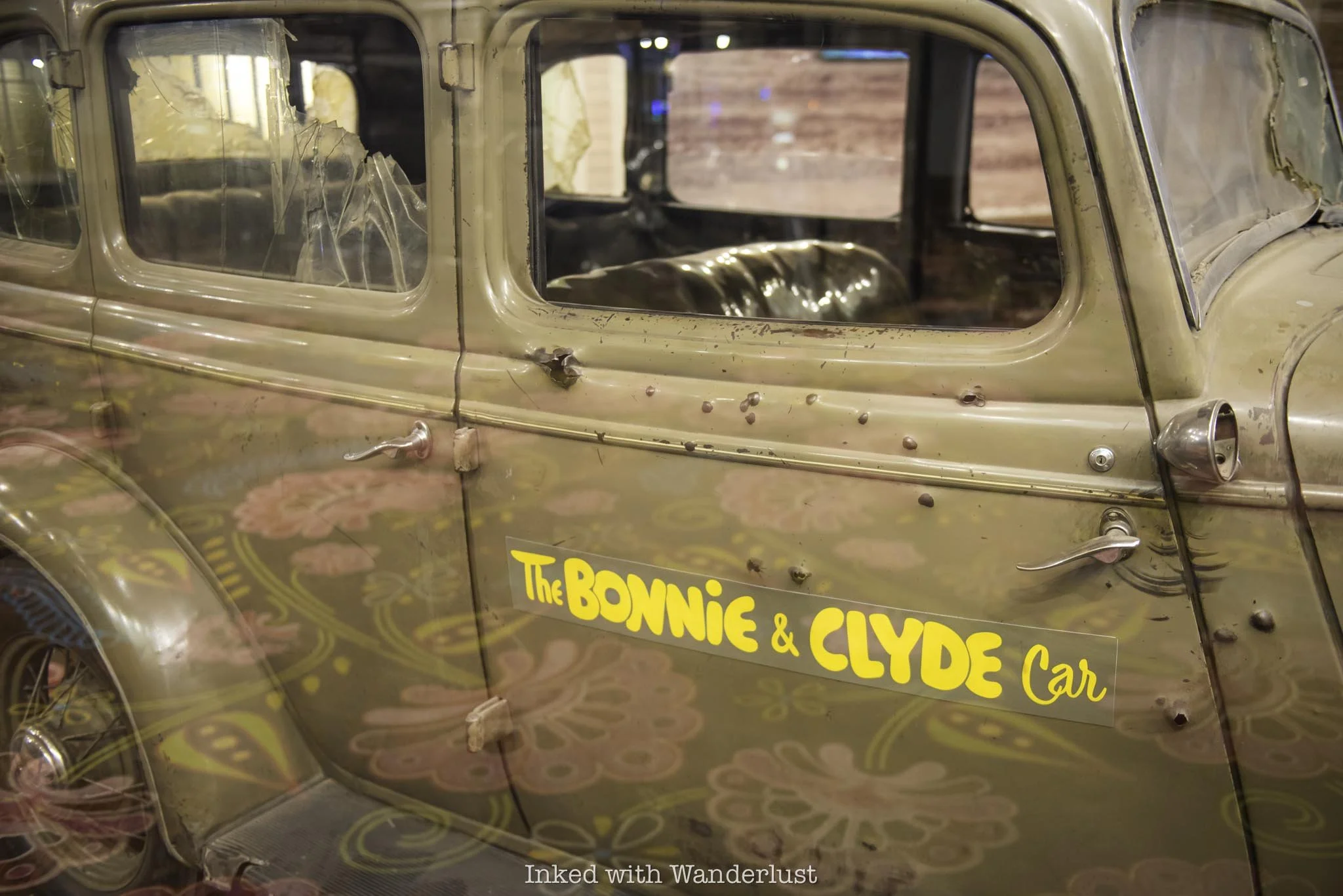
It’s likely as simple as how Clyde pulled over. The couple recognized the man “stranded” on the side of the road as the father of one of their accomplices, prompting Clyde to flip a u-turn. Before he could even come to a full stop, the posse jumped out from behind the bushes and opened fire.
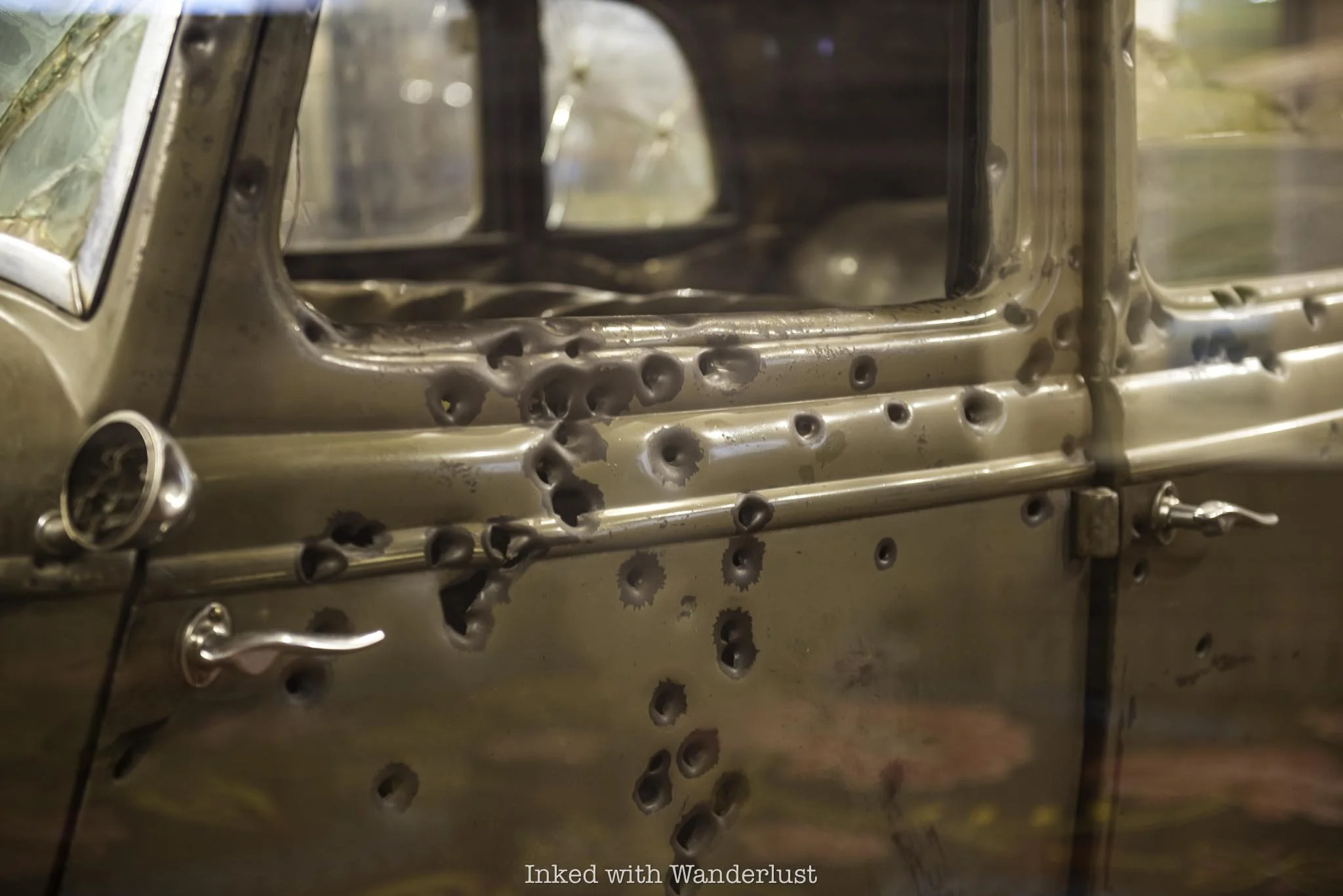
The stark contrast between the amount of bullets that went into the driver side versus how few exit holes there are on the passenger side is a clear indicator of just how many hits the duo took. They likely didn’t even know what hit them.
Of the 130-plus rounds fired into the vehicle, 26 made contact with Bonnie while Clyde took 17, including the initial, fatal head shot. Using a combination of semi-automatic rifles, shotguns, and pistols, the entire event lasted just 16-seconds.
A poem written by Bonnie titled, “The Trail’s End”, found in a sealed envelope and published posthumously, reveals Bonnie knew death would eventually come their way. Like a premonition, an excerpt reads:
“Some day they’ll go down together, they’ll bury them side-by-side, to few it’ll be grief, to the law a relief, but it’s death for Bonnie and Clyde”
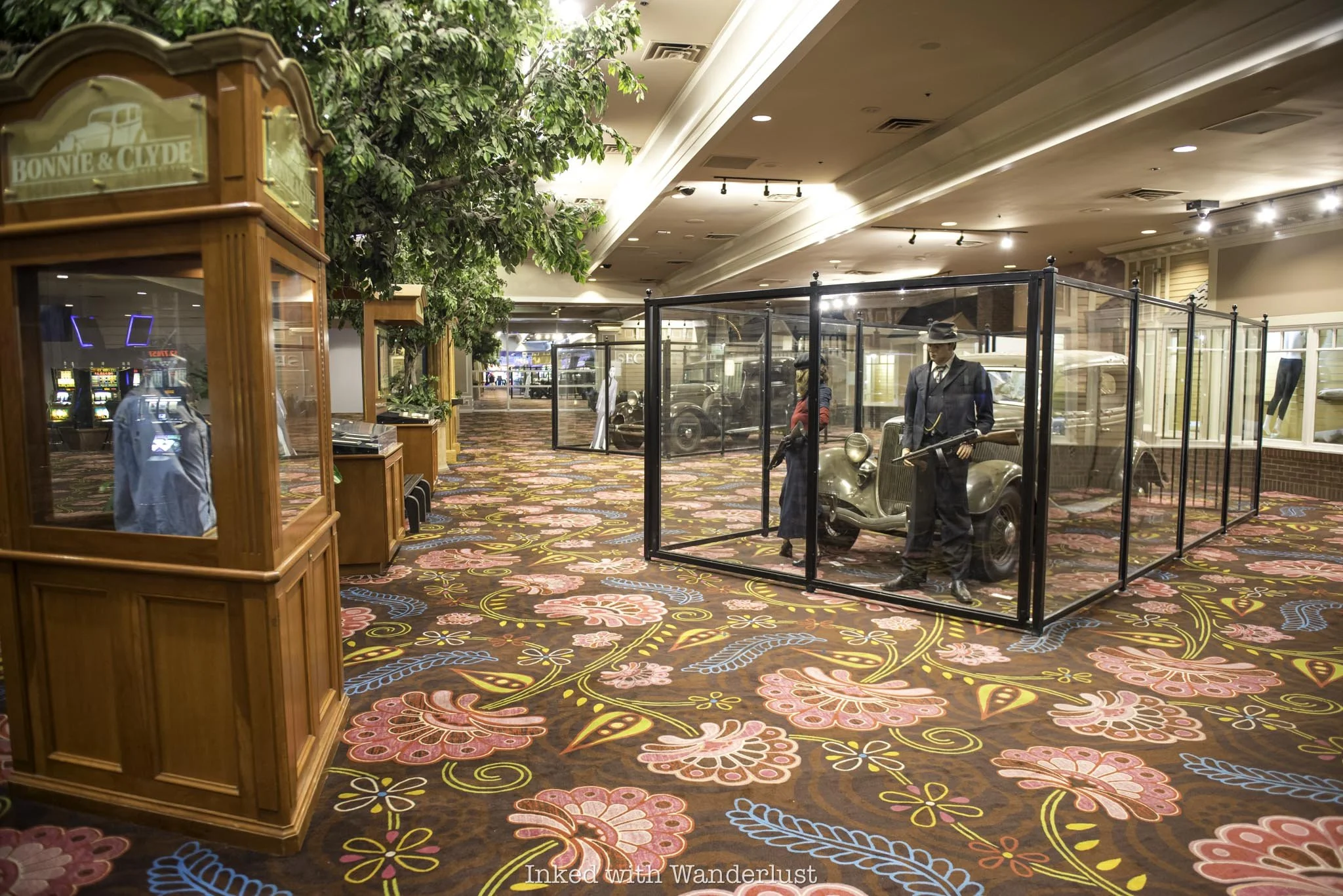
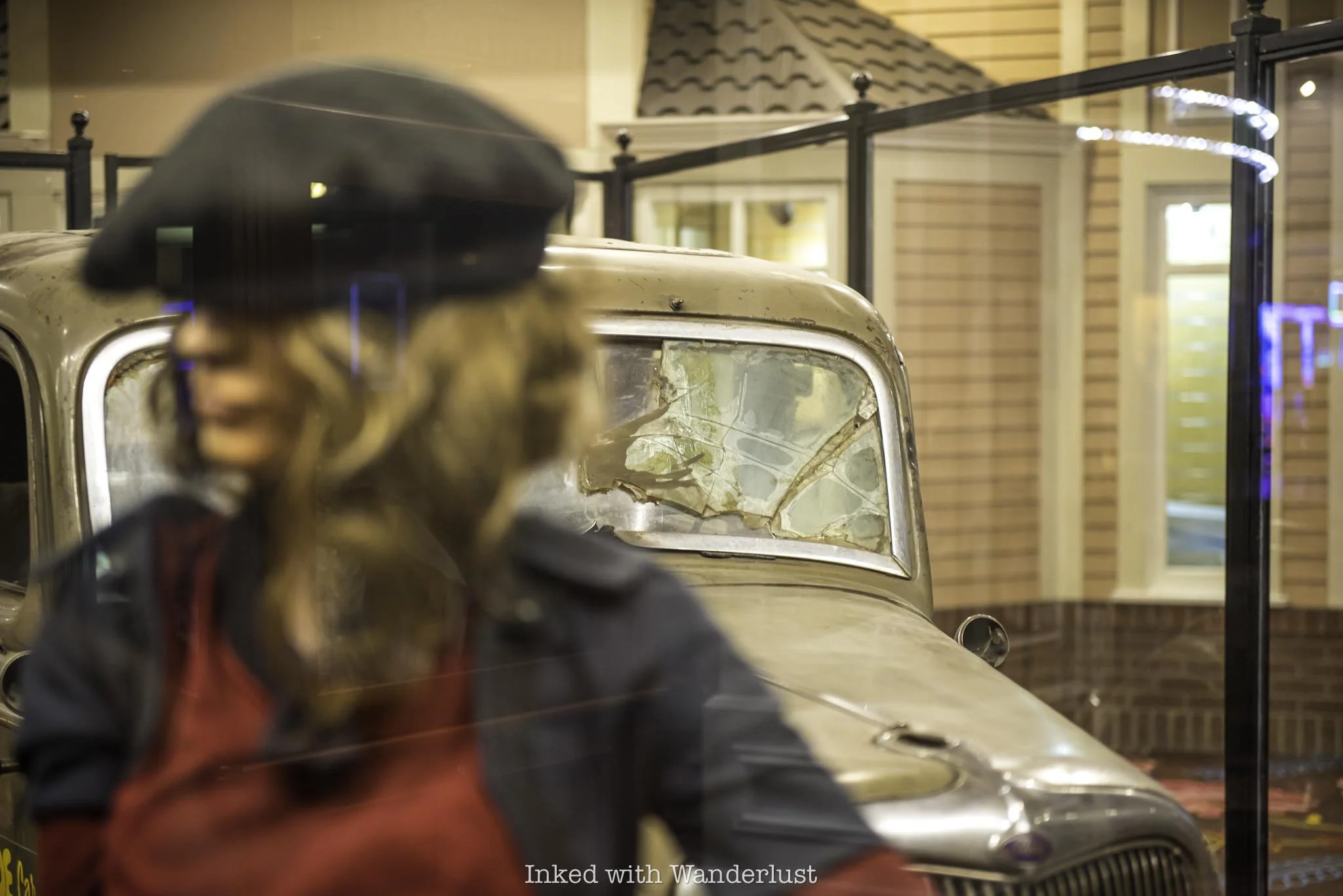
As you’ll likely notice, the death car is displayed within a protective plexiglass barrier. For a time the car was simply roped off but as is usually the case, vandals and folks who can’t follow simple rules ruined it for everyone.
As you can probably tell in my photos, the glare is a bore to contend with when attempting to take photos. If you’re shooting with a DSLR I recommend bringing a polarizer to help combat that.
More Artifacts on Display
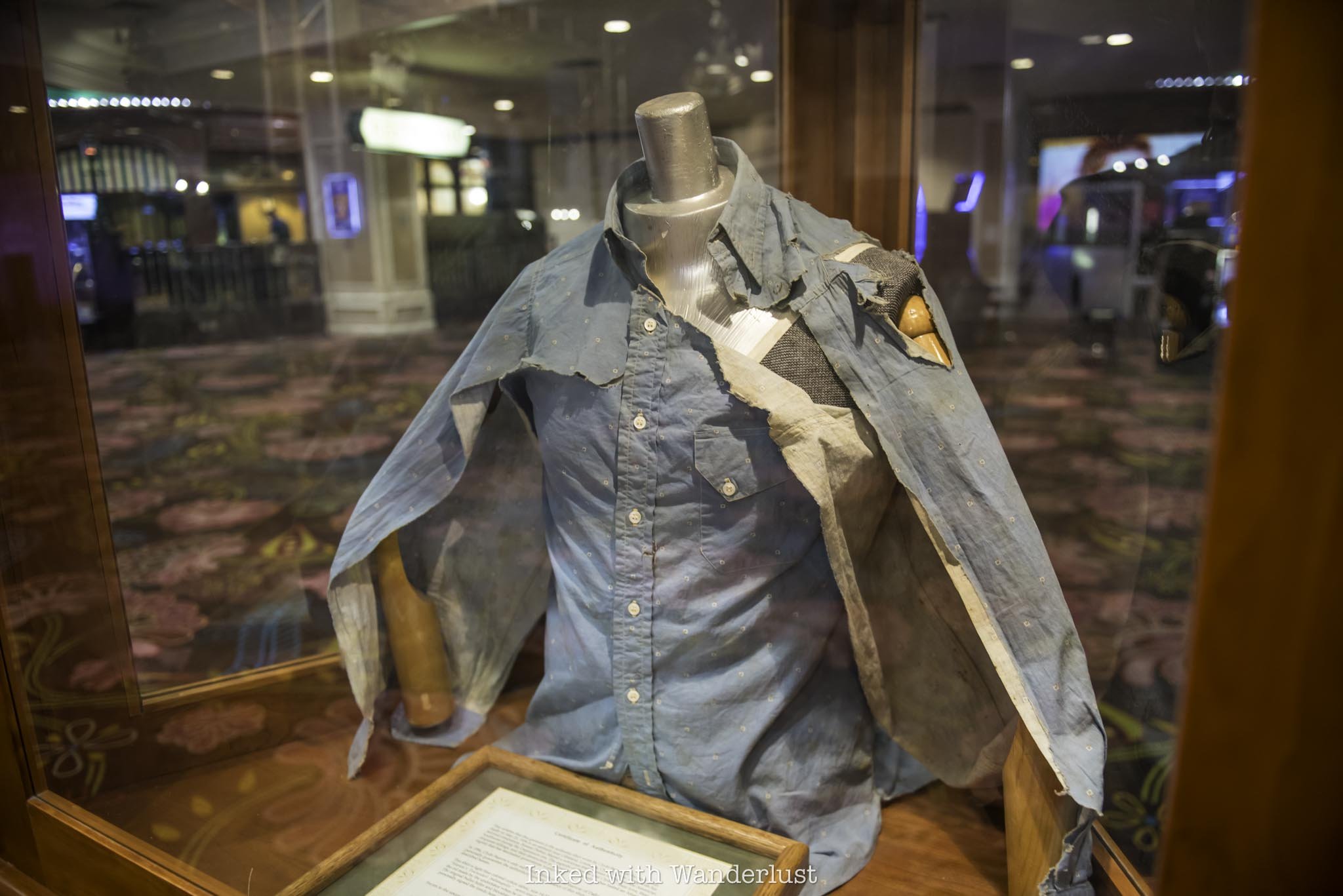
The death car isn’t the only artifact on display. Adjacent to it are several glass displays with a variety of items in them. The most significant of which being the actual shirt Clyde Barrow was wearing when he and Bonnie were killed in the ambush.
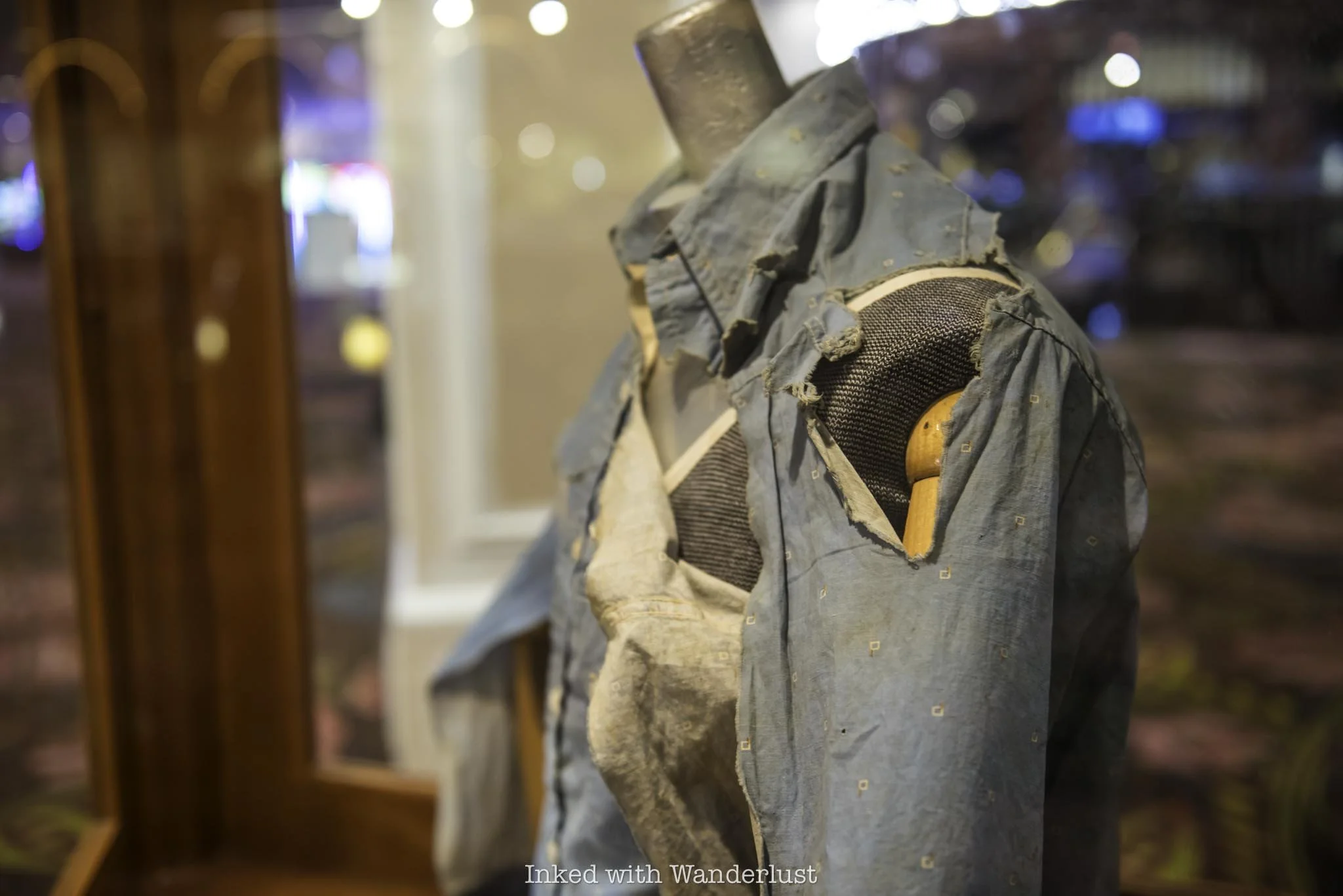
The blue dress shirt is perforated with ragged holes and tears on the front and back, caused by the rapid gunfire. You can clearly make out many faded blood stains, as well as an inscription on the inside hem by Clyde’s sister, Marie Barrow, who gifted him the shirt.
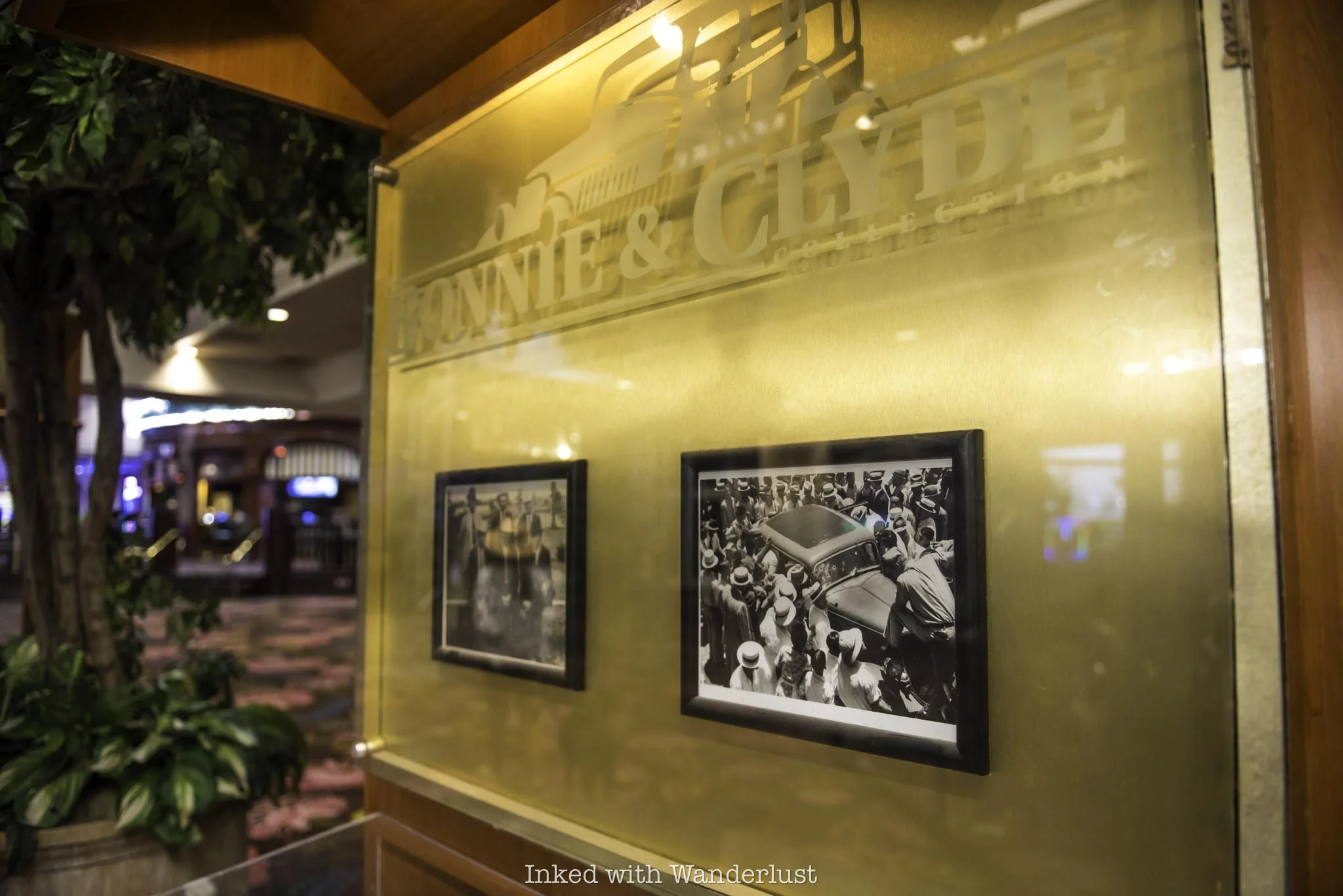
The next display case featured several personal items of Bonnie and Clyde, as well as photos taken the day they were killed. After the ambush, the police towed the bullet-ridden Ford to town (with the bodies of the couple still inside) through a dense crowd of onlookers.
People of the time were so infatuated with Bonnie and Clyde that souvenir seekers cut off and took locks of Bonnie’s hair, as well as pieces of Clyde’s shirt and Bonnie’s dress as the car was being towed.
Dutch Schultz’s Armored Car
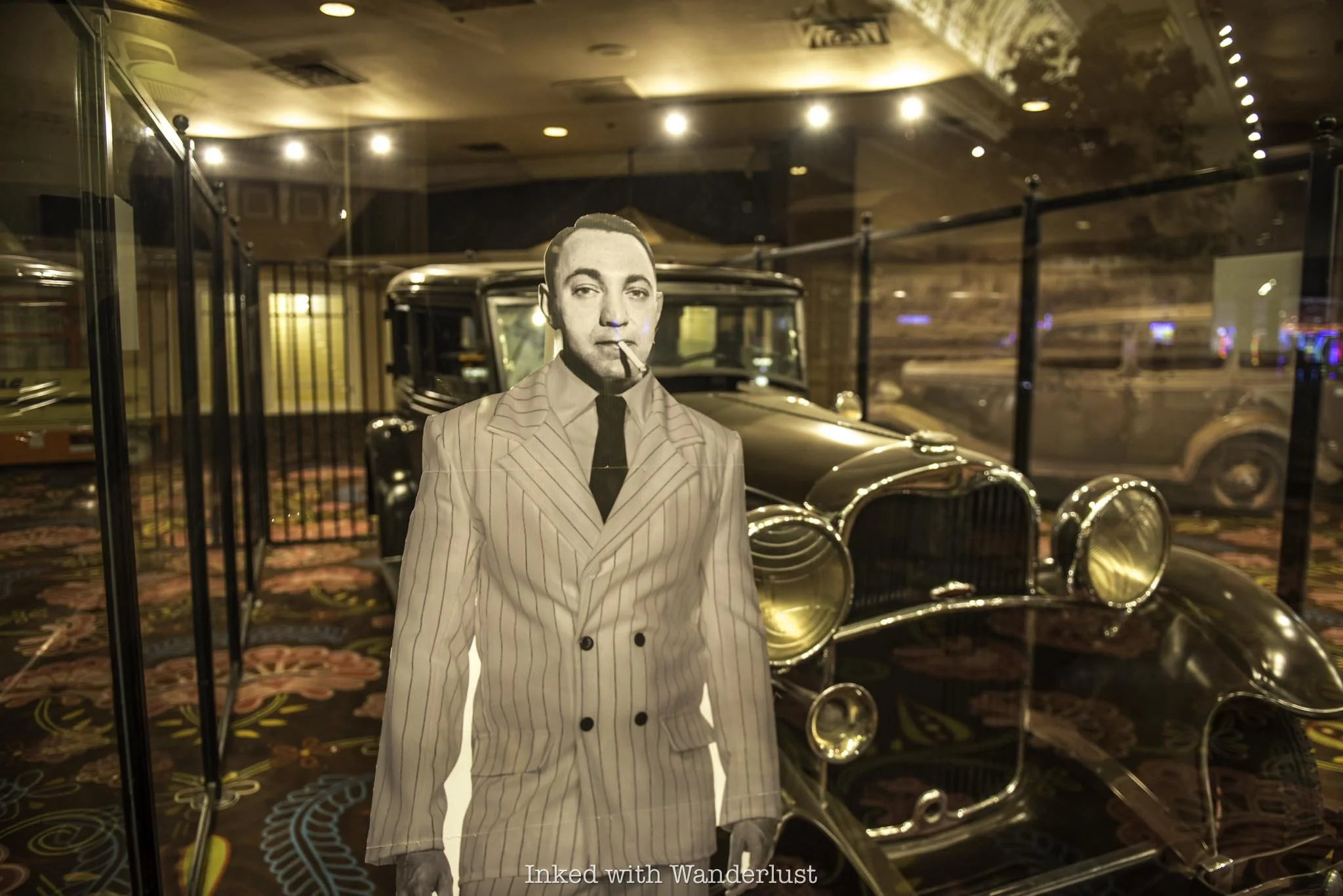
Also on display directly next to the Bonnie and Clyde death car is the armored vehicle formally owned by Dutch Schultz. If you don’t know who Dutch Schultz is, don’t worry, I didn’t either prior to this visit.
Schultz was a notorious American mobster hailing from Bronx, New York. Nicknamed the “Beer Baron”, Schultz made his fortune manufacturing alcohol during the Prohibition Era and earned a reputation for ruthless violence.
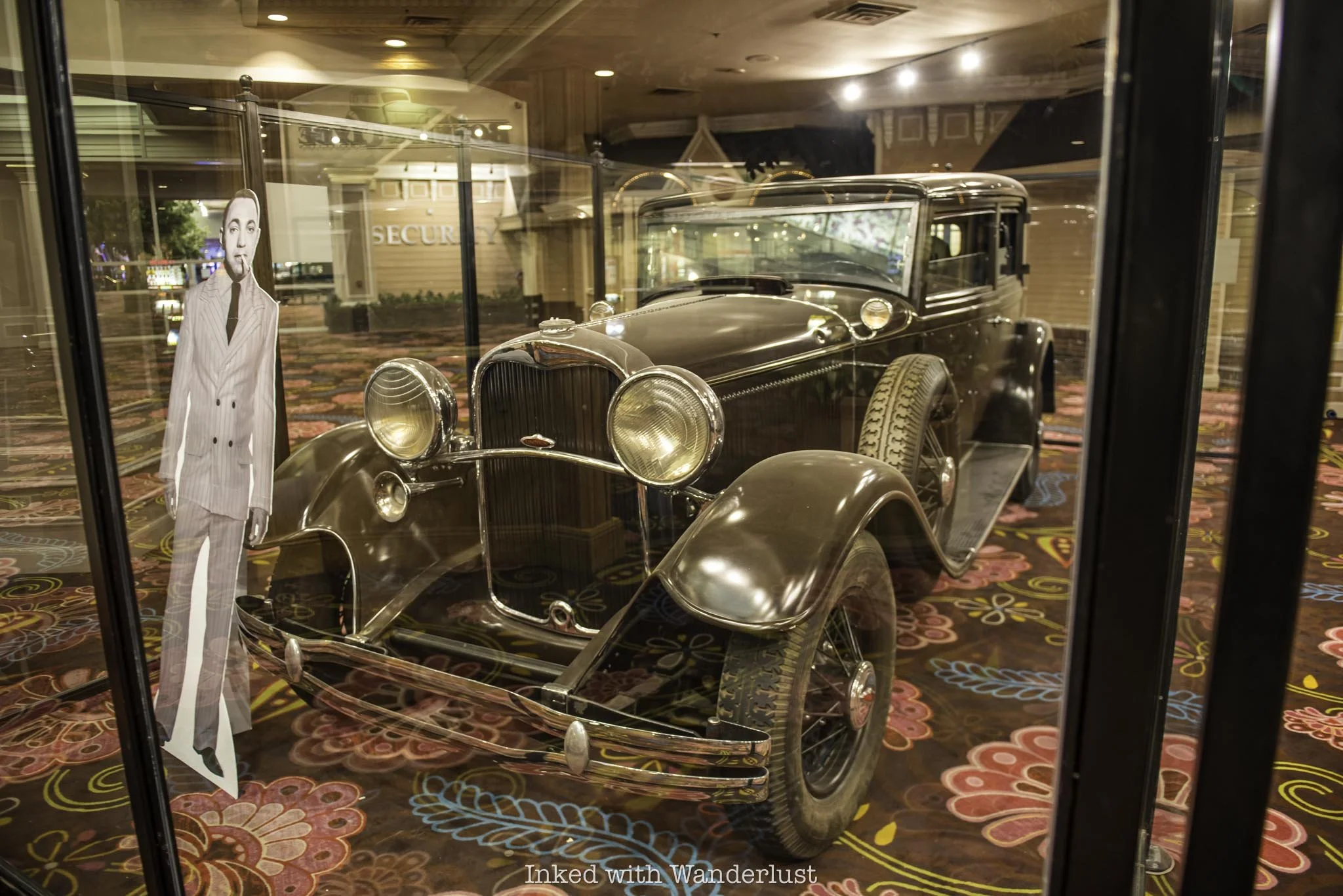
Like most high level mobsters of the era, Schultz was being targeted by District Attorney Thomas E. Dewey with several charges of tax evasion. Facing significant time, Schultz sought the permission of the National Crime Syndicate’s “Commission” to assassinate Dewey.
Fearing heavy retaliation from law enforcement, the Commission denied his request, which angered Schultz. So much so that he threatened to do it anyway. Consequently, the Commission ordered Schultz’s execution, which ultimately occurred at a New Jersey steakhouse on October 23, 1935.
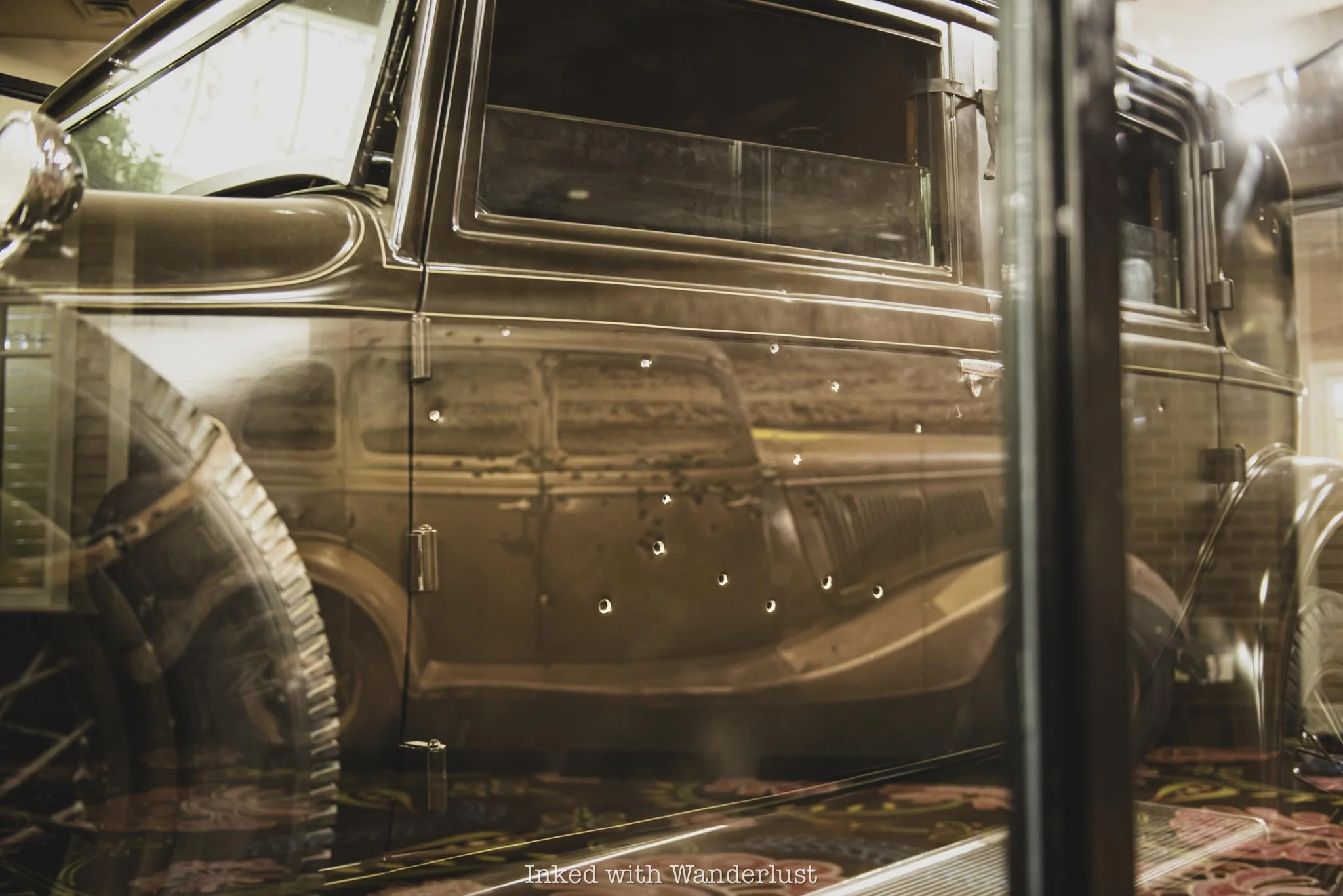
The armor-plated Lincoln belonged to Schultz from 1931 until his death. He used it for safe passage around the city, protected by the thick armor and bullet-proof glass. After Schultz was killed, it was taken by Al Capone’s mob and then somehow ended up in President FDR’s possession.
As far as the bullet holes go, well, they’re probably not legit. Word is that Gary Primm, original owner of Primm Resort, had the car towed into the desert where he and some friends shot into it before towing it back. Apparently this was done in an effort to make the car look more “authentic”.
Know Before you Go
The exhibit is free. Both parking and the exhibit are 100% free of charge. You can always spend some money gambling or on a meal but if you just want to check out the exhibit, you won’t pay anything.
This car is the real deal. There are many museums and exhibits throughout the U.S claiming to have the death car. These are either outright fakes or well-intentioned replicas. However, the one on display at Primm Valley Resort is the legitimate Ford Bonnie and Clyde stole and died in.
Primm Valley Resort is still open! In mid-2026 things were looking grim for Primm Valley Resort. The former owners initially announced they would be closing and lay off all employees. Thankfully, the Terrible’s company purchased the property before that occurred and they kept the death car exhibit going as well.
It’s NOT in Las Vegas. Despite popular belief, the death car exhibit is not in Las Vegas. It’s in Primm, Nevada, roughly a 45-minute drive from the strip on Interstate 15.
If you’re still looking for something to check out in the area, take a short drive down Interstate 15 to Seven Magic Mountains, a free to see outdoor art exhibit. If you’re heading back to Las Vegas, check out a few of my favorites:
Mob Museum (post coming soon)
*If you’ve found this post helpful, please consider leaving a tip at the “Buy me a Coffee” button below. These tips help a lot with ongoing costs such as parking fees, entry fees, meals, etc. Thank you!

How to Visit Meow Wolf Omega Mart in Las Vegas
Las Vegas is filled with quirky, one-of-a-kind attractions that promise something different, but few are as unexpected as Meow Wolf’s Omega Mart inside…
Disclosure: This post contains affiliate links. If you make a purchase through these links, I may earn a small commission at no additional cost to you. I only recommend products or services that I believe will add value to my readers.
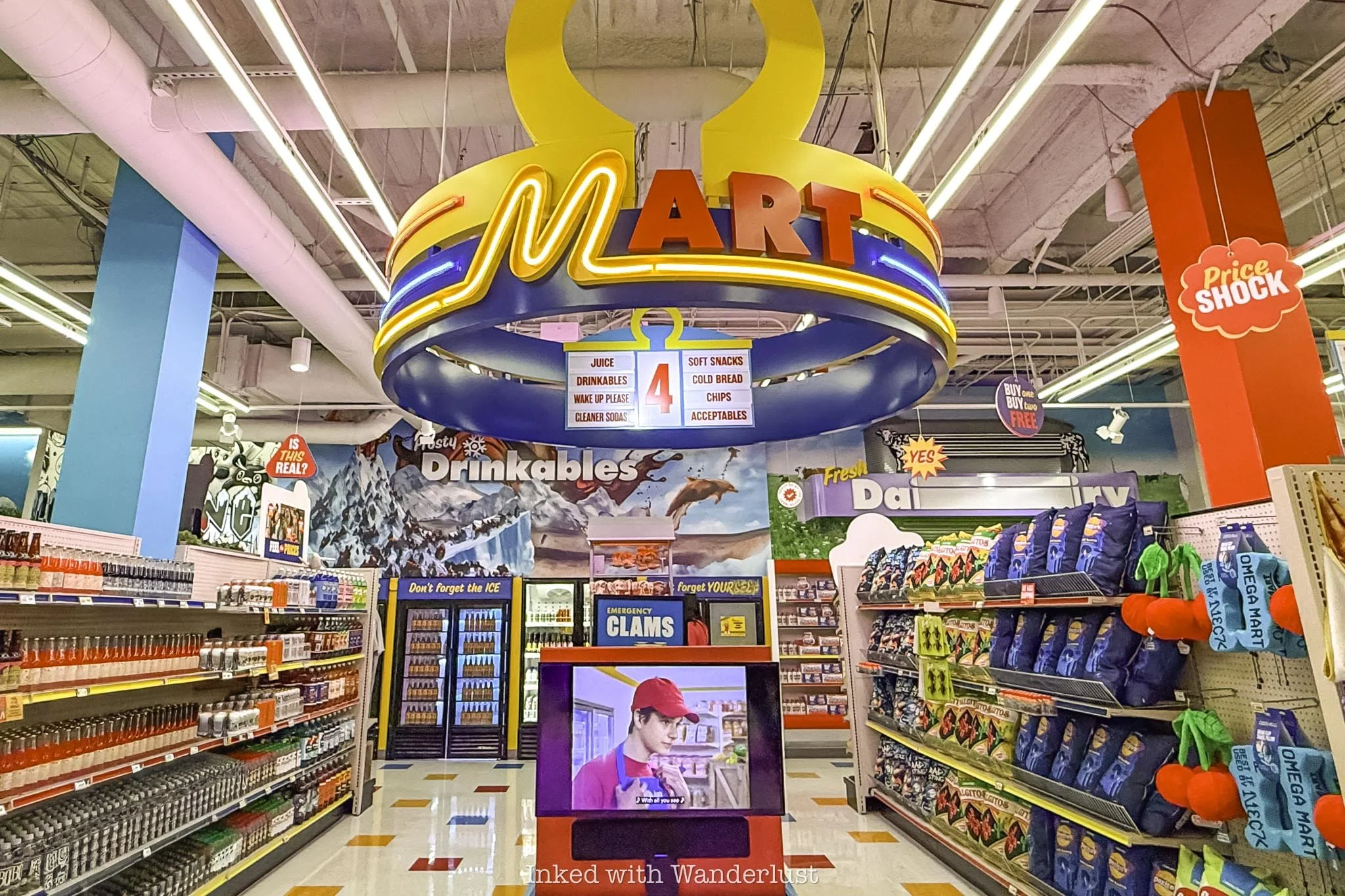
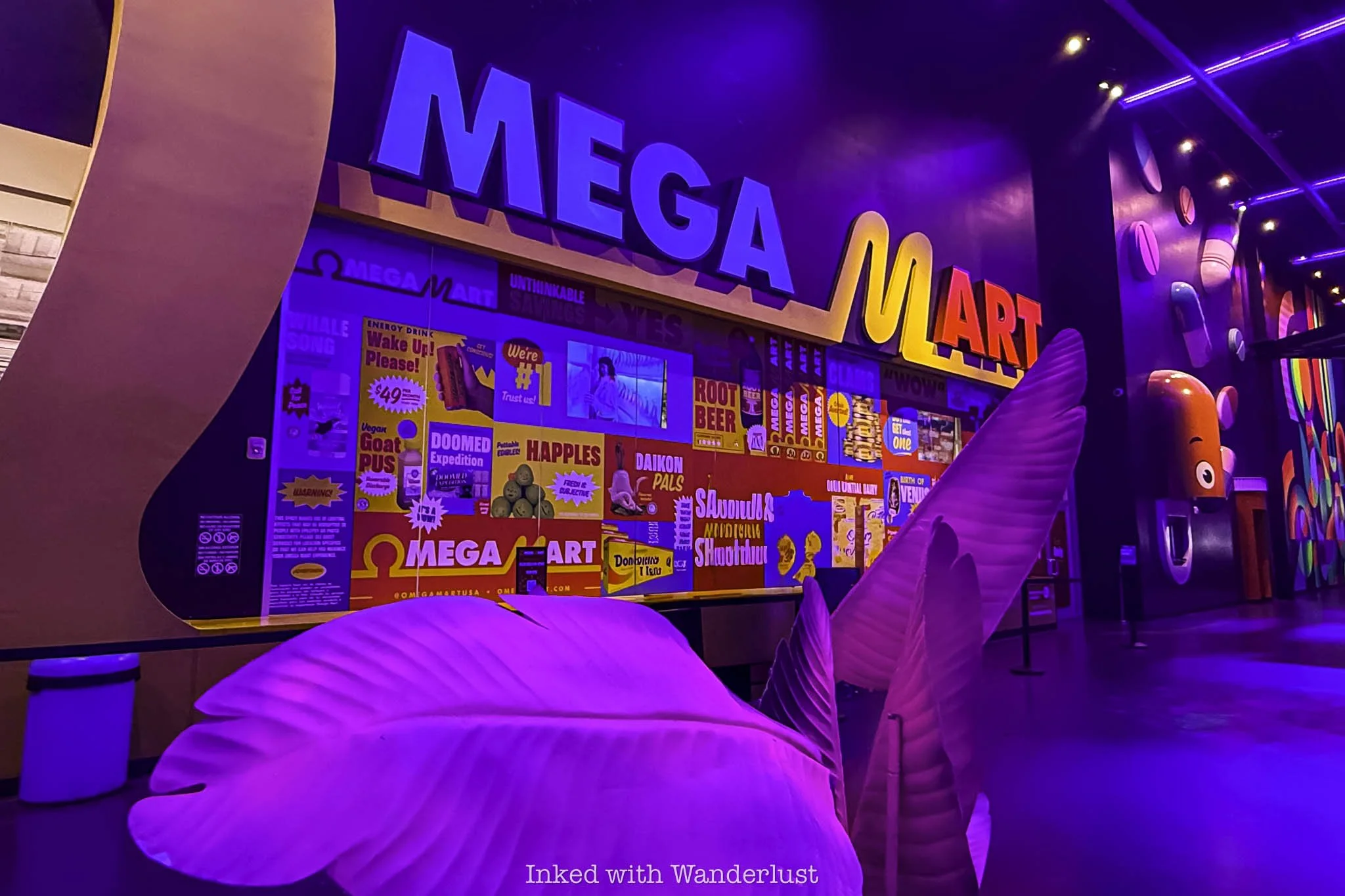
Las Vegas is filled with quirky, one-of-a-kind attractions that promise something different, but few are as unexpected as Meow Wolf’s Omega Mart. What initially appears to just be a parody of a grocery store quickly transforms into a mind-bending adventure.
Filled with hidden passageways, surreal art installations, and a story that unfolds the deeper you explore, it quickly becomes clear that Omega Mart is far more than a simple attraction. It’s an immersive world designed to spark your curiosity.
After constantly hearing about Omega Mart, I finally decided to see what the hype was all about for myself. What I found was one of the most creative and imaginative attractions in Las Vegas that left me wanting more.
In the post below, I’ll discuss topics such as what to expect, ticket prices, roughly how much time you’ll spend exploring it, and hidden passages (and more), with the intended goal of helping you decide if Omega Mart is worth it to you. Let’s get into it!

What is Meow Wolf?
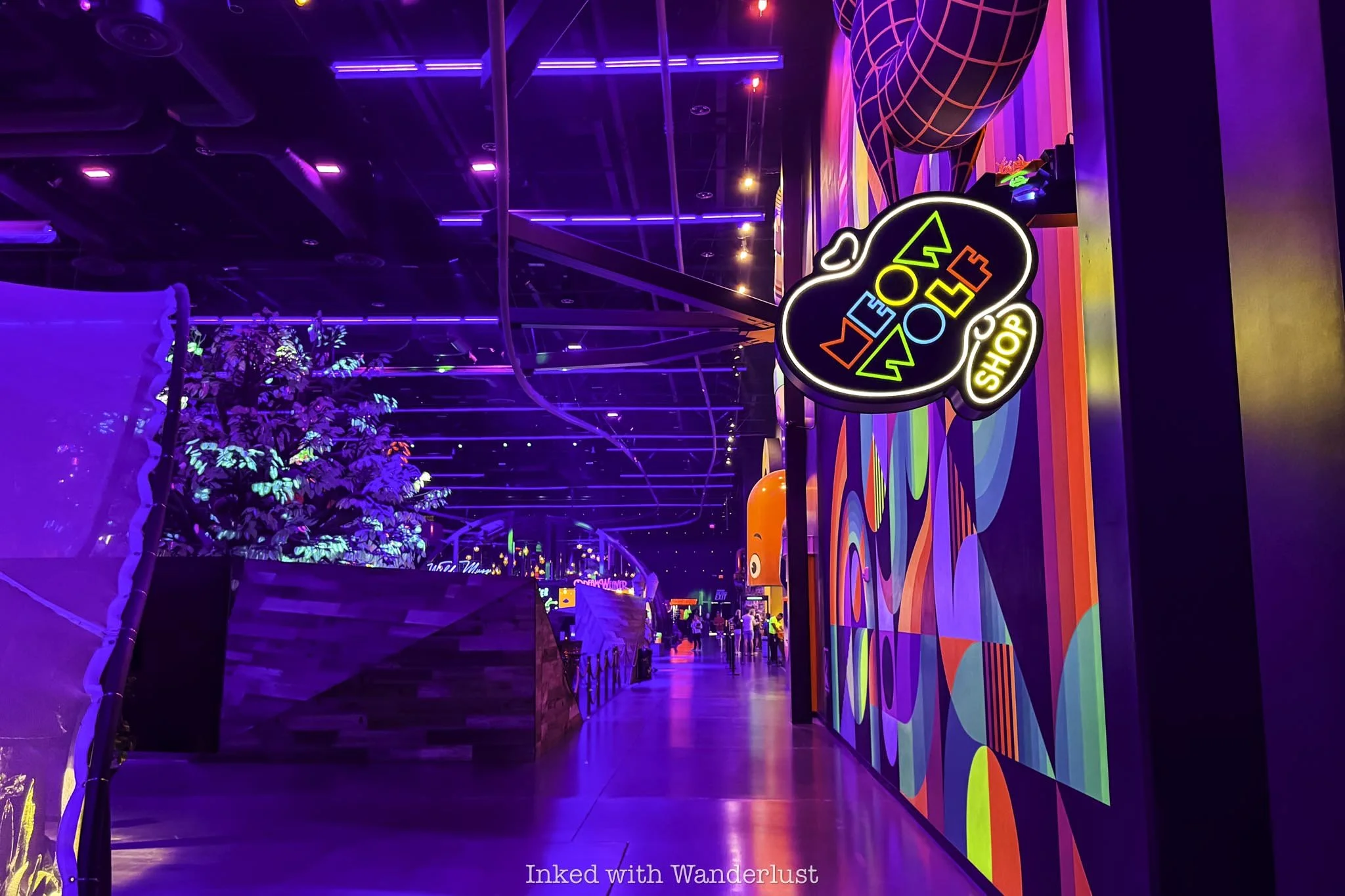
If you’ve never visited a Meow Wolf attraction before, it’s difficult to articulate exactly what it is. Part immersive art exhibit, part interactive storytelling experience, and part giant playground for the imagination, Meow Wolf creates elaborate worlds inviting guests to explore and interact with their surroundings.
Rather than simply observing artwork, guests become active participants, uncovering hidden details, secret passageways, and interconnected stories throughout the experience.
Each Meow Wolf location (soon to be six) features its own unique theme and narrative, but all share the same sense of creativity and exploration. There’s no right or wrong way to experience them. Solve a mystery or simply wander freely, the choice is yours.
Location, Parking, and Hours

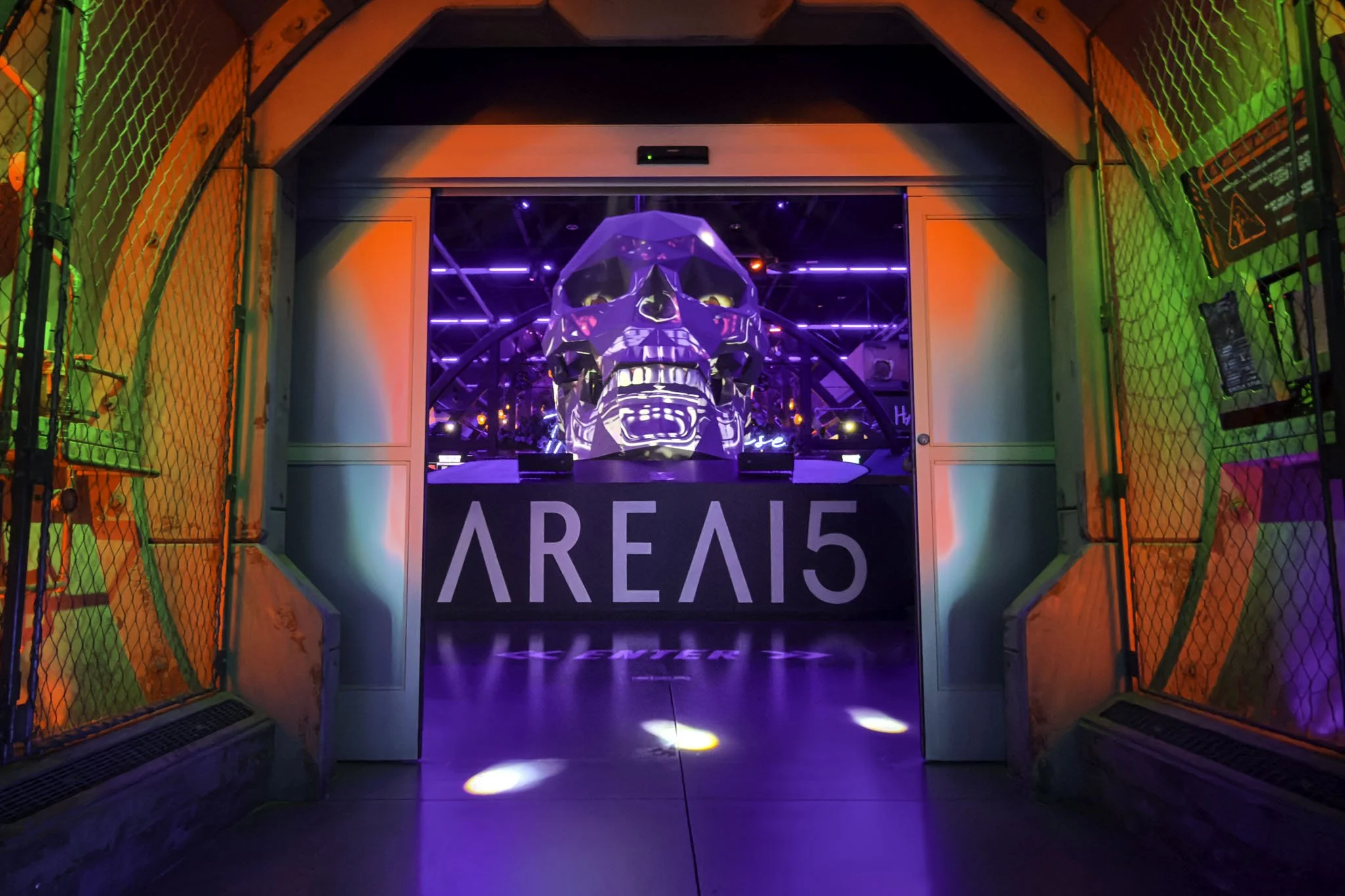
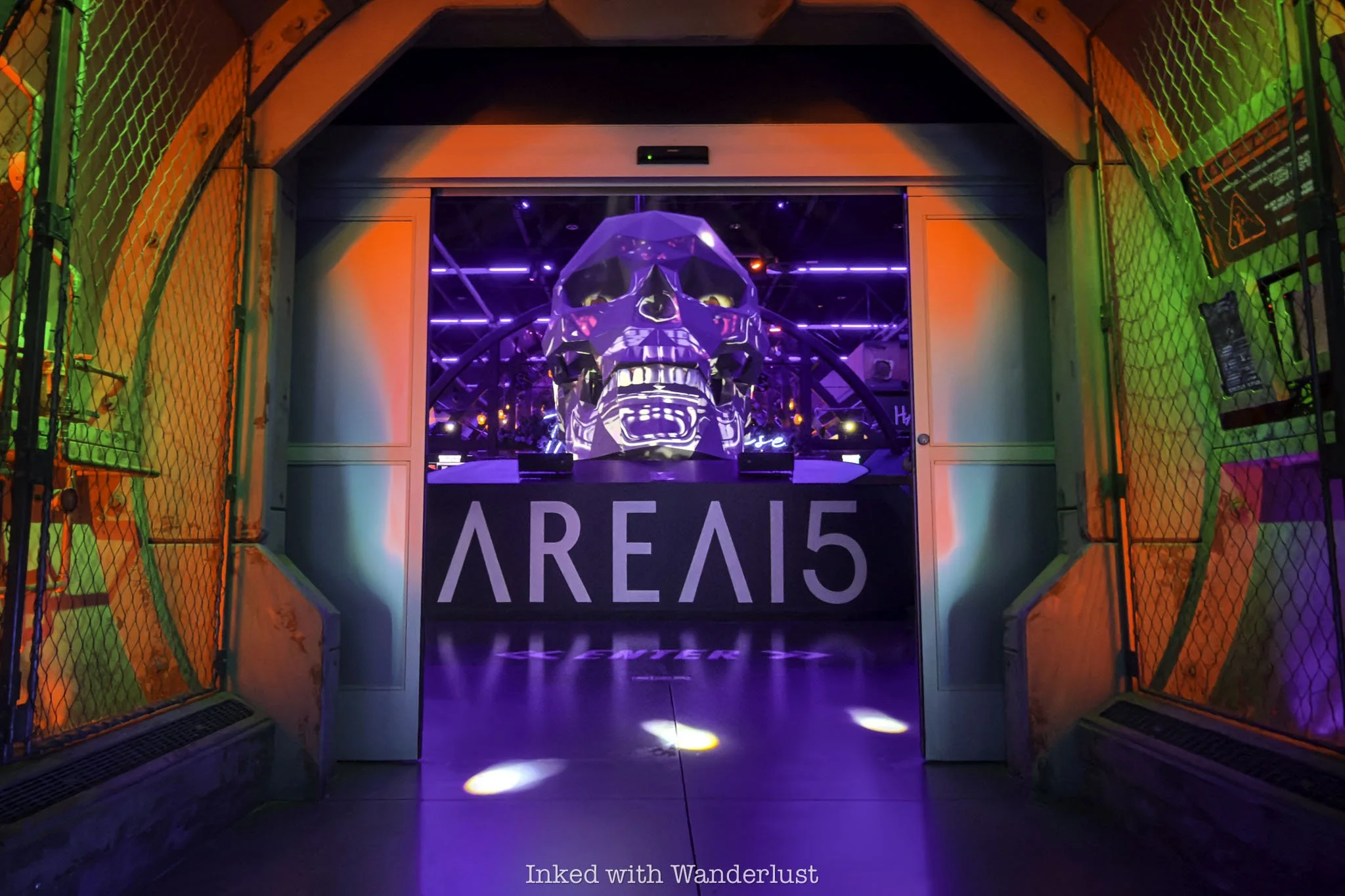
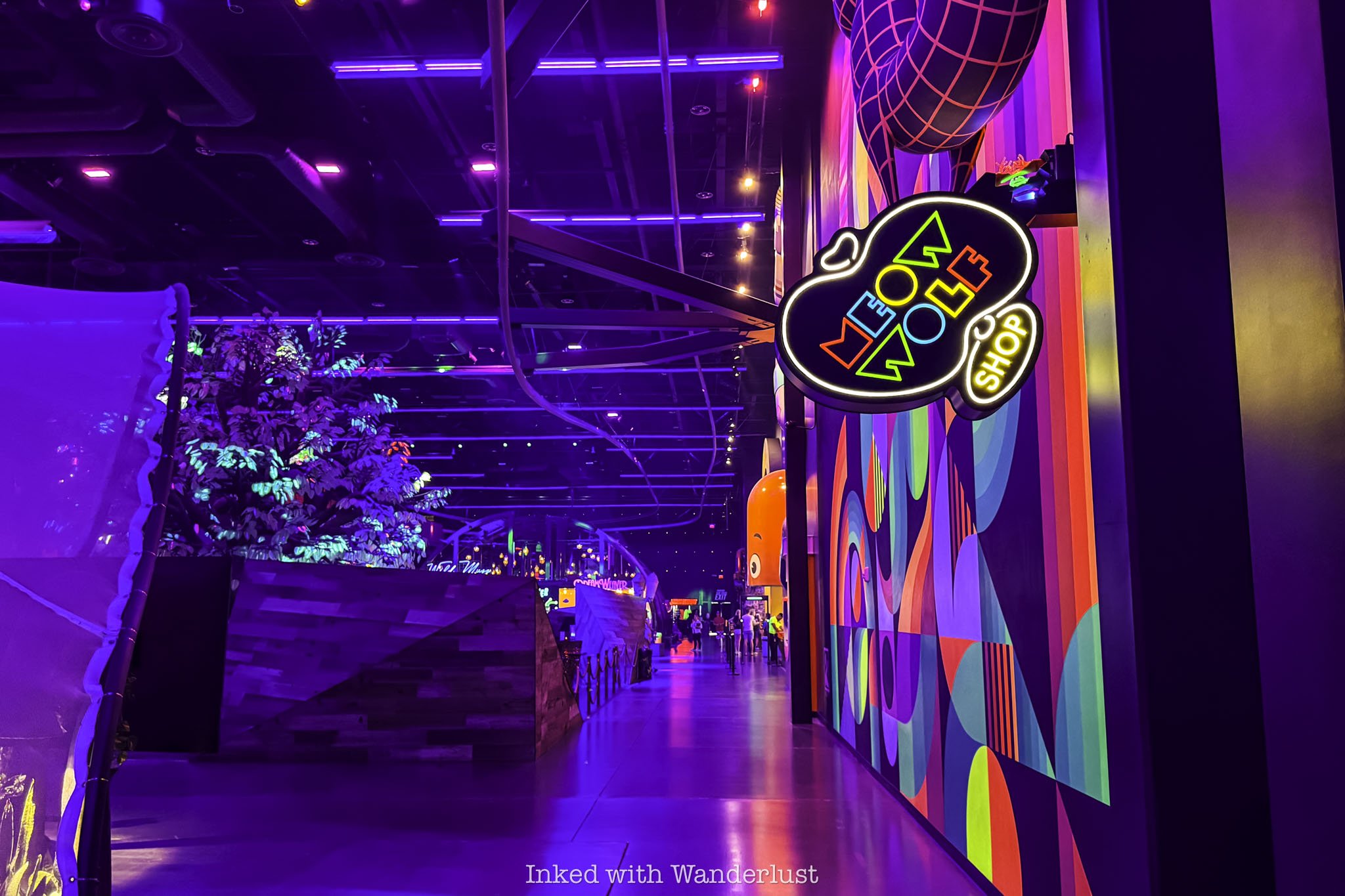
Meow Wolf’s Omega Mart is located in Las Vegas, Nevada. It’s the anchor attraction within the Area 15 Entertainment District, housed inside the namesake building in zone one. Upon walking inside, go left at the giant color-changing skull and you’ll find Omega Mart shortly thereafter.
Parking can be found throughout the grounds. The closest lot to Omega Mart is directly adjacent to the building and there’s a multi-story garage in zone two. Nevada residents (with NV plates) receive free parking while everyone else pays a modest $6.99 (full day/no cash).
As far as hours of operation is concerned, Omega Mart is open seven days a week from 10am - 11pm each day, though this can vary. Note that on select nights Omega Mart may close early for private events. Refer to their calendar for up-to-date hours and scheduled events.
Omega Mart Ticket Prices
Since Omega Mart is owned by Meow Wolf, meaning it’s independently operated from Area 15, it has its own ticket requirement and price. There are many ways to purchase Omega Mart tickets and we’ll cover a few below.
One way is to purchase an Area 15 Experience Pass that includes Omega Mart. Going that route, you have two options - their Level 3A or Level 4 passes. Those are the only two Area 15 passes that include Omega Mart. You can read more details about Experience Passes in my Area 15 Ultimate Guide here.
Secondly, you can purchase directly through Meow Wolf at this link. They have several options which include:
General Admission (starts at $45 for adults and $40 for kids)
Nevada Resident General Admission (starts at $35)
Anytime Admission (starts at $75 for adults and $70 for kids)
VIP Package (starts at $90)
Omega Quest (starts at $119)
Portal Pass (starts at $139 for the year)
General and anytime admission tickets are the most common and are virtually the same with the exception of the “anytime” element. With general, you select a time of arrival but with anytime, you aren’t beholden to a specific time.
The VIP option also includes the anytime option, along with a few other perks such as a VIP lanyard, commemorative ticket, one beverage at their speakeasy “Datamosh”, 15% off merchandise, and more.
The Omega Quest ticket includes everything in the VIP package along with VIP entry and a “detailed-hungry scavenger hunt of Omega Mart”. Not sure the latter is worth the extra expenditure but if you’re into scavenger hunts, this is the ticket for you.
Thirdly, you can purchase Omega Mart tickets through my preferred ticket partner, Viator. Viator is a reputable ticket vendor worldwide and sells tickets to many of Las Vegas’ most well-known attractions.
Purchasing through them often results in spending less as they frequently sell below face value but are sometimes the same, at worst. Purchasing through my link helps to support Inked with Wanderlust and doesn’t cost you anything extra as my small “cut” comes directly from Viator.
The Omega Mart Experience
No Ordinary Grocery Store…
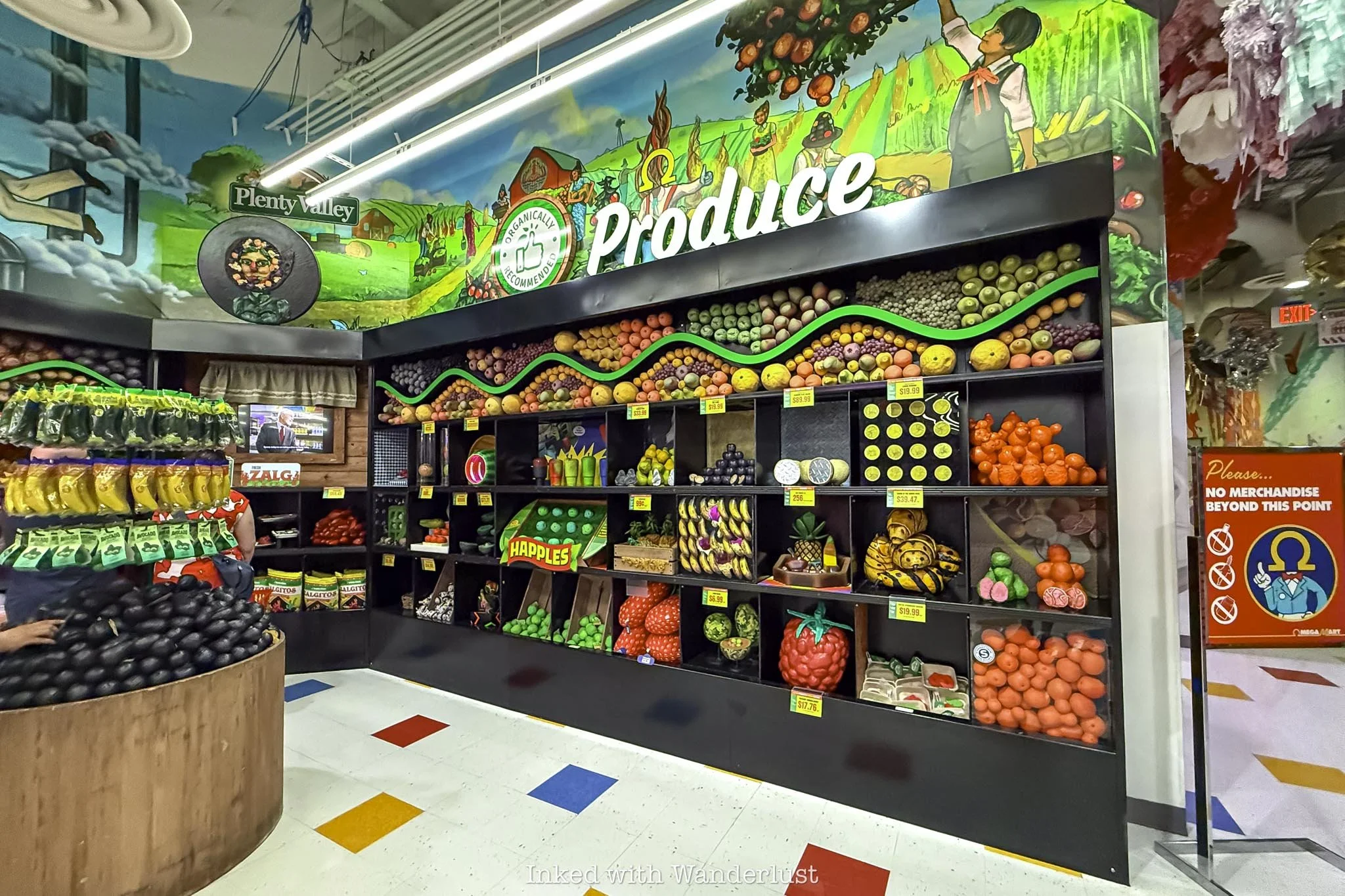
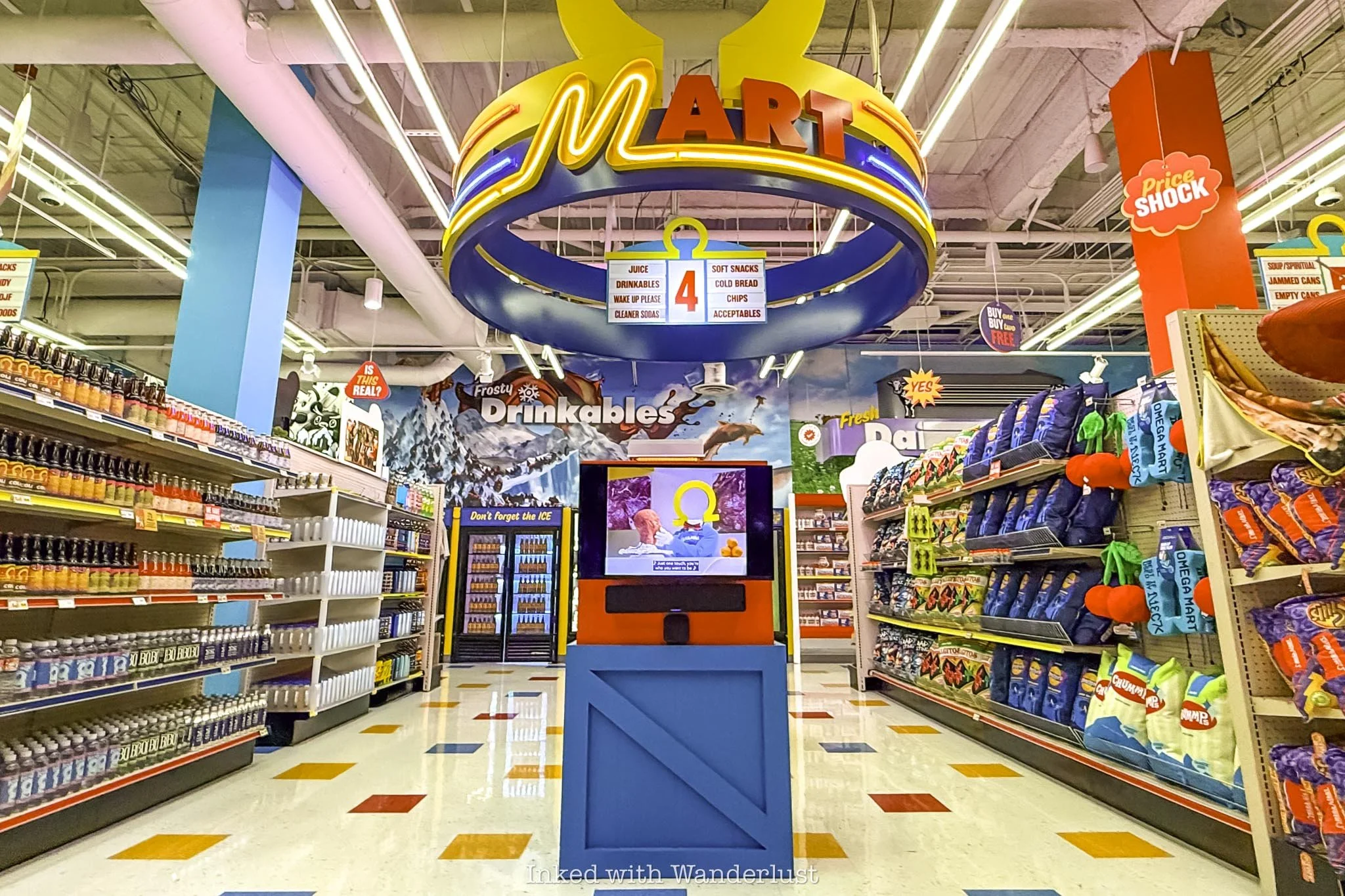
At first glance, Omega Mart appears to be a mock, ordinarily-looking grocery store. Shopping carts are parked near the entrance, the shelves are stocked neatly, and eye-catching advertisements promote a variety of products.
The more you look around, though, the more you begin to realize that something just doesn’t add up. Strange brands line the aisles, bizarre products fill the shelves, and just about every display contains a pun, hidden clue, or mystery.
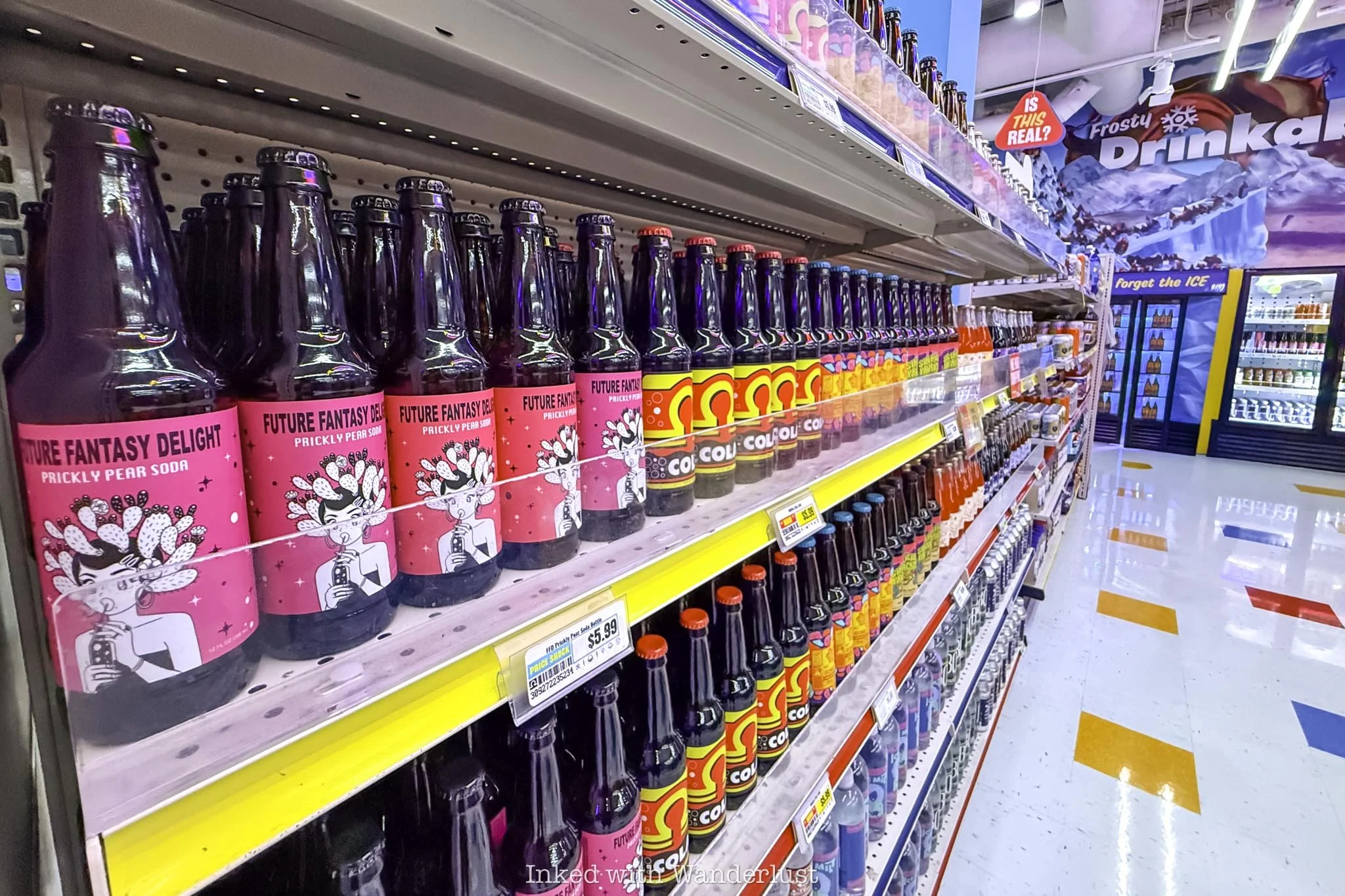
If you’ve never been to Omega Mart, you may be thinking, is this it? I did. Initially, it came across to us as nothing more than a pun-filled grocery store with items for sale (yes, you can purchase most of the items on the shelves).
It had everything you’d find at your local grocery store - a meat department, produce department, coolers with chilled items, bakery, slushie station, etc.
As my wife and I made our way to the back of the store, though, we discovered these unassuming, unsigned passageways leading to the “backroom”. We took one, thinking it would be a walk-through of a stock room or something similar. But little did we know…
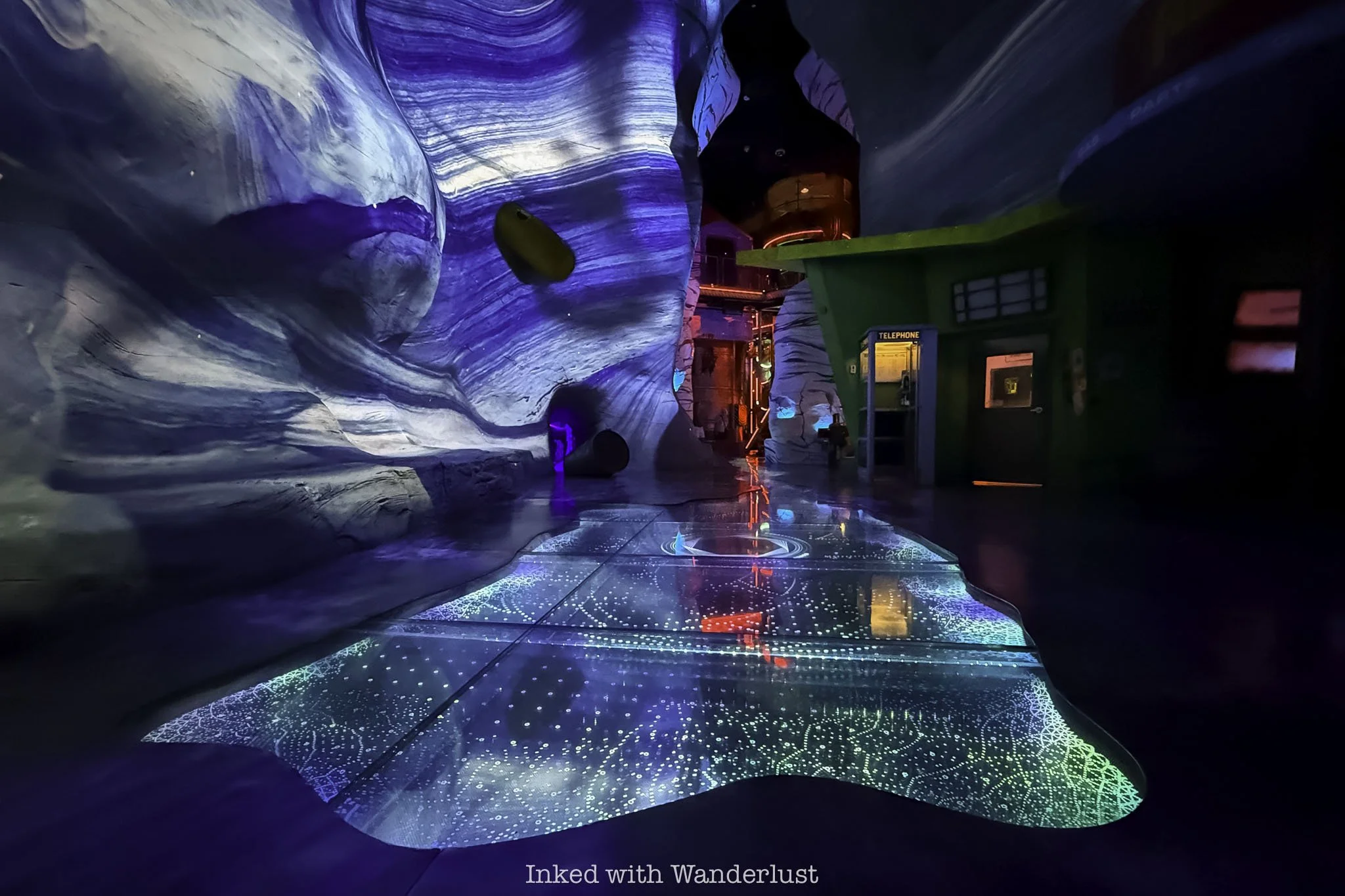
Something Otherworldly…
Venturing beyond the supermarket portion of Omega Mart is where the real fun begins. Several hidden and not-so-hidden passageways concealed behind soda coolers, a camping tent, and other seemingly ordinary fixtures lead you into a sprawling network of surreal environments.
When you walk (or crawl) into the other side, you’re transformed into a journey through impossible spaces, where glowing tunnels, cosmic landscapes, and futuristic, dreamlike art installations replace the familiar surroundings of the market.
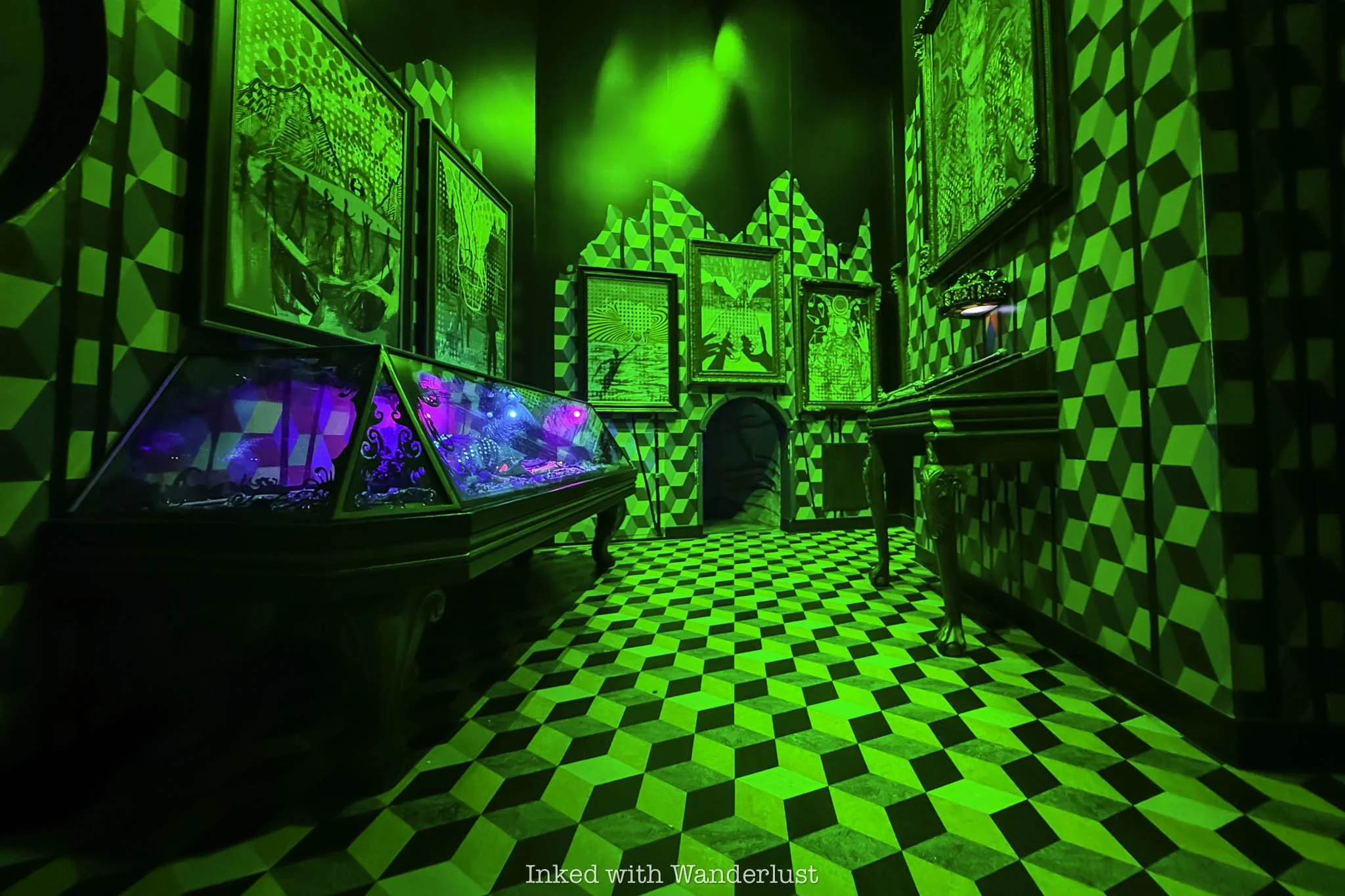
Each new room feels like stepping into a different dimension. Some of the spaces are filled with vibrant colors and interactive artwork, while others are mysterious, immersive, and outright otherworldly.
The transitions between these worlds are part of the experience, creating a constant sense of surprise as you uncover secret doors and hidden routes. Omega Mart isn’t just another attraction you walk through, it’s a place to explore.

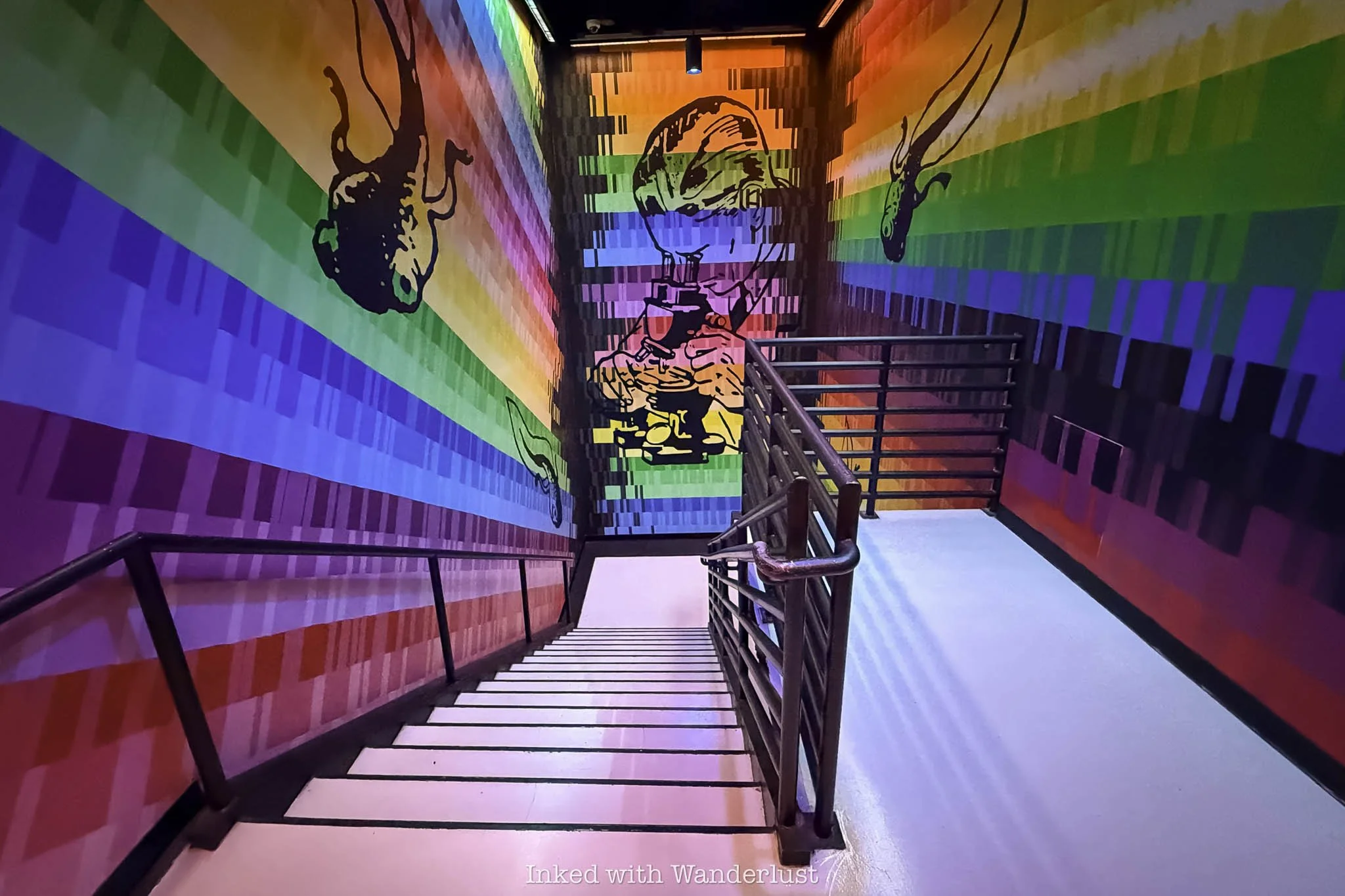
Some rooms pulse with color and music, while others feel strangely peaceful and contemplative. Interactive elements encourage visitors to touch, explore, and experiment, creating the feeling of actively participating in the environment you’re in.
Every doorway seemed to lead to somewhere unexpected and every turn revealed another layer of the attraction’s intricate narrative. Its sheer scale and seemingly endless creativity both impressed and overwhelmed me.
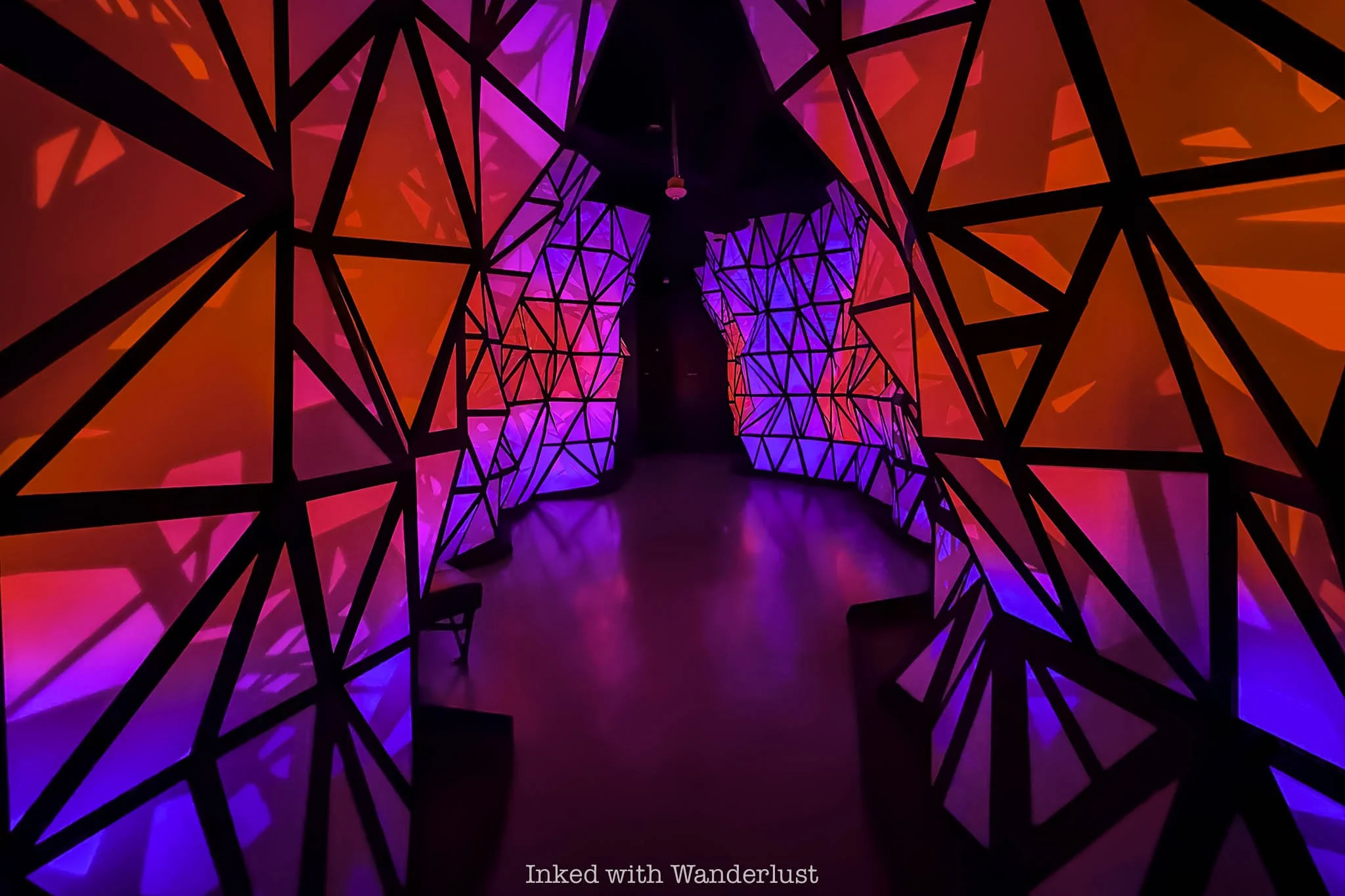
By the time my wife and I returned to the supermarket portion of Omega Mart, it felt almost normal compared to what we’ve just seen. What began as a playful parody of everyday life quickly morphed into a collection of imaginative dimensions, blurring the lines of reality.
That contrast is what makes Omega Mart such a memorable experience. Once you’ve experienced it, it’s easy to see how it became such a popular attraction in the short amount of time it did.
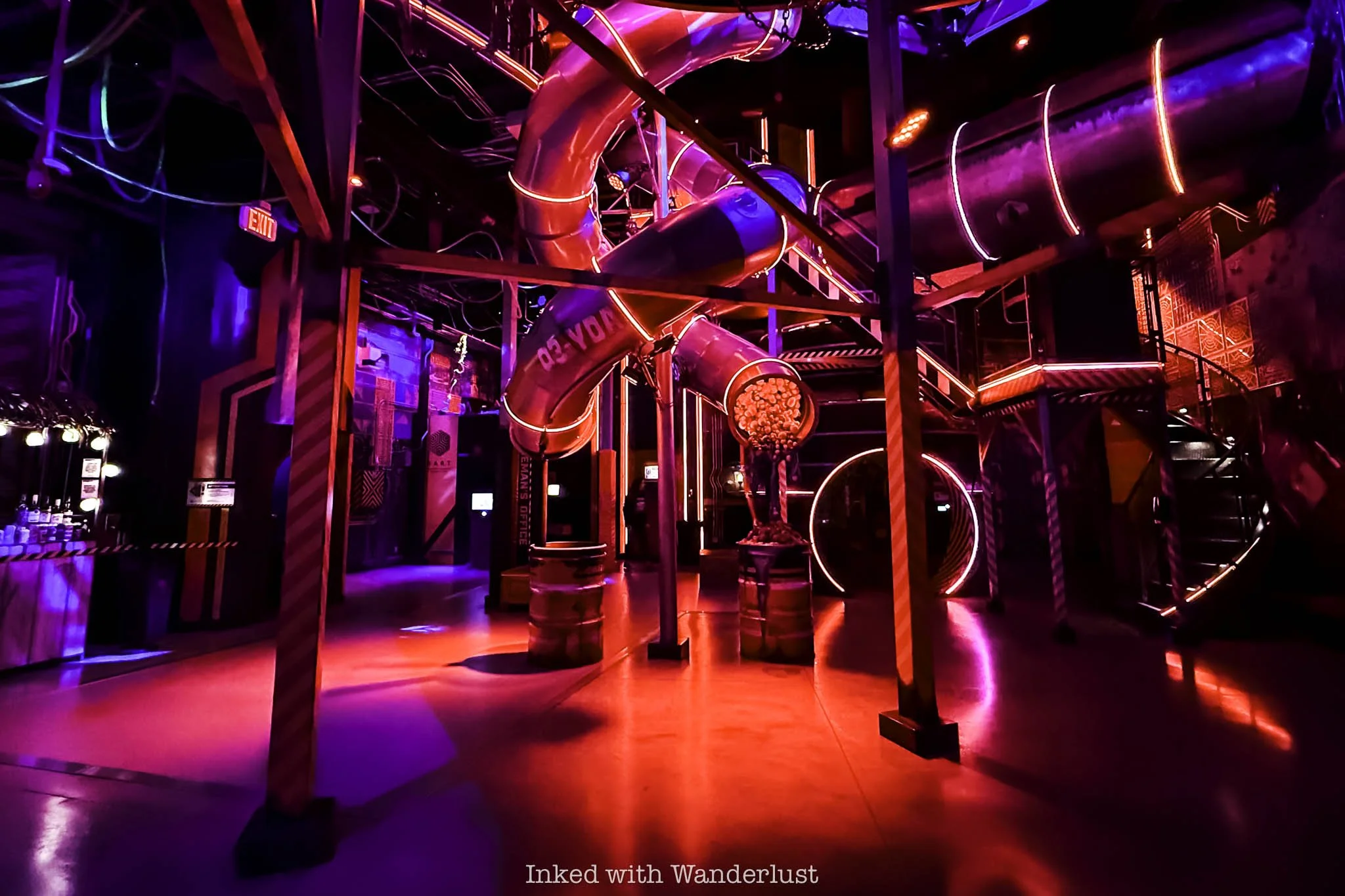
Omega Quest…
While many visit Omega Mart to simply admire the immersive artwork and discover hidden details, the Omega Quest ticket option (starting at $119) adds an entirely new layer to the experience.
Think of it as a high-tech scavenger hunt woven directly into the attraction’s mysterious storyline. Participants use interactive stations scattered throughout Omega Mart to collect clues, unlock intel, and piece together the secrets behind the strange events unfolding within it.
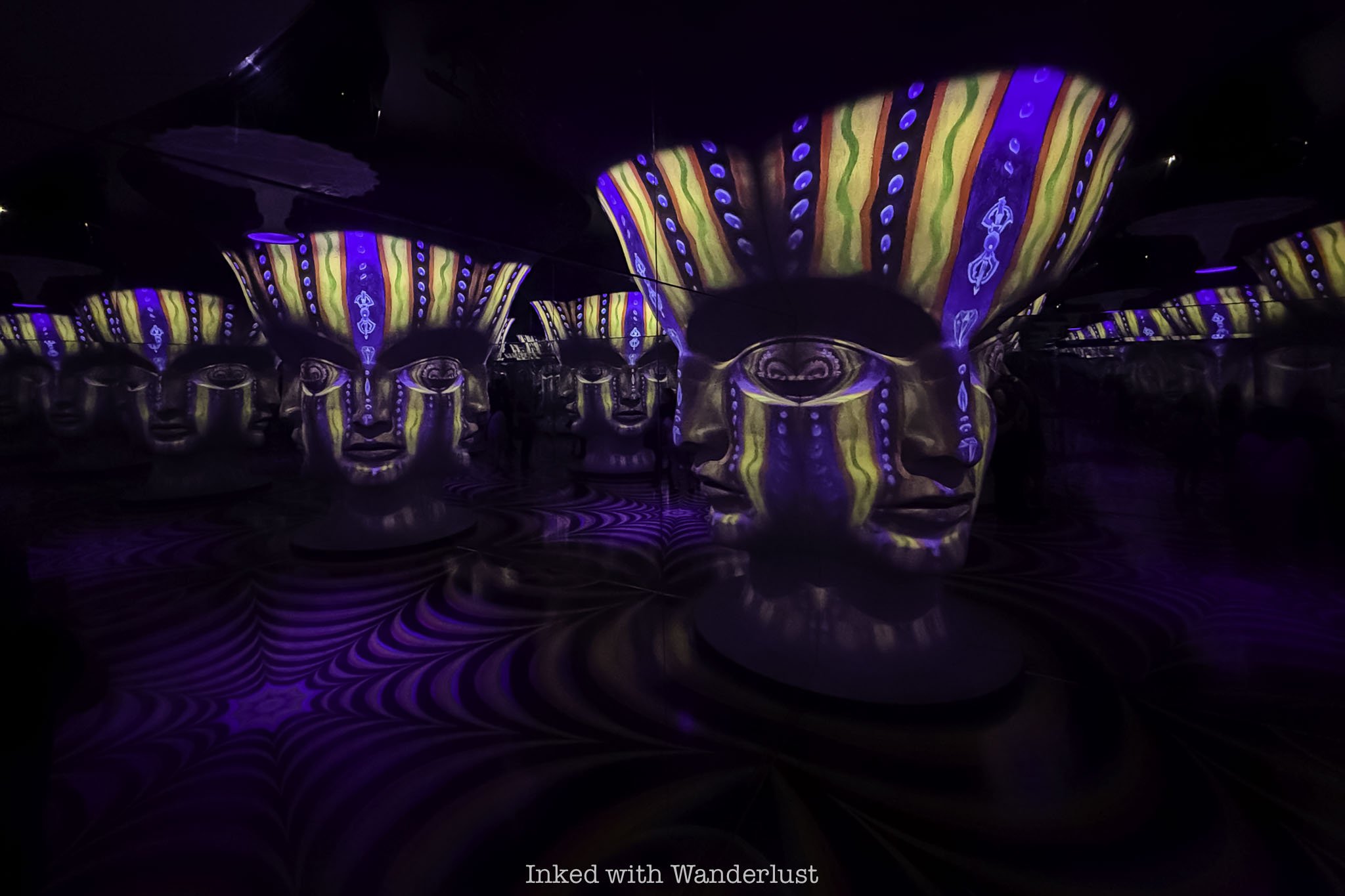
You’ll encounter terminals, exhibits, and interactive elements that reveal details about the characters, corporation, and mysteries that make up Omega Mart’s universe. The more you explore, the more the puzzle falls into place.
It isn’t necessary to enjoy your time here, but it does add new layers of depth and meaning to your visit. Omega Quest provides a rewarding reason to slow down, investigate every corner, and look beyond what first appears on the surface.
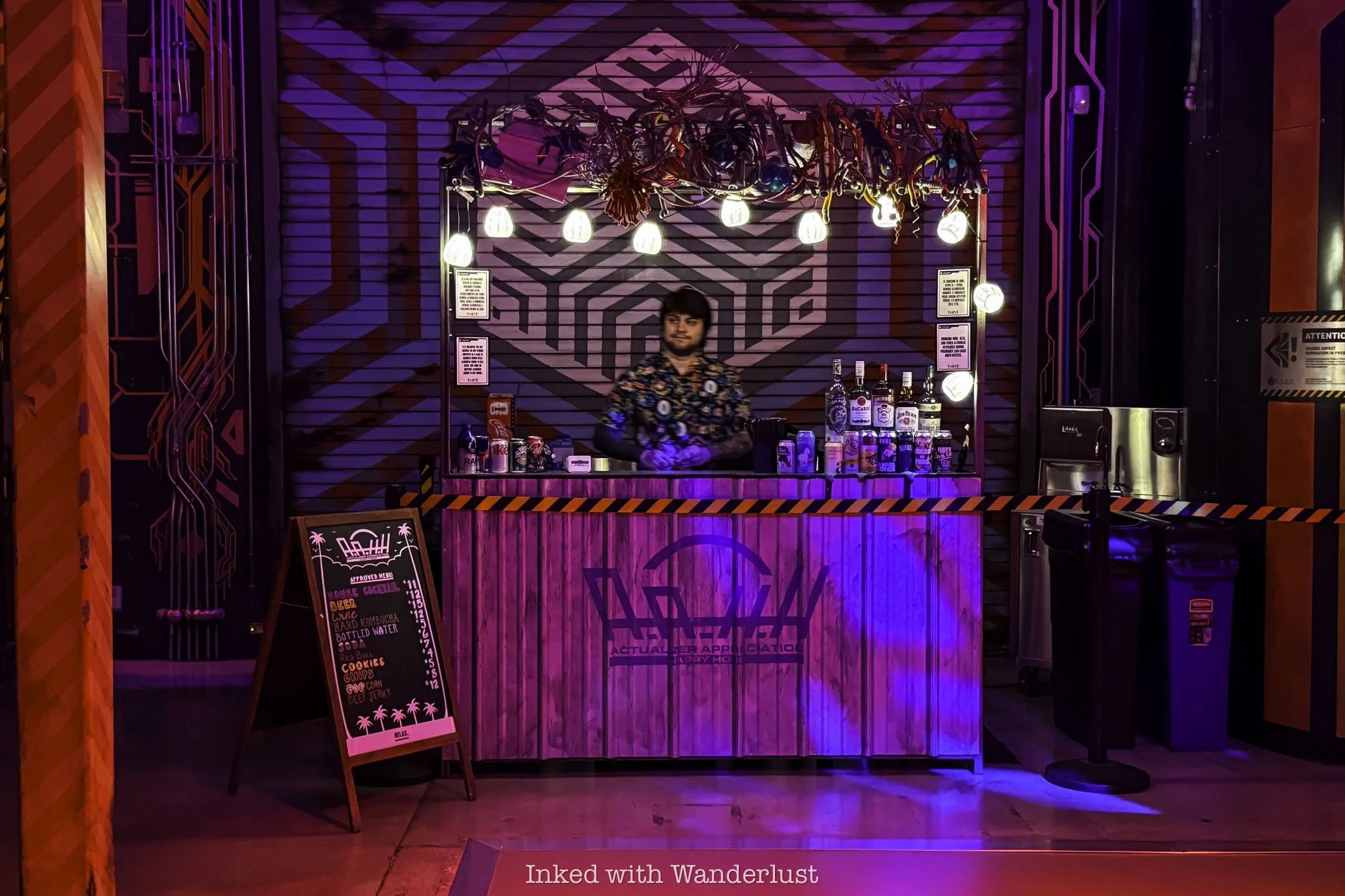
Night Shift - Adults Only…
Night Shift is Omega Mart’s exclusive, adults-only (21 years+) after-hours event held on select Thursday nights. By 8pm, all guests under the age of 21 must exit as Omega Mart transforms itself with dimmed lights, pop-up bars, music, and curated cocktails.
Event Time: Select Thursday nights starting at 8pm. Last entry for all guests under 21 is 6pm.
Tickets: Night Shift is included in any purchased ticket or Portal Pass.
Cocktails: A variety of curated cocktails, such as their famous Orange Dream, available for purchase at their in-house bar, Datamosh, or at the various pop-up bars.
Datamosh Speakeasy
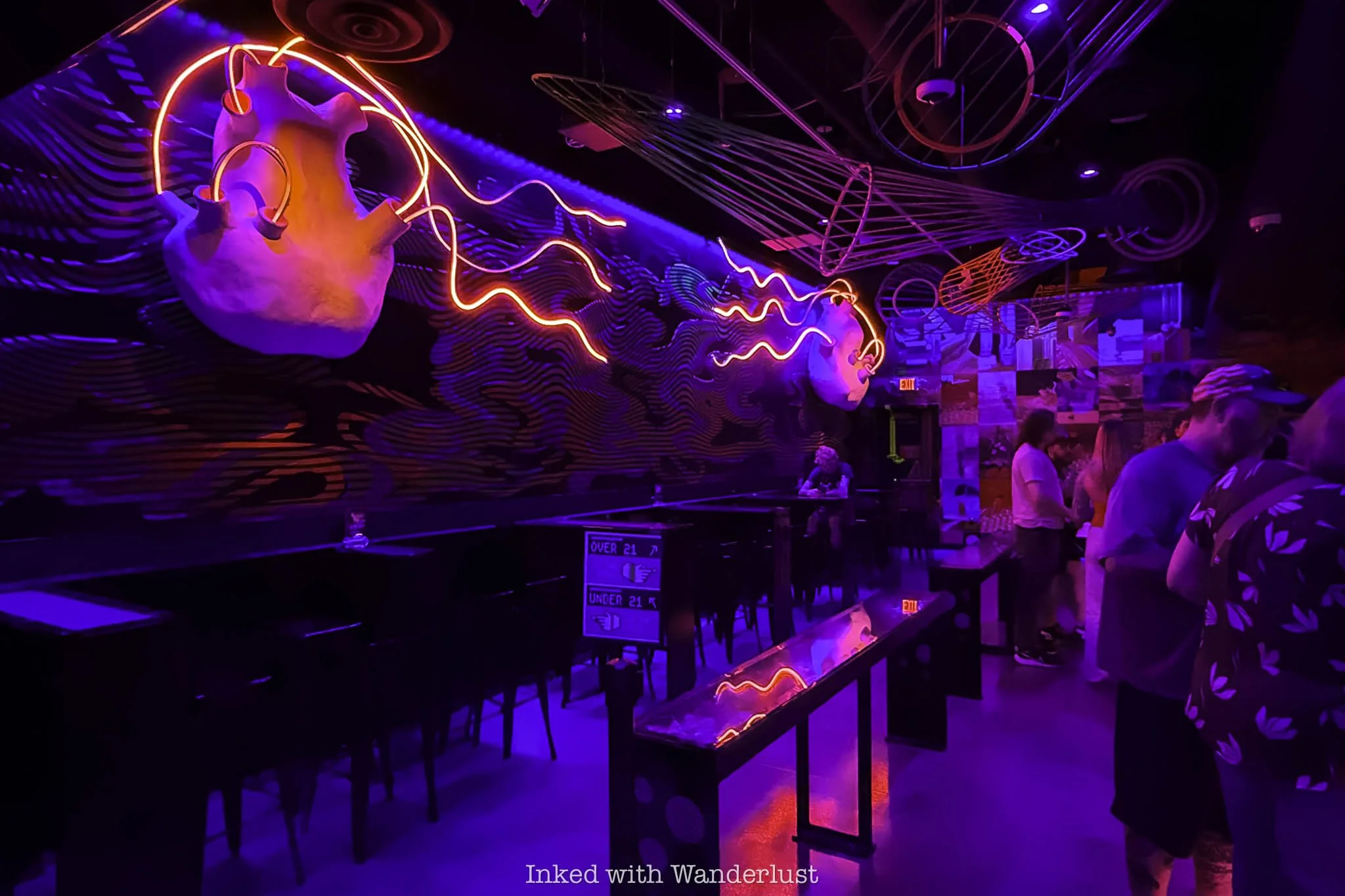
Hidden behind an unassuming entrance (a mock walk-in cooler), Datamosh, Omega Mart’s speakeasy-style bar, rewards curious guests with a space that feels worlds away from the bustling grocery store just steps away.
From the moment you arrive, you’re surrounded by glowing neon lights and a vibe-packed space that perfectly compliments the surreal nature of the attraction. Datamosh is intimate and inviting, making it the perfect spot to relax after exploring Omega Mart’s extensive backroom.
Even if you don’t order a cocktail, it’s still worth stopping by to see the unique design elements and soak in the ambiance. It’s mostly just drinks, though. They do offer light snacks (popcorn, nuts, etc), but that’s it. If you’re hungry, head over to nearby Kaia for excellent sushi and ramen bowls.
How Long Does it Take to Go Through Omega Mart?
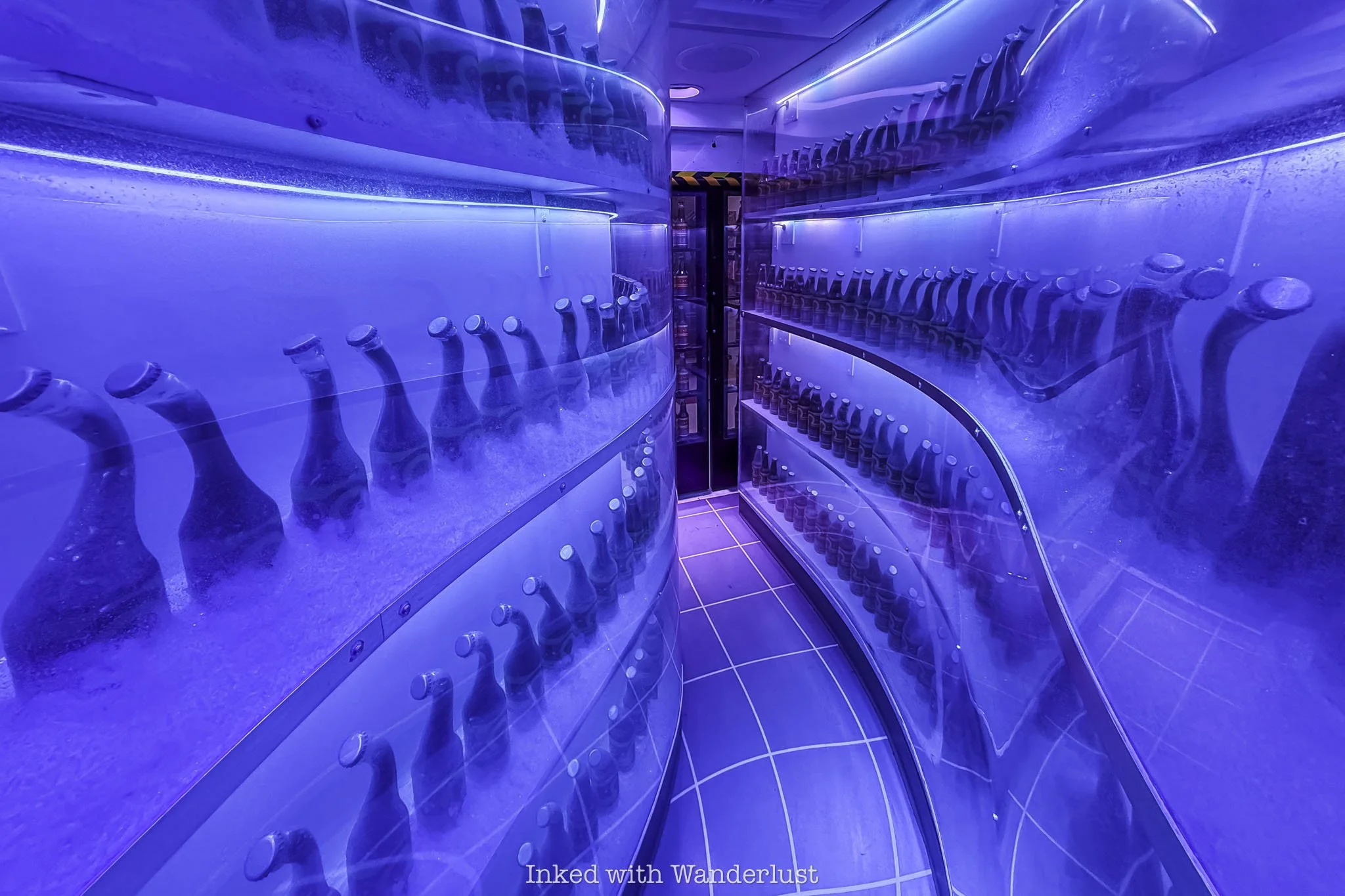
One of the most common questions people have about Omega Mart is how much time they’ll need to set aside for it. The answer largely depends on how you plan to explore. Most attractions take around an hour or so, maybe two, but Omega Mart isn’t just any attraction.
Omega Mart was designed to reward curiosity, making it more than easy to spend more time inside than you initially anticipated.
For those who simply want to explore and wander through the exhibit, check out the artwork, and discover the hidden passages, I recommend setting aside a minimum of 90-minutes to two hours.
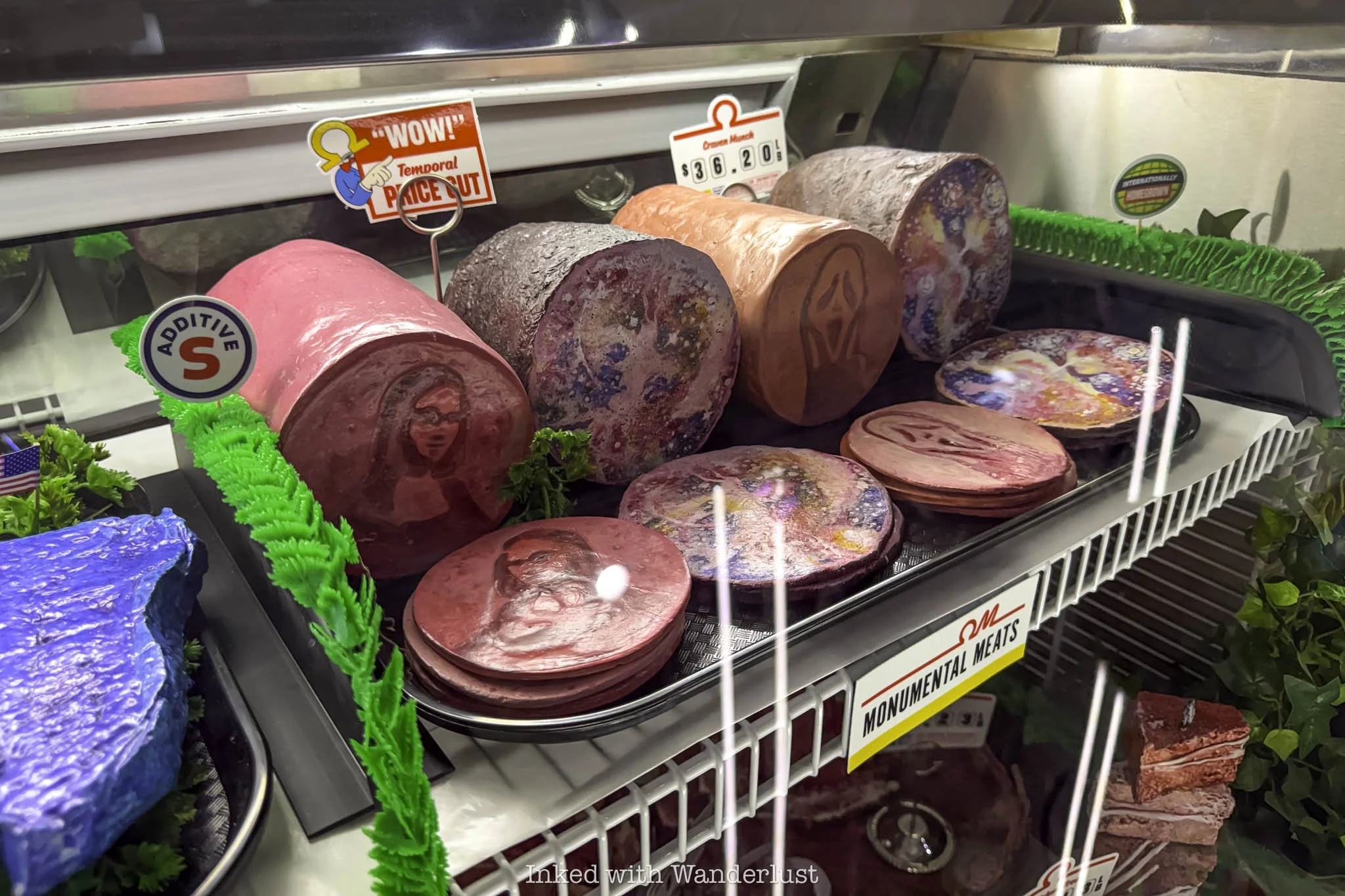
This allows enough time to explore the grocery store, uncover the secret portals, and experience many of the immersive environments and exhibits without feeling rushed. Perhaps you can even sneak in a drink or two at Datamosh.
Conversely, if you plan to participate in the aforementioned Omega Quest, expect your visit to expand to three to four (or more) hours. Remember, the deeper you dive into the narrative, the more time you’ll end up dedicating to it.
Personally, I would recommend setting aside at least two to three hours to take it all in, especially if it’s your first time. Omega Mart is one of those rare experiences where slowing down pays dividends for your time. Above all, don’t rush, and allow Omega Mart to guide you.
Is Meow Wolf Omega Mart Worth It?
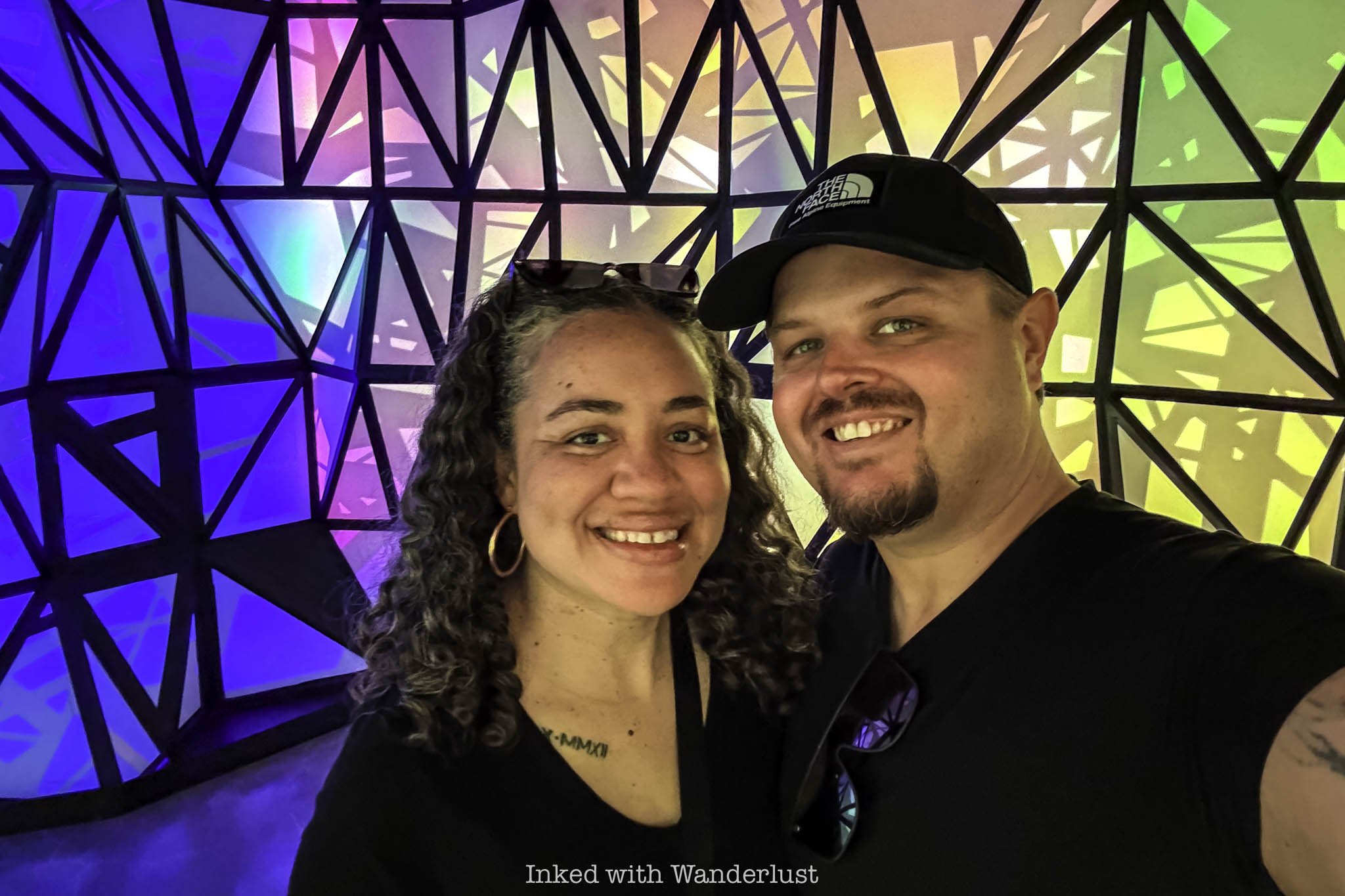
If you appreciate attractions that are totally unique and unlike anything you’ve ever experienced, yes, Meow Wolf’s Omega Mart is absolutely worth it. The immersive exhibits, pun-filled grocery items, speakeasy, and seemingly endless exploration makes it must-see.
Admittedly, admission isn’t cheap, which is the biggest downside to Omega Mart. If you’re visiting with a family in tow, costs can add up quickly. Additionally, Omega Mart can be overwhelming to guests who prefer a more traditional, low-key attraction.
There is no clear, single path to guide you. As much of the experience is intentionally built to be open-ended, those expecting a conventional museum-like attraction or quick walk-through may become confused, potentially frustrated, and experience sensory overload.
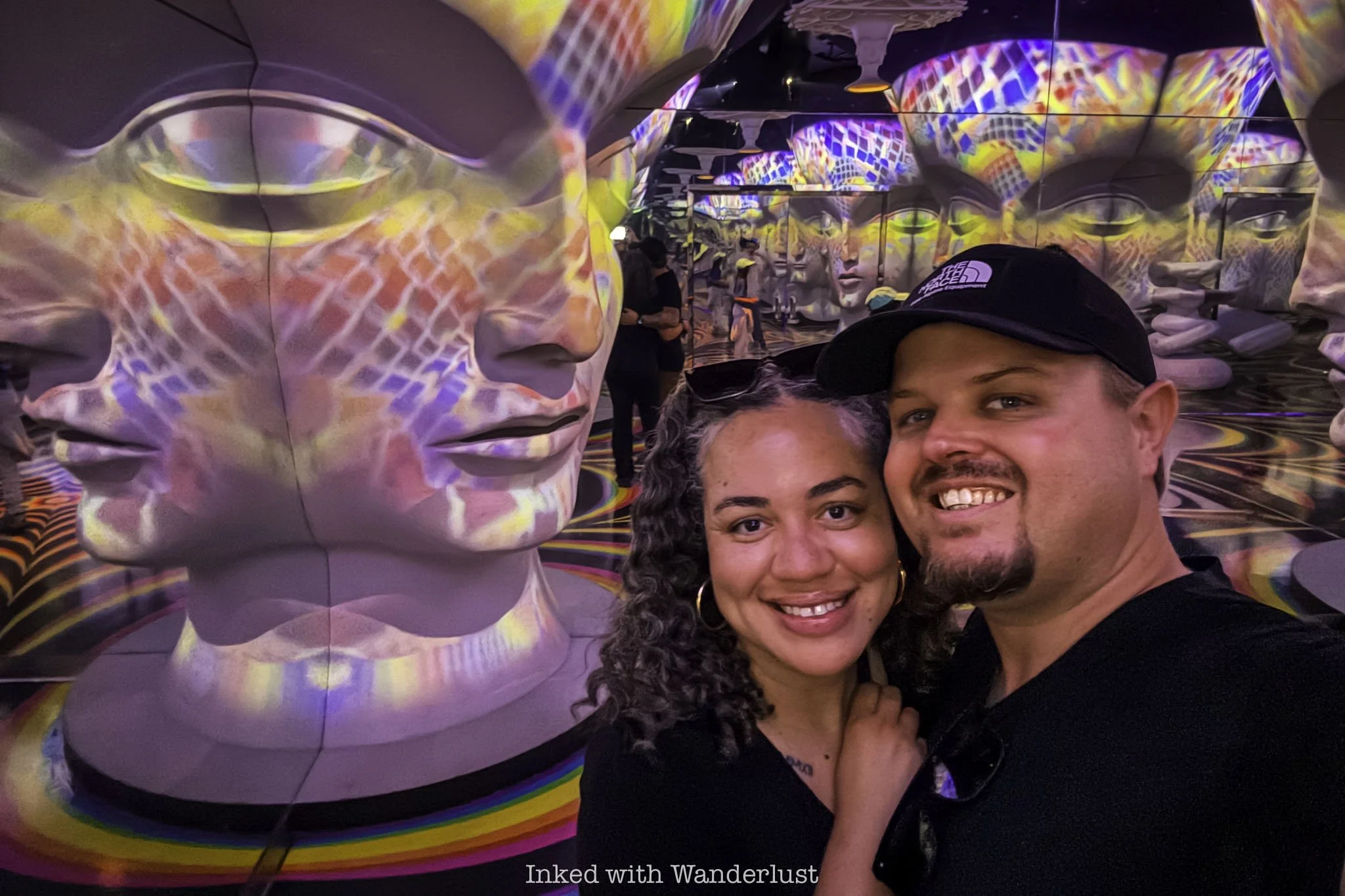
That said, I believe Omega Mart delivers in every conceivable way and provides an excellent value for those who do enjoy immersive experiences. It was easy for my wife and I to kill over two hours without even trying. We only left when we did because we were on a time crunch.
Despite spending several hours at Omega Mart, I left with the feeling that we barely scratched the surface. I’ve been to many attractions in Las Vegas, but Omega Mart was easily the most memorable of the bunch and one that I highly recommend.
If you’re looking for more unique Las Vegas attractions nearby, click or tap on the links below for more recommendations:
Minus5 Ice Bar (post coming soon)
Mob Museum (post coming soon)
***If you’ve found this post helpful, please consider leaving a tip via the “Buy me a Coffee” button above. These tips help to cover expenses such as parking fees, meals, entry fees, permits, etc.
My Honest Review of Kaia at Area 15
With so many attractions competing for attention at Area 15, it would be easy to overlook the food. That would be…
Disclosure: This post contains affiliate links. If you make a purchase through these links, I may earn a small commission at no additional cost to you. I only recommend products or services that I believe will add value to my readers.
With so many attractions competing for attention at Area 15, it would be easy to overlook the food. That would be a mistake, as Kaia offers a welcome escape from the venue’s sensory overload.
While most visitors come for the immersive art installations, interactive exhibits, and one-of-a-kind experiences, Kaia offers a reason to slow down and take a break from the excitement while enjoying a delicious meal.
Pairing its stylish atmosphere with a menu that blends creative flavors and beautifully presented dishes, Kaia lives up to the hype. The restaurant feels more refined than you might expect from an attraction-focused destination.
My wife and I recently enjoyed lunch here during our visit to Area 15. In this review of Kaia, I’m going to discuss topics such as its location, as well as detail my experience with the service, food, and drinks.
Kaia Location
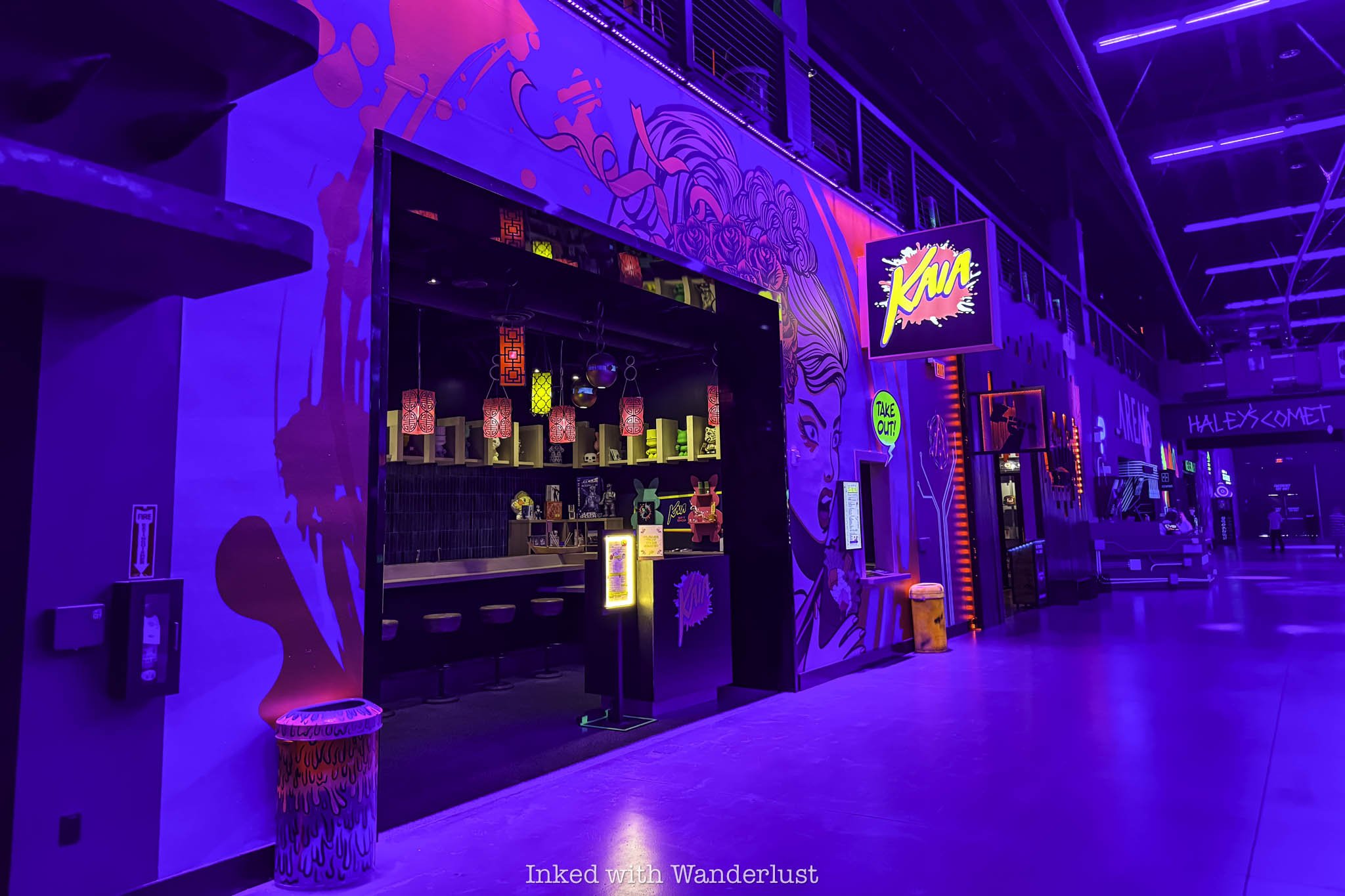
As stated above, Kaia is located within the Area 15 building, which itself is west of the Las Vegas Strip. Its exact address is:
3215 South Rancho Drive, Suite 150
How far it is from the strip entirely depends on which hotel you’re staying (north, center, south). A center-strip hotel (Flamingo, Cosmo, Linq, Caesars, etc) would put you closest to Area 15. Rio, while off-strip, is even closer.
On arrival, you can find Kaia on the ground level of Area 15. Upon walking in, keep to the right, go past the information desk and you’ll immediately recognize Kaia. It’s across from Meow Wolf Omega Mart and Oddwood Bar.
Kaia Menu
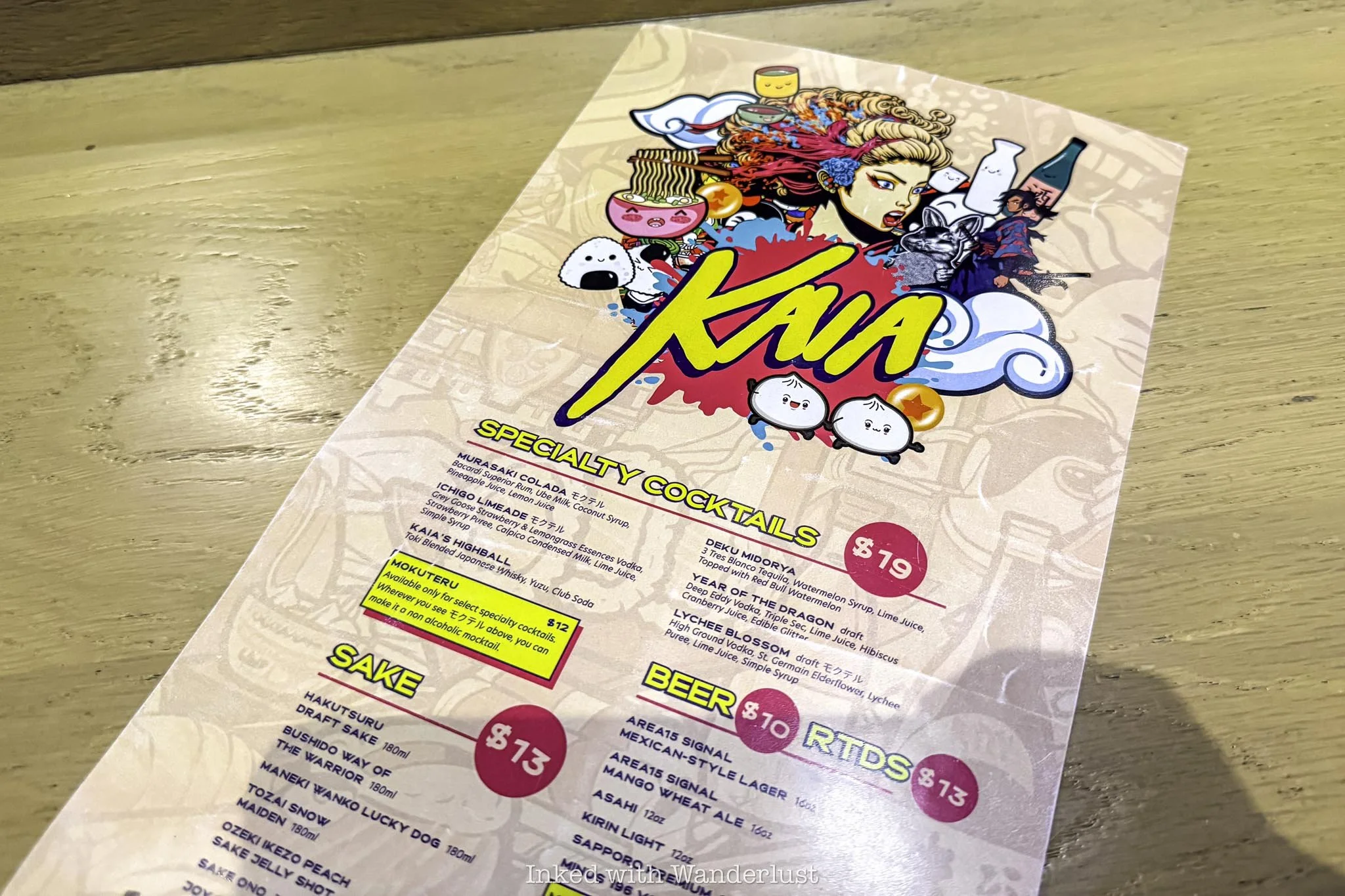
On Kaia’s menu, guests will find a variety of sushi rolls, ramen, small plates, and shareable dishes alongside specialty cocktails and desserts. The menu is minimalistic, but that’s a positive as it isn’t overwhelming and there’s enough variety to appeal to most.
The menu draws inspiration from Asian cuisine while incorporating creative twists and contemporary flavors. Sushi is the clear headliner with selections ranging from traditional rolls and fresh sashimi to speciality creations with bold flavors.
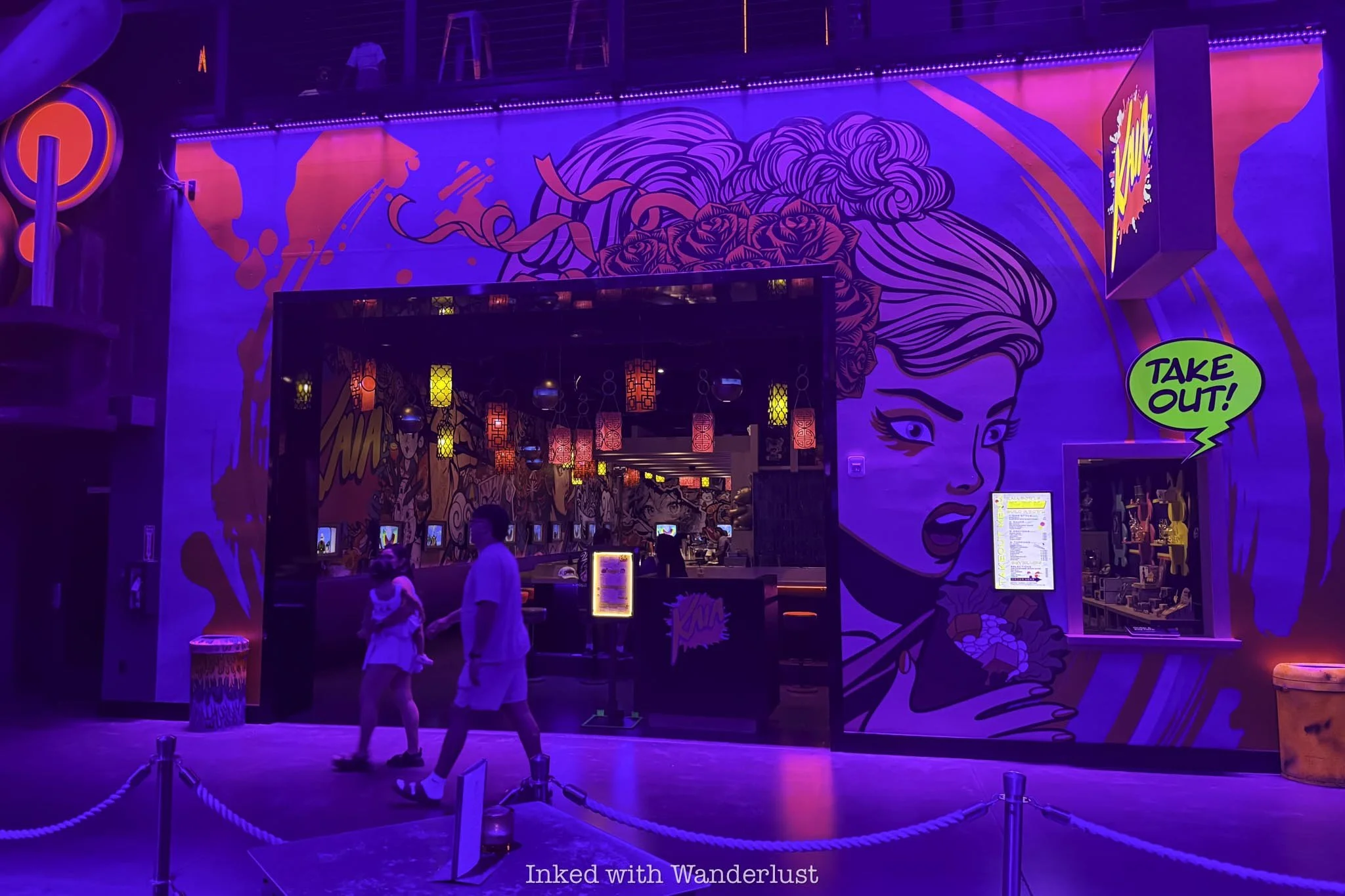
While known for their hand rolls, the noodle offerings deserve just as much attention. Kaia’s ramen selection provides a hearty alternative to the lighter seafood-focused dishes on the menu, providing a choice for guests who particularly don’t enjoy sushi.
Kaia also offers a thoughtfully curated beverage selection featuring specialty cocktails, sake, beer, and mocktails. Furthermore, while options are limited, their featured dessert offering serves up an explosion of creamy flavor (details below).
Atmosphere and Vibe
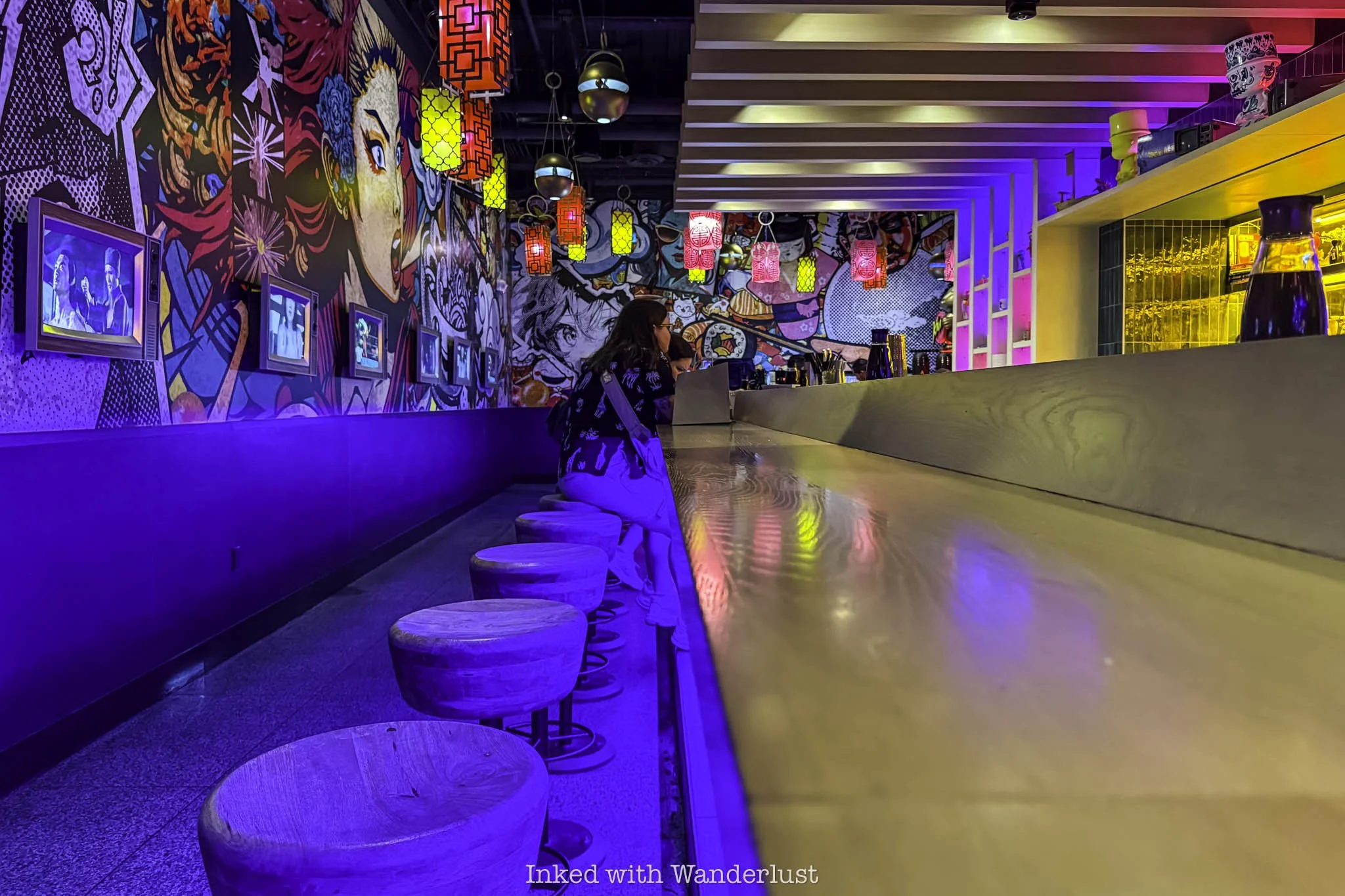
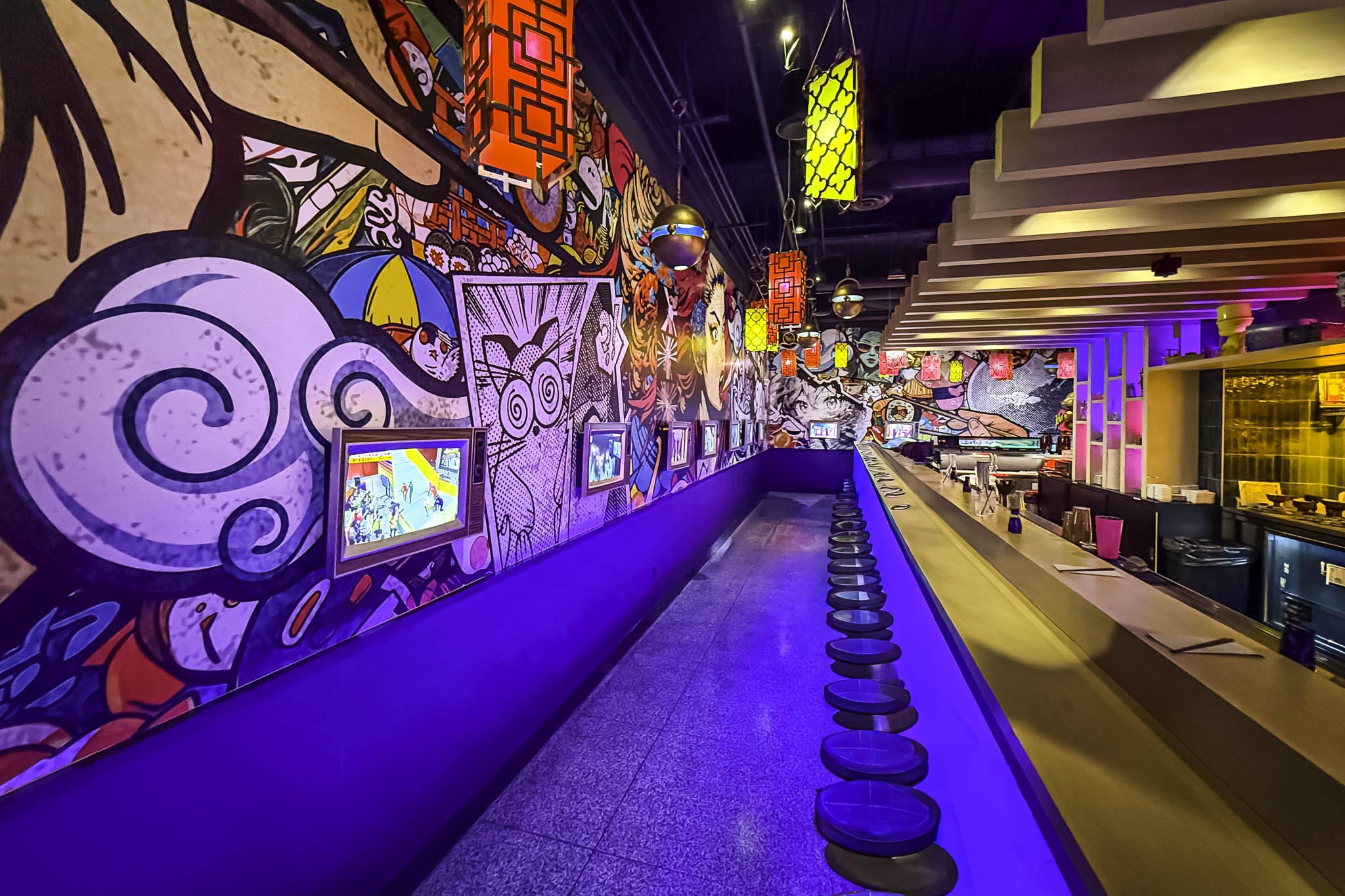
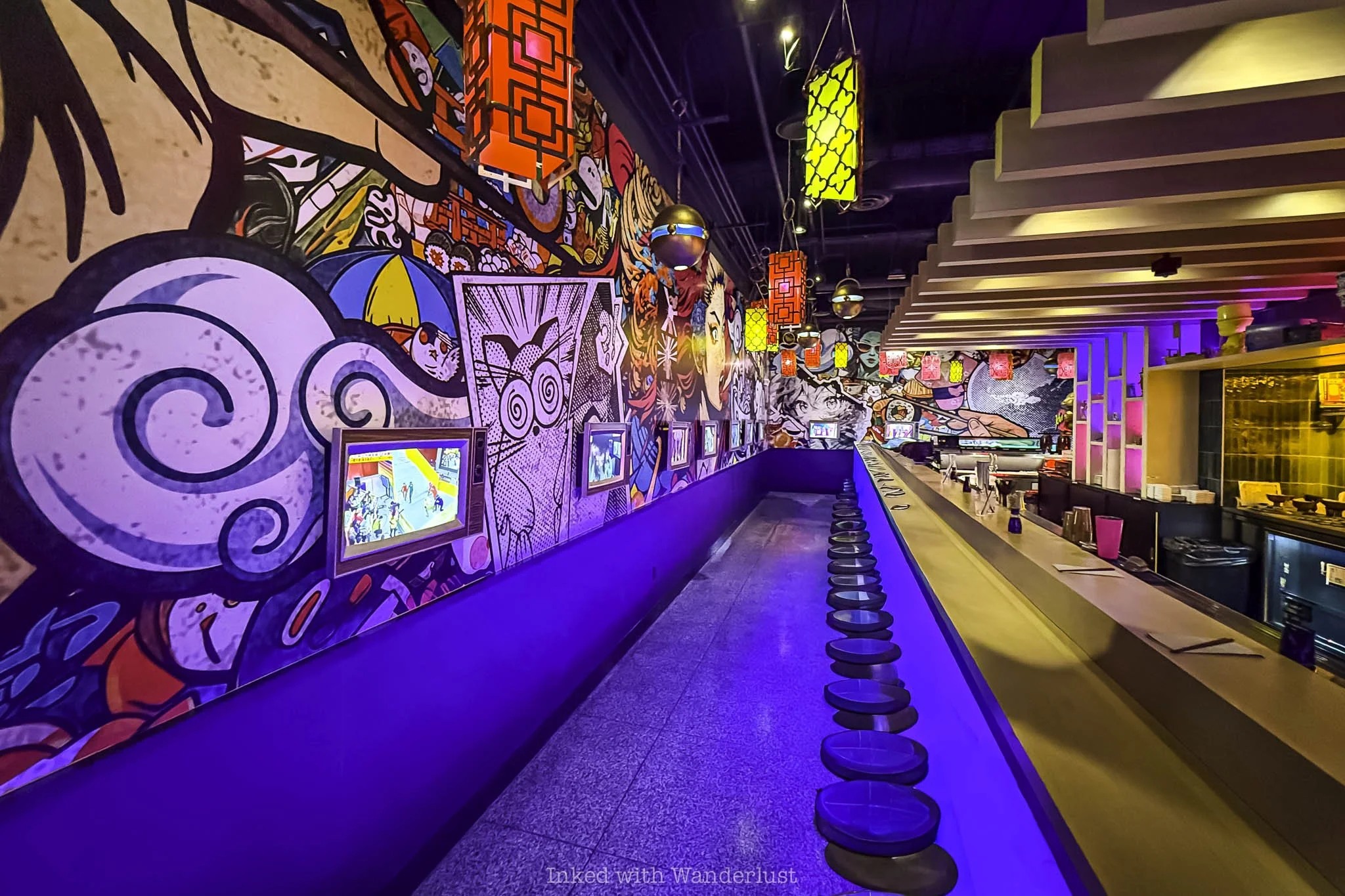
Kaia’s modern interior feels both comfortable and upscale, creating a relaxing contrast to the sensory overload found throughout the Area 15 venue. Warm lighting, contemporary decor, and open layout provides a great spot to recharge.
Known for its bold color that compliments its host venue, Kaia offers a more refined experience without completely disconnecting from the creative energy that makes Area 15 so unique. Stepping inside feels like entering a sophisticated retreat tucked within the excitement.
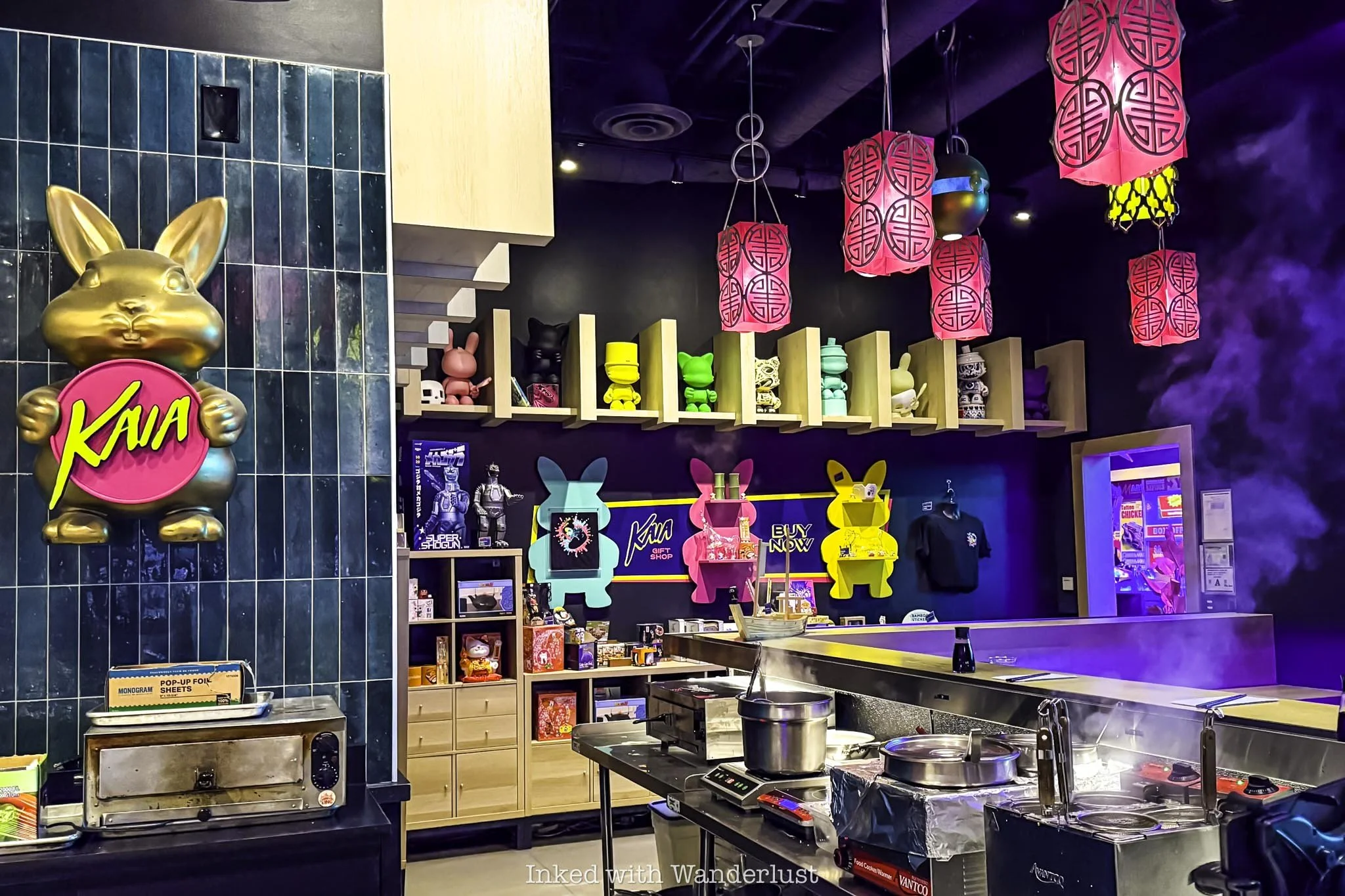
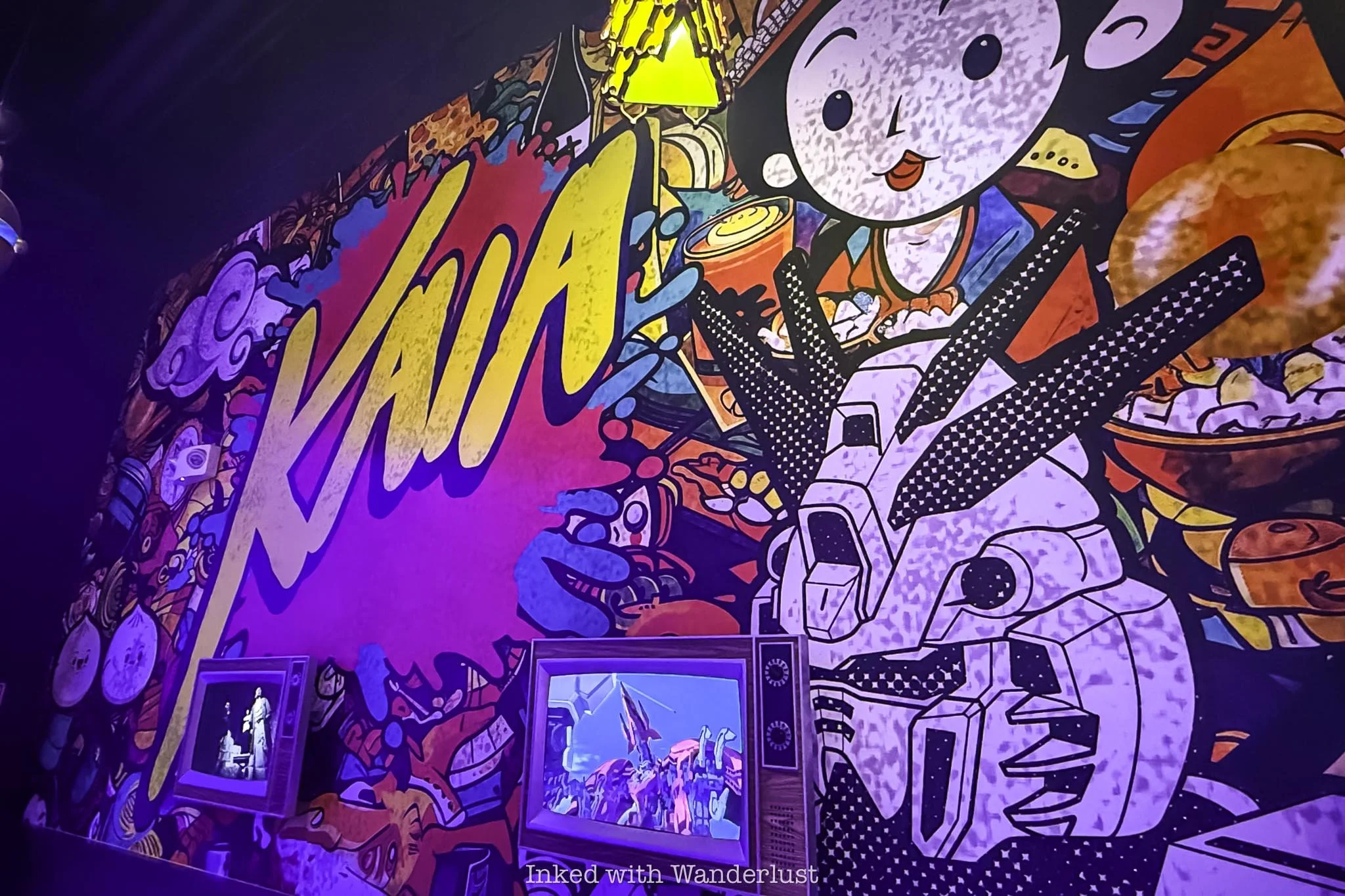
The restaurant embraces its modern design aesthetic, blending clean lines, warm lighting, and natural textures to create an inviting environment. Wood accents, counter-based seating, and bold artwork give Kaia an upscale feel, while remaining casual.
It’s stylish without being intimidating, making it equally suitable for a casual lunch, date night, or or special occasion. Music enhances the atmosphere without overpowering it, allowing guests to conversate without a need to shout.
Unlike some restaurants inside venues that rely heavily on spectacle, Kaia focuses on creating an environment where food remains the centerpiece while still celebrating the artistic and free-spirited nature of its host.
The Menu Items We Tried
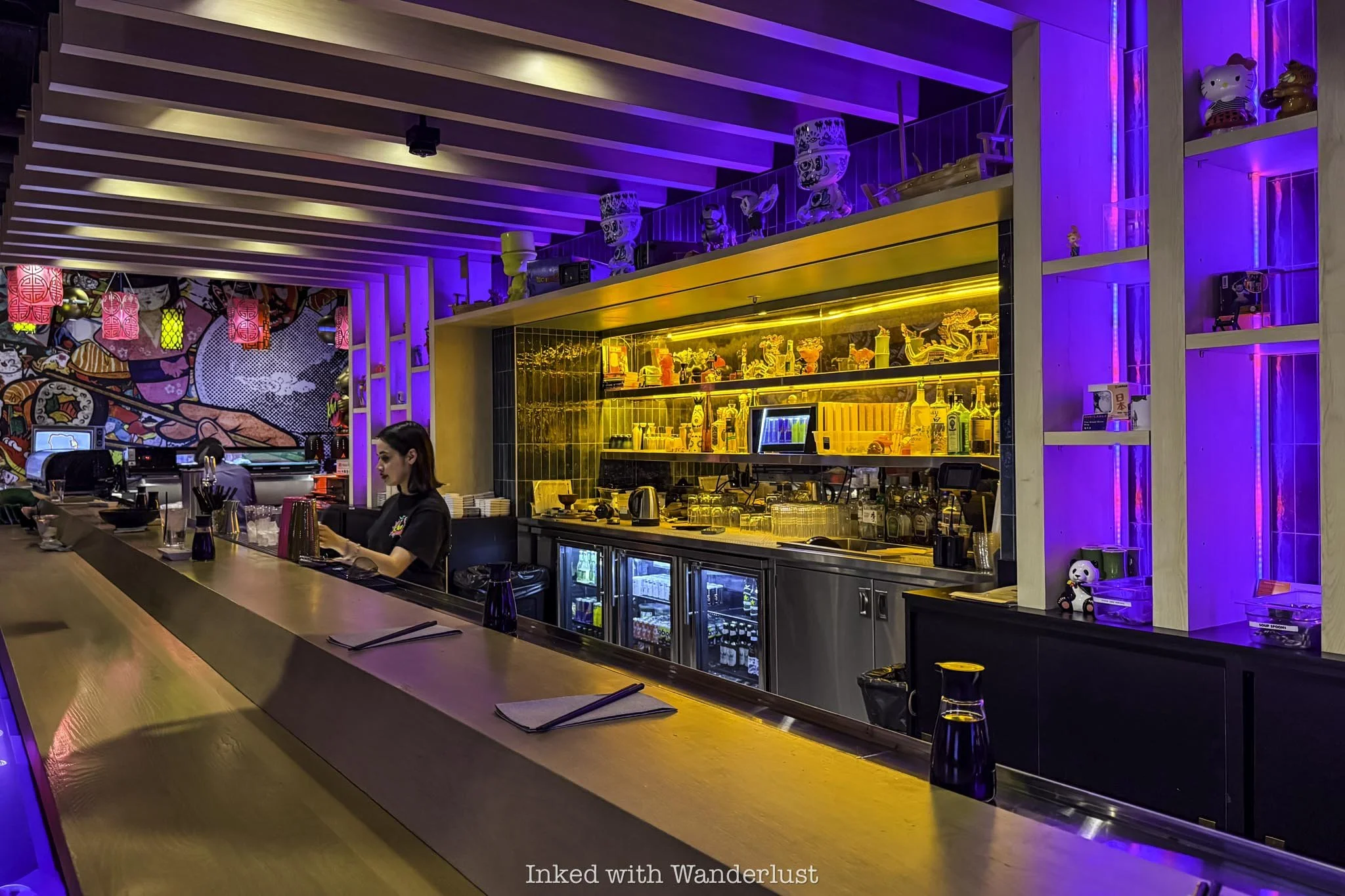
I booked a reservation at Kaia because my wife is a sushi connoisseur and doesn’t get it too often. I’m not one for sushi, so I went with their Birria Ramen bowl. We also began with an item from their starter selection, as well as a couple cocktails before finishing with dessert.
My description of the sushi will be my wife’s take. She ordered one roll each from their “Classics” and “Specialties” sections - the Spicy Tuna and Tempura Trolley Roll, respectively. If you’ve purchased an Area 15 experience pass, present it to receive a complimentary classic roll.
Ninja Beans (starter)
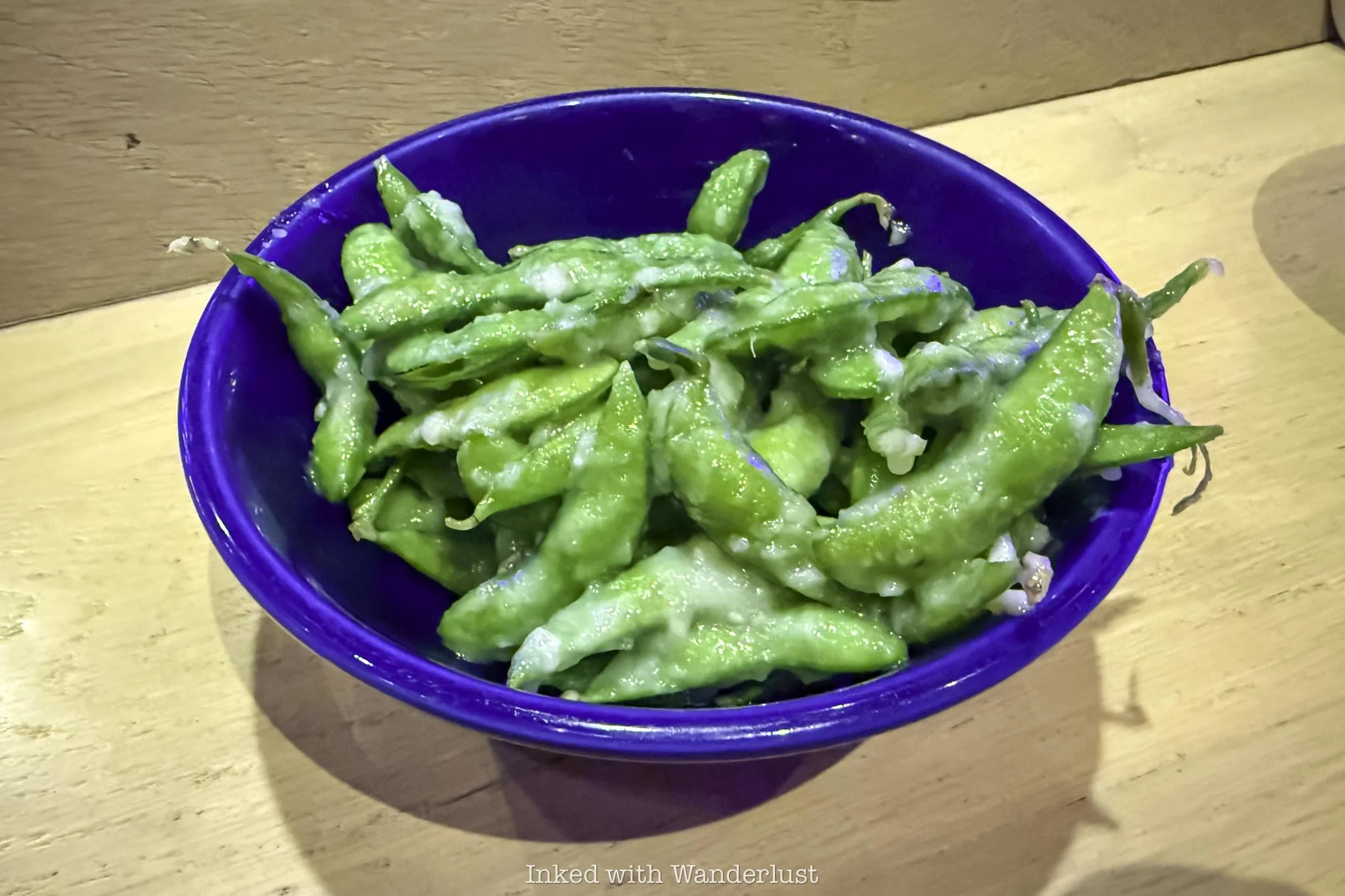
We started our meal with their Ninja Beans appetizer, which was a bowl of Edamame beans coated in garlic and chili oil. It’s easily the simplest item on the menu, but they proved to be surprisingly additive.
They were the perfect snack to enjoy while waiting for our entrees to arrive, offering a light yet satisfying beginning to the meal. They’re certainly not their flashiest offering, but they were executed exceptionally well.
Lychee Blossom (cocktail)
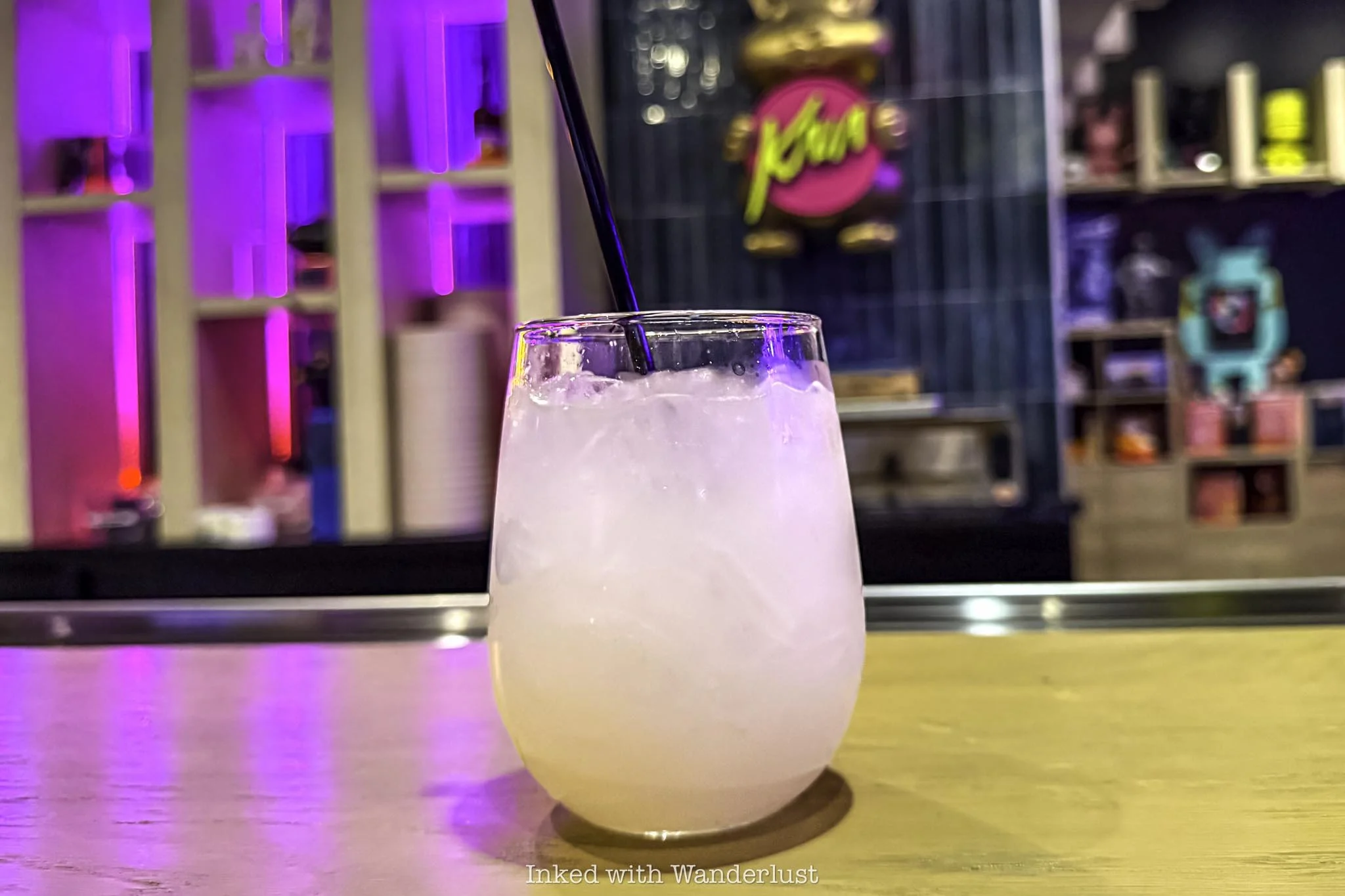
Their featured cocktail is the Lychee Blossom. It’s a vodka based beverage with St. Germain elderflower, lychee puree, lime juice, and simple syrup. It’s refreshing and elegant, pairing well with Kaia’s Asian-inspired menu.
Light, slightly sweet, and beautifully presented, it showcased the delicate floral notes of lychee without being overly sugary. Each sip proved smooth and balanced, making it a sip-easy drink that felt sophisticated, yet simple.
Spicy Tuna (classic roll) & Tempura Trolley (specialty roll)
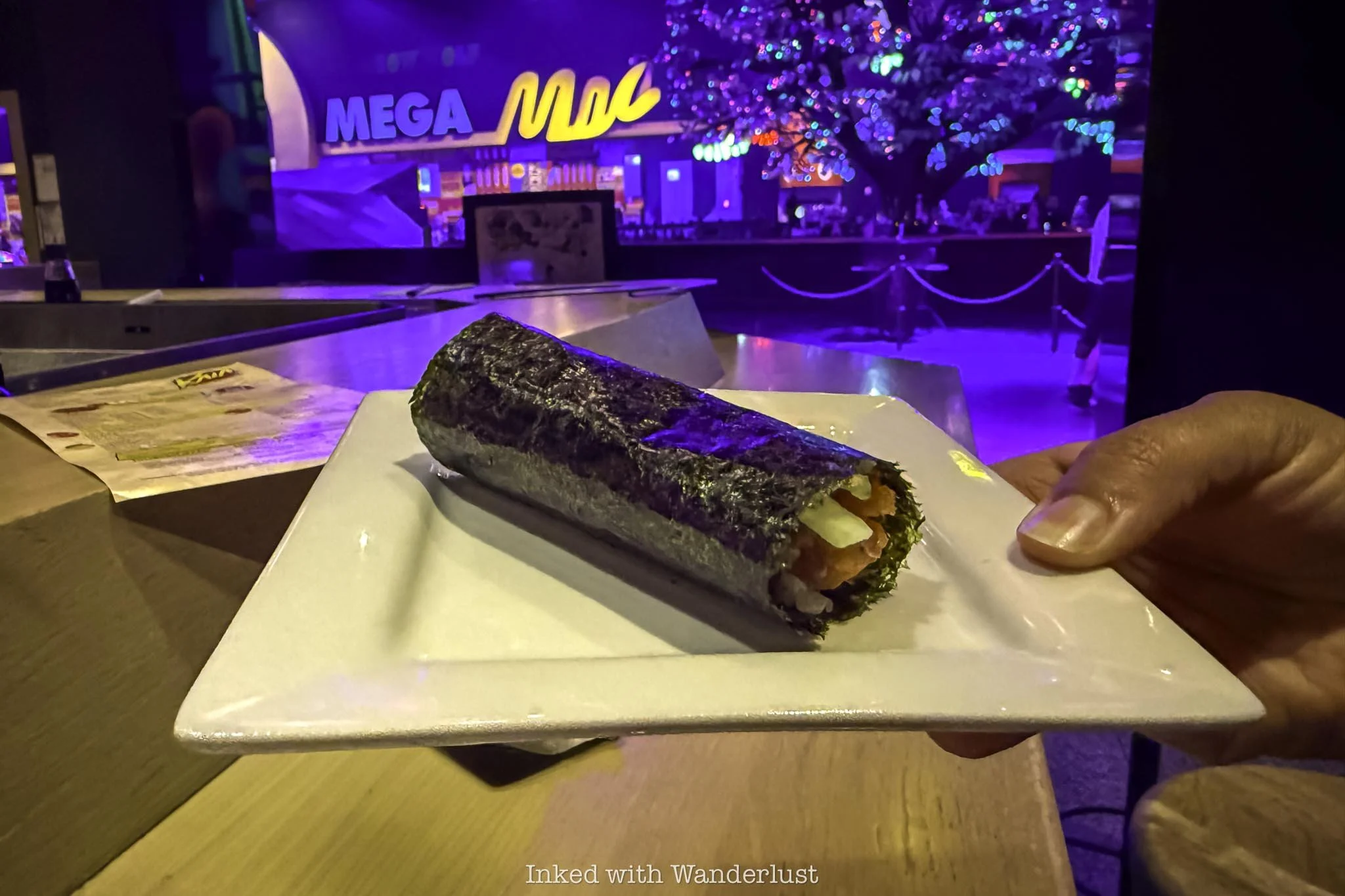
The Spicy Tuna Roll (above) takes a minimalistic, traditional-leaning approach. Served fresh and wrapped in crisp nori, it offered a pleasant kick of heat that complemented rather than overwhelmed the tuna. Its simple presentation emphasized balance and freshness, making it an excellent choice for sushi purists.
Conversely, the Tempura Trolley Roll (below) delivered a satisfying crunch every great tempura roll should have, with a combination of textures that kept each bite interesting. The crispy exterior contrasted nicely with the interior’s fresh ingredients, resulting in a roll that felt indulgent without being overly heavy.
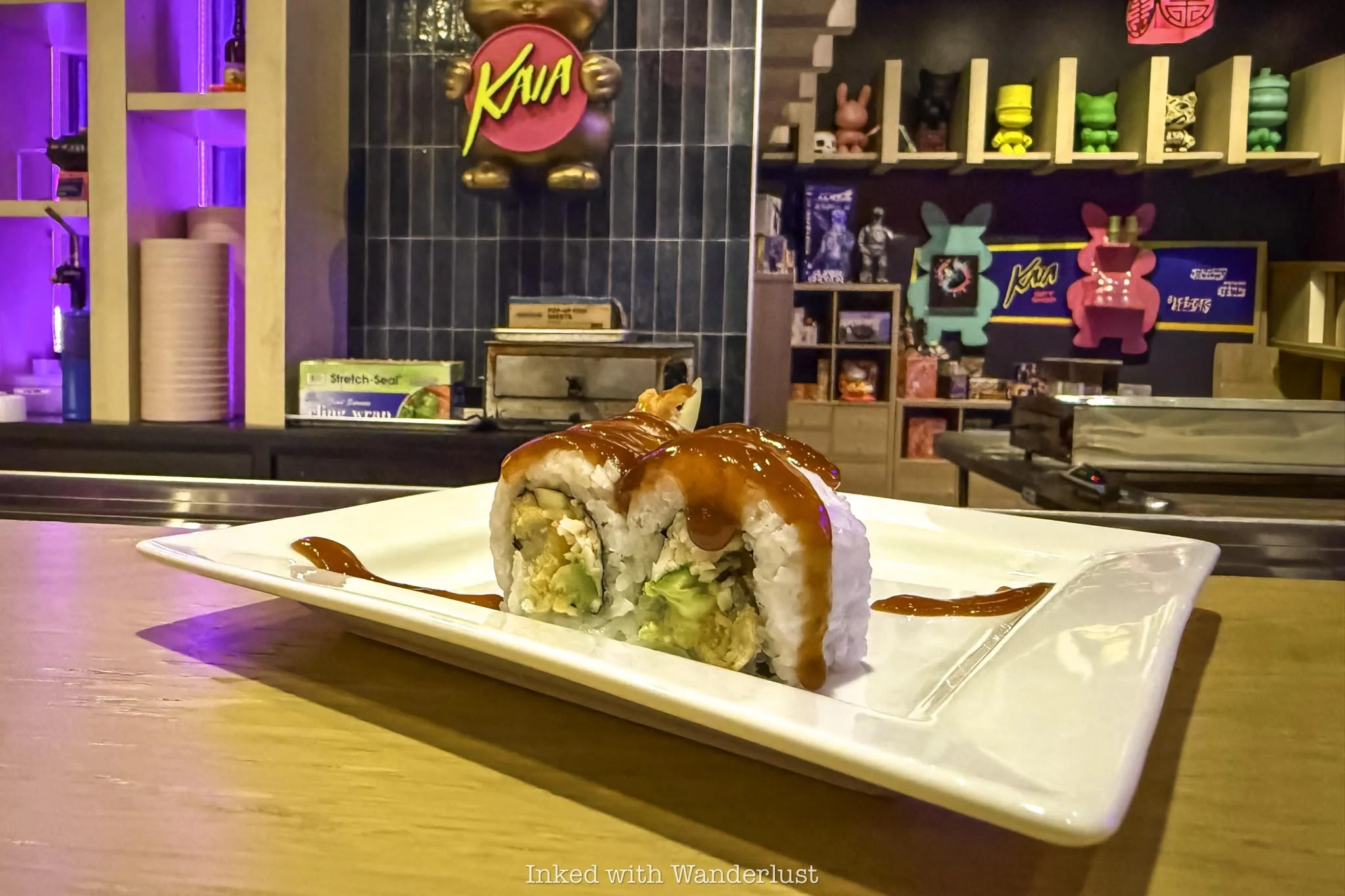
Together, these two items demonstrated the versatility of Kaia's menu. The Tempura Trolley Roll satisfied cravings for something rich and crunchy, while the Spicy Tuna Roll delivered clean flavors with a more traditional sushi experience.
If you're looking to sample both the creative and classic sides of Kaia, these two menu items are worth ordering. As mentioned earlier, be sure to present your Area 15 Experience Pass, if you have one, as you’ll receive a complimentary classic roll for doing so (such as the Spicy Tuna).
Birria Ramen
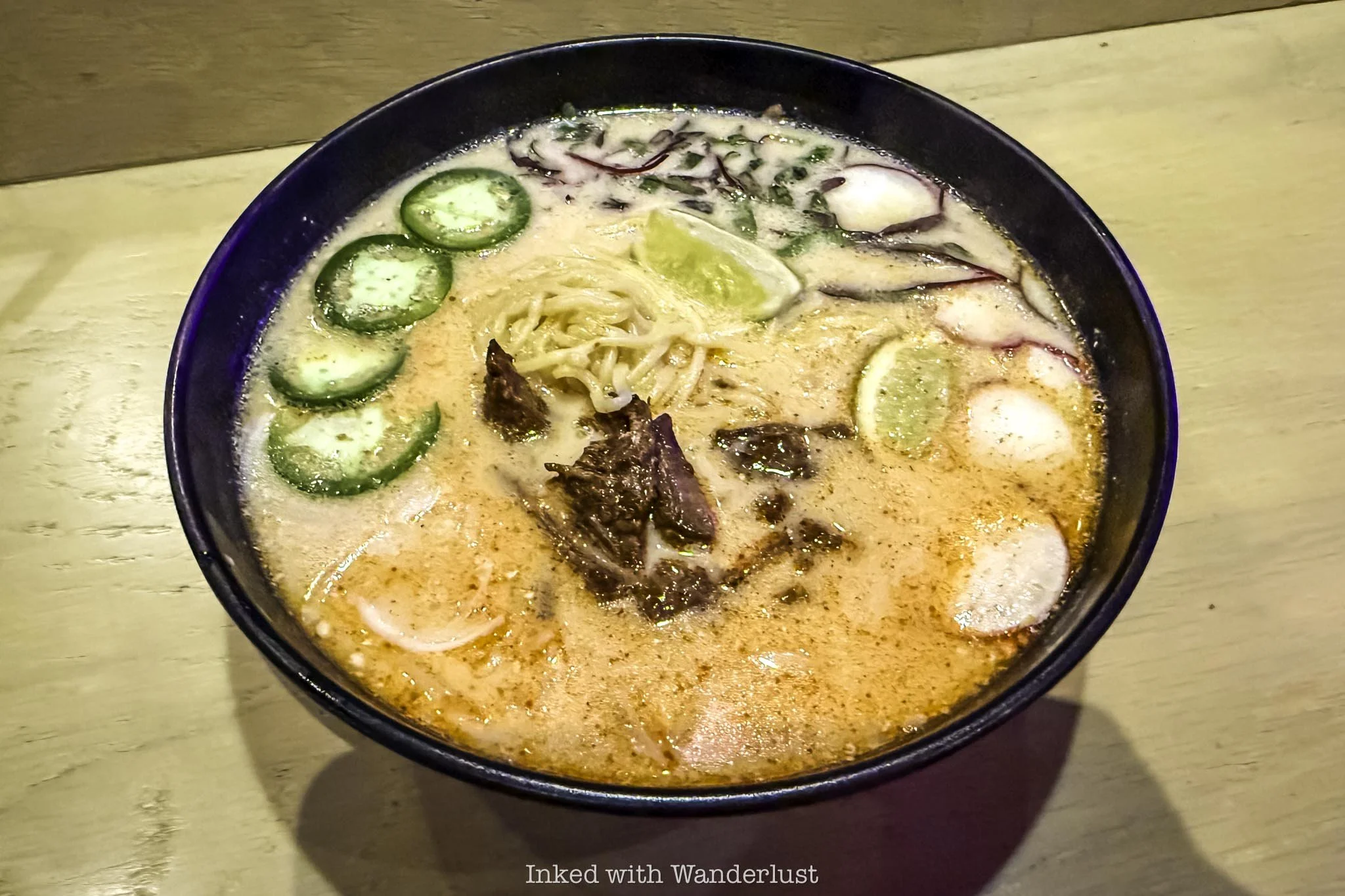
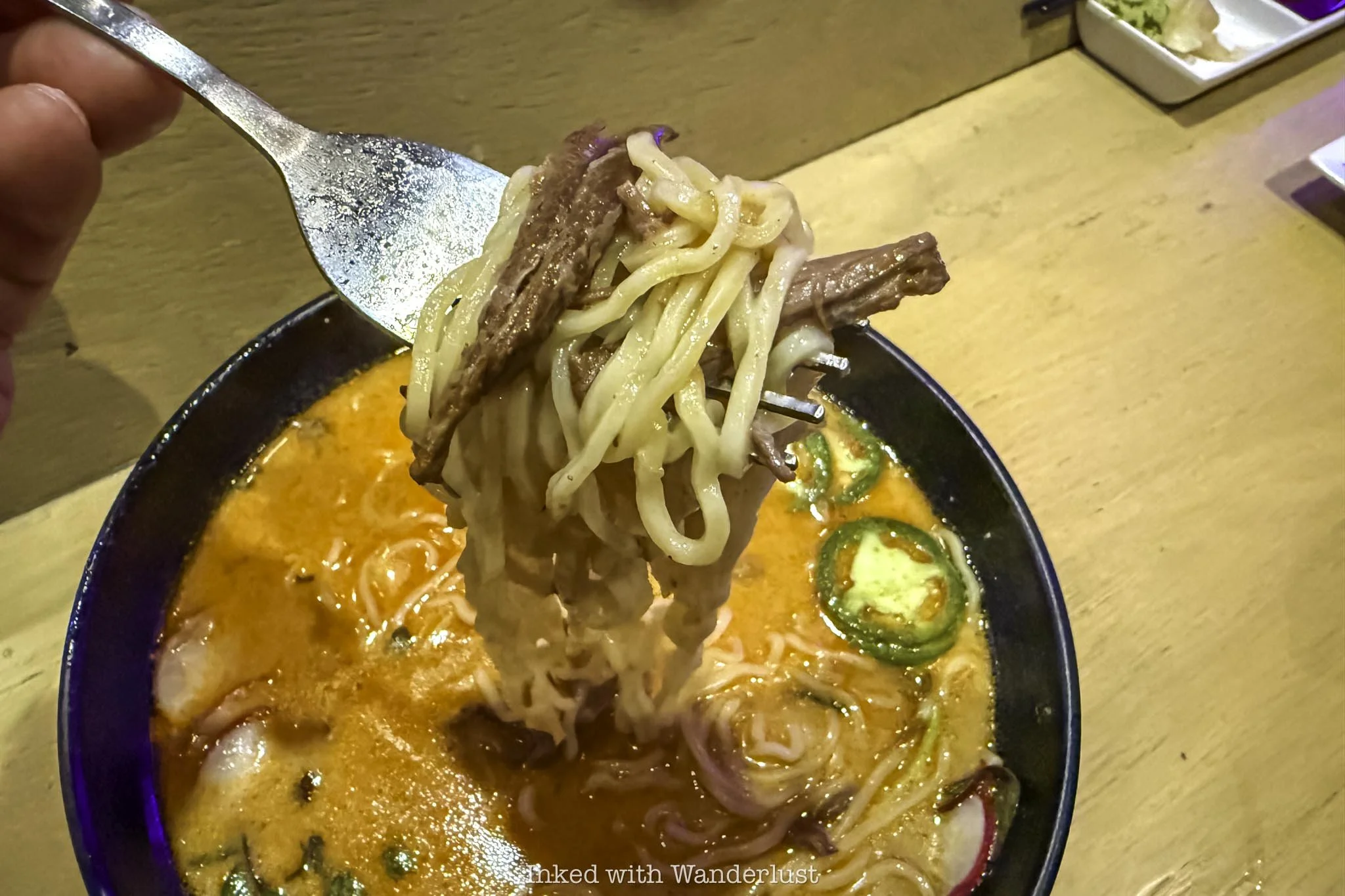
In my humble opinion, the Birria Ramen has to be one of the most memorable dishes at Kaia. Combining the rich, slow-cooked flavors of traditional birria with the comforting elements of ramen, it delivered a bold and satisfying bowl packed with flavor.
The broth was deeply savory, the meat flavorful and tender, and the thick noodles provided the perfect foundation for every bite. Furthermore, the generous, hearty portion Kaia provides doesn’t leave a whole lot of room for much else.
Much like the Birria Ramen at Disney California Adventure, it’s a creative fusion that may appear gimmicky on the surface, but fret not, because it comes together seamlessly, making it a must-try entree.
Ube Cheesecake (dessert)
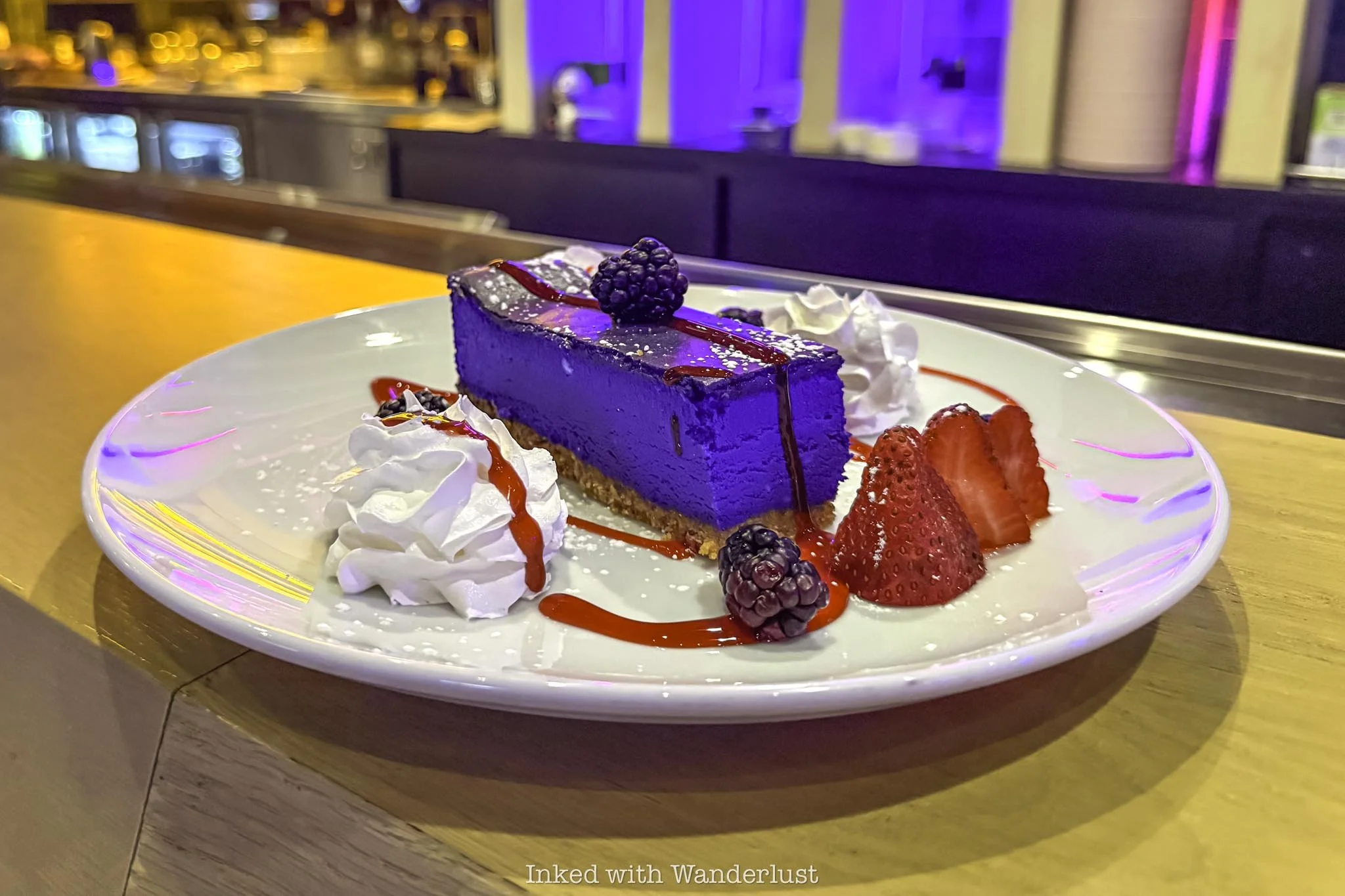
The Ube Cheesecake was a standout dessert and memorable finale to our meal at Kaia. Its vibrant purple color immediately catches your attention, making it one of the most visually appealing items on the menu. Fortunately, the flavor lived up to the presentation.
The cheesecake was rich and creamy with a smooth texture that practically melted with each bite, while the ube added a subtle sweetness and nutty depth that set it apart from traditional cheesecake.
Despite its decadent appearance, the dessert never felt overly heavy nor overly sweet. Instead, it offered a light and satisfying finish after enjoying our sushi, ramen, and cocktails. The combination of unique flavor and creamy consistency made the Ube Cheesecake much more than an afterthought.
Final Thoughts
Kaia succeeds at being much more than a convenient restaurant inside Area15. Between its stylish atmosphere, creative menu, and well-executed dishes, it delivers a dining experience that can easily stand on its own.
Highlights such as the Birria Ramen, specialty rolls, crafted cocktails, and Ube Cheesecake showcase a kitchen that isn't afraid to experiment while still keeping quality and flavor on the forefront.
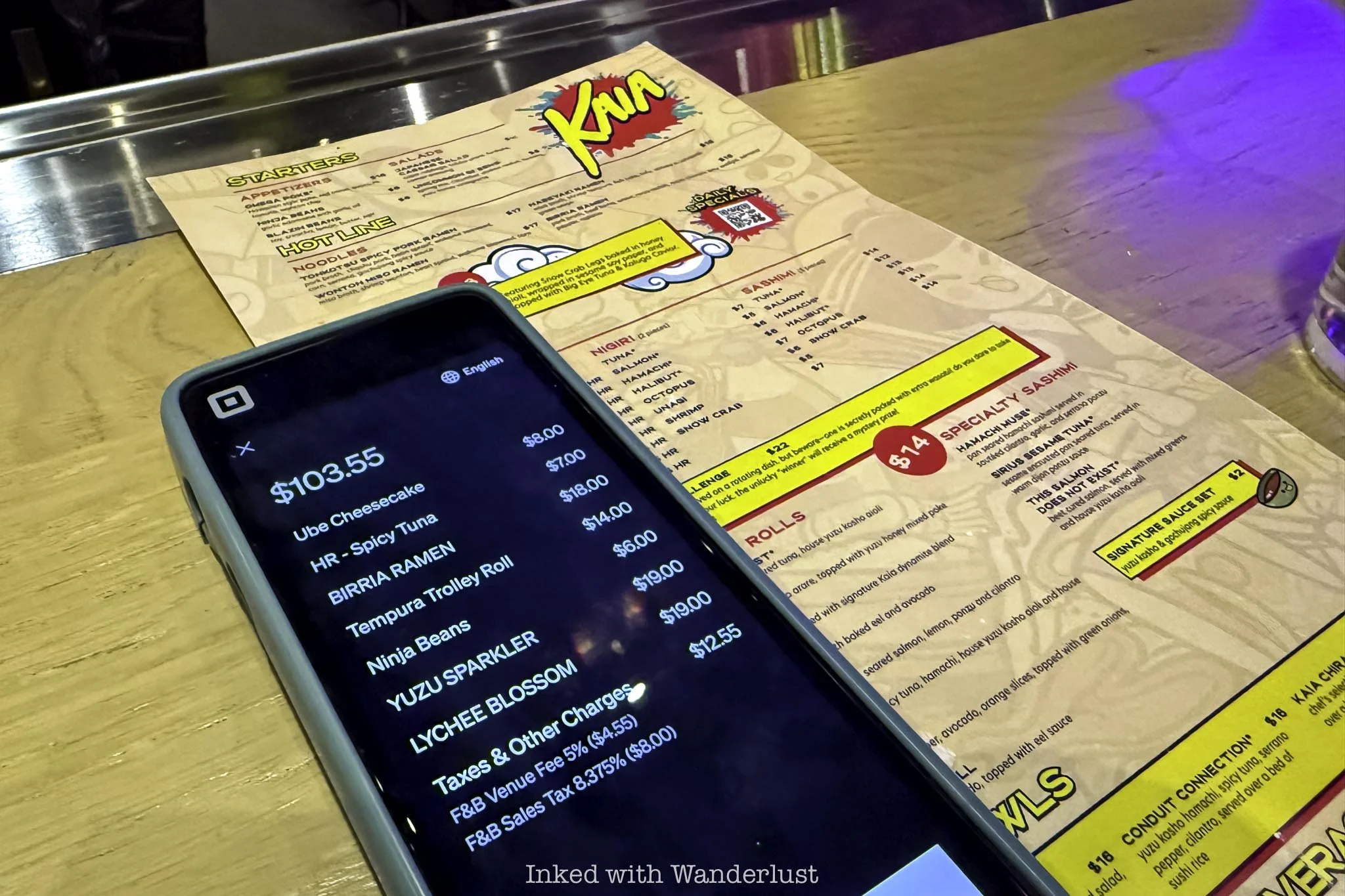
The biggest drawback is the price. Like many restaurants located within major entertainment destinations, the cost can add up quickly (see photo of my bill above), especially if you're ordering multiple courses and cocktails.
That said, the quality of the food, attentive service, and inviting atmosphere help justify the expense. Kaia offers a welcome break from the excitement of Area15 while still remaining “in the bubble”. If you're looking for a solid meal during your visit, I highly recommend Kaia.
Once your meal concludes, head across the walkway to Oddwood Bar for an excellent selection of crafted cocktails. If you’re spending the day at Area 15, consider purchasing an experience pass or tap the “book now” tab in the ad below for a deal on tickets to Meow Wolf’s Omega Mart!
Nearby experiences…(tap link to view post)
The Ultimate Guide to Area 15 in Las Vegas
Opening its doors back in September 2020, Area 15 quickly garnered the attention of Las Vegas locals and visitors alike. What…
Disclosure: This post contains affiliate links. If you make a purchase through these links, I may earn a small commission at no additional cost to you. I only recommend products or services that I believe will add value to my readers.
Opening its doors back in September 2020, Area 15 quickly garnered the attention of Las Vegas locals and visitors alike. What began as a 200,000 square foot bunker with select art installations and interactive features, it has since expanded into a 40 acre entertainment district.
While featuring popular premium attractions such as Universal Horror Unleashed, the John Wick Experience and Omega Mart, Area 15 itself offers its own attractions and dining/drink offerings. Having fun isn’t an issue…but figuring it all out can be.
Despite researching prior to my first visit, I found myself dazed, confused, and sometimes lost at Area 15. It’s a place with a lot to do and even more to see, so it’s easy to get distracted and even disappointed if you don’t know what’s going on. This guide aims to clear that up for you.
In my ultimate Area 15 guide, I’m going to discuss important visitation details such as where everything is, the different zones, ticket pricing and inclusions, what isn’t included in your ticket, dining options, parking, and more.
How Far is Area 15 From the Strip?
Given the sheer size of Area 15, there was no way they would be able to fit it all on the strip. Don’t make the mistake of thinking it’s there. Area 15 was built on a large land parcel west of the strip.
How far Area 15 is from the strip depends entirely on which section of the strip you’ll be coming from:
From north strip: About 1.9 to 2.2 miles (Sahara, Strat, Resorts World)
From center strip: About 1.3 to 1.8 miles (Caesars Palace, Flamingo, Wynn, Linq)
From south strip: About 2.9 to 3.6 miles (Luxor, MGM Grand, Mandalay)
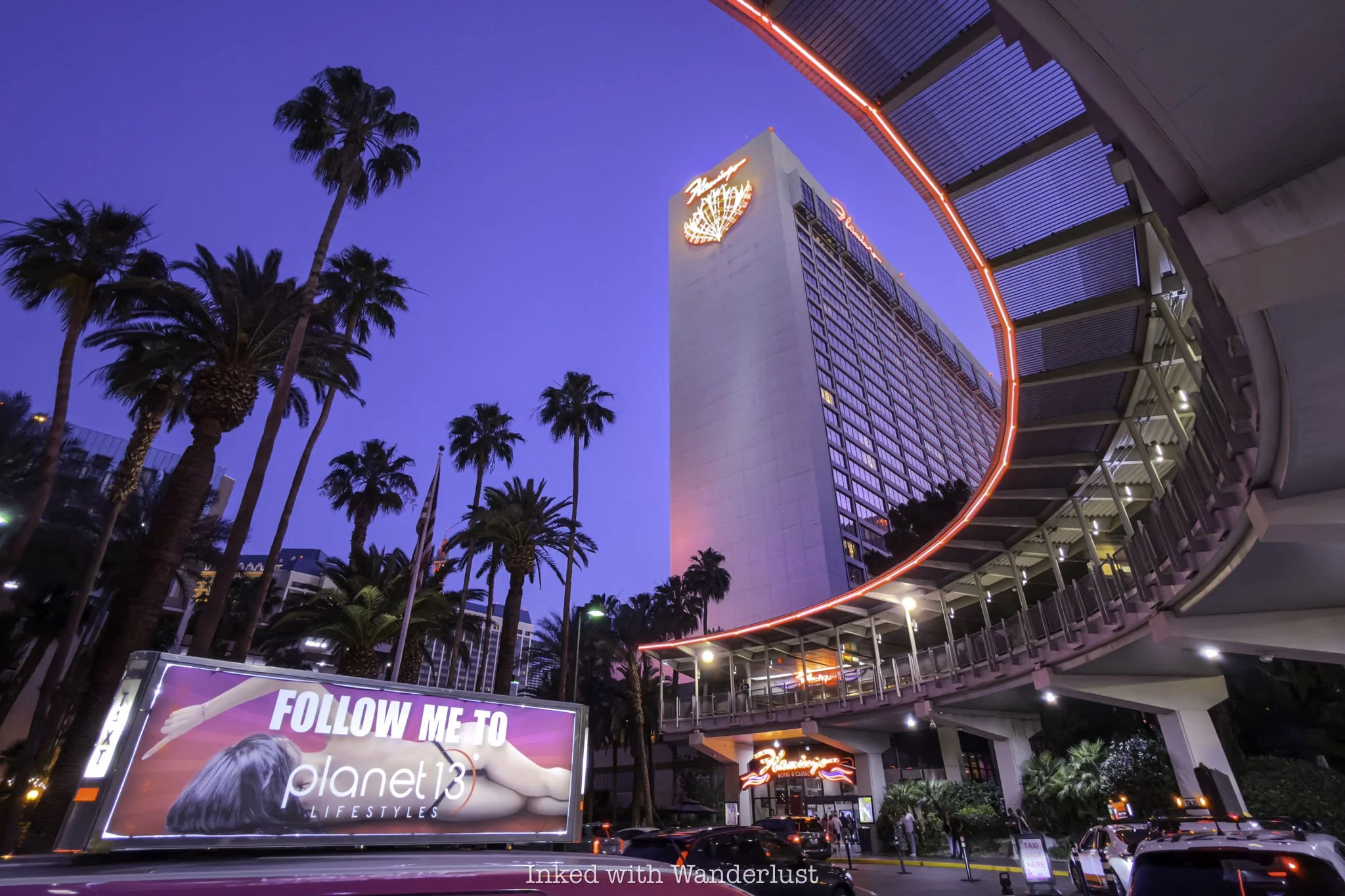
As you can see, booking a center-strip hotel would put you closest to the action. Furthermore, it would be advantageous to book a hotel on the strip’s west side. These include properties such as Caesars, Bellagio, Treasure Island, and Hard Rock (coming soon).
There is an on-site hotel and residential complex planned for Area 15 as part of their “Zone 3” expansion, which also includes more restaurants and attractions, but those are a ways off still.
If Area 15 will be a major part of your Las Vegas travel itinerary, staying off-strip may be your best bet. The two closest major off-strip hotels to Area 15 are Rio Hotel (about 1.3 miles south) and Palace Station (about one mile north).
Getting There and Parking
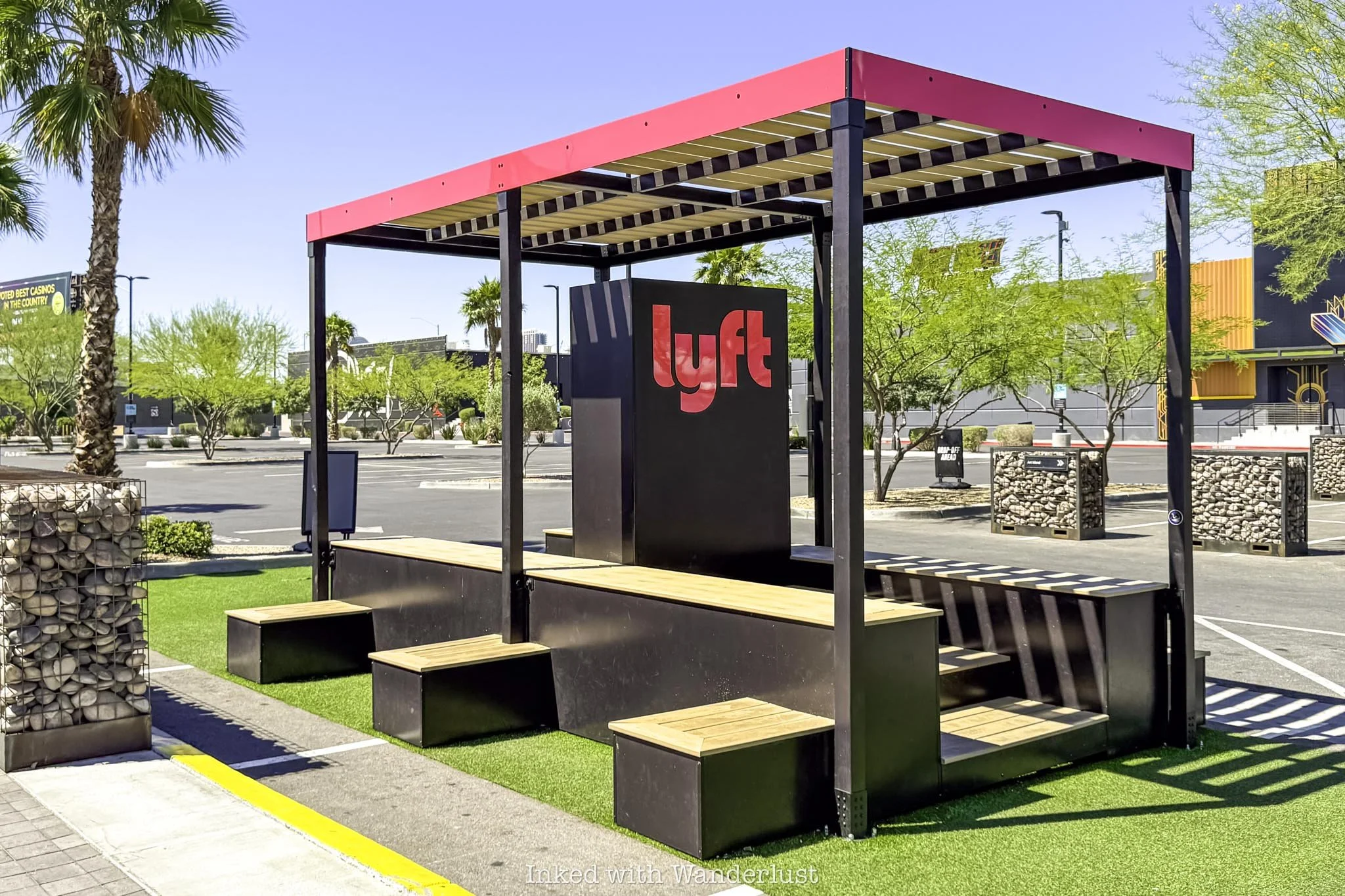
If you’re driving yourself to Area 15, there’s a large open lot located right next to the building in zone one. In zone two (more on that later), there’s a multi-story garage. Nevada residents (with registered plate) receive complimentary parking in both.
For non-residents, it’s a super reasonable $6.99 for a full day of parking. That’ll be the least you’ll pay for parking in all of Vegas. Area 15 uses the Metropolis app to collect parking fees and you can download the app to your phone at this link.
Getting around the entertainment complex is easy via Area 15’s free tram that’ll take you between both zones throughout the day and evening. There are designated pick up and drop off areas in both zones (just follow the signs).
Ride share remains the preferred method, though. There is a designated ride share space just outside of the bunker in zone one. In zone two, riders can be picked up on the bottom level of the garage, which is the same space the tram uses.
Area 15 Experience Pass
At Area 15, tickets are referred to as “experience passes”. They’re multi-tired according to how much you want to do and are priced accordingly. It’s important to note that Area 15 itself doesn’t cost anything to enter. You could just go in and look around if you wanted.
If you want to take part in any of the attractions, though, you’ll either have to pay a la carte or purchase an experience pass. A la carte pricing depends on the attraction and day, but you can expect to pay between $5 and $35 each (not including premium attractions - more details later).
Some pricing examples are as follows (these can change at any time):
Brainstorm: $5
Particle Quest: $8
Birdly: $13.50
Haley’s Comet: $15 - $18
Wink World: $12 - $15
Dueling Axes: $35 (starting)
I advise researching the various attractions ahead of time before investing in an experience pass. If only two or three interests you, paying a la carte would be more affordable. If you decide to do several, though, an experience pass would be the way to go.
As stated above, there are five experience passes to choose from:
Access Level 1: Starts at $31
Access Level 2: Starts at $63
Access Level 3A: Starts at $116 (includes Omega Mart and good for two days)
Access Level 3B: Starts at $144 (includes Universal Horror Unleashed and good for two days)
Access Level 4: Starts at $160 (includes Omega Mart and good for three days)
Pricing listed above are current as of the publishing of this post. Exact pricing is day and time of year dependent as well. I recommend checking Area 15’s website for current pricing and inclusions.
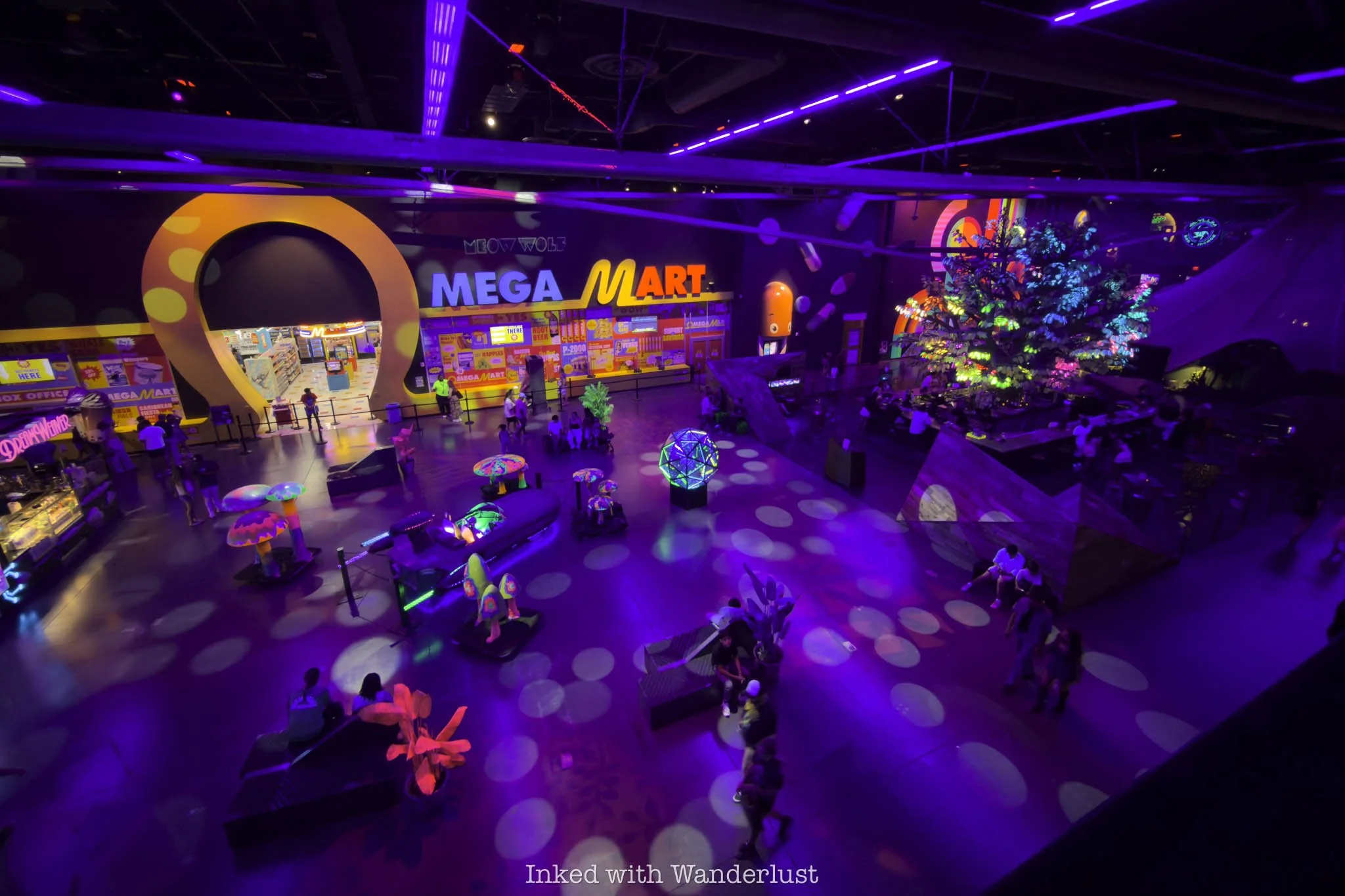
Each pass includes and excludes certain attractions. For example, the Level 1 pass includes thirteen attractions such as Brainstorm, Museum Fiasco, Laser Maze, Liftoff, and more.
The Level 2 pass includes eighteen attractions, including popular Haley’s Comet and Wink World. Additionally, you can choose one premium attraction, such as Interstellar Arc or John Wick Experience.
The two versions of Level 3 passes (3A and 3B) include everything level two does, except one includes Omega Mart and other Universal Horror Unleashed (there’s no single pass that includes both). They’re good for two days, whereas the first two are good for one, and you can choose two premium attractions.
Level 4 is virtually the same as Level 3A, in that it includes all Area 15 attractions and Omega Mart. Though what sets it apart is it’s valid for three days and includes access to all premium attractions (Universal Horror Unleashed being the sole exception).
You can purchase a level one or level two experience pass from my preferred ticket vendor, Viator, at this link or by clicking/tapping the ad below.
Doing so helps support Inked with Wanderlust and doesn’t cost you anything more.
Area 15 Zones
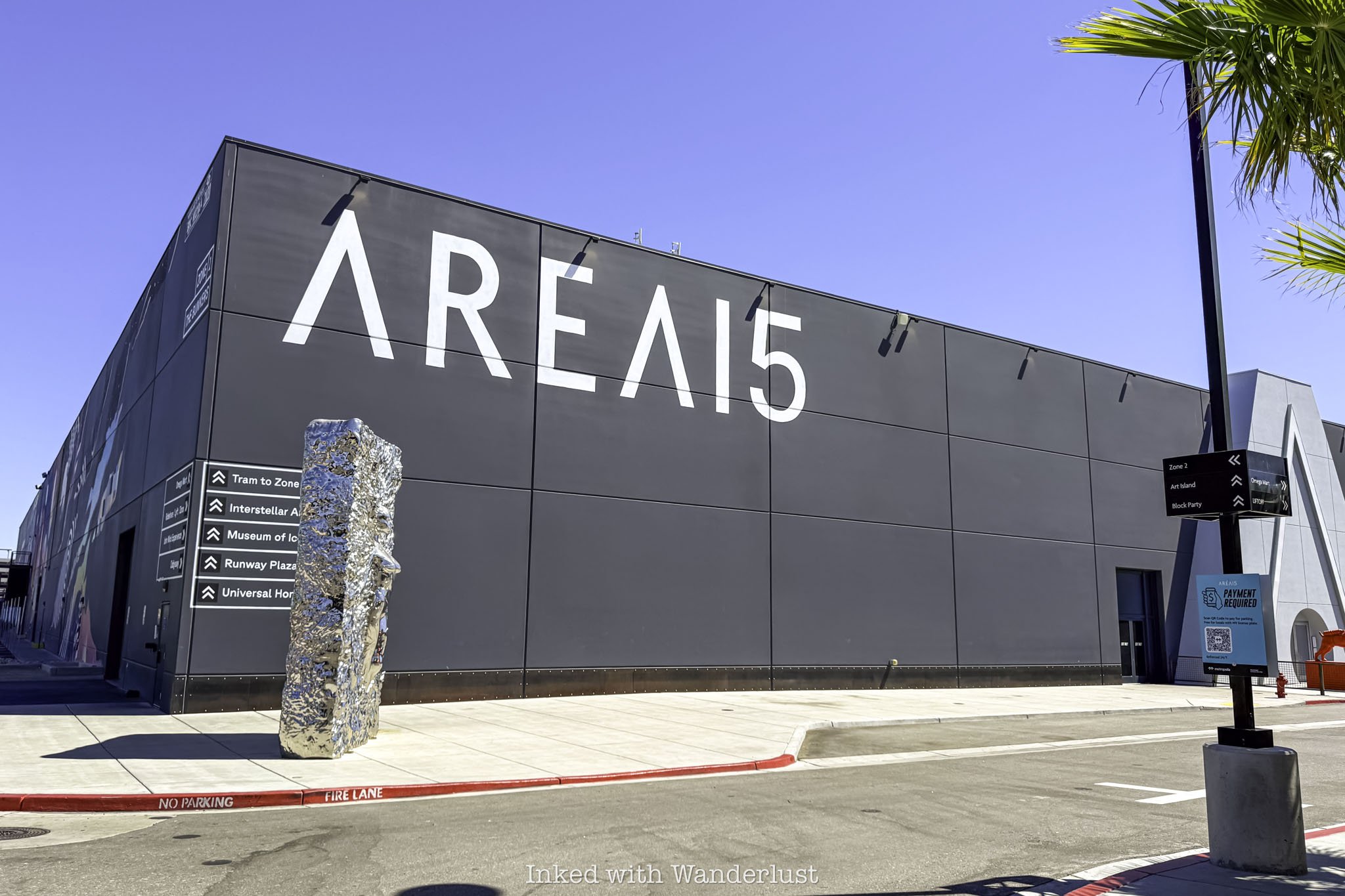
There are currently two zones at Area 15, each with its own attractions, shops, and dining options. Zone one is referred to as “The Bunkers” and zone two is referred to as “The Terminals”.
This is important to distinguish as depending on which attractions(s) you’re going to be visiting, you’ll need to know which zone it’s in to avoid having to needlessly spend time walking or taking the tram to the other side.
The Bunkers (Zone 1)
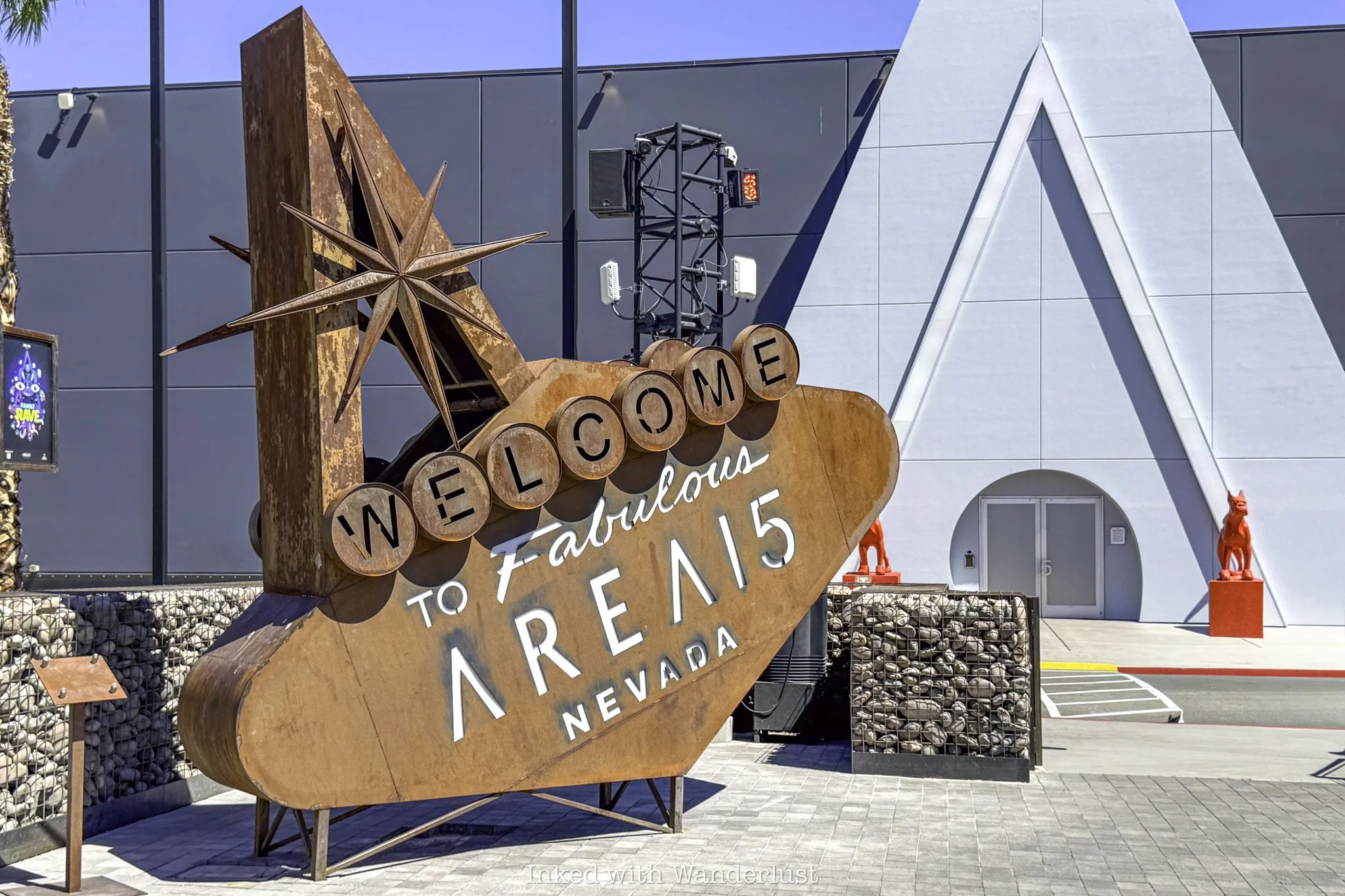
The Bunkers is the original zone of Area 15. The list of attractions you’ll find in this zone include:
Area 15 complex
John Wick Experience
Art Island
Liftoff Bar & Ride
Odyssey Manor (dining, drinks, and performance)
Kaia (dining)
Haley’s Comet
The Beast (dining)
Oddwood (drinks)
Wink World
The Terminals (Zone 2)
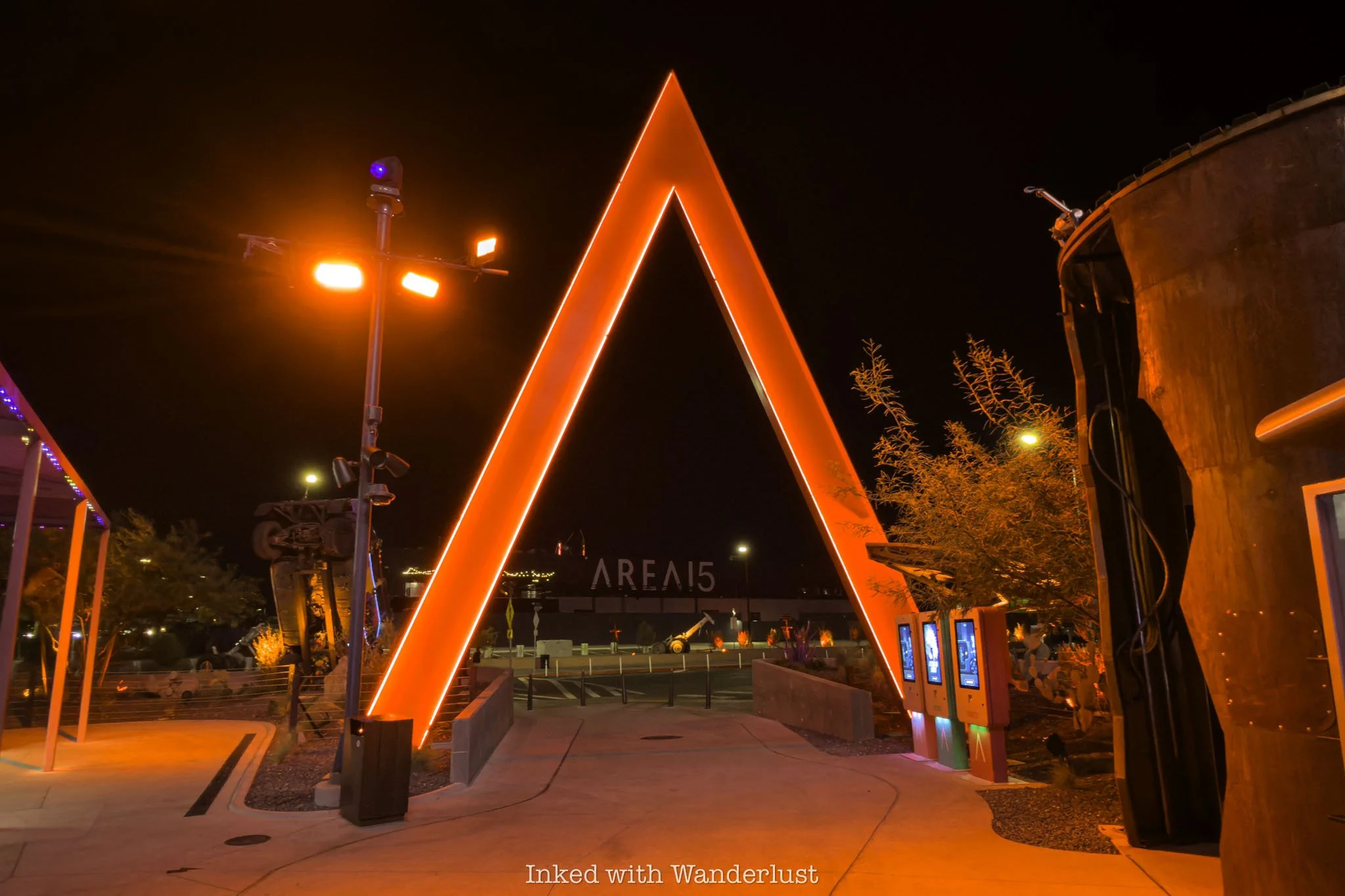
Officially opening in August 2025, the Terminals (zone two) is a 20-acre expansion that features headline anchor attraction, Universal Horror Unleashed. Here, you’ll also find shops, dining options, art installations, and more.
A list of said attractions in The Terminals include:
Universal Horror Unleashed
Interstellar Arc
Looper
Gateway Plaza
Great Big Game Show
The Escape Game
Museum of Ice Cream
Runway Plaza
ALTAIR Lounge (event space)
Grounded Grills (dining)
Dolls Kill (retail)
Eye Dropper
Saint Honore Doughnuts (dining)
iFly Indoor Skydiving (coming soon)
Nacho Daddy (dining)
Good Company Burgers (coming soon)
Fuku (coming soon)
Chilangos Tacos (coming soon)
The Bowl (coming soon)
Alien Pizza Party (coming soon)
Premium Attractions
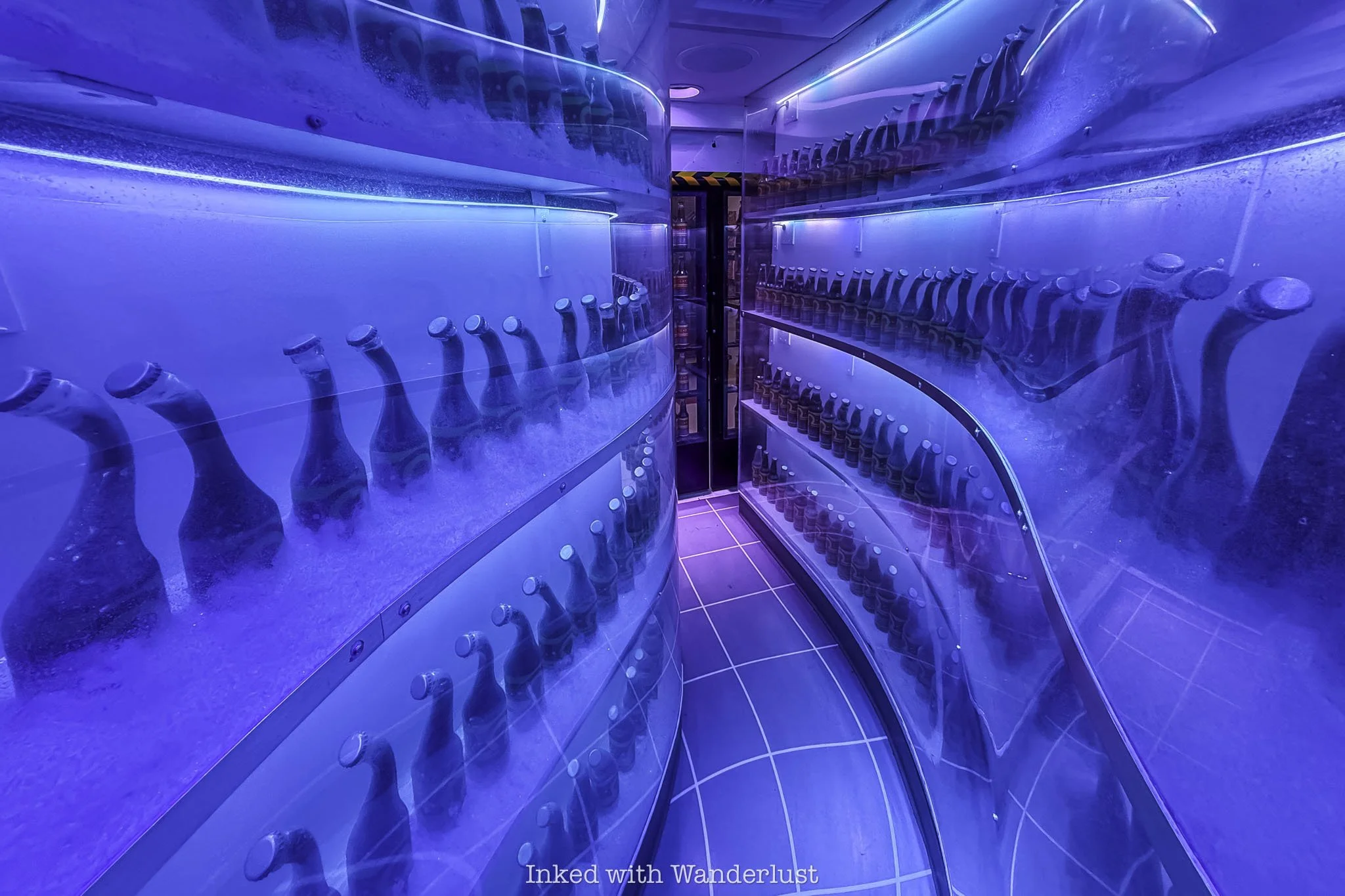
Premium attractions at Area 15 are those that are part of the entertainment district as whole but not necessarily operated by Area 15. In simple terms, think of Area 15 as a mall. While malls themselves will have their own features, they’re largely fueled by third-party businesses.
Premium attractions are only included in the higher-tiered experience passes (level three or higher). Alternatively, you can purchase tickets through each one directly.
These premium attractions include:
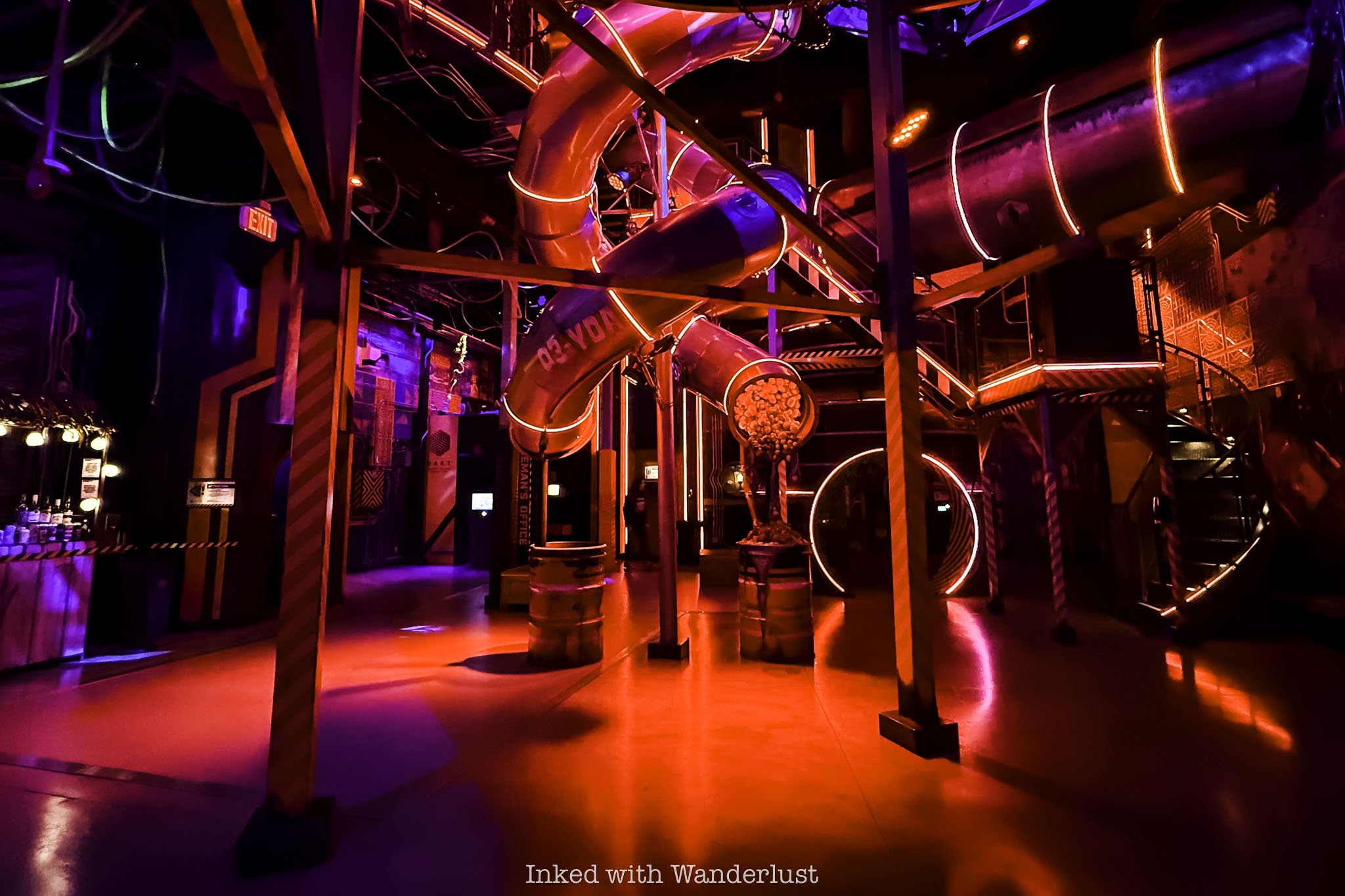
Meow Wolf Omega Mart
Universal Horror Unleashed
Museum of Ice Cream
Interstellar Arc
John Wick Experience
Odyssey Manor
The Escape Game
Great Big Game Show
Eye Dropper
iFly Indoor Skydiving (coming soon)
Meow Wolf’s Omega Mart opened in 2021 (read my extensive post here) and has since become Area 15’s most popular attraction, often eclipsing that of Area 15 itself. Furthermore, it’s the only premium, third-party attraction located inside the Area 15 bunker.

Universal Horror Unleashed, located in the Terminals (Zone 2) is Area 15’s year-round haunt. Brought to the complex by Universal, Horror Unleashed features four themed haunted houses, character experiences, dining options, bars, and live entertainment.
I won’t get too deep in UHU here, as I’ve previously written an extensive review of my experience at Horror Unleashed (that you can read here). If you’re a horror fanatic, or even just mildly curious, I highly recommend it.

New to the Area 15 Entertainment District is the Museum of Ice Cream. With several locations throughout the world, their Las Vegas location is their biggest yet, eclipsing their flagship New York venue in both size and scope.
Features include 14 immersive, Las Vegas-inspired installations, a “sprinkles filled banana boat” canal ride, an ice cream wedding chapel, and an expansion of their popular sprinkles pool.
Area 15 Dining and Drink Options
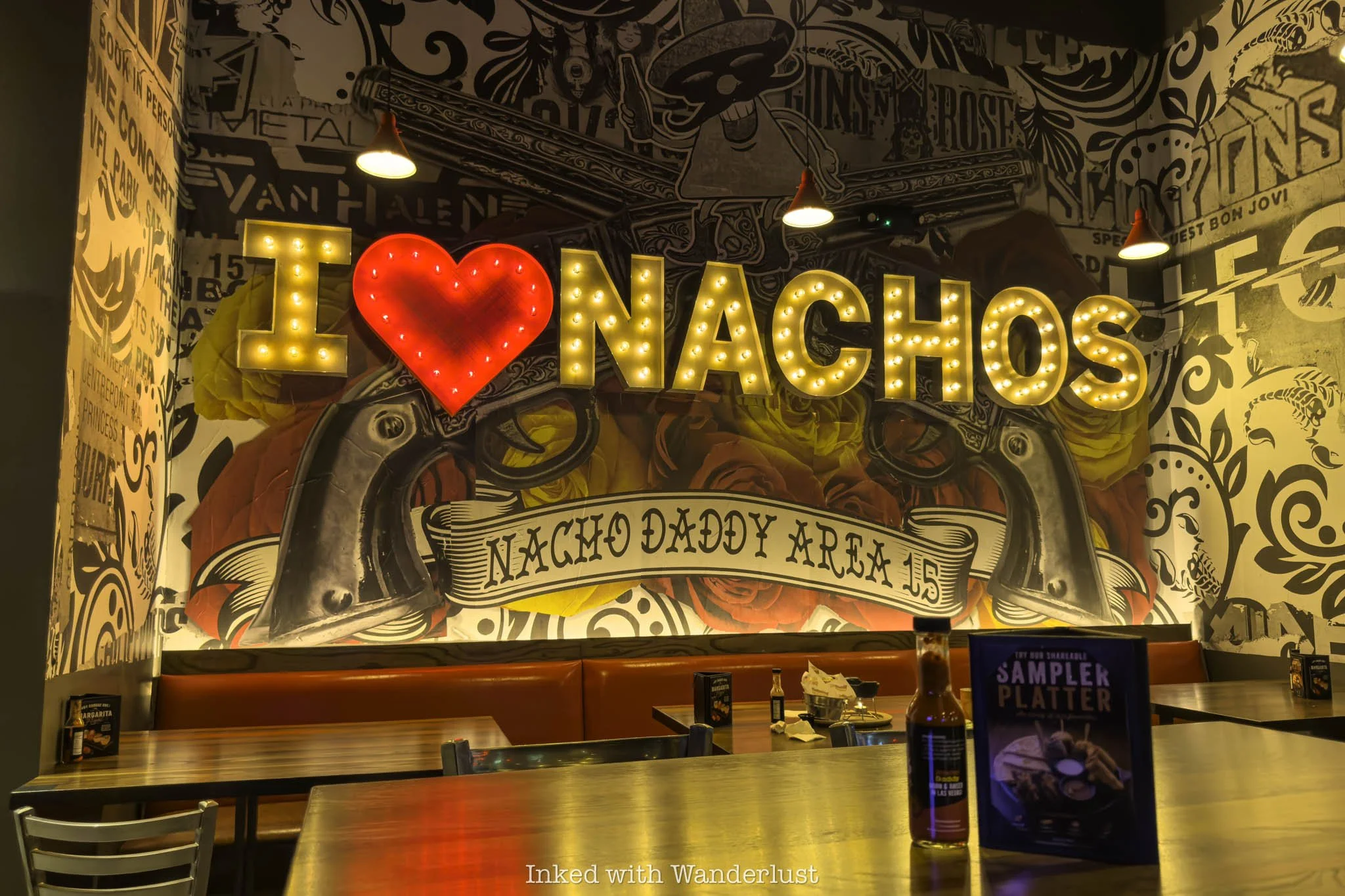
Within the vast Area 15 Entertainment District there are a plethora of dining and drink options to satisfy just about anyone. These include:
The Beast
The Beast food truck
Asylum Bar & Arcade
Conduit Cafe
Dream Weaver
Oddwood Bar
Datamosh
Grounded Grills
Liftoff Bar & Ride
Looper
Premiere House
Rough Cuts
The Broiler
Jack’s Alley Bar
Nacho Daddy
Saint Honore Doughnuts
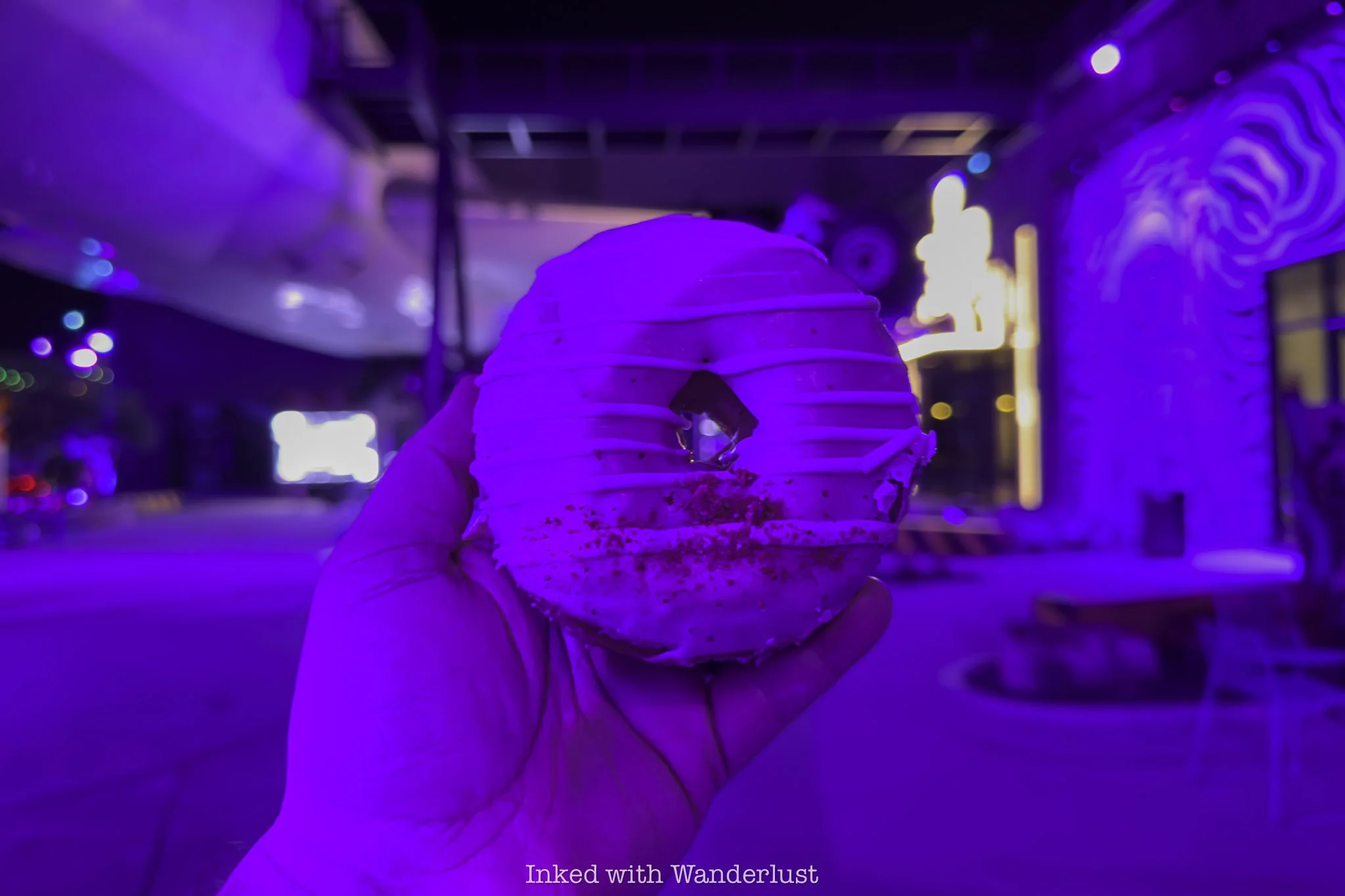
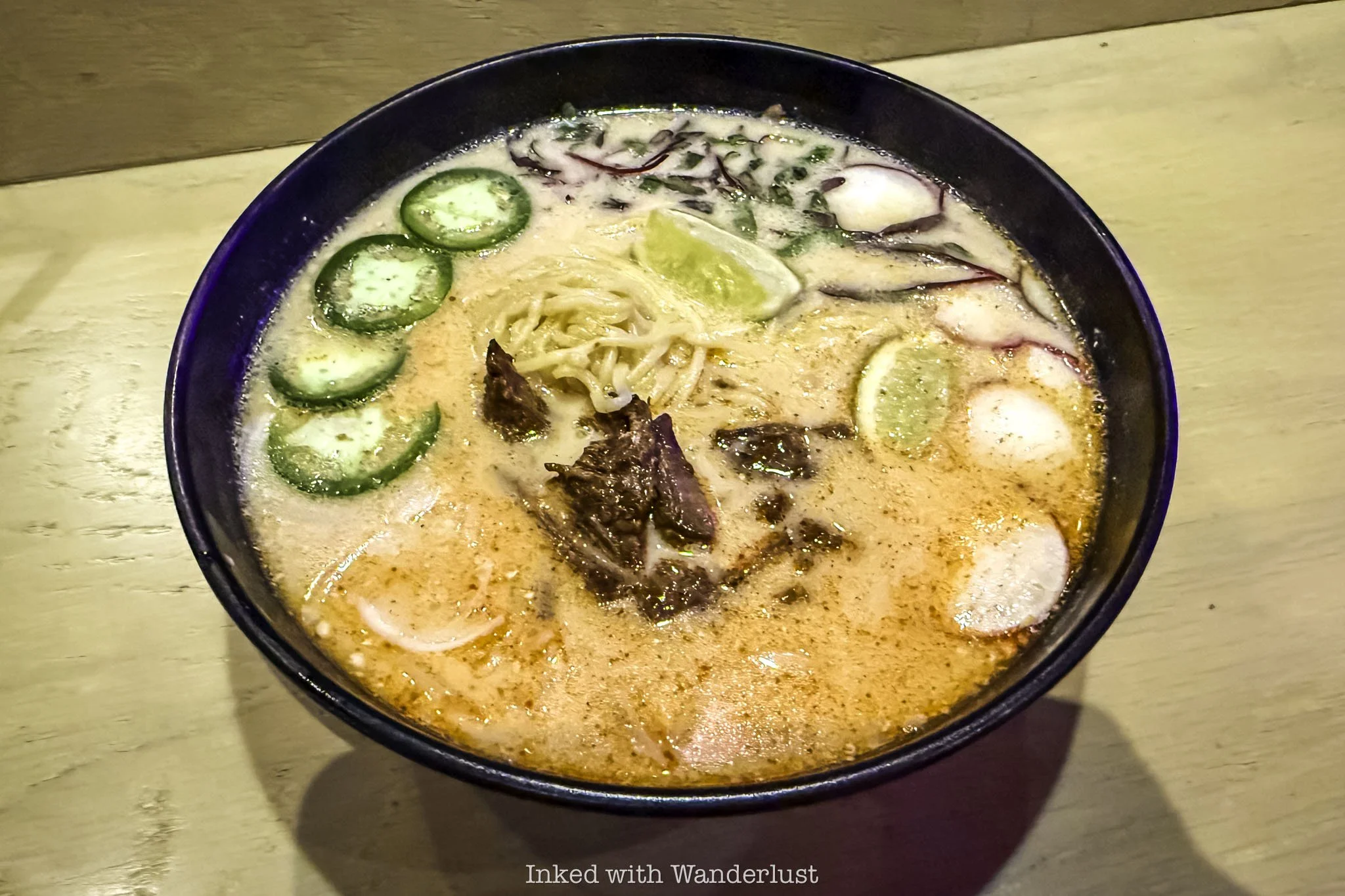
On my wife and I’s visit to Area 15 we enjoyed lunch at Kaia, an Asian-electric sushi and noodle restaurant. Its interior matches the creative, artistic spirit of Area 15. Warm lighting, bold artwork, and contemporary design elements give the eatery a distinct personality.
I tried their stand-out dish, Birria Ramen. It’s packed with rich, slow-cooked flavors with a comforting broth that felt both indulgent and unique. Their sushi line-up features traditional favorites as well as inventive, beautifully presented rolls.
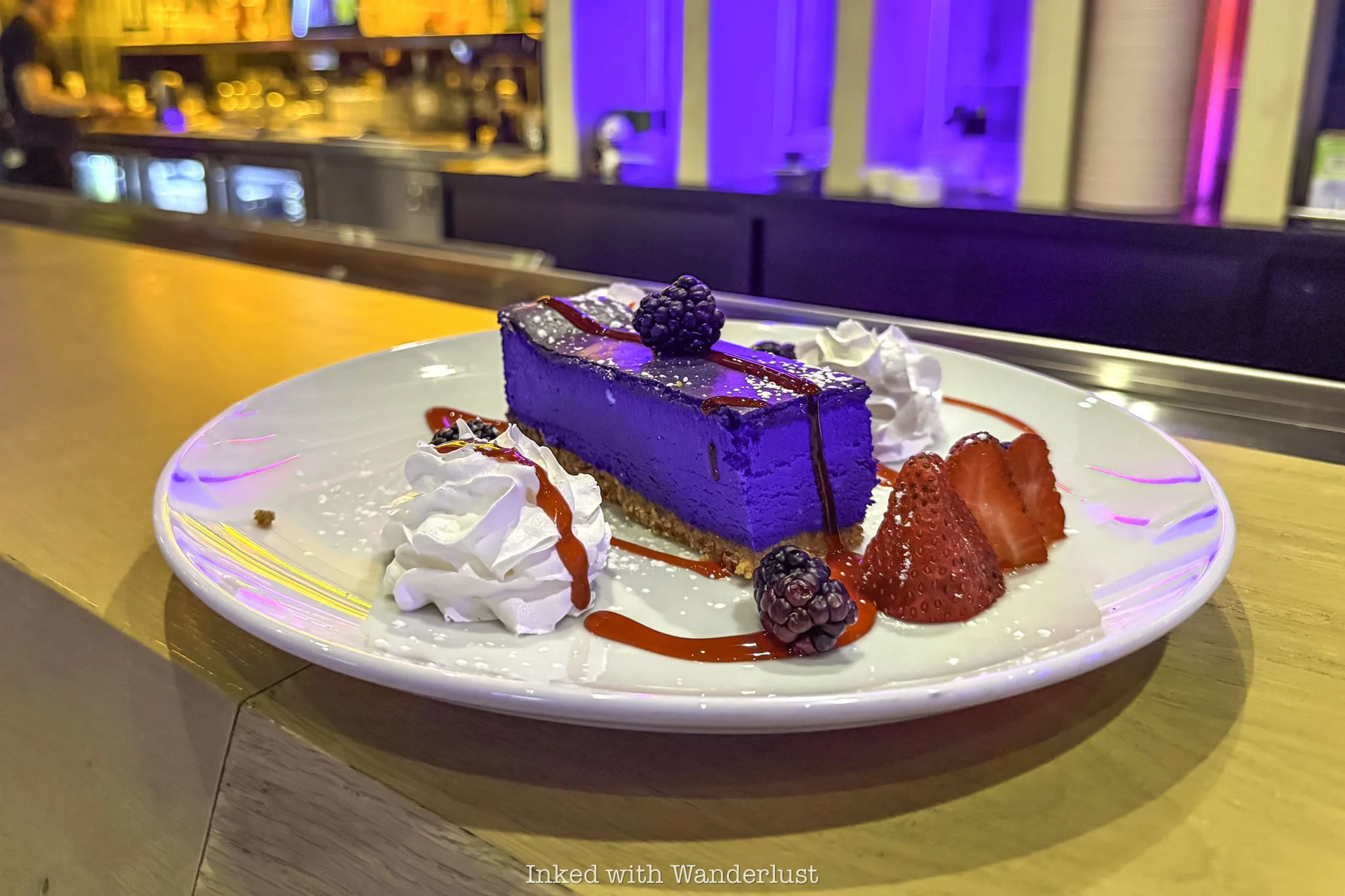
Our finale was the bold, eye-catching Ube Cheesecake. It featured the distinctively sweet, nutty flavor of ube, giving the cheesecake a rich purple hue and a taste that’s slightly earthy, but pleasantly sweet. It’s smooth, creamy, and checks all the boxes.
***You can read my comprehensive review of Kaia at this link!
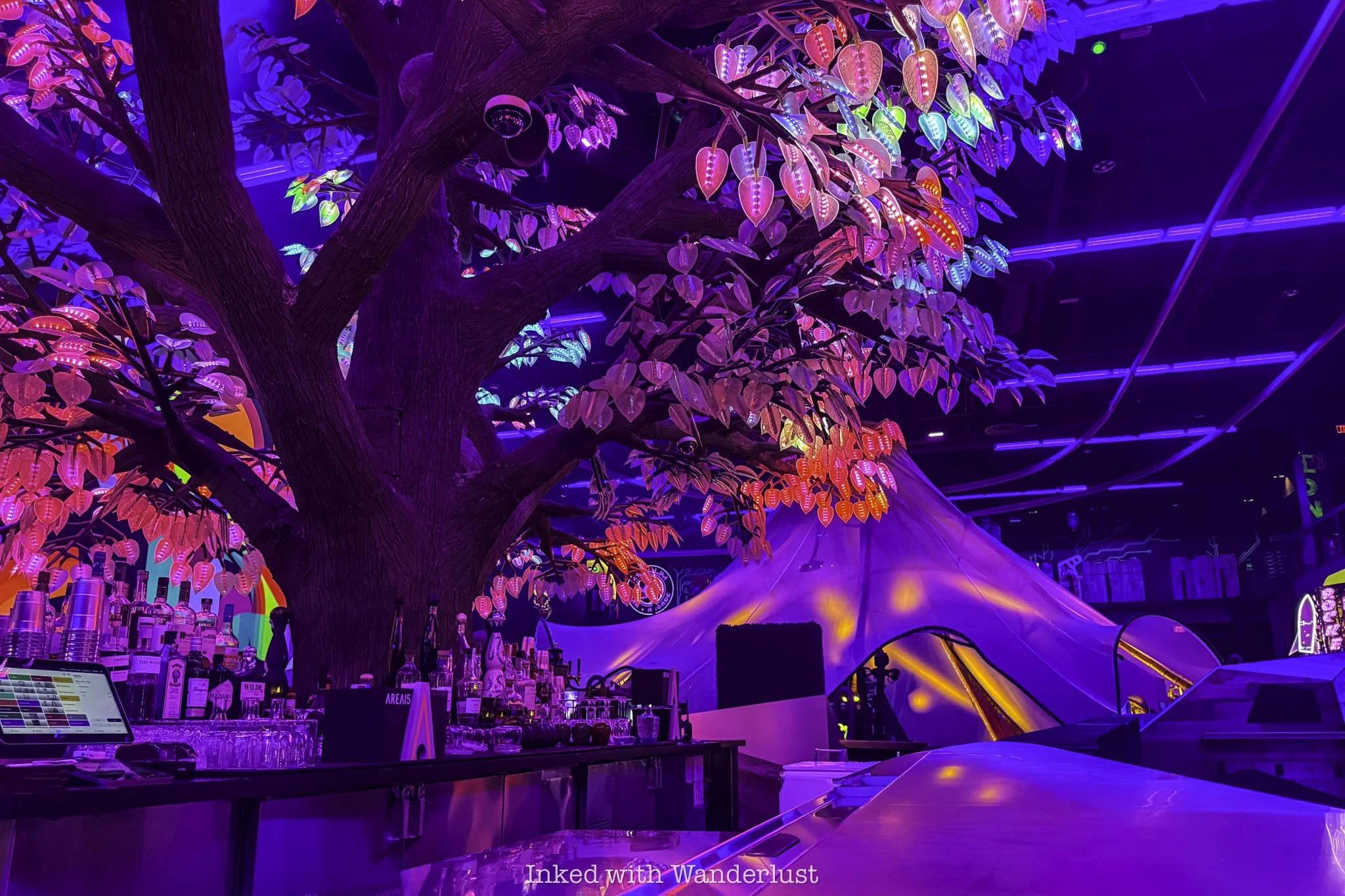
For post-game drinks we headed across the venue to Oddwood Bar. Anchored by its glowing centerpiece tree, the space is filled with vibrant colors, shifting lights, and an energy reflective of Area 15’s atmosphere.
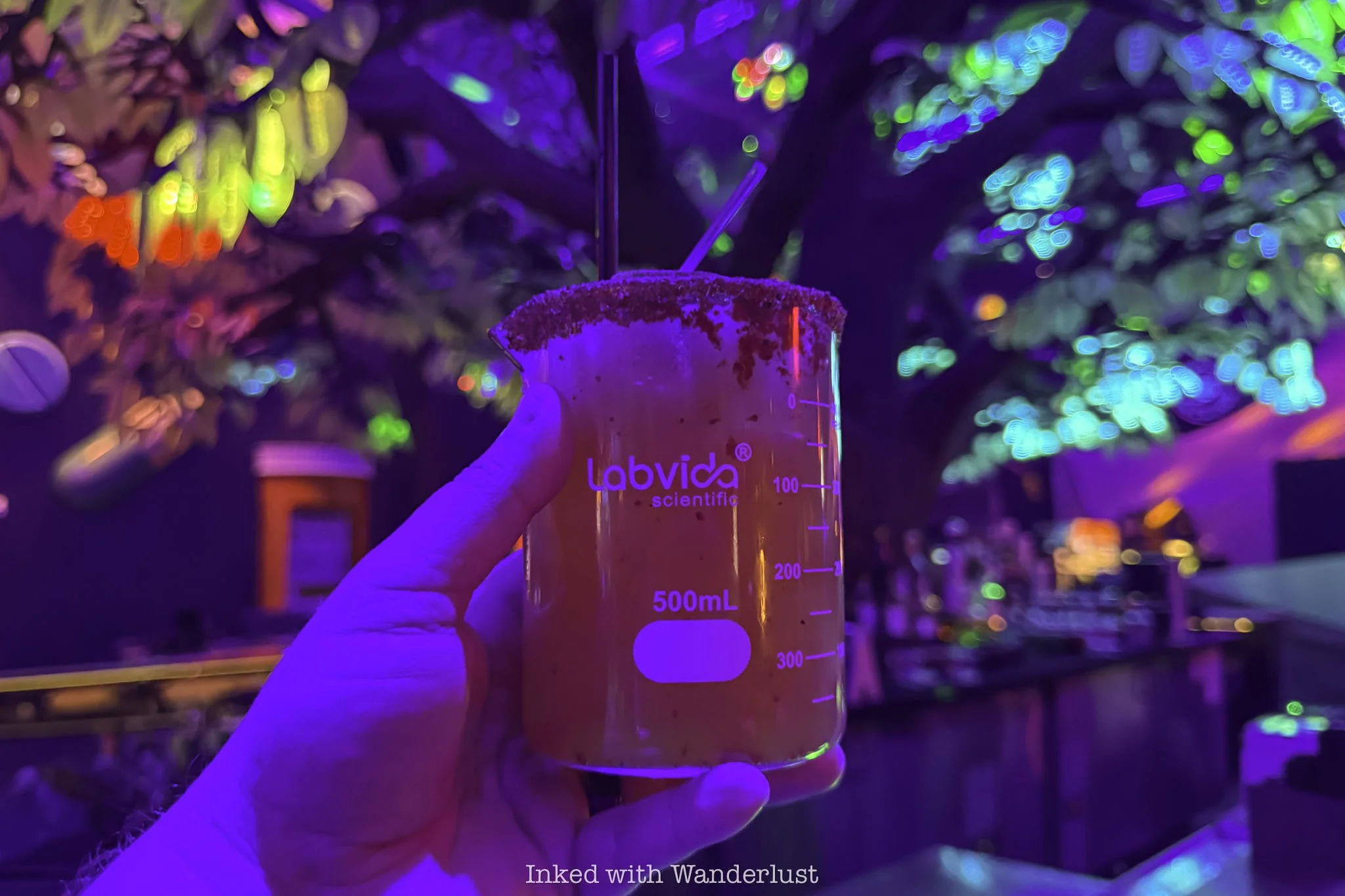
It was a great place to sip on a crafted cocktail while taking in the scenery surrounding us. If you’re like me, you may end up spending more time admiring the environment than looking at the menu.
Even among Area 15’s many visual spectacles, Oddwood managed to stand out as an attraction in its own right. The multi-colored illuminated tree catches your eye while managing to bring you in, if nothing else, out of pure curiosity.
There are many additional dining options coming soon to the property, mostly within The Terminals zone. Everything from gourmet doughnuts and smash burgers to pizza and protein bowls prepared by robotic chefs are in the pipeline.
How Many Days Should You Spend at Area 15…
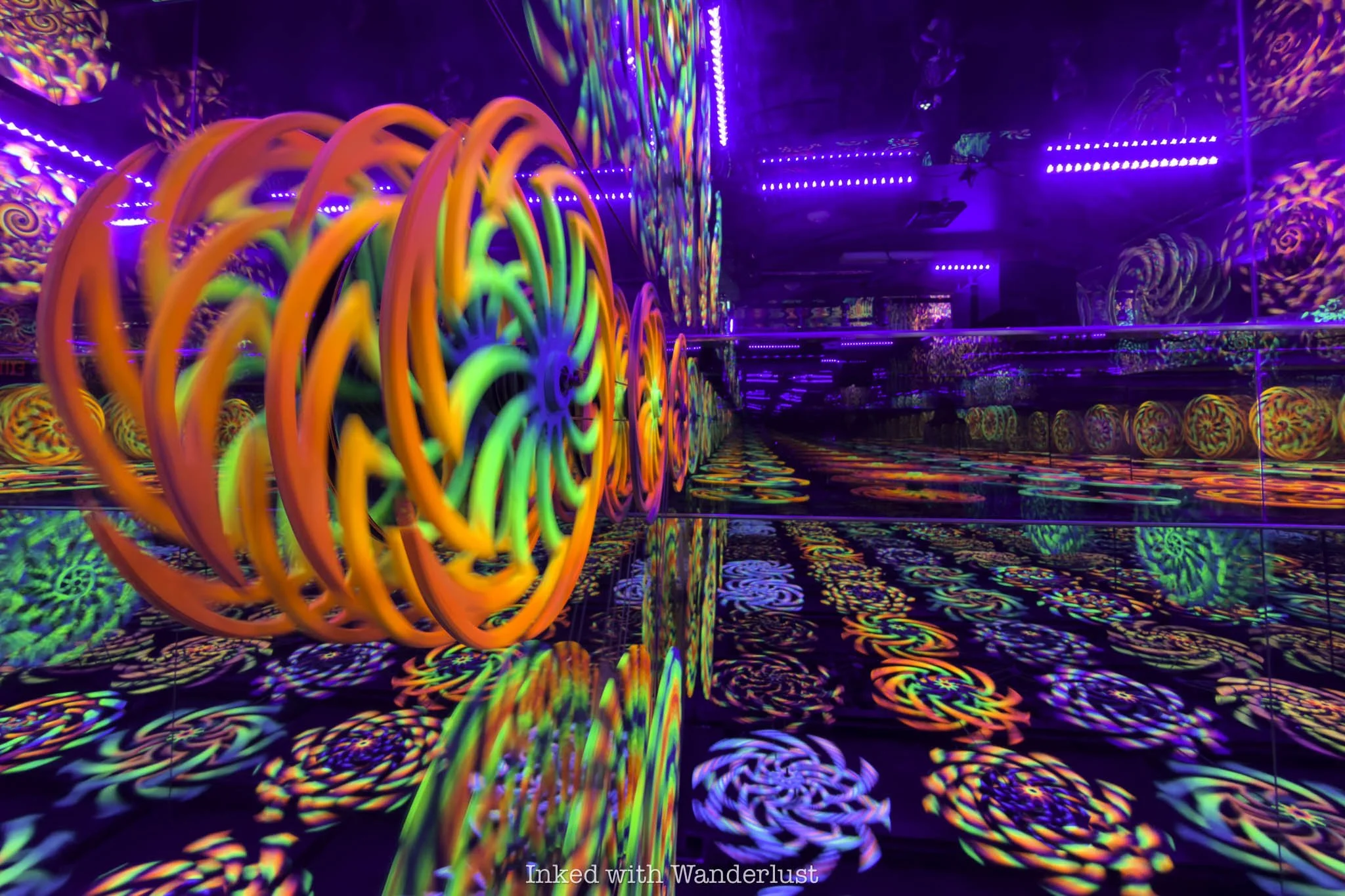
For most visitors, I’d recommend budgeting and planning for half a day to a full day, depending entirely on how much you want to do. I suggest researching each Area 15 attraction and deciding on which ones (how many) you want to experience.
Omega Mart is the top draw for a reason, so I highly recommend starting your day there as it gets packed quickly. They either open at 10am or 11am, depending on the day. My suggestion would be to get there right at opening.
If you’re wanting to visit Universal Horror Unleashed as well, that doesn’t open until 4pm. If you plan accordingly and don’t get tied up on too many Area 15 attractions, it’s entirely possible to visit Omega Mart, a handful of Area 15 attractions, and Horror Unleashed in one day.
Conversely, if Horror Unleashed doesn’t interest you, you could easily knock out Omega Mart and a few other attractions in a half day. Each attraction (aside from Omega Mart) takes five to ten minutes each to do. Omega Mart will easily set you back a couple hours on its own.
Multiple days only comes into the equation when considering additional premium attractions like Interstellar Arc or the John Wick Experience, and/or you’re wanting to experience all of what Area 15 proper has to offer. If that’s you, two days would be essential.
Is Area 15 Worth It?
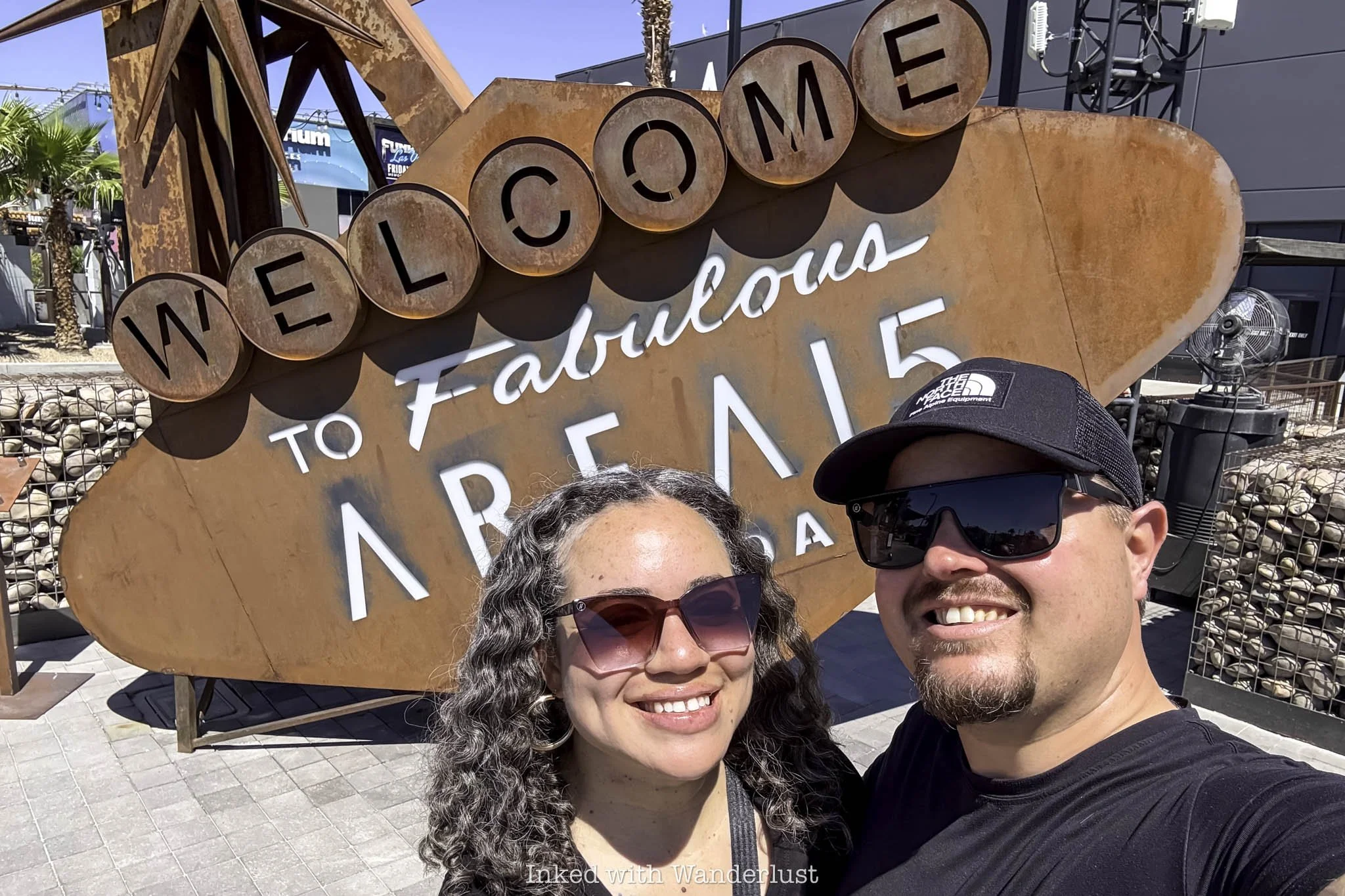
If you enjoy immersive attractions, interactive art, and outside-the-norm experiences, then Area 15 is absolutely worth a visit. It’s one of the most unique attractions in Las Vegas because it combines art, bars, restaurants, rides, virtual reality, and interactive exhibits into a single venue.
Since it acts as a pick-your-poison type of attraction, controlling costs is manageable. You can do as little or as much you want, or pay nothing to walk in and simply explore the space, or simply just enjoy a meal with your partner.
Like most things, it has its drawbacks. If left unchecked, it can get very expensive to visit, crowds can get dense (particularly on weekends and evenings), and let’s just say not all of the attractions were created equal.
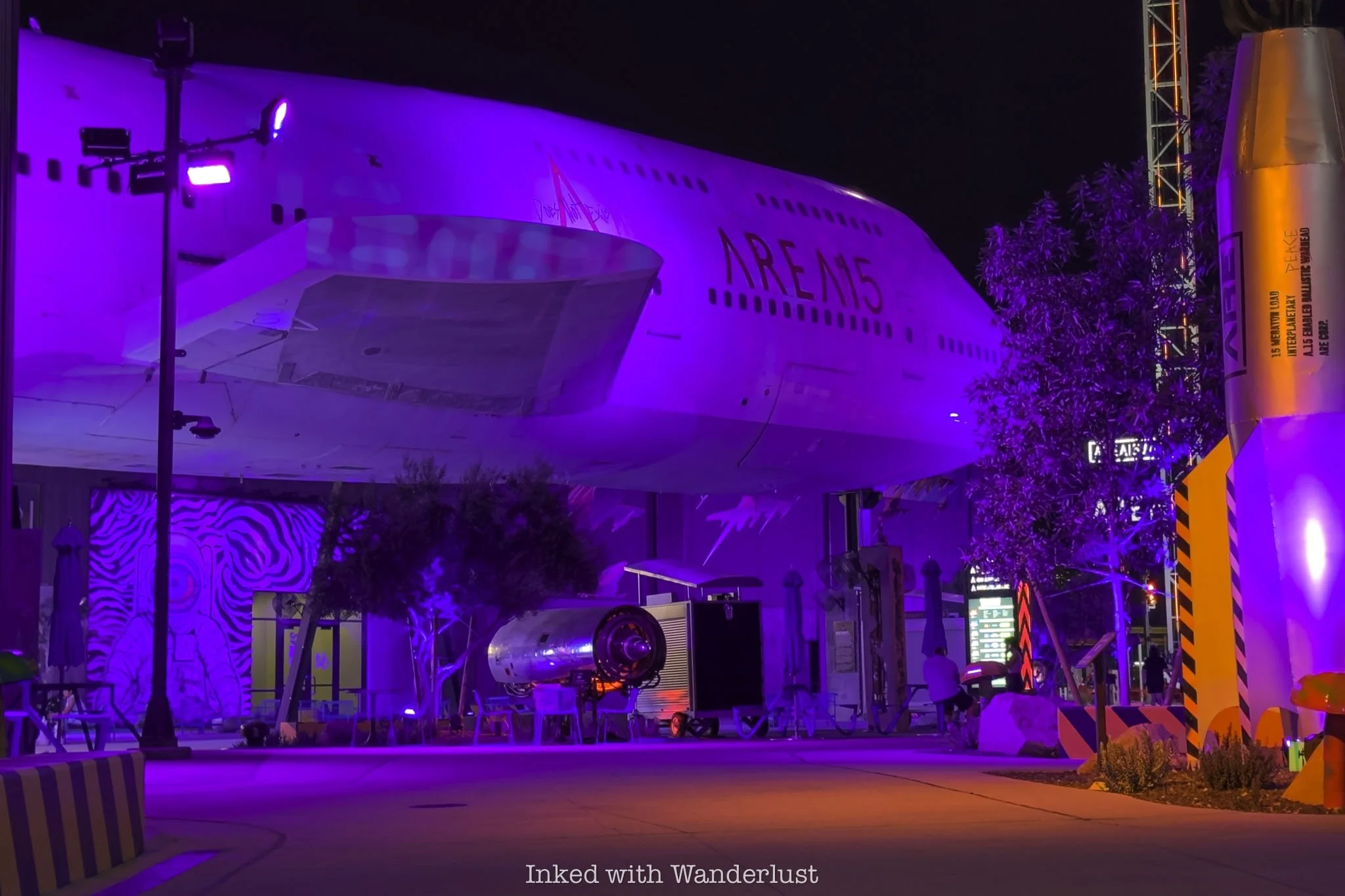
The best attractions, in my opinion, are Omega Mart, Universal Horror Unleashed, Interstellar Arc, Wink World, Liftoff (at night is best), Haley’s Comet, Museum Fiasco, and Eye Dropper. When it opens, I’m sure Museum of Ice Cream will make this list as well.
If you go with a plan and budget, Area 15 can be an enjoyable experience for couples, friend groups, or the whole family. Much like a trip to Disney, it’s a place where children, parents, and couples alike can all have fun together.
See my review of my experience at Universal Horror Unleashed to decide if it’s for you. Also, if you’ve never experienced Omega Mart, read my comprehensive post to learn more about it.
If you’re looking for an on-strip activity, read about my experience at Flyover Las Vegas, as well as my review of the Happy Half Hour ride on High Roller.

My Experience at Universal Horror Unleashed in Las Vegas (+ Info)
Opening in 2025 as one of the newest additions to ever-expanding Area 15 complex, located roughly one mile west from the Las Vegas Strip, Universal Horror…
Disclosure: This post contains affiliate links. If you make a purchase through these links, I may earn a small commission at no additional cost to you. I only recommend products or services that I believe will add value to my readers.

Opening in 2025 as one of the newest additions to the ever-expanding Area 15 complex, located roughly one mile west from the Las Vegas Strip, Universal Horror Unleashed became one of the region’s first year-round haunt.
Universal Horror Unleashed delivers an immersive horror experience that feels more like stepping into a series of nightmare-ish movie sets than visiting a traditional attraction.
The detailed environments, talented and committed scare actors and impressive special effects create a near-constant sense of tension, even between scares. For horror fans, it’s one of the most unique and ambitious attractions currently in Las Vegas.
In this post, I’m going to cover several topics, including getting there, where to get tickets (and discounts), how much it costs, what to expect and dining options, while also articulating my experience to help you decide whether or not it’s for you. Let’s get into it!
Universal Horror Unleashed Location and Parking
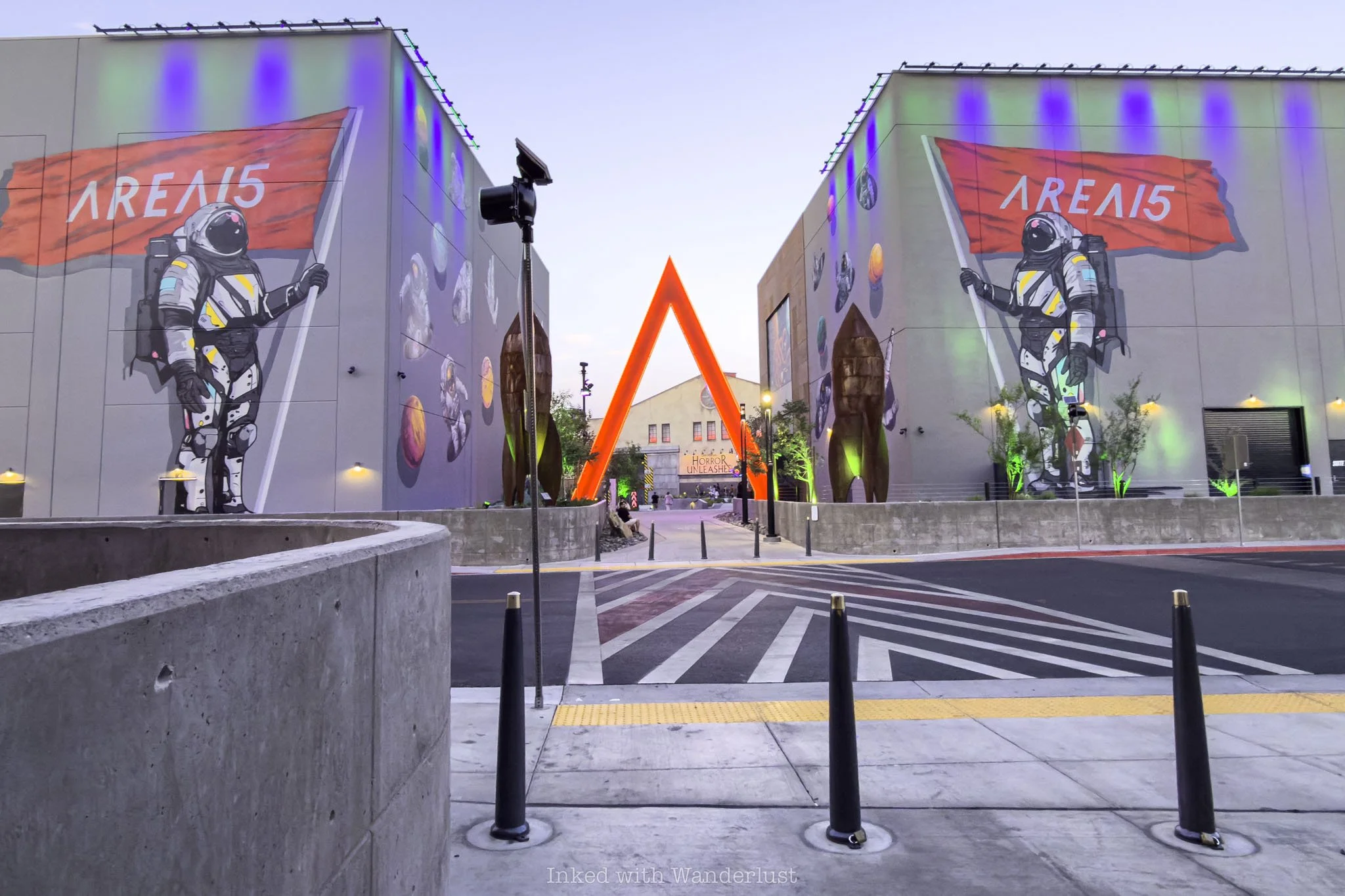
Universal Horror Unleashed (will go by the initialism, UHU, going forward) is located on the vast grounds of the Area 15 complex, but not attached to Area 15 itself. Area 15 is in Zone 1 (or, “The Bunkers”) while UHU is in Zone 2 (or, “The Terminals”).
Due to its popularity, it isn’t difficult to find as there is plenty of signage pointing the way. You’ll find it between and beyond two other giant buildings donned in various Area 15-themed artwork (pictured above).
If you’re driving in, parking is plentiful in the multi-story parking garage just across the road. Parking is free for Nevada residents (vehicle must have a Nevada plate) and out-of-towners pay a reasonable daily rate of $6.99.
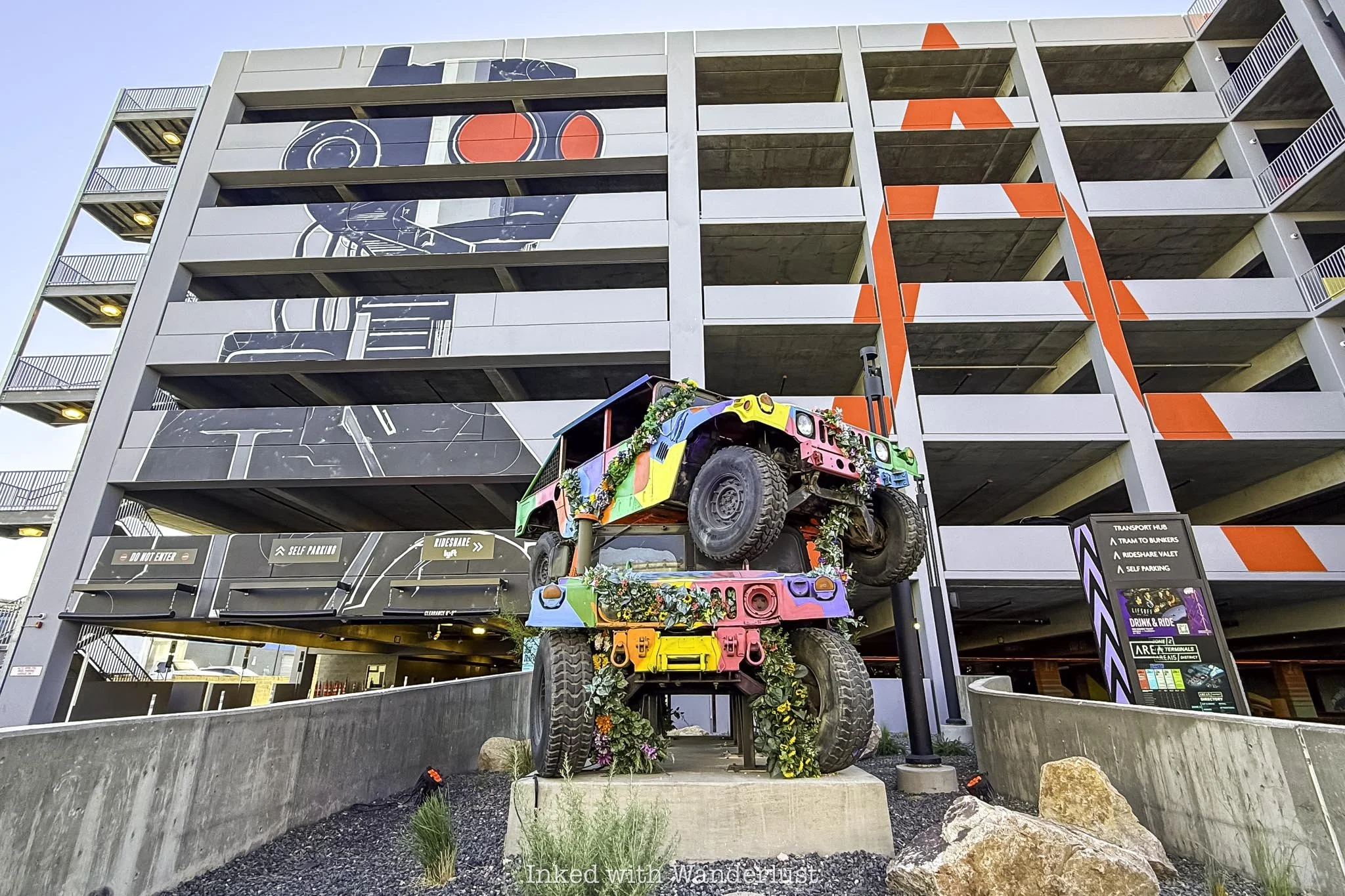
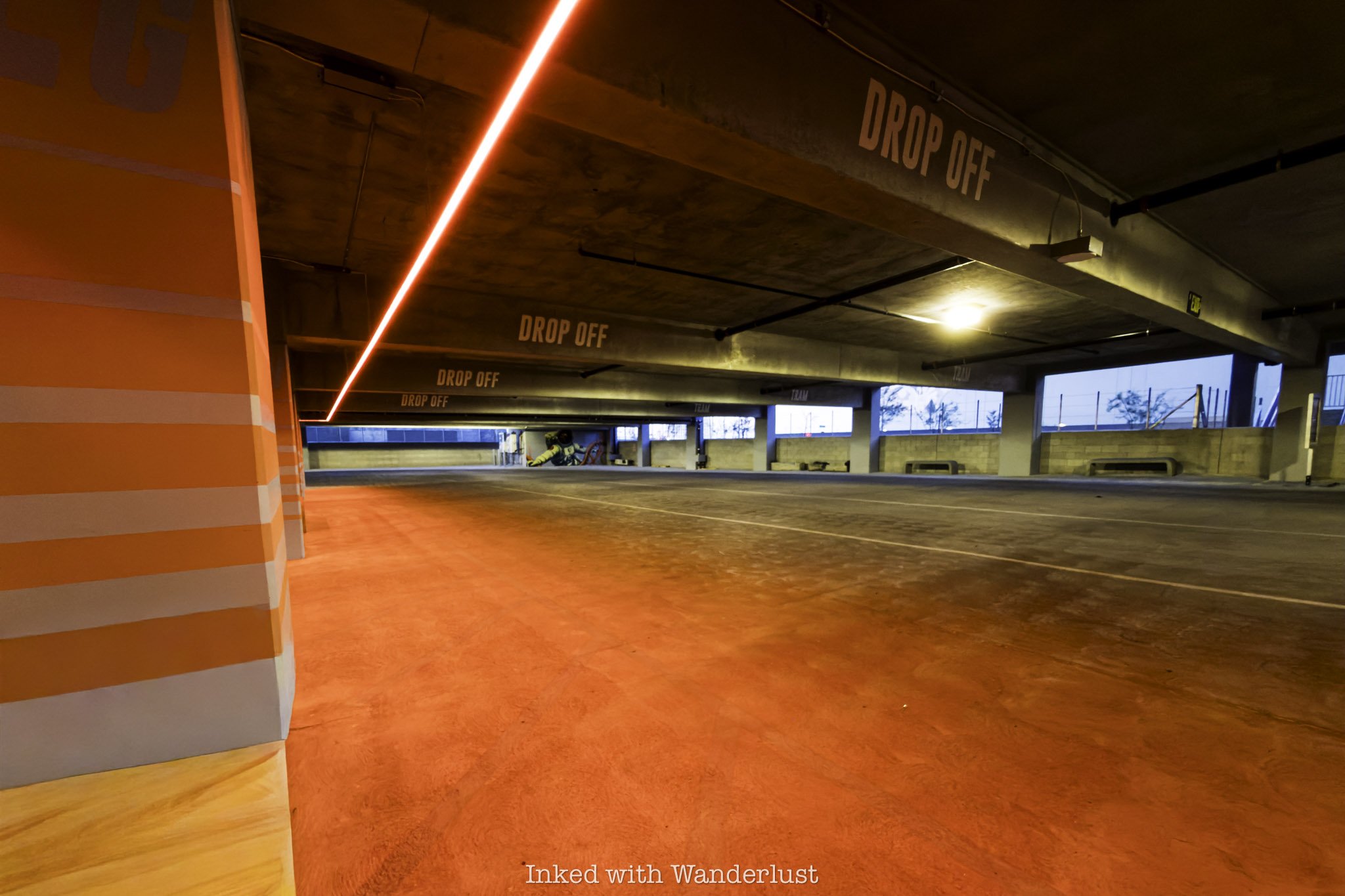
The ground level of the parking garage is the drop off/pick up area. Again, this is just across the road from the UHU building. This is also where Area 15’s tram picks up and drops off. If you’re already at Area 15, the free tram will transport you between venues.
Remember, UHU (and Area 15 as a whole) isn’t on the Las Vegas Strip. It’s roughly one mile (give or take) from the strip’s center portion. There are numerous transport options, including ride share (what we did) and taxi.
There are no hotels on property. A handful of the closest strip and strip-area hotels to Area15 include Rio, Treasure Island, Resorts World, and Towneplace Suites Stadium District. These hotels are a seven minute or less drive away.
Universal Horror Unleashed Tickets and Hours
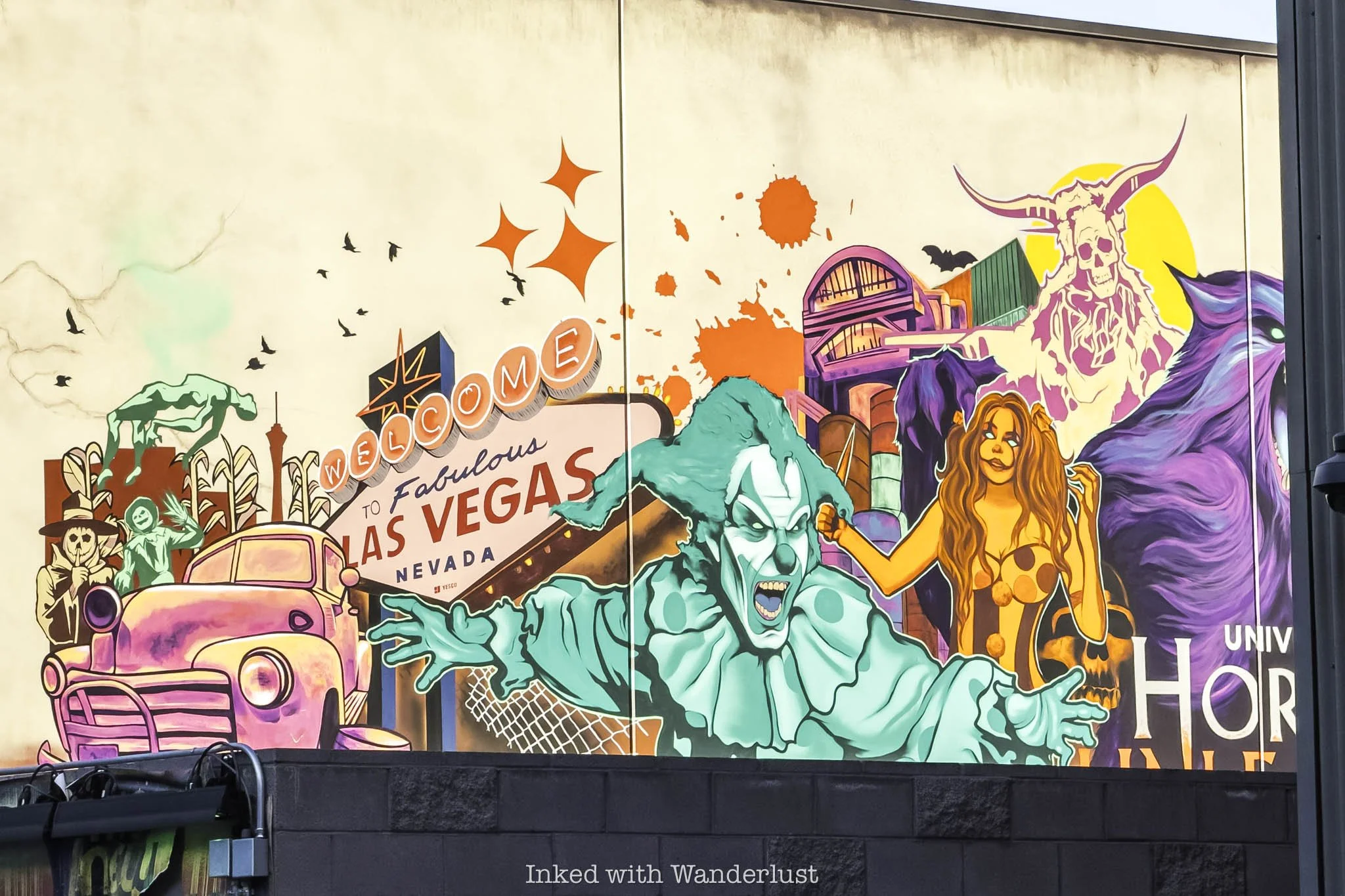
Unlike nearby Area 15, admission tickets are required in order to enter UHU, as the action begins almost as soon as you walk inside. There are several ticket types and ways to purchase them.
You can either purchase tickets either directly through Universal, as part of an Area 15 “Experience Pass” (which includes several Area 15 experiences as well), or through my preferred ticket partner, Viator, which offers discounts.

Through Universal, there are three ticket tiers:
General Admission (unlimited access)
General Admission (one-time access)
Fraidy Cat
The difference between the general admission tickets is one grants unlimited access to each haunted house and the other grants one-time access to each. These tickets offer the highest value, but the one-time access ticket is the most popular.
The Fraidy Cat ticket, as the name would imply, is for those who would prefer to skip the haunted house aspect of UHU and simply access the common areas, which include the bars, restaurants and interacting with the scare actors.
Ticket Price and Discounts

Exact ticket prices are dependent on time of year and day of week. Generally, summer months garner the highest price range with Saturday and Sundays commanding the high-end of said range.
Unlimited access tickets start at $89 each and top out at $129 (at time of publishing). Looking at the summer calendar, $99 appears to be the cheapest option and those are all weekdays. Into the fall and winter is when you’ll see the $89 price-point more.
One-time access tickets start at $69 each and peak at $89 throughout the summer. If you reside in Nevada, you can take advantage of their resident discount on one-time access tickets, which is currently $10 less than face pricing.
*Note: There’s no separate pricing for adults and children
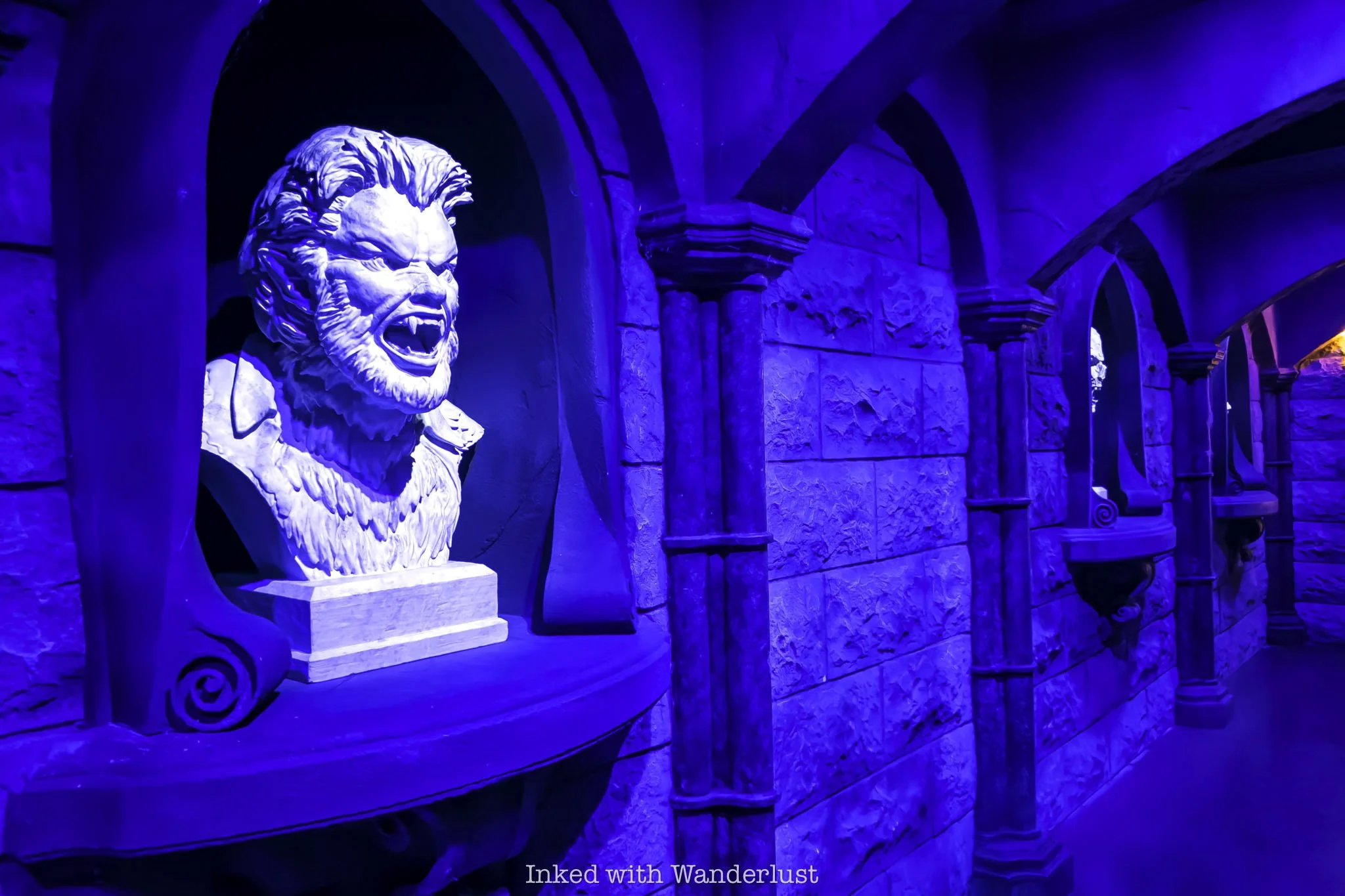
The “Fraidy Cat” ticket ranges between $29 and $49. Remember, this is for those who still want to go but don’t want to walk through the haunted houses. These ticket holders will only have access to common areas.
Furthermore, there’s a VIP package that includes tickets for six, unlimited access to each haunted house, a $450 dining credit with reserved table and bottle service, and additional perks, starting at $2,750.
**My preferred ticket vendor, Viator, offers discounted one-time access tickets. They also vary according to day and season but you’ll pay $8 - $10 less per ticket than if purchased through Universal directly. You can take advantage of that discount at my link here.
Hours of Operation

Universal Horror Unleashed is a year-round operation, but not a daily one. It’s currently closed on Mondays, Tuesdays and Wednesdays, operating only Thursday - Sunday.
Additionally, it opens at 4:00pm daily and closes at 10:30pm. Admission is granted anytime up to 8:30pm, as the entry cut-off window is two hours prior to closing. My suggestion is to arrive as close to opening time as possible to maximize value.
My Experience at Universal Horror Unleashed
Arrival
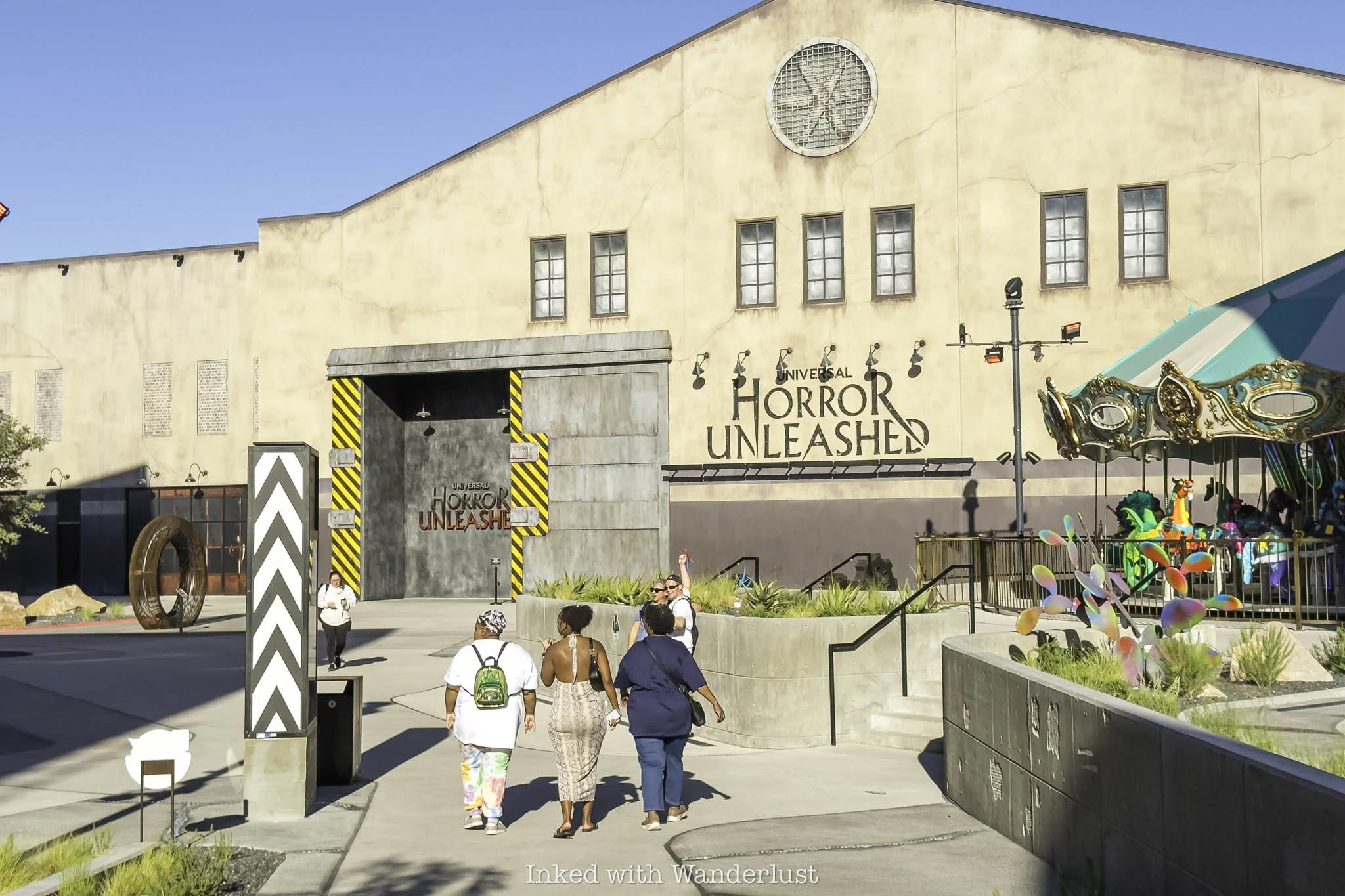
After getting dropped off, our journey to UHU temporarily halted just prior to the entrance. Around us were numerous art installations, wall murals, and even a carousel! Though they proved distractive, we didn’t mind the temporary detour.
Exploring the “Terminals” space of Area 15 revealed much more than just UHU. Here is where other attractions such as Interstellar Arc and The Escape Room reside, as well as a plethora of shops and dining options (more coming soon).
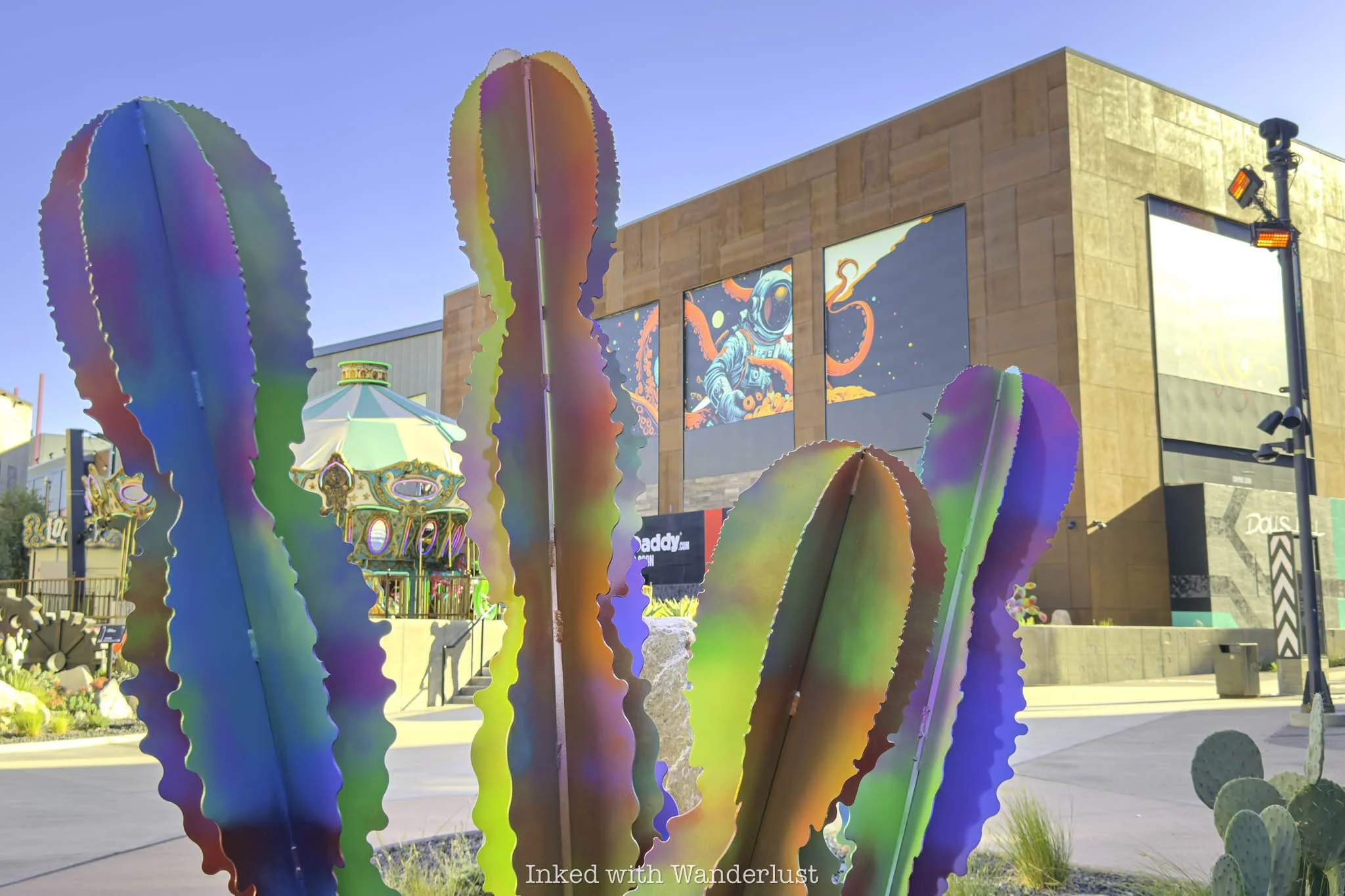
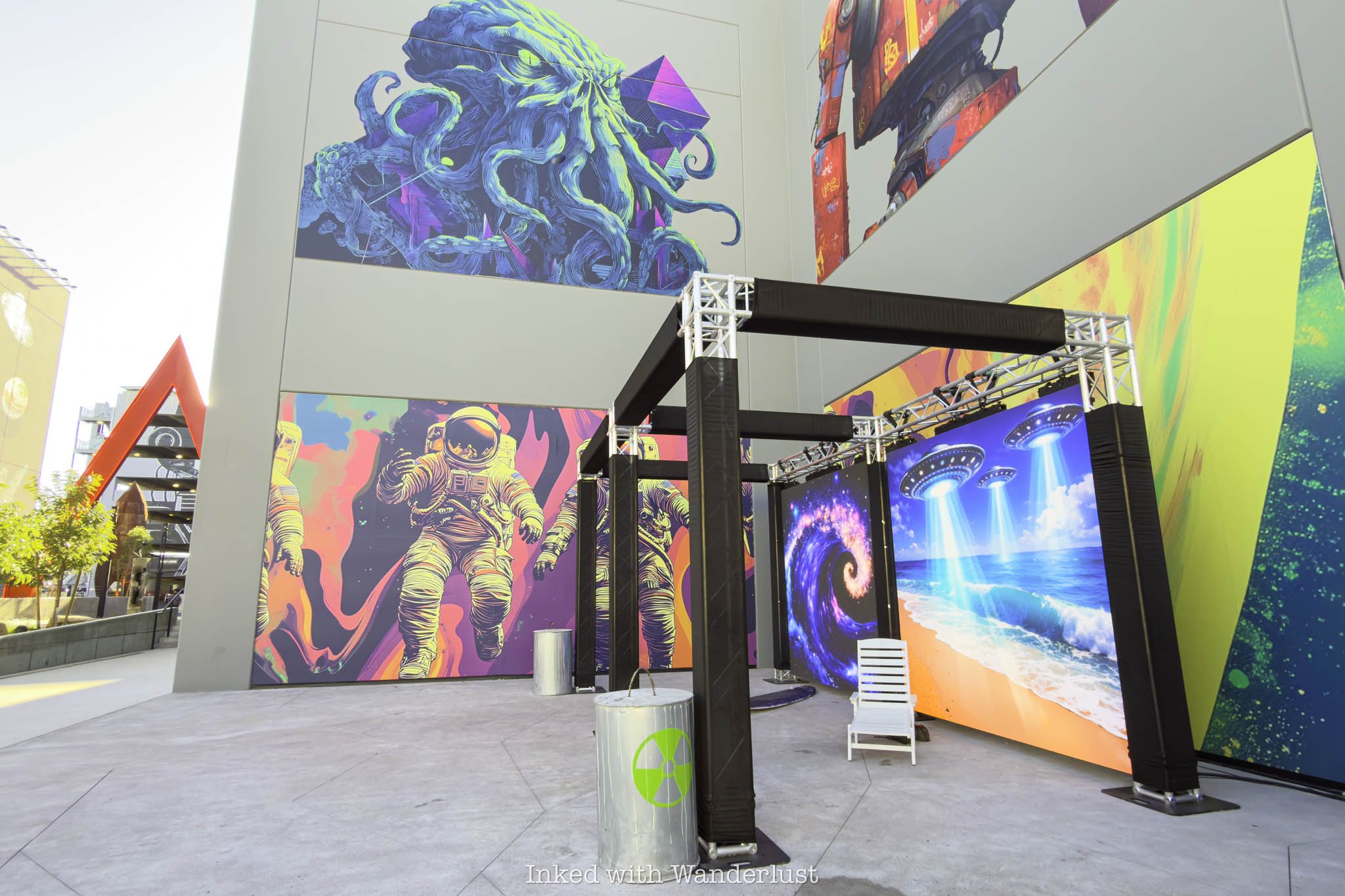
We had a lot fun exploring the area, seeing and photographing the many art murals, as well as the art installations scattered throughout the property. It was an appetizer, of sorts. A way to “wet the whistle” before walking into the horror-vibes that awaited us.
There are also a handful of photo ops inside some containers near the entrance to UHU. To be honest, I wasn’t entirely certain it was ok to step inside them, but there wasn’t anything indicating we couldn’t and on top of that…nobody stopped us.
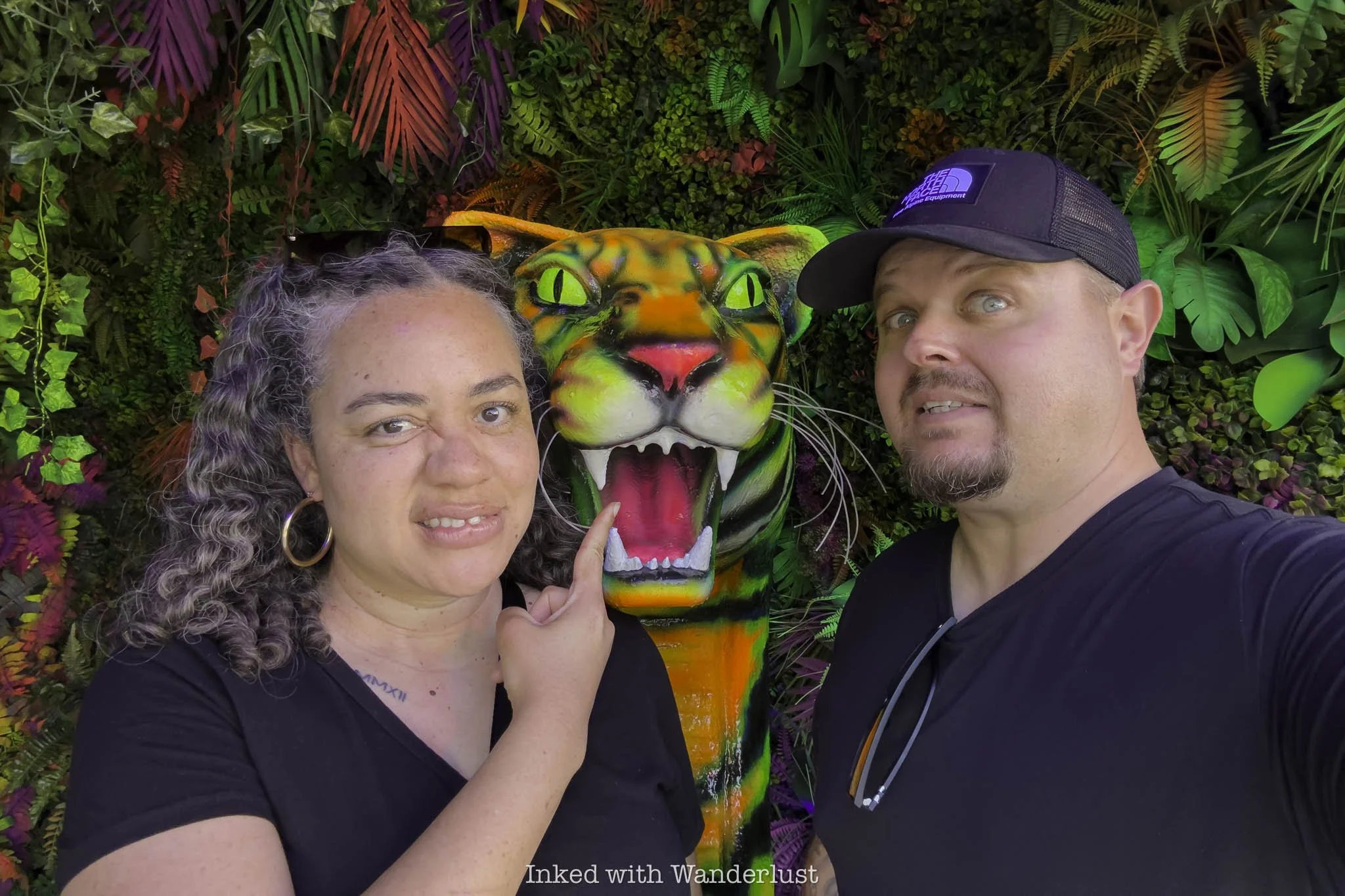
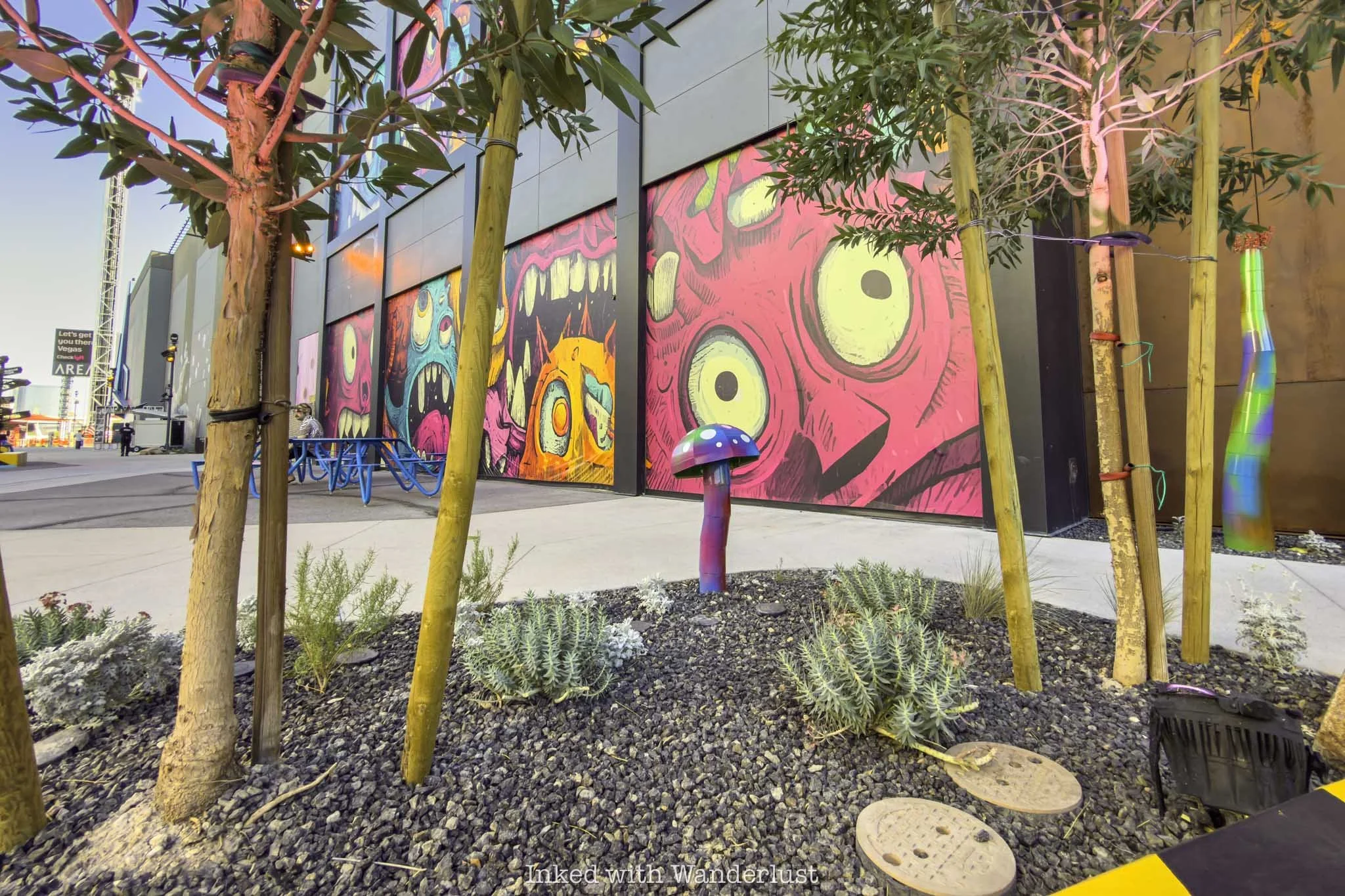
While I wanted to explore further, we had an itinerary to stick to with dinner plans on the strip and a ride on the High Roller that night. Not wanting to rush through Horror Unleashed, it was time to make our way inside.
That tense, anxious feeling in my stomach began to churn as we made our way inside. I’m not much of a horror genre fan and I’ve never particularly enjoyed being scared, so I was completely out of my element here.
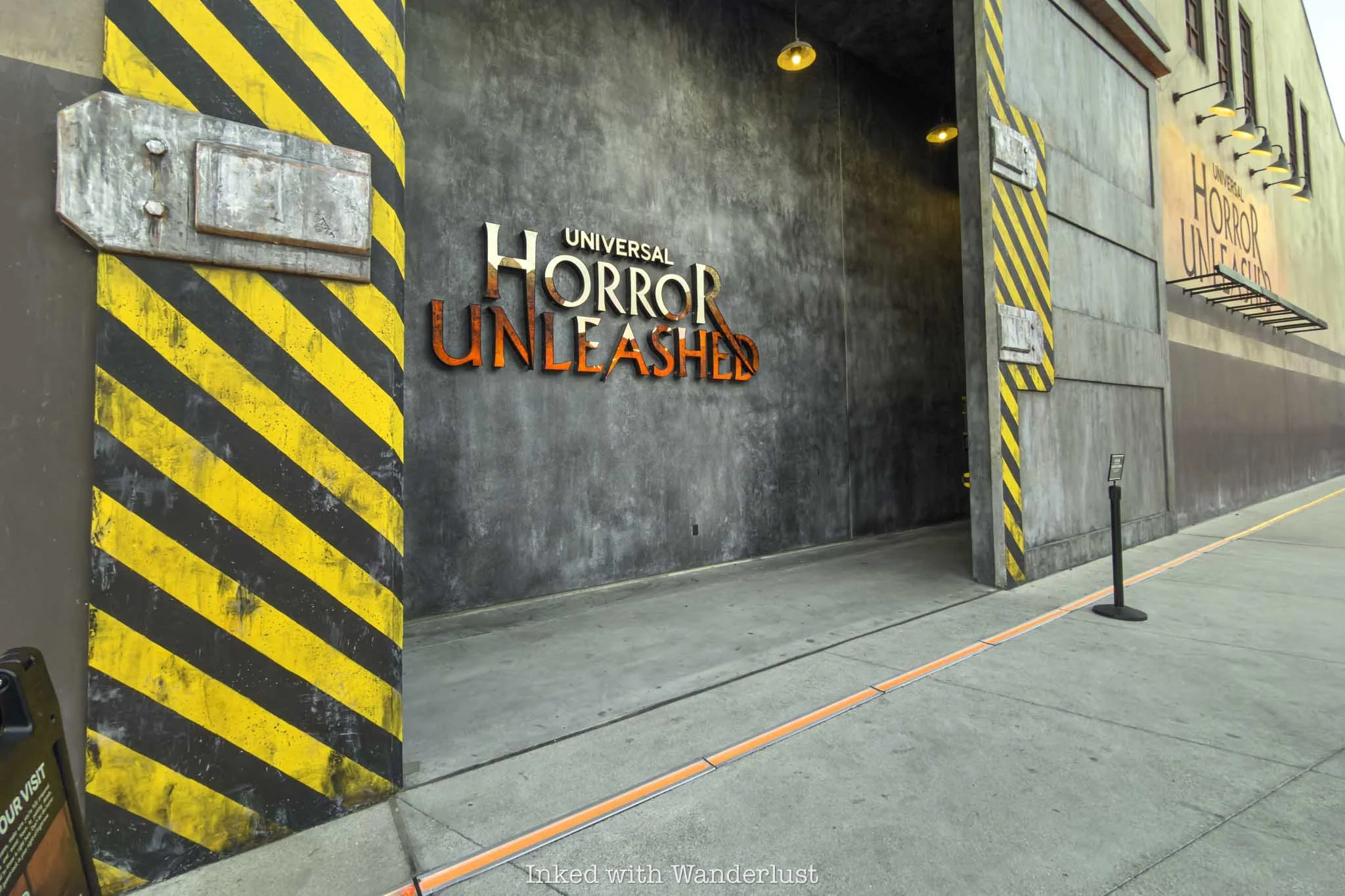
We were quickly greeted by a pair of staff members who welcomed us and gave us a brief, in-character spiel about what to expect and the rules. The “in-character” trait was a taste of things to come, as the commitment to being “on” by the employees was spot-on for the entirety of our visit.
After posing for a photo, security check was up next. It was your standard metal detector and bag search that most places in Las Vegas implement. We got through swiftly, as the friendly security personnel did their jobs efficiently.
Atmosphere
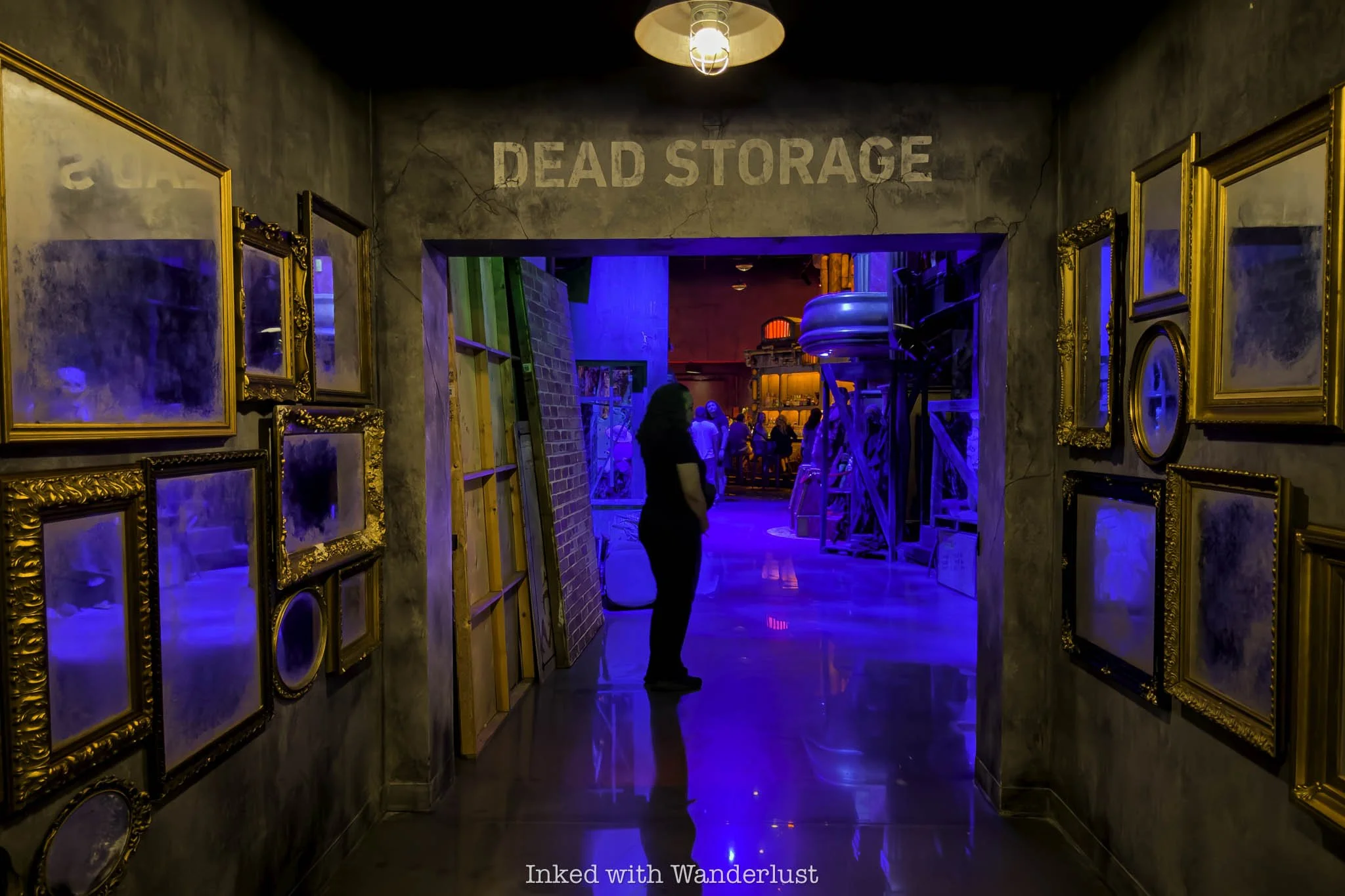
After passing through security, we were directed down a dimly lit hallway with creepily framed photos plastered along both walls. At the end, we came into an illuminated atrium, giving the feeling of crossing a threshold into another world.
The lighting is kept intentionally low and eerie music echoes throughout the space. Those design features, in combination with the intricate and detailed set pieces, immediately established a creepy atmosphere.
Before we even entered a haunted house, the roaming characters, themed environment, and ominous sounds created a sense of anticipation that kept my wife and I on edge. We never quite knew what was lurking around the corner.
Roaming Characters
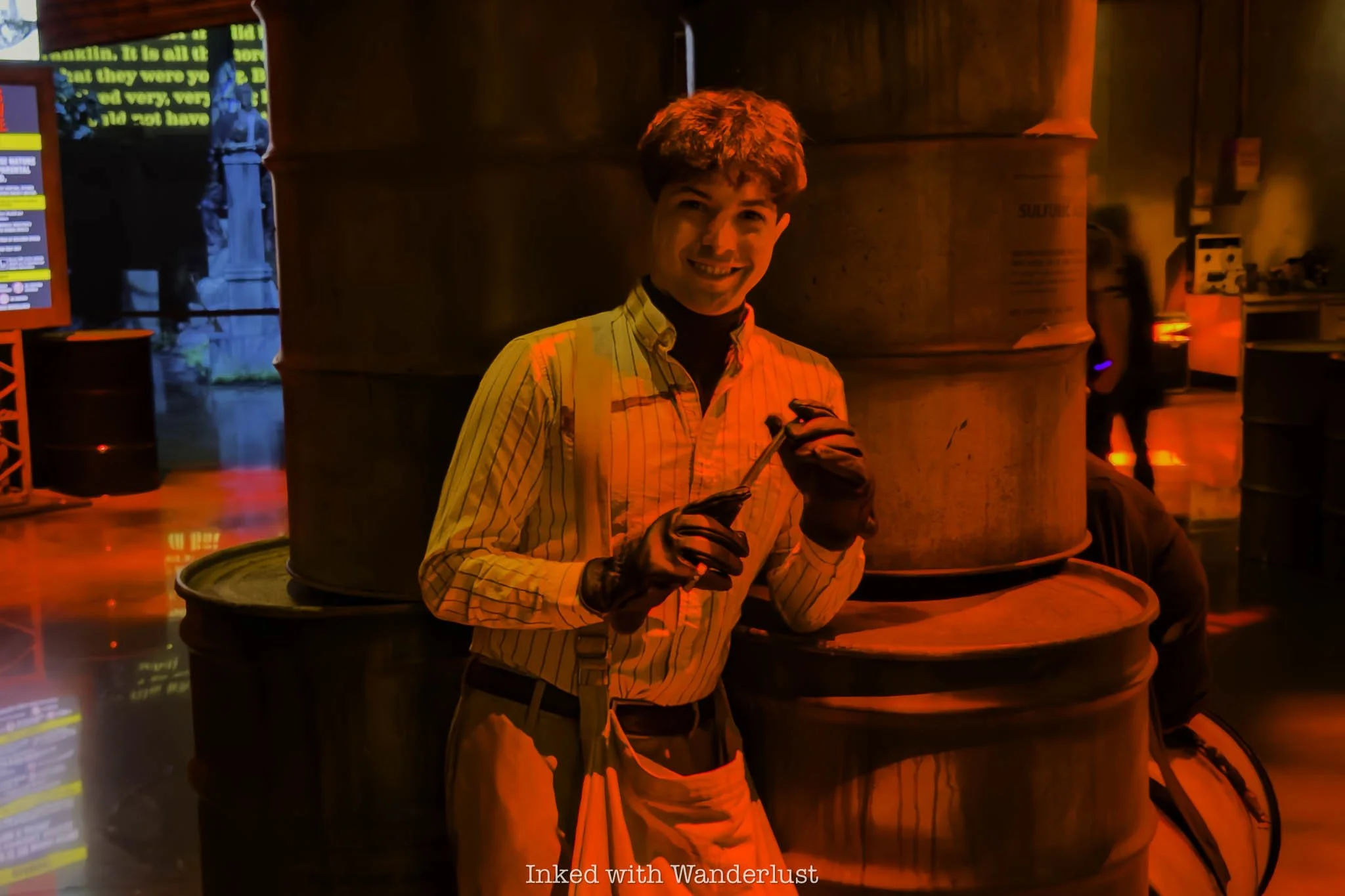
The stand-out feature for us were the dedicated scare actors. They fully inhabited their role, roaming the themed areas with unsettling confidence and remaining in character during every interaction.
In fact, the scare actor pictured above took a disturbing interest in my wife, silently following her every move while starring and grinning intently, all while fiddling with an obviously fake, but real-looking enough knife.
Every time we found him he’d be in a different spot, still starring and grinning. At one point, we thought we’d lost him, but as we gazed at themed elements in the rafters above, he popped up behind us out of nowhere, giving us a good scare. This was just the first ten minutes!
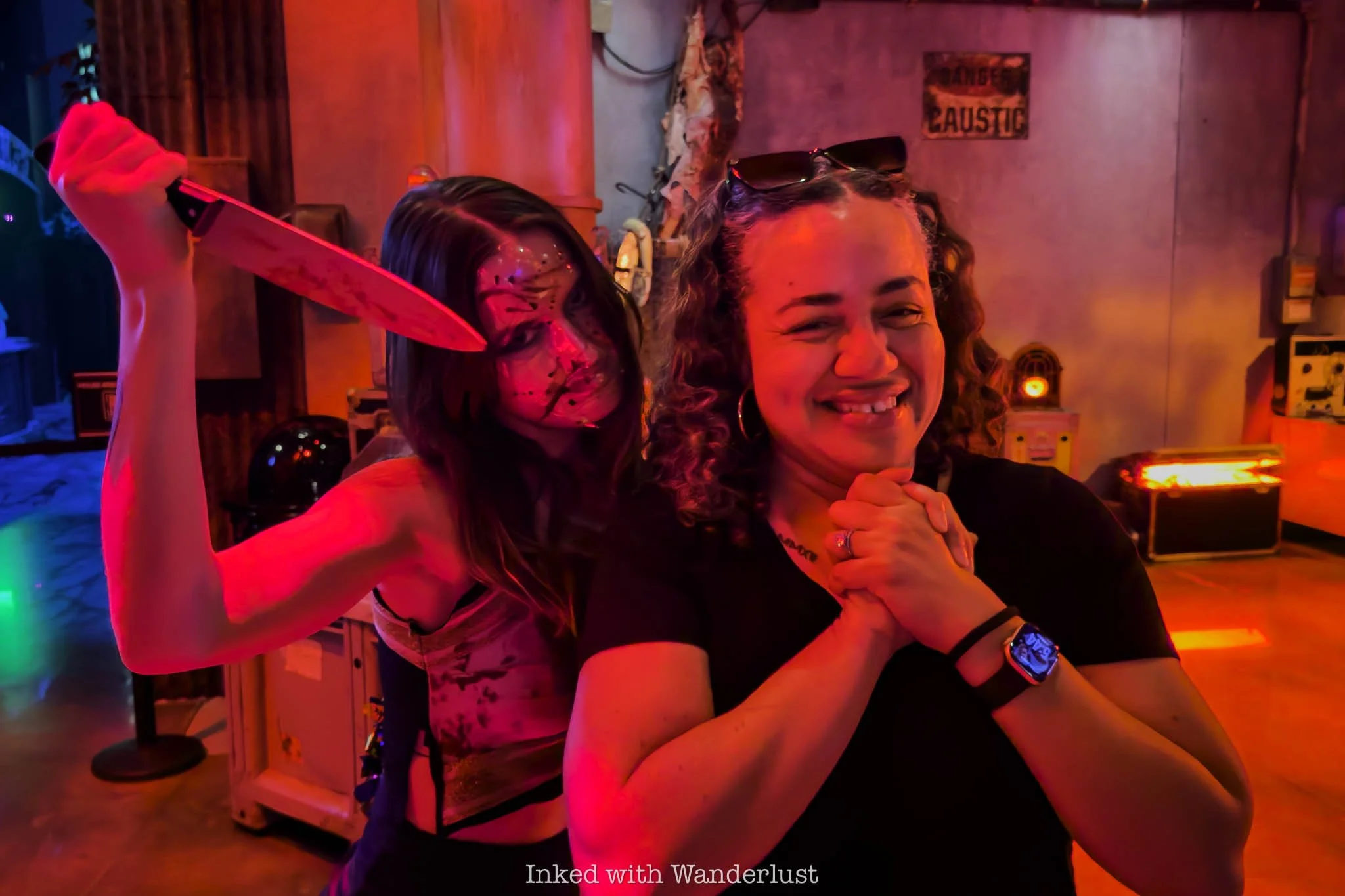

Characters included stationary ones inside the haunted houses and roaming characters in the common areas. There were a mix of original, non-specific characters and recognizable ones from movies like M3GAN, The Black Phone and Texas Chainsaw Massacre.
Some, like M3GAN, appear for meet and greet opportunities while others simply roamed the venue, randomly interacting with guests. Though even the ones that roamed would pose for photos if requested (at least those we interacted with did).
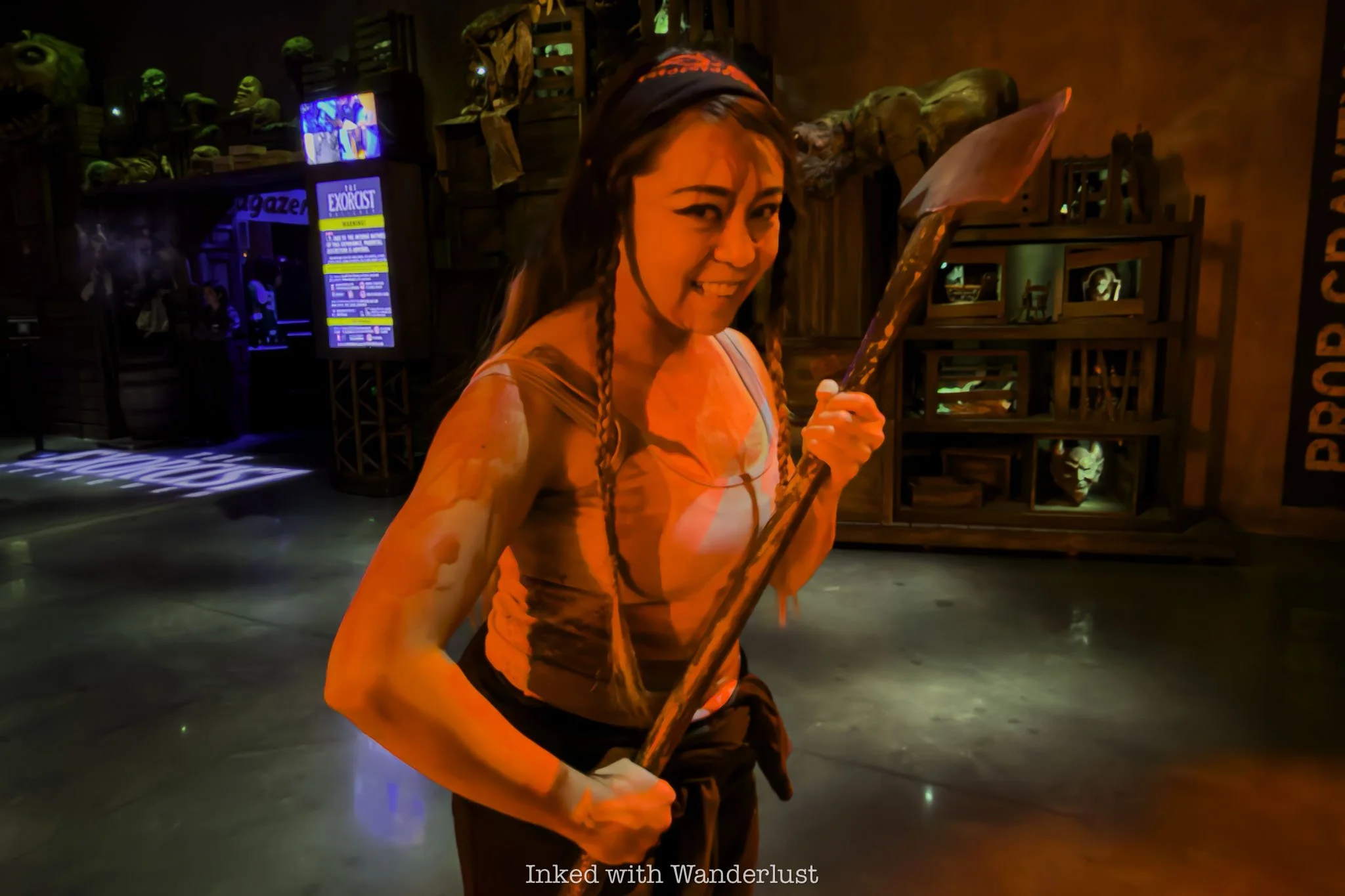
Interacting with the characters added an extra layer of immersion as each encounter appeared tailored to us specifically. They felt spontaneous rather than scripted and even when they weren’t actively scaring, their mere presence brought the entire venue to life.
The result was an atmosphere where we couldn’t let our guard down, as we knew a chilling interaction could happen at any moment. I cannot praise them enough. They were easily our favorite element of the entire experience and I hope Universal continues keeping them a priority.
Haunted Houses
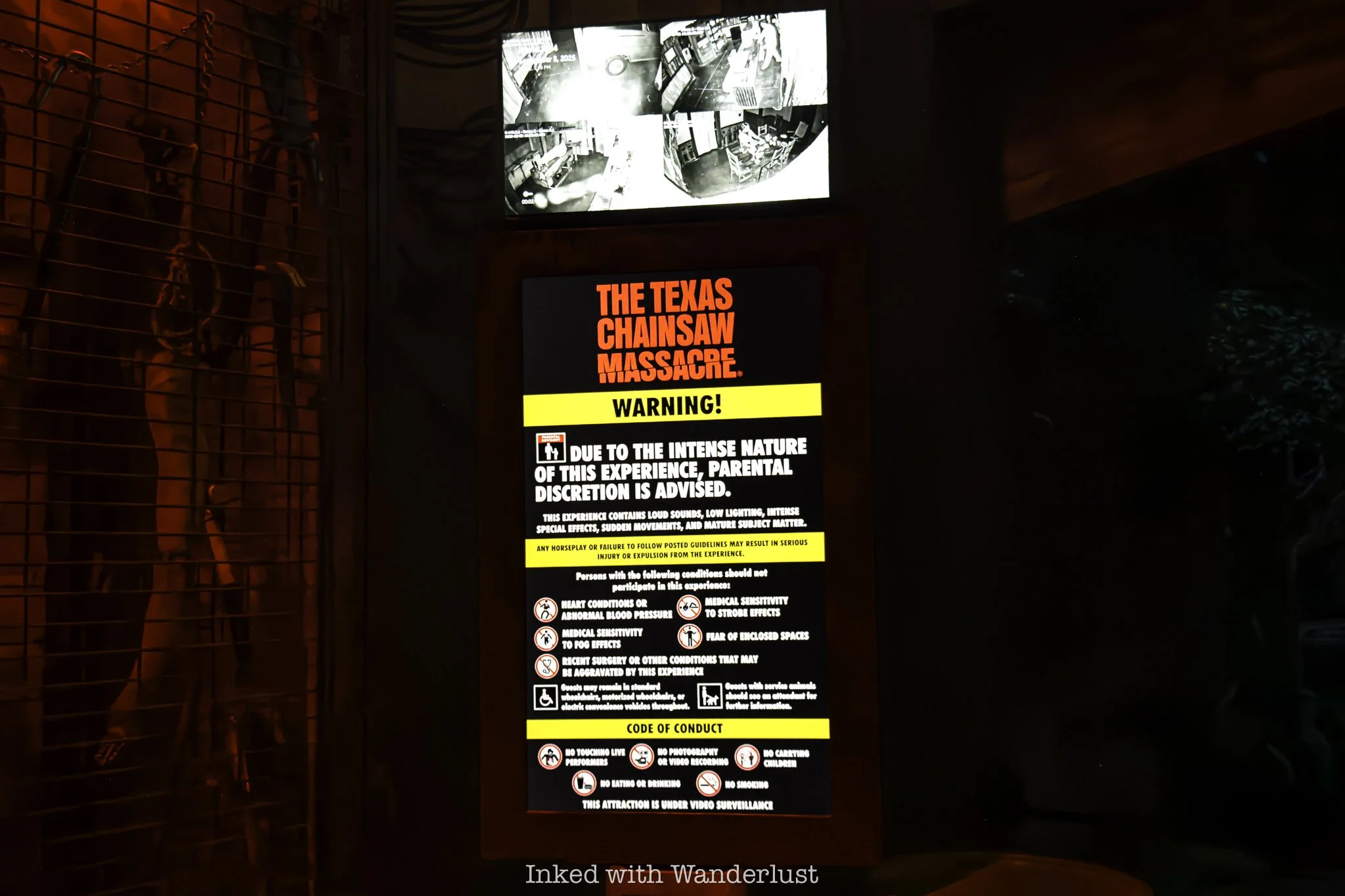
Currently, there are four haunted houses at Universal Horror Unleashed. They’re each differently themed, with three of them themed for existing intellectual properties and the other an original concept.
The four haunted houses are:
Universal Monsters
Texas Chainsaw Massacre
The Exorcist: Believer
Scarecrow: The Reaping
These aren’t your standard, run-of-the-mill seasonal haunts. These distinctively detailed haunted houses offer a cinematic experience, at times making you feel like you’ve stepped right into a horror movie.
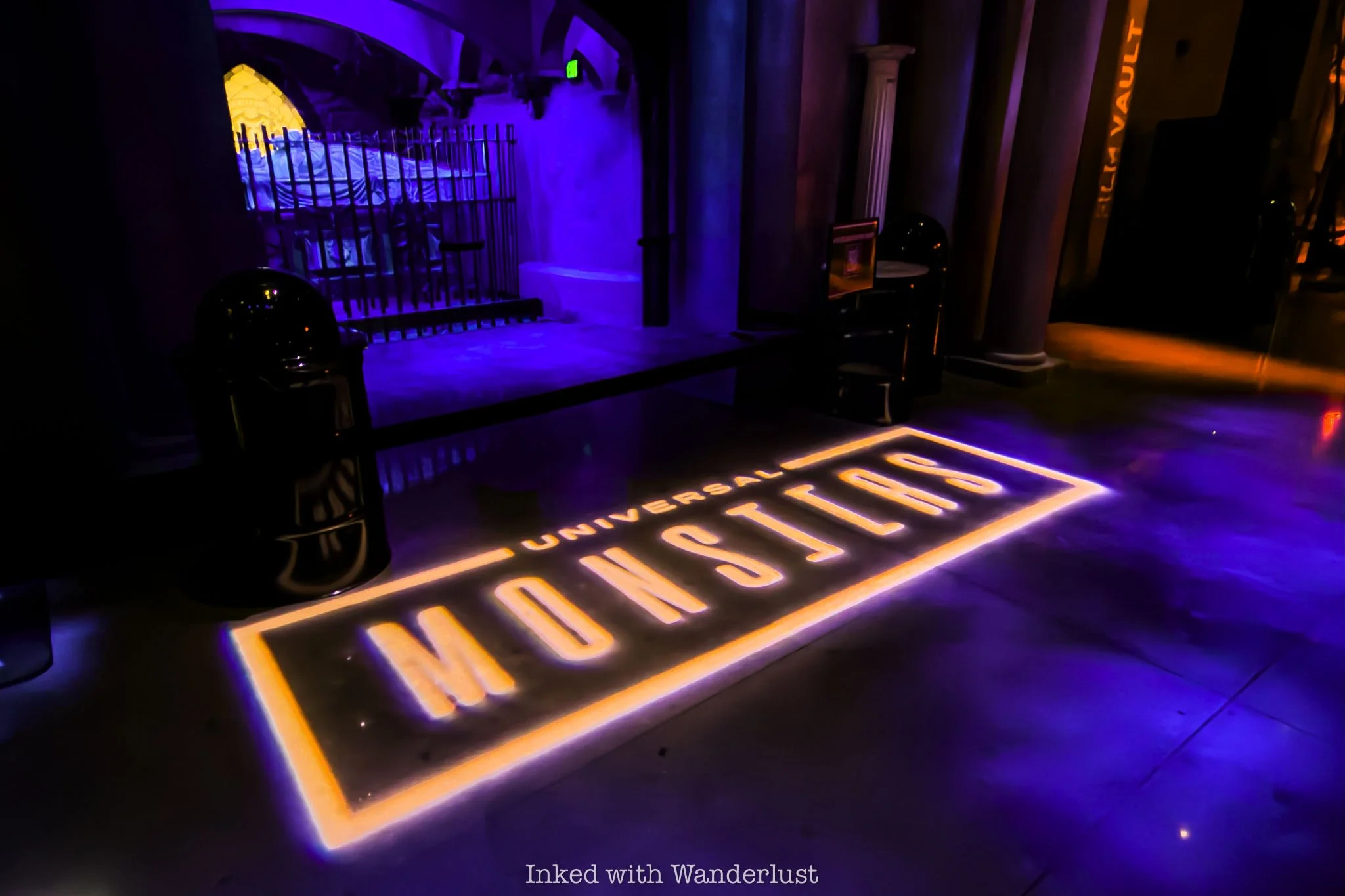
I was impressed with the level of detail, as each haunt we experienced featured expansive environments, cinematic lighting, immersive sound design and practical effects that blurred the line between attraction and film production.
Rather than rushing us from one scare to the next, the houses took time to establish their settings, allowing tension to build naturally as we moved from scene to scene, whether that was through a dark corridor or stepping into iconic horror movie moments.
Each house had its own distinct atmosphere, visual style and pacing, preventing them from feeling repetitive. The scare actors, of course, brought it all to life and made each encounter feel unpredictable.
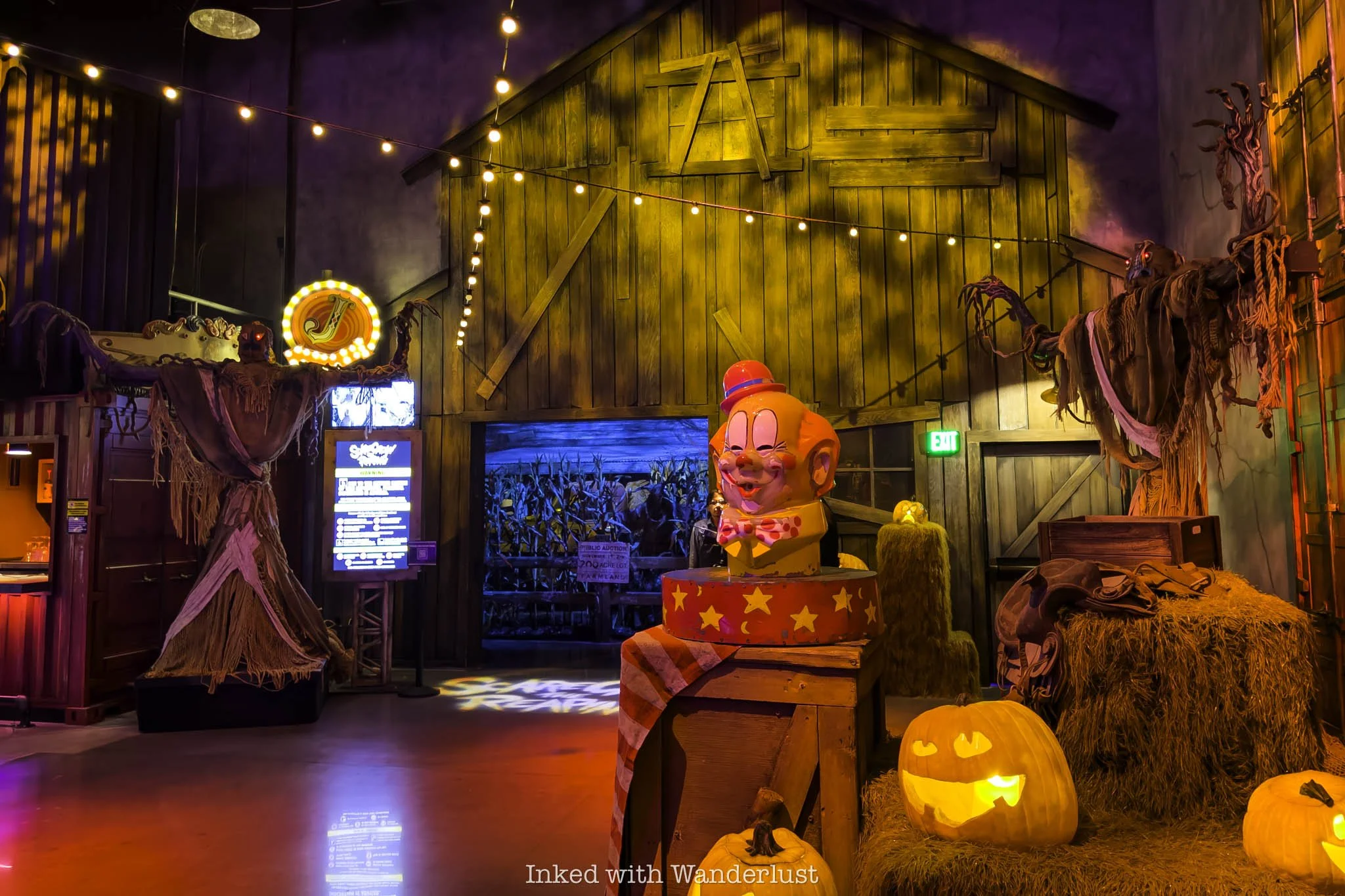
The houses were noticeably longer than what many may be accustomed to at seasonal haunted houses. Instead of a quick walk-through, each experience unfolded over multiple scenes, giving you time to absorb the great deal of thought that went into each one.
Universal Monsters, the flagship haunt at Horror Unleashed, focused more on atmosphere than outright terror. Iconic characters like Count Dracula and Frankenstein provided familiarity, but kept the scares coming with nondescript characters as well.
Seeing these classic monsters brought to life in such a setting was a true treat, despite my lack of extensive knowledge on the horror genre. It definitely wasn’t the scariest in the lineup, though I’d argue it was the most visually impressive.
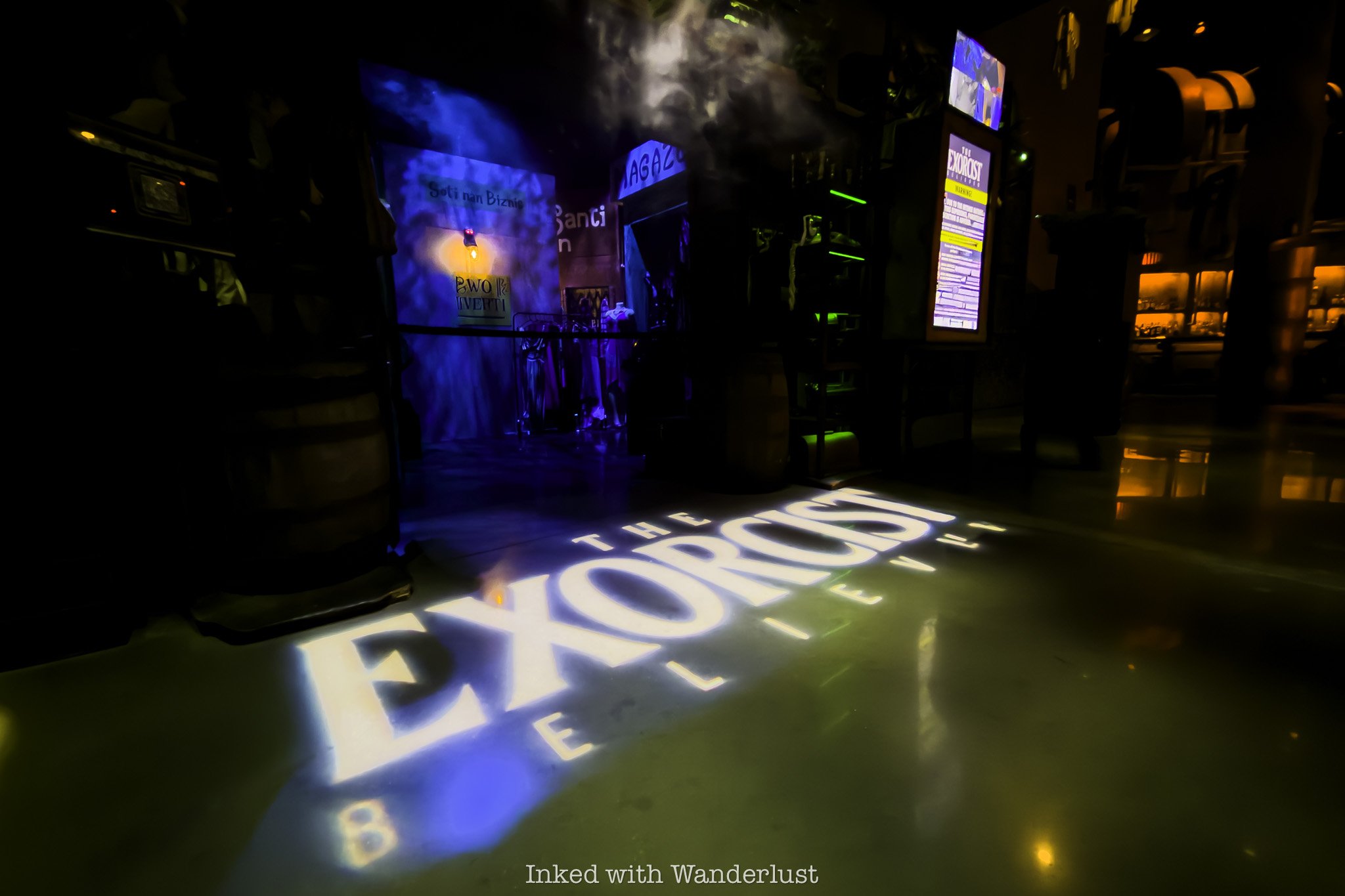
Unfortunately, pictures and video are not allowed inside the haunted houses (in most cases), so I don’t have any to show you. There are several preview videos on Universal’s website and various YouTube influencer videos as well.
Kisha and I experienced two of the four haunted houses - Universal Monsters and Scarecrow: The Reaping. We ran out of time and couldn’t wait for Texas Chainsaw Massacre to reopen and there wasn’t a snowball’s chance in hell of me walking into the Exorcist haunt.
Of the two, Universal Monsters was my clear favorite. Scarecrow was excellent, though, as the rural farm setting gave me a feeling of isolation and unsettled anxiety. It built tension incredibly well, though the end fell flat as we ended up surprising the scare actor who initially didn’t see us.
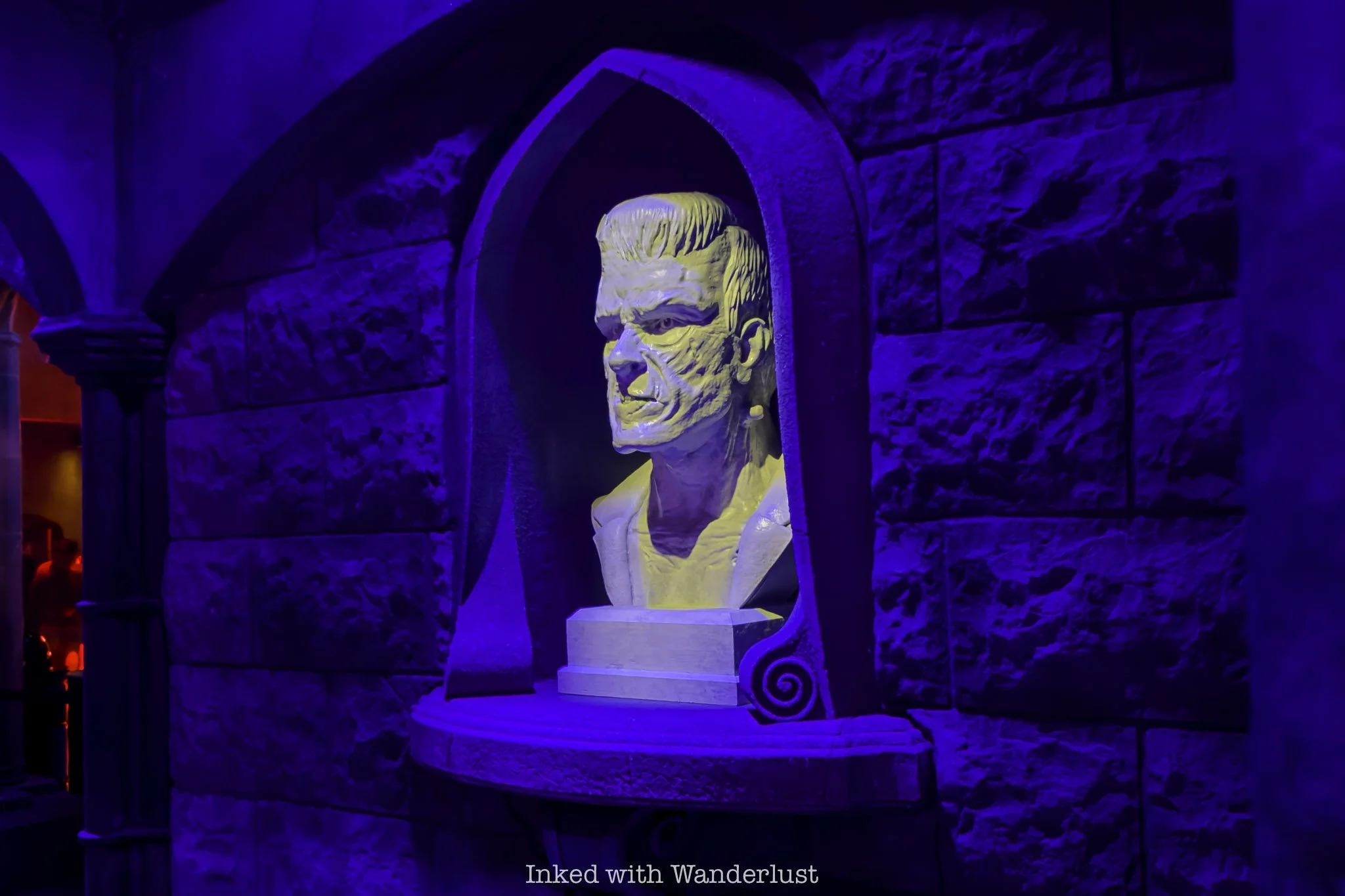
Another well done trait of Universal’s haunted houses was the spacing of guests. A common complaint I’ve had of seasonal haunts is being sent in with a large group and the scares being ruined as they often occur at the front of said group, effectively ruining the experience for those in the back.
At Universal Horror Unleashed, employees send each party through by themselves and won’t let another through until the previous party reaches a certain threshold. Not once did I hear or see a scare coming due to the previous party’s screams.
Spacing us out retained the surprise element while also making us feel isolated, which significantly increased the suspense and tension, making each scare an event rather than a cheap pop. Aside from that one flub in Scarecrow, the actors executed each scare superbly well.
Live Entertainment

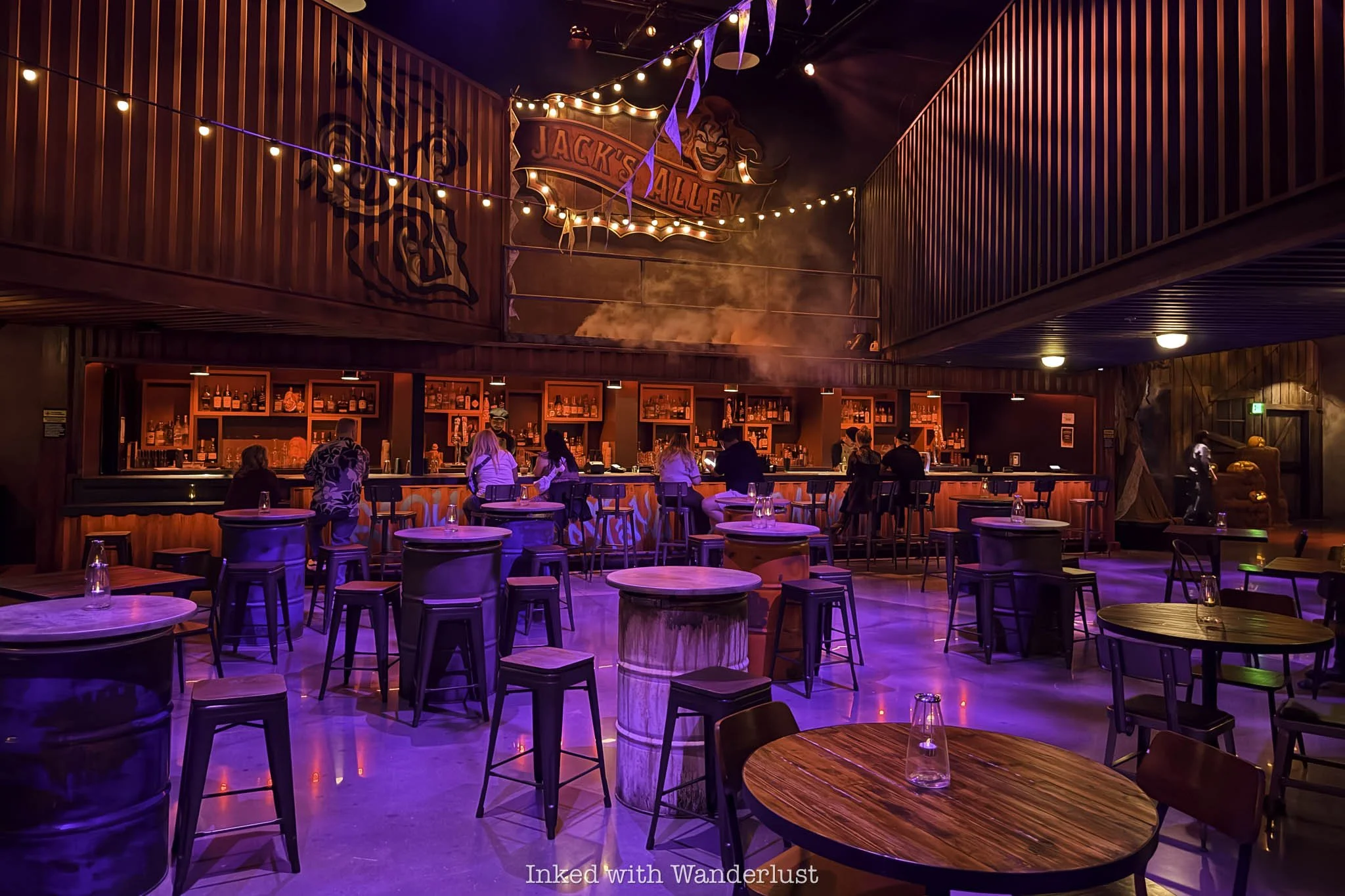
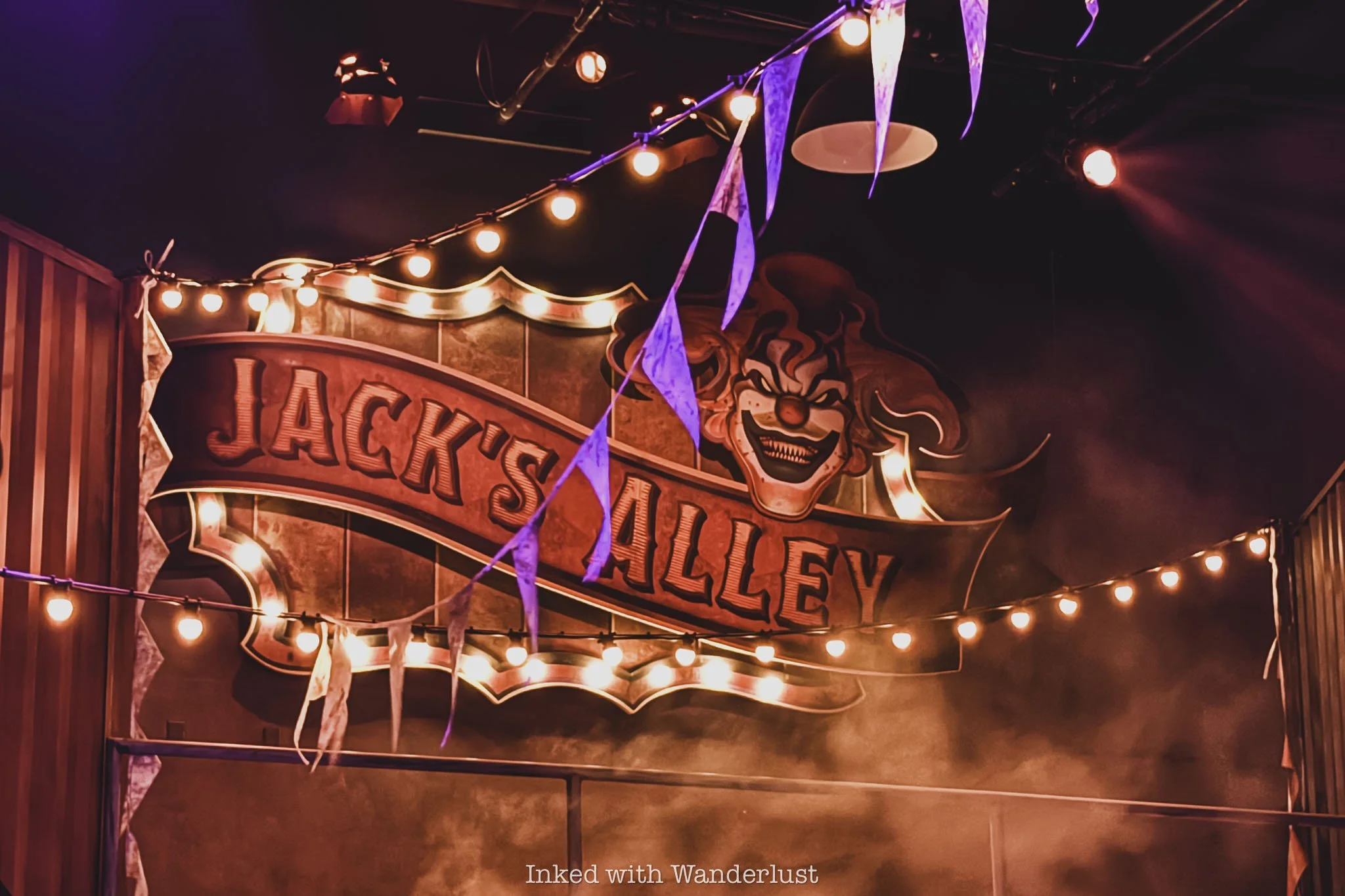
On the stage between Scarecrow: The Reaping haunt and the Premiere House restaurant, in the “Jack’s Alley” space of the venue, a variety of stage shows occur throughout the night at regular intervals.
The main show, hosted by Halloween Horror Nights icons Jack the Clown and his partner, Chance, is aptly named “Jack & Chance: Stay or Slay”. It’s a dark comedy talent show where unwilling “contestants” are brought on stage.
The contestants perform a variety of acts to impress Jack and his followers. If they do, they’ll stay (or, live). If they fail, they’ll slay (or, die - figuratively, of course). I caught this show from afar while enjoying a drink and meal at Premiere House.
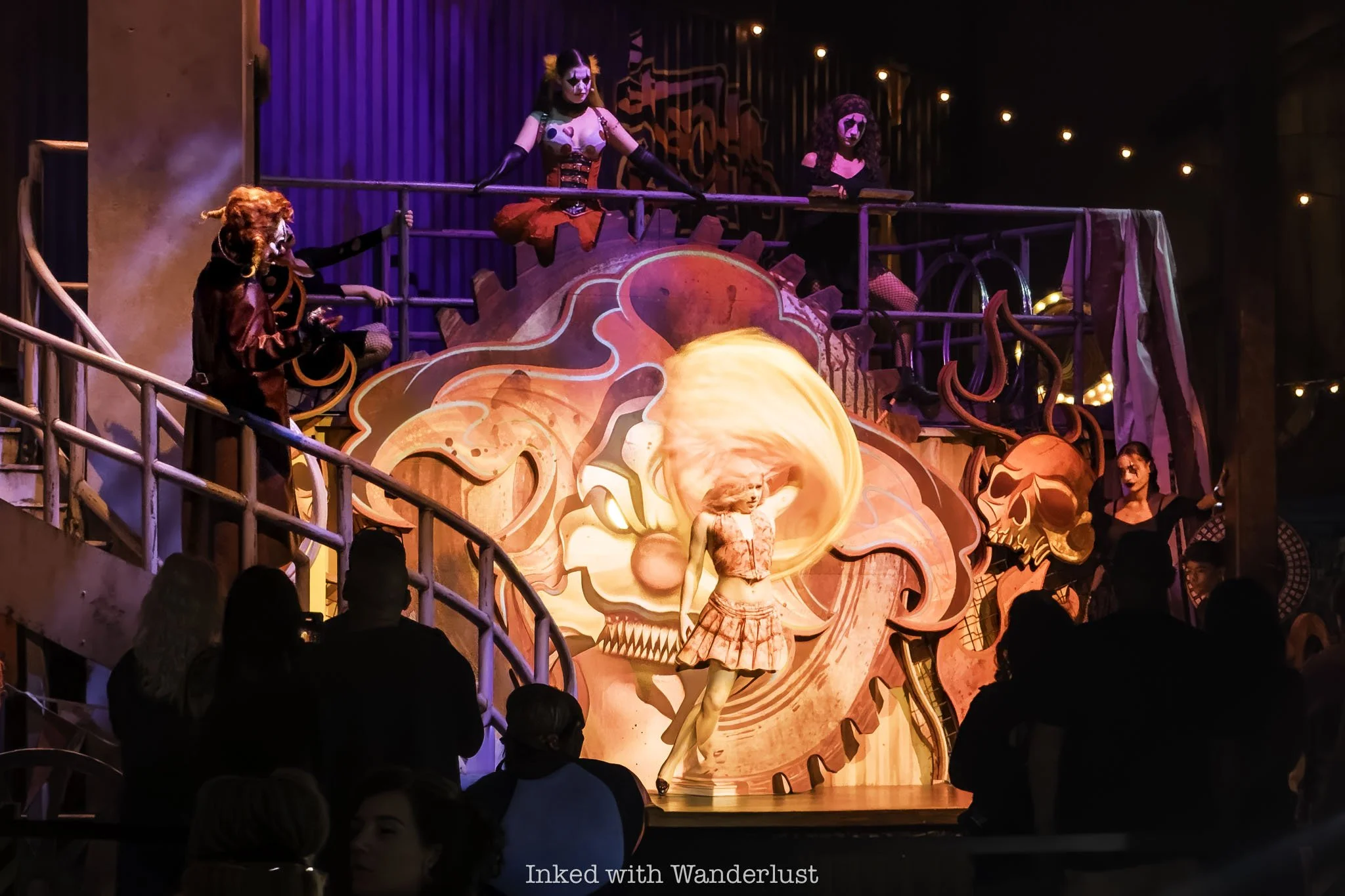

Another show is performed by a character named, The Joker. It’s a stand-up comedy-style show with heavy emphasis on adult-oriented topics. The Joker also performs an impressive juggling act using various “severed body parts” and other objects.
Both stage shows are more appropriate for a mature audience, but The Joker’s show is definitely not suitable for kids at all. There are many murder and domestic violence-related remarks, as well as many sexual innuendos.
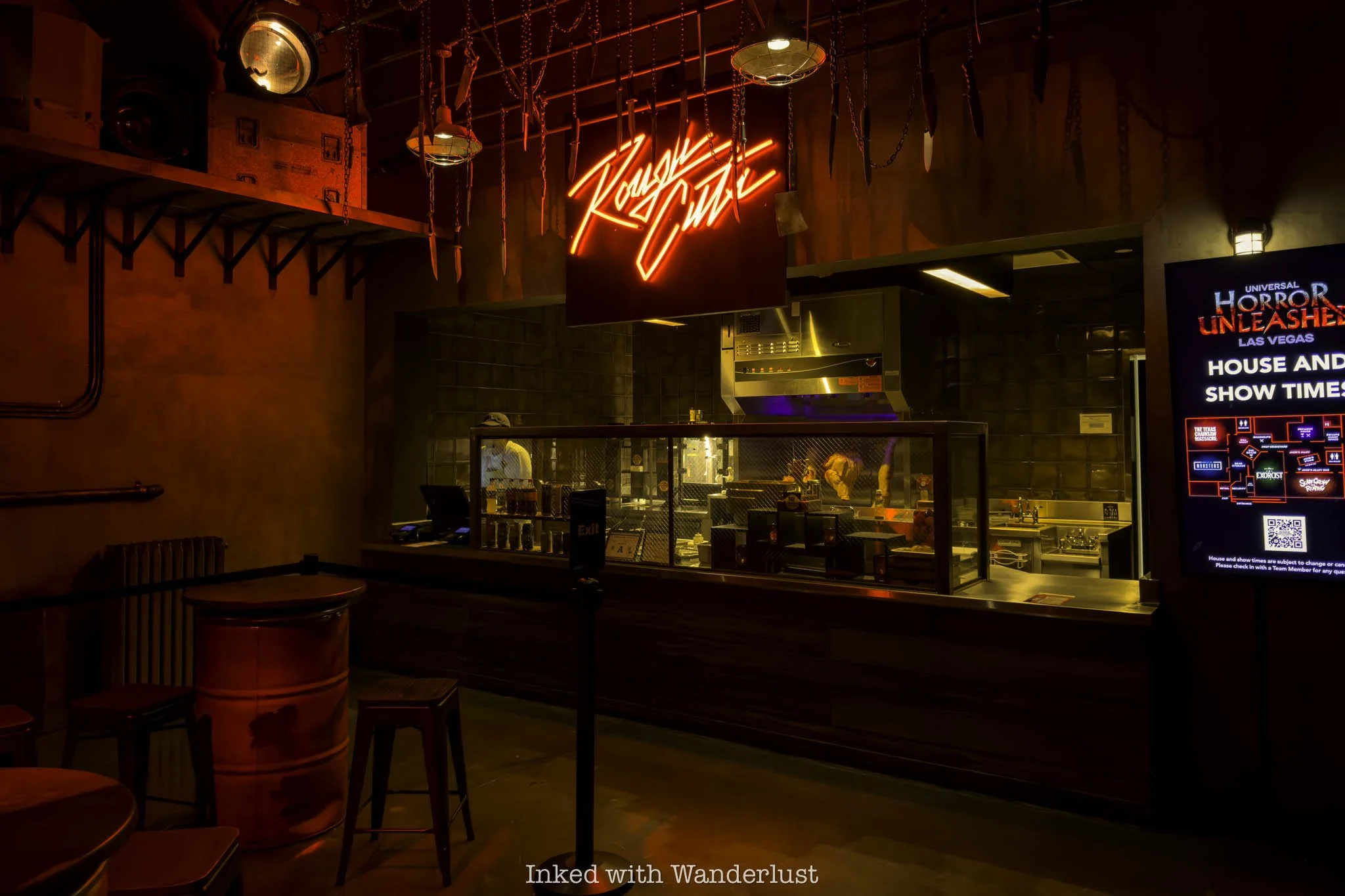
To see which shows are planned for the day and their respective showtimes, you can check the digital board on the wall to the right of the Rough Cuts ordering counter. There may be other boards throughout the venue, but that’s the only one I noticed.
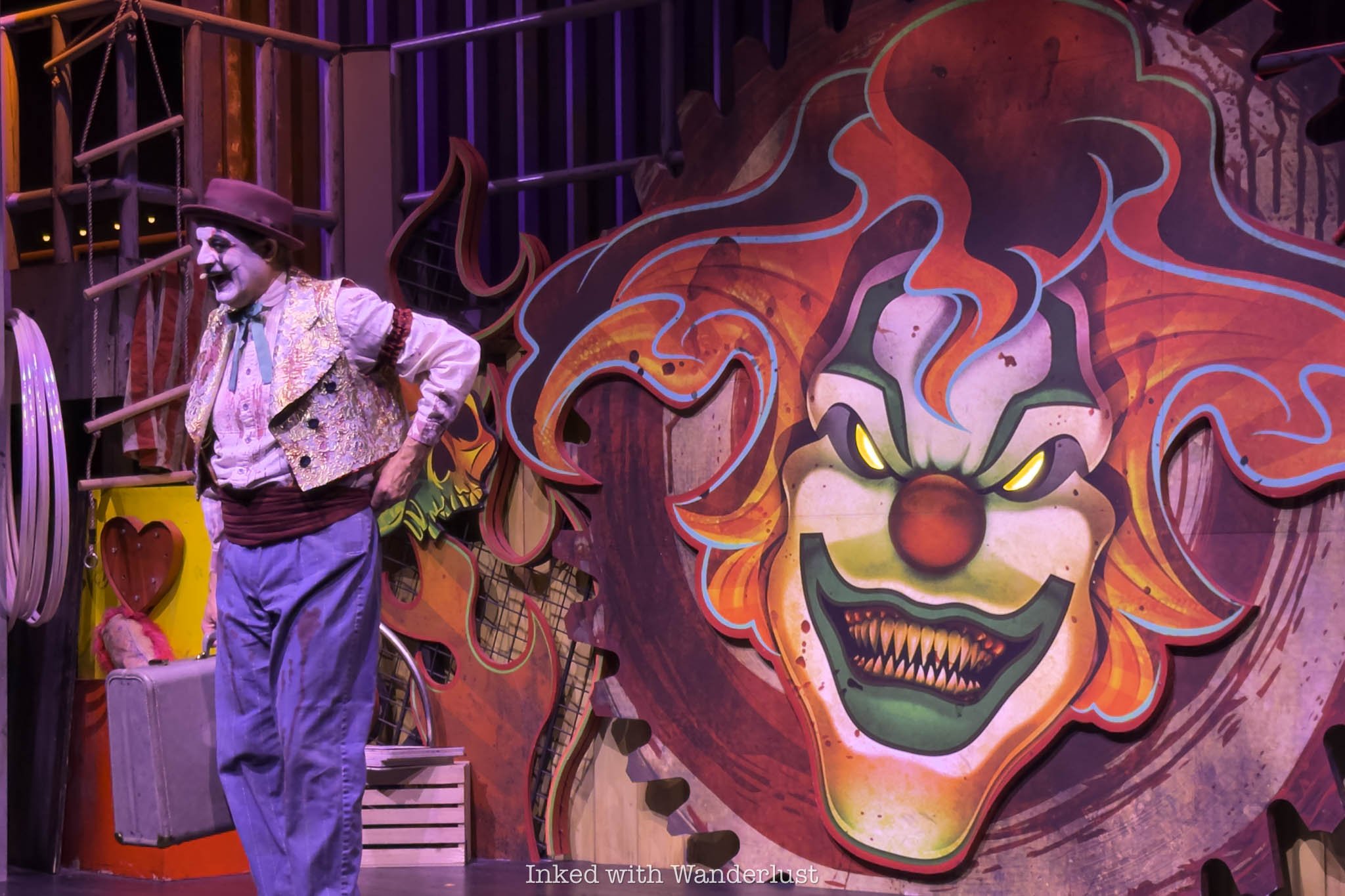
Both shows offer a pleasant change of pace between haunted houses, offering a mix of horror, dark humor and energetic performances. The performers are clearly committed to their roles and production values are decent.
They’re high energy, but relatively short. Depending on your timing, it could be easy to miss large portions of a show while exploring the venue. Also, I felt that storytelling took a bit of a backseat to spectacle, which devalued the overall show.
That said, the stage shows are a fun addition that help make Universal Horror Unleashed feel like a complete travel destination rather than just a collection of haunted houses. They play a significant role in keeping the energy of the venue high.
Dining Options
There are several on-site dining and drink options at Universal Horror Unleashed. They have a quick service-style eatery, “Rough Cuts”, that serves a variety of handheld entrees such as ribs, pizza and hot chicken sandwiches. You can find it adjacent to the Texas Chainsaw Massacre haunt.
In the same vicinity is “The Boiler”, an industrial-themed bar serving up crafted cocktails, beer, wine and mocktails. It’s an eye-catcher, as it’s one of the first features you’ll see upon entering the Dead Storage area of the venue.
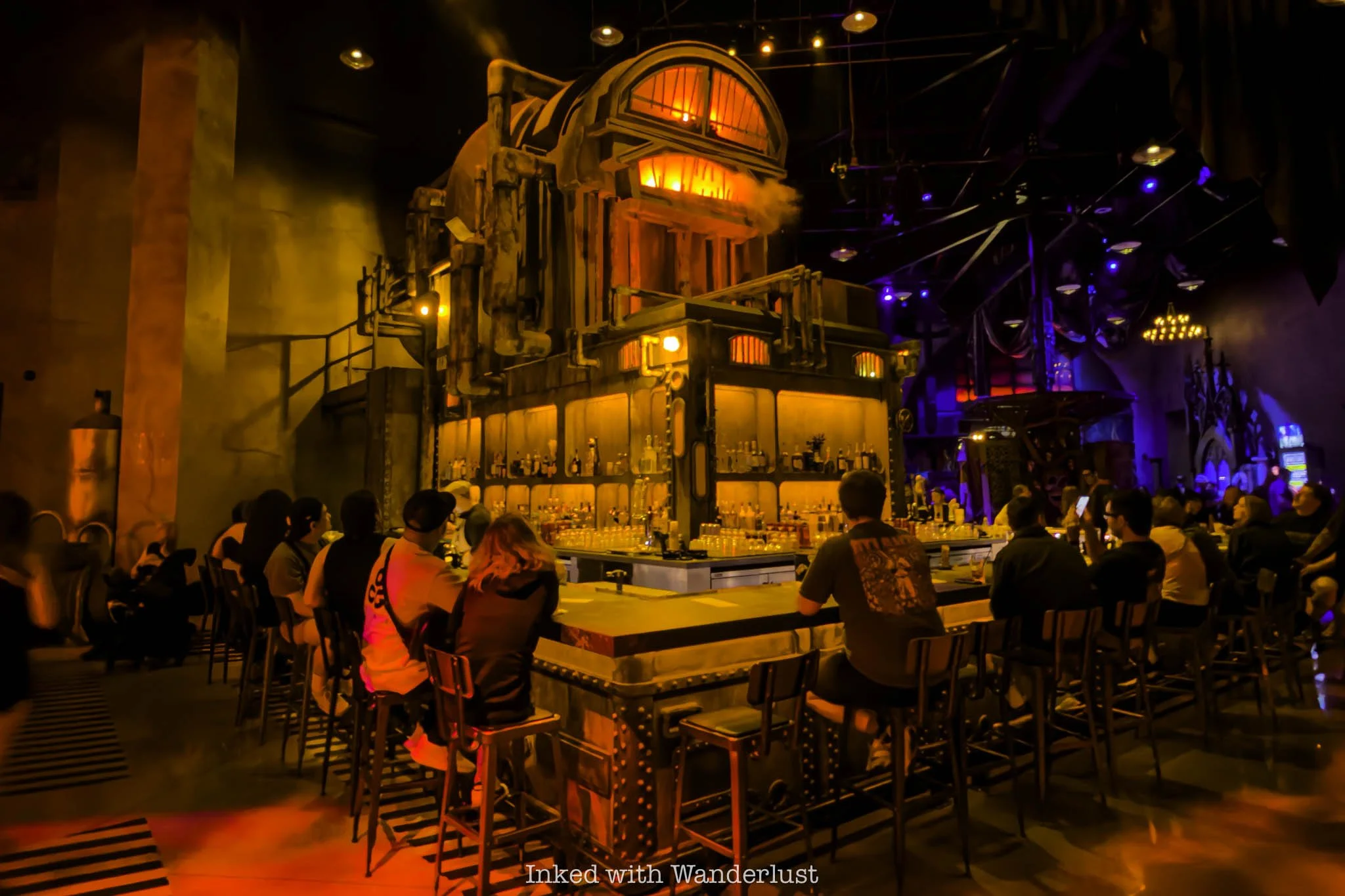
Past the Prop Graveyard hallway and into Jack’s Alley are two more food and drink options. To the left of Scarecrow: The Reaping haunted house is Jack’s Alley Bar, heavily themed after HHN icon Jack the Clown and his demented circus.
Many of the drinks served at The Boiler are also served here, but Jack’s Alley Bar features exclusive drink options as well. One such cocktail is the rum-based “Jack’s Juice”, a delicious concoction of cherry brandi, bitters, lime, simple syrup and mango nectar.
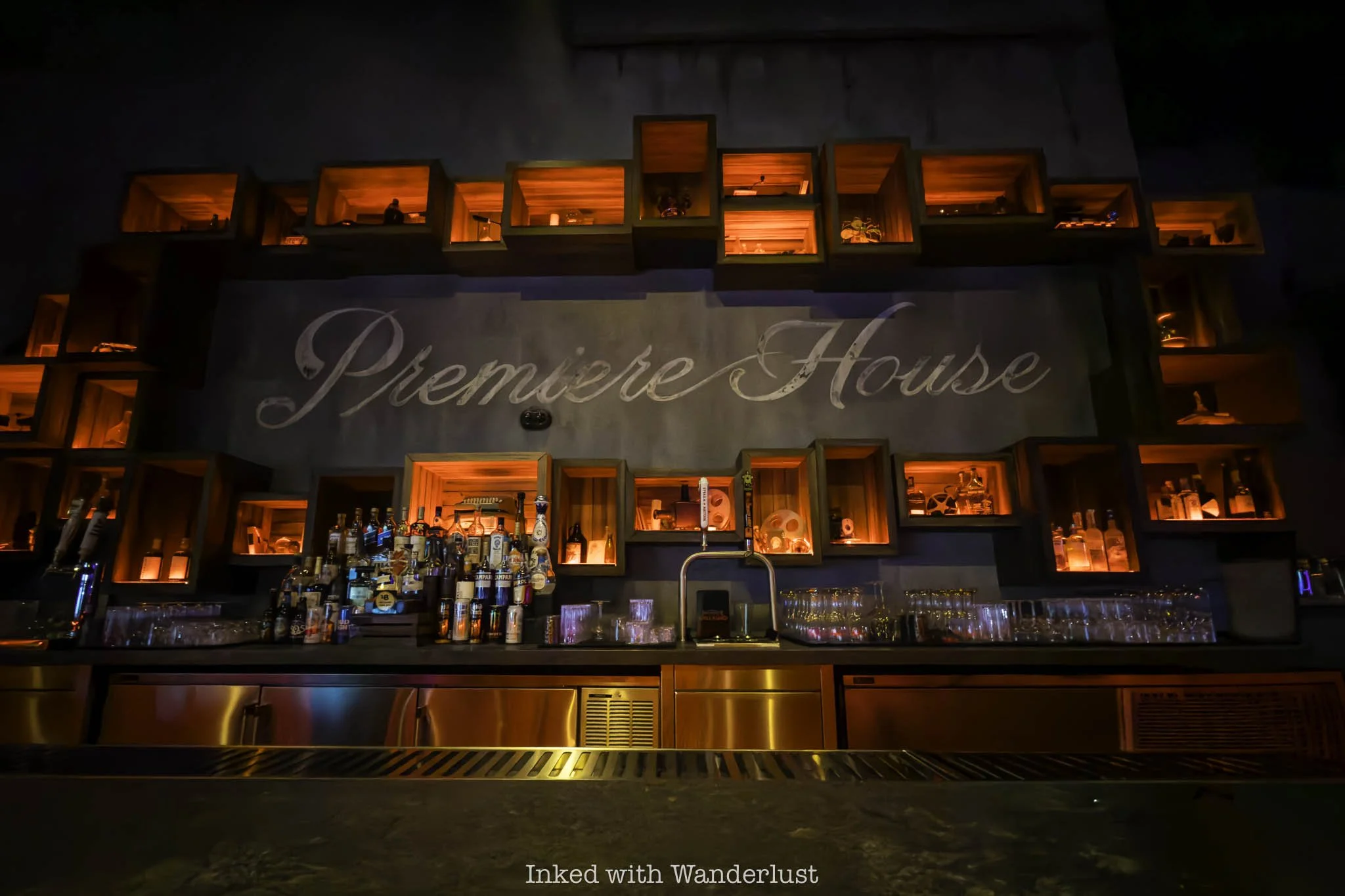
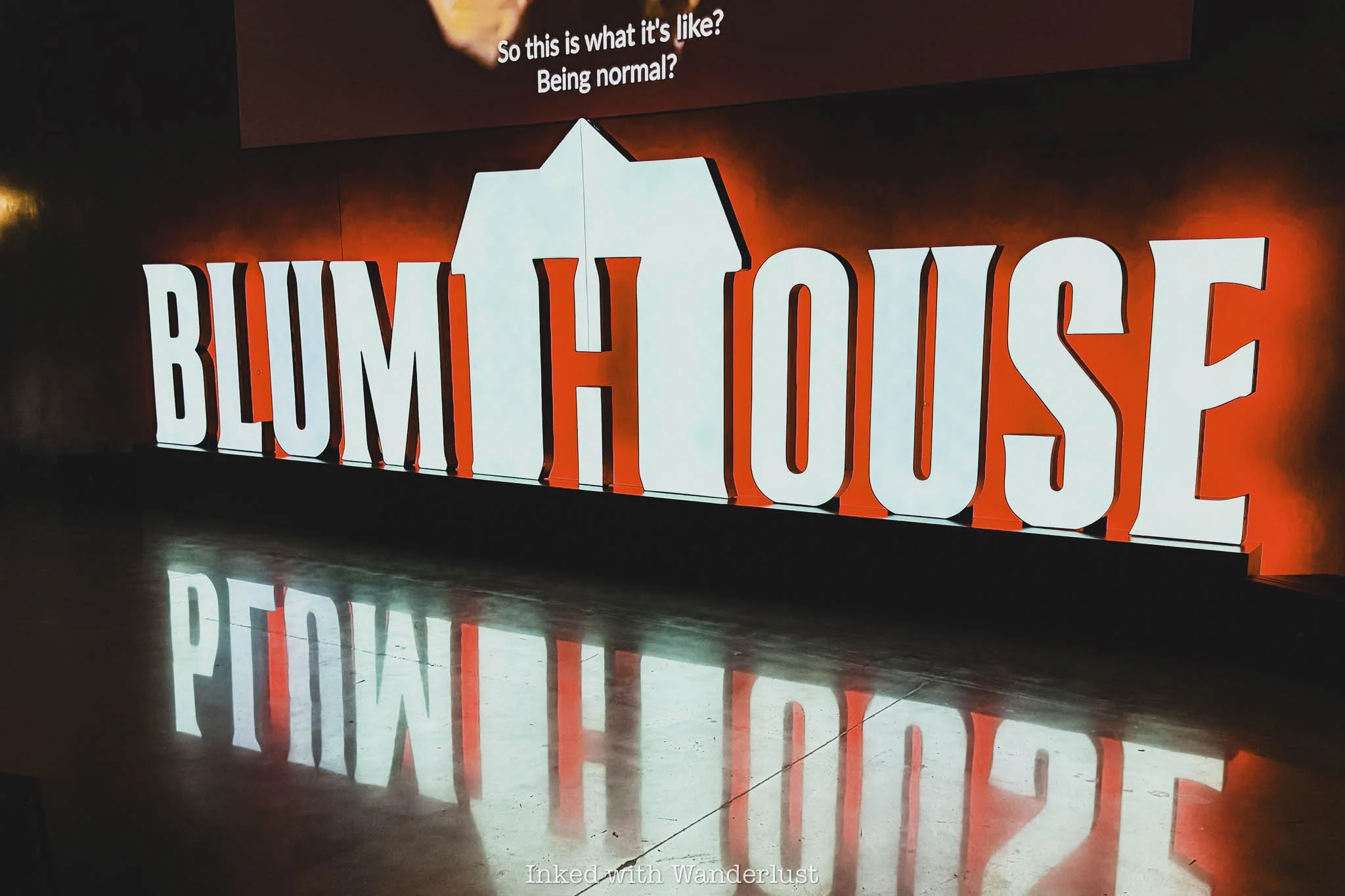
The flagship restaurant at Universal Horror Unleashed is “Premiere House”, heavily themed to Blumhouse, an immensely popular production company responsible for many modern day horror film classics.
Premiere House extends the horror experience with a moody, cinematic atmosphere filled with creepy details, dramatic lighting, and subtle nods to some of horror’s most recognizable films. It feels more like another attraction rather than just a restaurant.
Despite its unsettling surroundings, it’s a great place to sit and relax between scares while enjoying a meal from their surprisingly polished menu. There are also movie props on display, as well as appearances from horror AI doll, M3GAN.
Is Universal Horror Unleashed Ok for Kids?
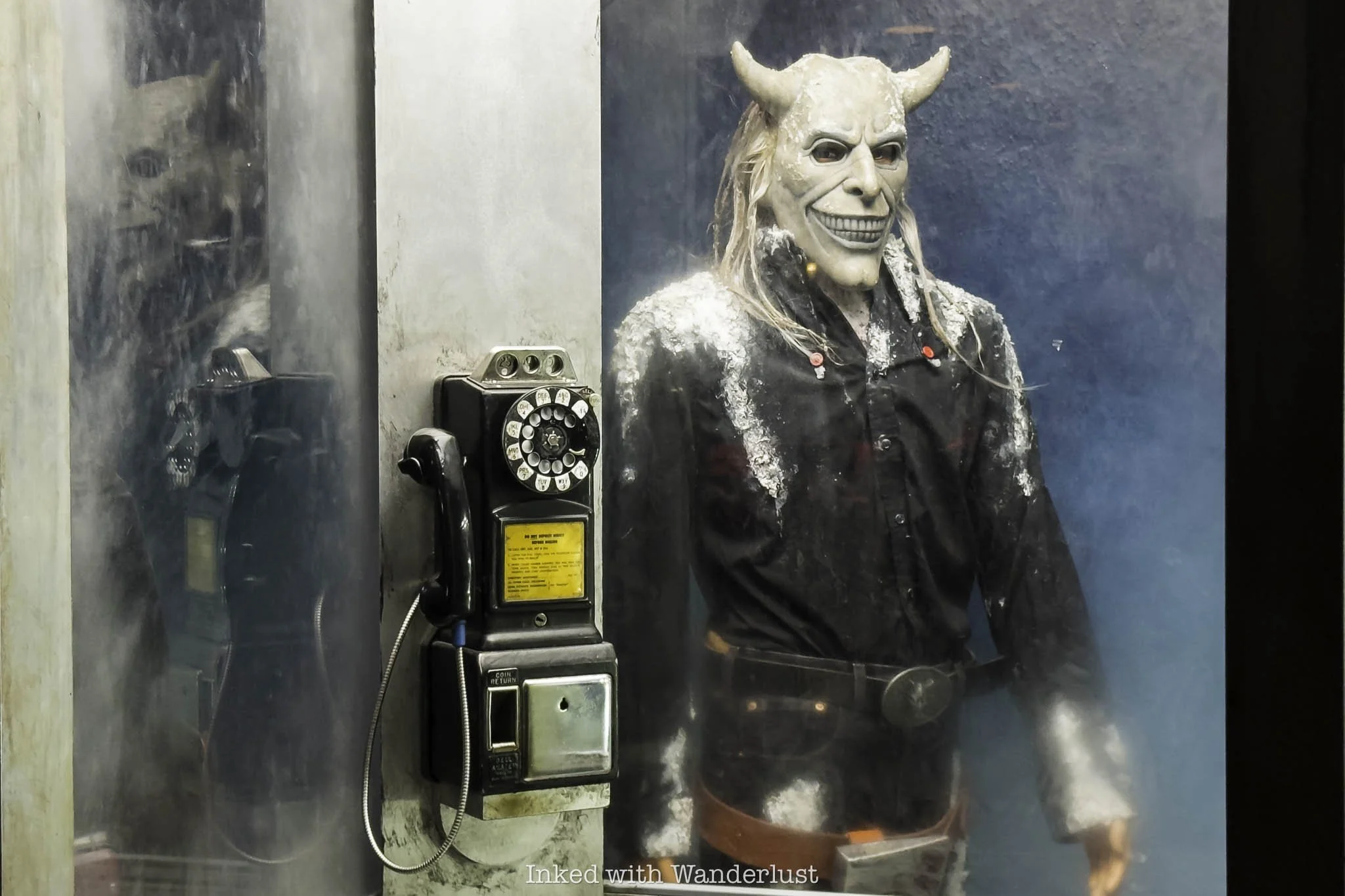
I believe questions like this are highly subjective and are up to each person’s perspectives and beliefs. What one parent may deem inappropriate for their child, another may see as no big deal for theirs. Neither are more right or wrong than the other.
Full transparency, I do not have kids. I do, however, have a young nephew and two, even younger nieces. So I’m going to answer this question from an Uncle’s perspective and whether or not I would take my own nephew and nieces to UHU.
Let’s begin with the fact that Universal themselves recommends taking no one under the age of thirteen to their venue. They don’t outright say that those under thirteen cannot enter, though. It’s important to distinguish that.
Conversely, they’ve implemented a chaperone policy for anyone under eighteen. So Universal doesn’t necessarily prohibit children from Horror Unleashed, but they do discourage bringing those under thirteen and require an adult to accompany any and all minors.
Honestly, it’s for good reason. The four haunted houses are indeed scary (likely downright terrifying to children), the props/decor are gory and lifelike, and the stage shows portray explicit topics and language.
So do I feel that Universal Horror Unleashed is suitable for kids? The answer is no, I do not. I wouldn’t judge any parent (or cool Uncle) for bringing theirs but I, personally, wouldn’t bring my young nephew and nieces here.

To say I wouldn’t recommend bringing kids to Universal Horror Unleashed isn’t a knock on the venue and shouldn’t be perceived as such. In fact, it’s a compliment. They’ve executed the horror element to the point that I just feel most kids wouldn’t handle it well.
That said, for everyone else, I highly recommend visiting UHU. If horror isn’t your thing but you’re mildly curious or you’re coming with someone who’s a fanatic, Horror Unleashed is a great introduction into the world of horror entertainment.
It made me a fan, for sure. While you’ll never catch me in any of the hardcore haunted houses or watching gory thrasher movies, I’m now more open to the entertainment and immersive side of the horror genre than I ever was before. I, for sure, will be going back.
Since you’ll be there anyway, consider exploring another popular Area 15 attraction, Meow Wolf’s Omega Mart, located a stone’s throw from Universal Horror Unleashed. Or, head to the strip and take a ride of Flyover Las Vegas! Never been to Area 15? Read my ultimate guide here!
***Take advantage of discounts by purchasing Universal Horror Unleashed tickets through my preferred partner, Viator, at my link here.
Is the High Roller Happy Half Hour Ticket Worth It?
Opened in 2014 as the crown jewel attraction of the then newly minted Linq Hotel and Experience, High Roller…
Disclosure: This post contains affiliate links. If you make a purchase through these links, I may earn a small commission at no additional cost to you. I only recommend products or services that I believe will add value to my readers.
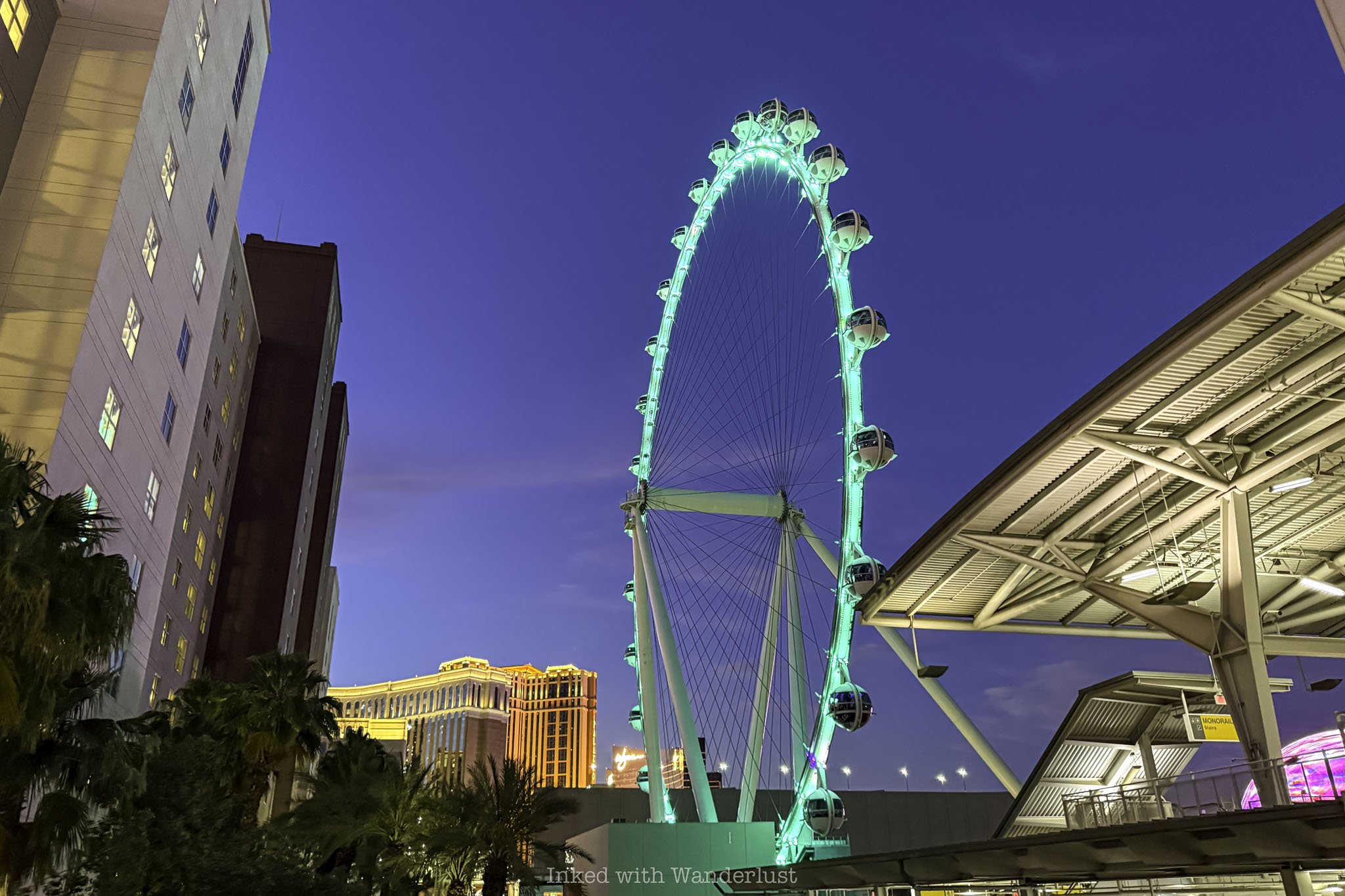
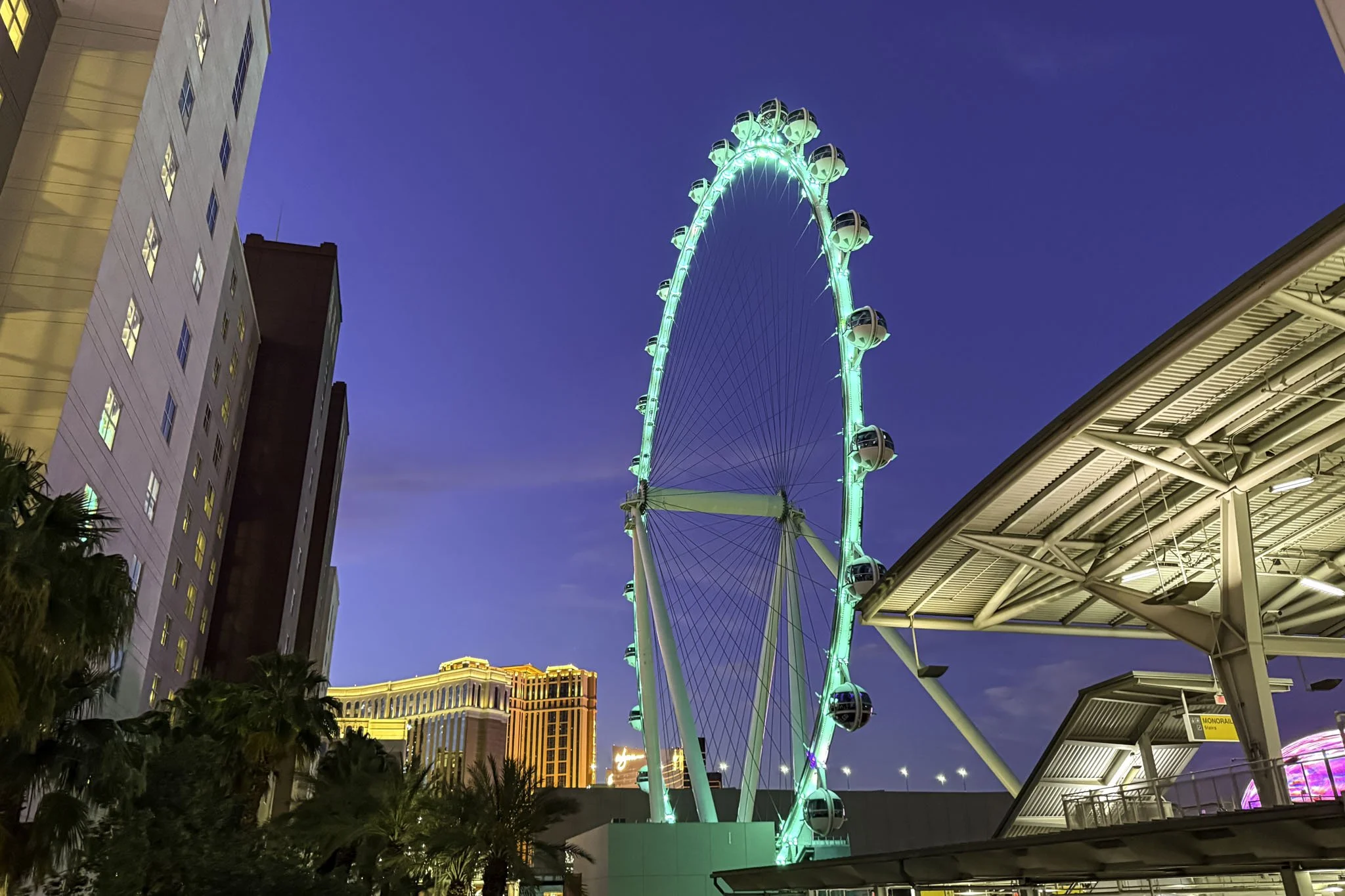
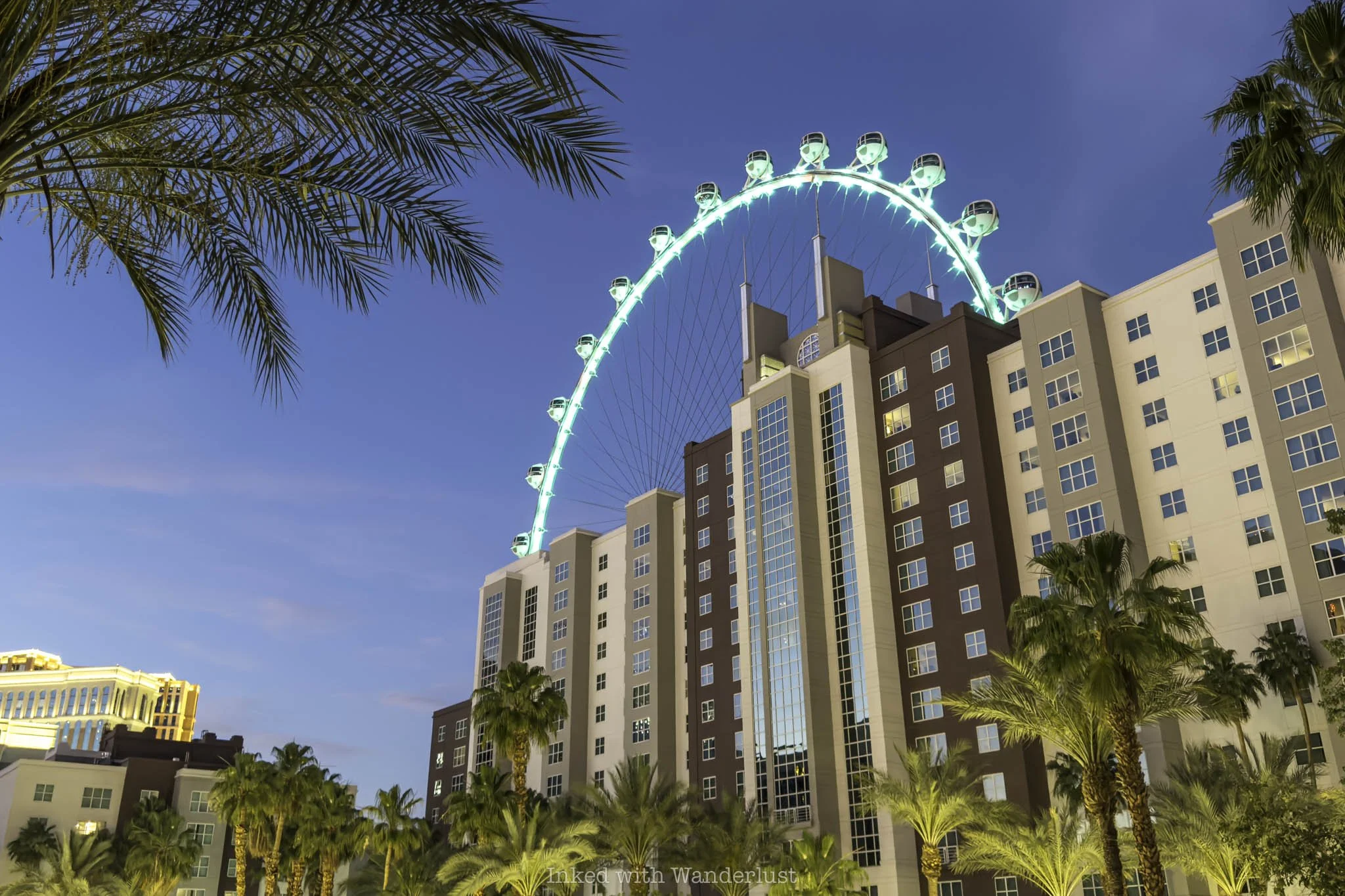
Opened in 2014 as the crown jewel attraction of the then newly minted Linq Hotel and Experience, High Roller quickly garnered the attention of Las Vegas tourists and cemented itself as a mainstay attraction along the strip.
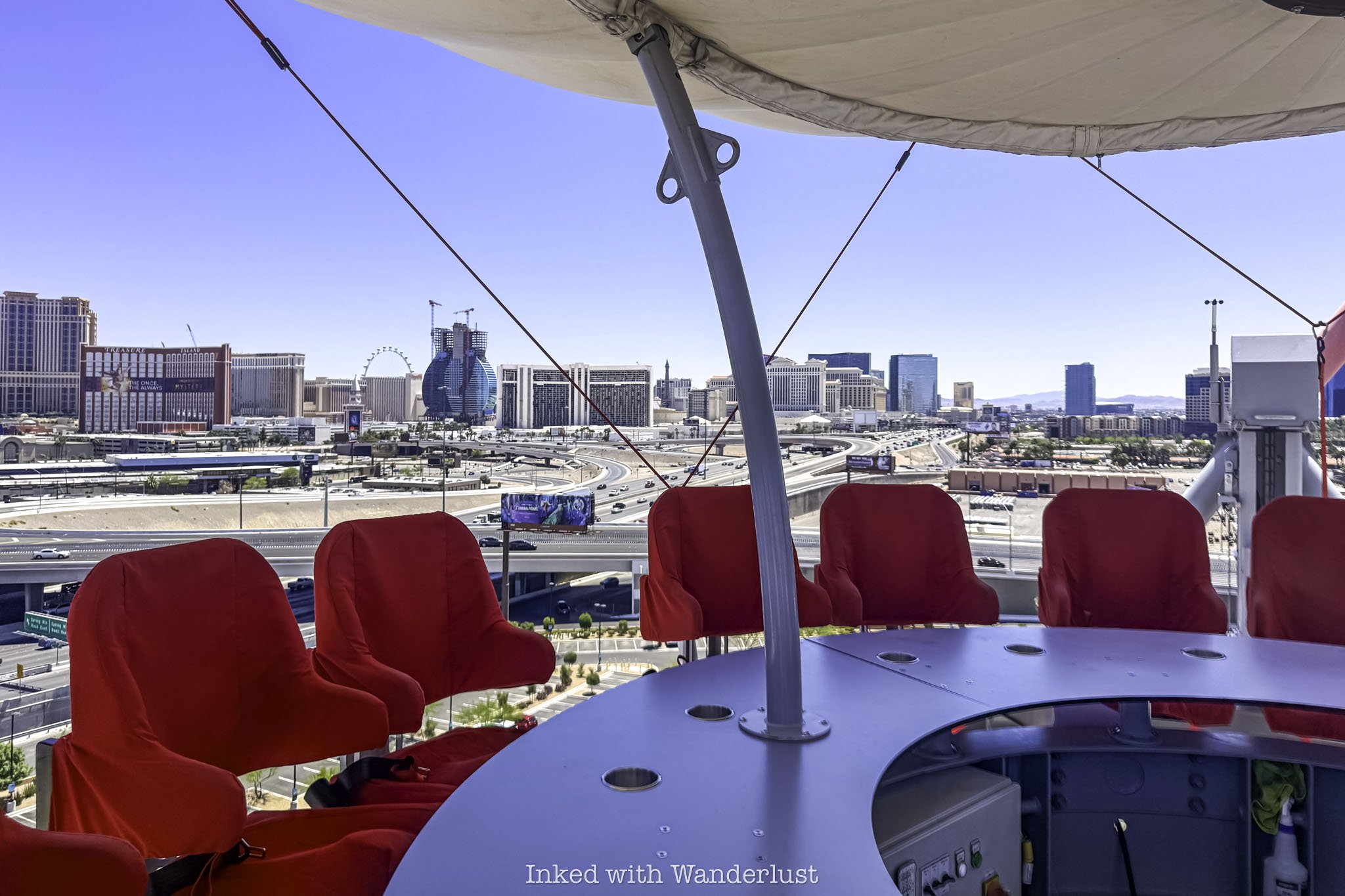
Looming over the Las Vegas Strip at a commanding 550-feet (168 meters) tall, it’s currently the tallest ferris wheel in the United States and the second tallest in the world (behind only the Ain Dubai, which stands at an impressive 820-feet).
One of the featured upgraded tickets is the “Happy Half Hour” option. It’s a word-play on the happy hour moniker, with “half” added due to the wheel taking thirty minutes to complete one full cycle. Oh, and an open bar inside your pod is included.
Many people, such as yourself, wonder if the Happy Half Hour ticket is worth it, especially considering the additional cost. Recently, I set out to try it for myself in order to answer that very question. This post will also cover ticket information, location and more. Let’s get into it.
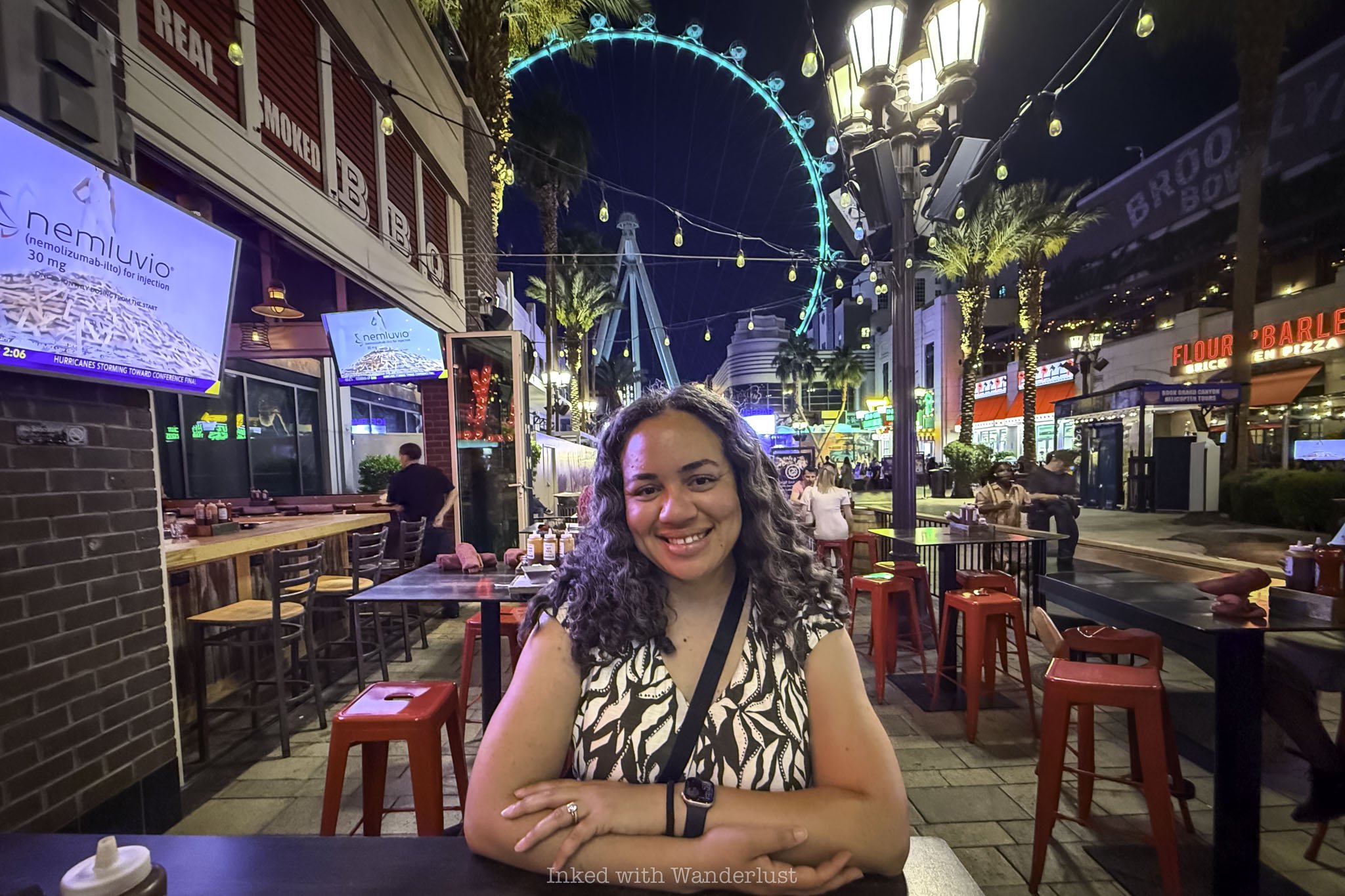
High Roller is located at the end of Linq Promenade, which itself is located center-strip between the Linq and Flamingo Hotels. If you’re staying at either, both properties have dedicated entrances to the promenade.
It isn’t a hefty walk to High Roller from the strip entrance, but it is at the very end. You’ll pass several shops and restaurants along the way, including Chayo Mexican Kitchen and Virgil’s BBQ (both of which are solid options if you’re hungry).
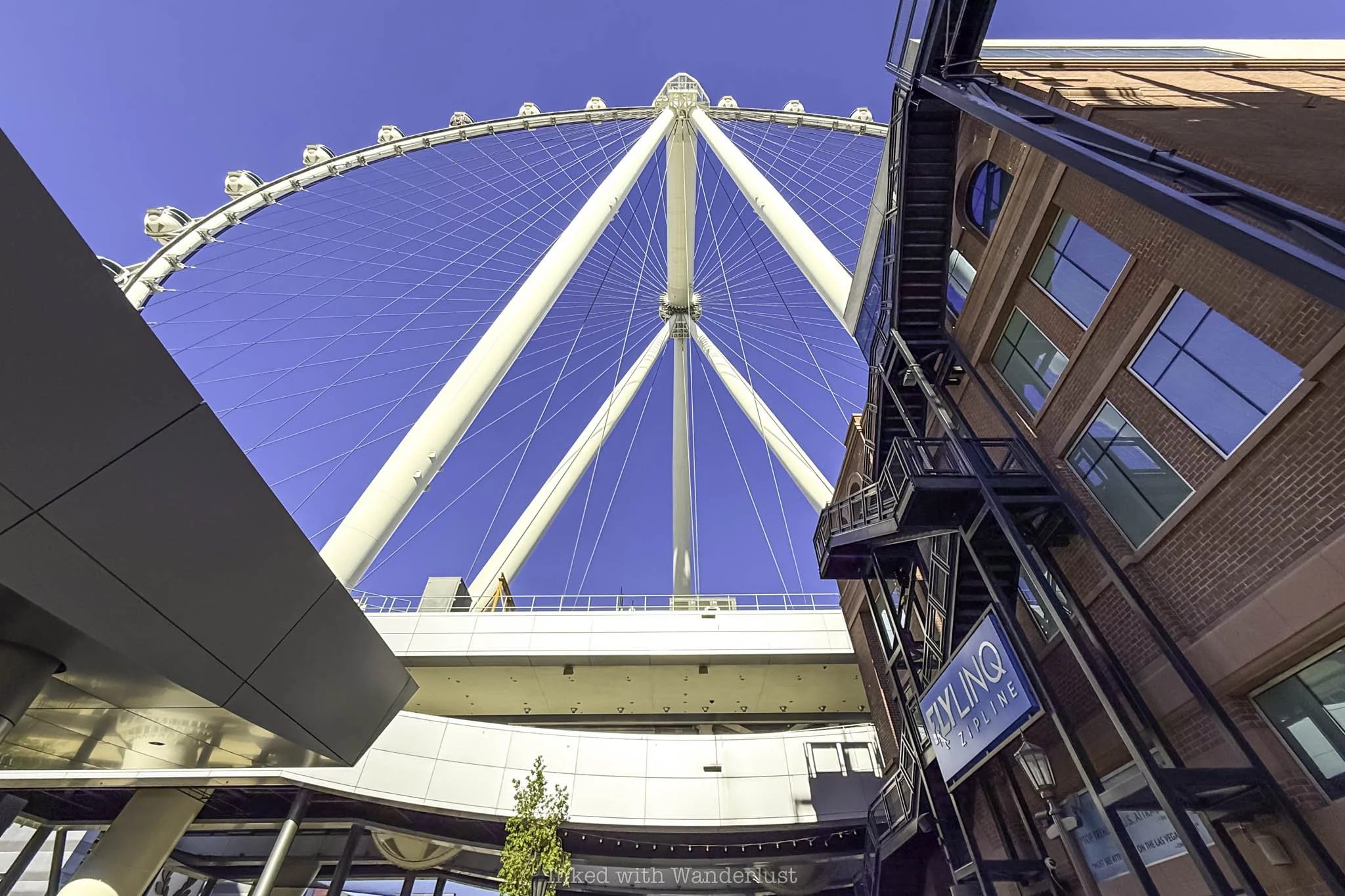
Tickets for High Roller start at $16 for youths (ages 4 - 12) and $30 for adults through High Roller directly (which, in turn, utilizes Ticketmaster as a sales portal, of all places). The prices above are for daytime rides, which mean you must arrive between 12 - 5pm.
For night rides, you have two options:
Elect for the “Anytime” option. This means you can arrive anytime, day or evening, during operating hours. This brings an additional cost of $10 - $12 each, depending on ticket type.
Elect for the “Happy Half Hour” ticket. This ticket includes the ride, anytime arrival and an open bar inside the pod. Yes, seriously. Clearly, this option is for those 21 years of age and up. Even if you don’t drink, you can opt for this if you’d prefer a kid-free experience. They start at $53.
Click or tap here to purchase your High Roller tickets through my preferred partner, Viator. They offer significant discounts on High Roller tickets (and other Vegas attractions).
For example, you can get two adult "Anytime” tickets for summer weekdays as low as $57.30 for the pair (just $28.65 each). Add youth “Anytime” tickets for as low as $18 each! Normally, these would cost $42 and $25 each, respectively.
If High Roller (or any Las Vegas Strip attraction) is on your itinerary, consider purchasing through Viator at my link to take advantage of these money-saving discounts!
High Roller Happy Half Hour Experience
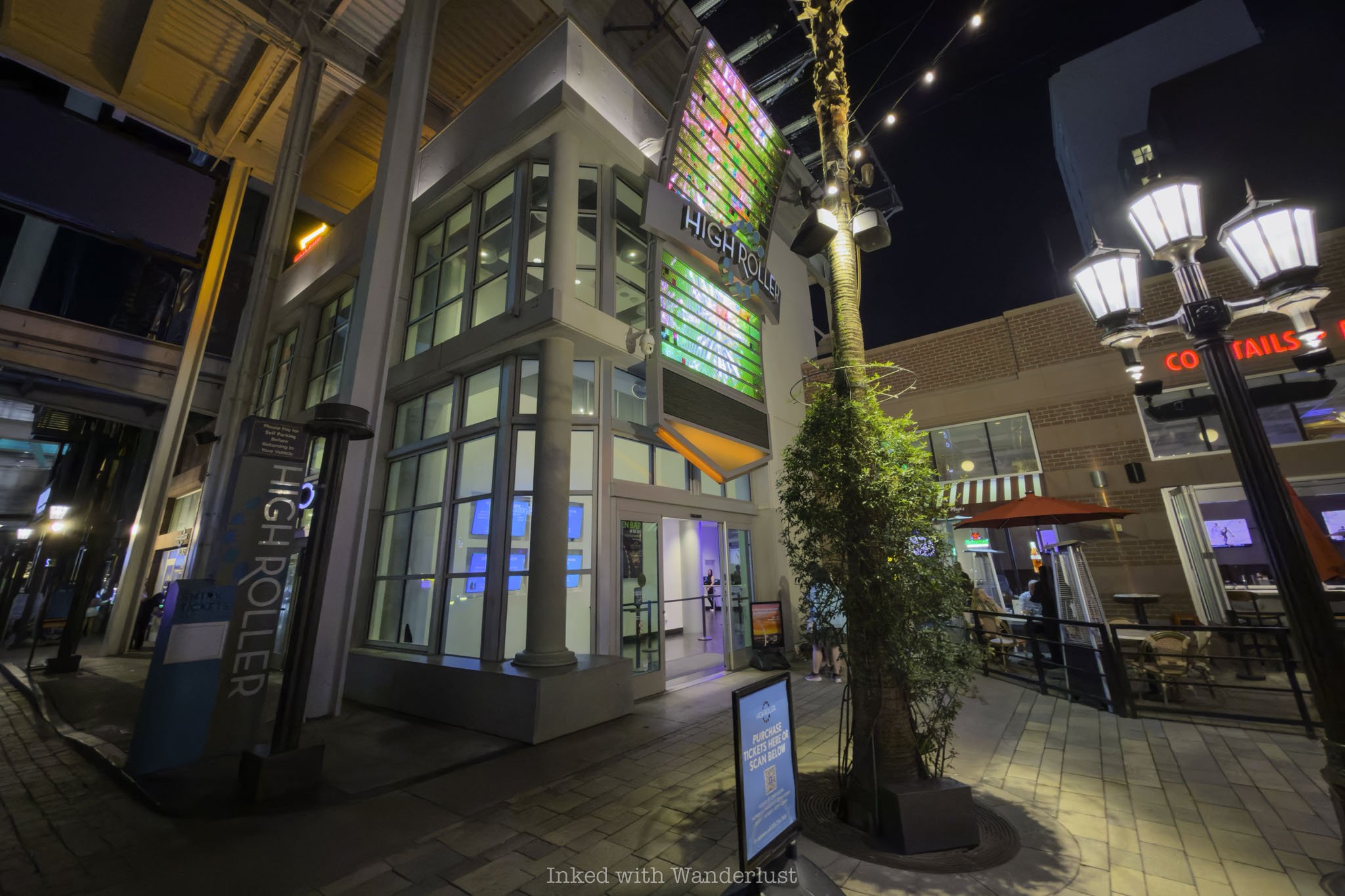
Your ride on High Roller begins at the end of Linq Promenade in what initially appears to be a small building on the right, just after passing Maxie’s restaurant. When entering, you’ll get into the left queue if you already have tickets or the right queue if you need to purchase.
**You’ll save a whole lot of time and money by purchasing your tickets online ahead of time.
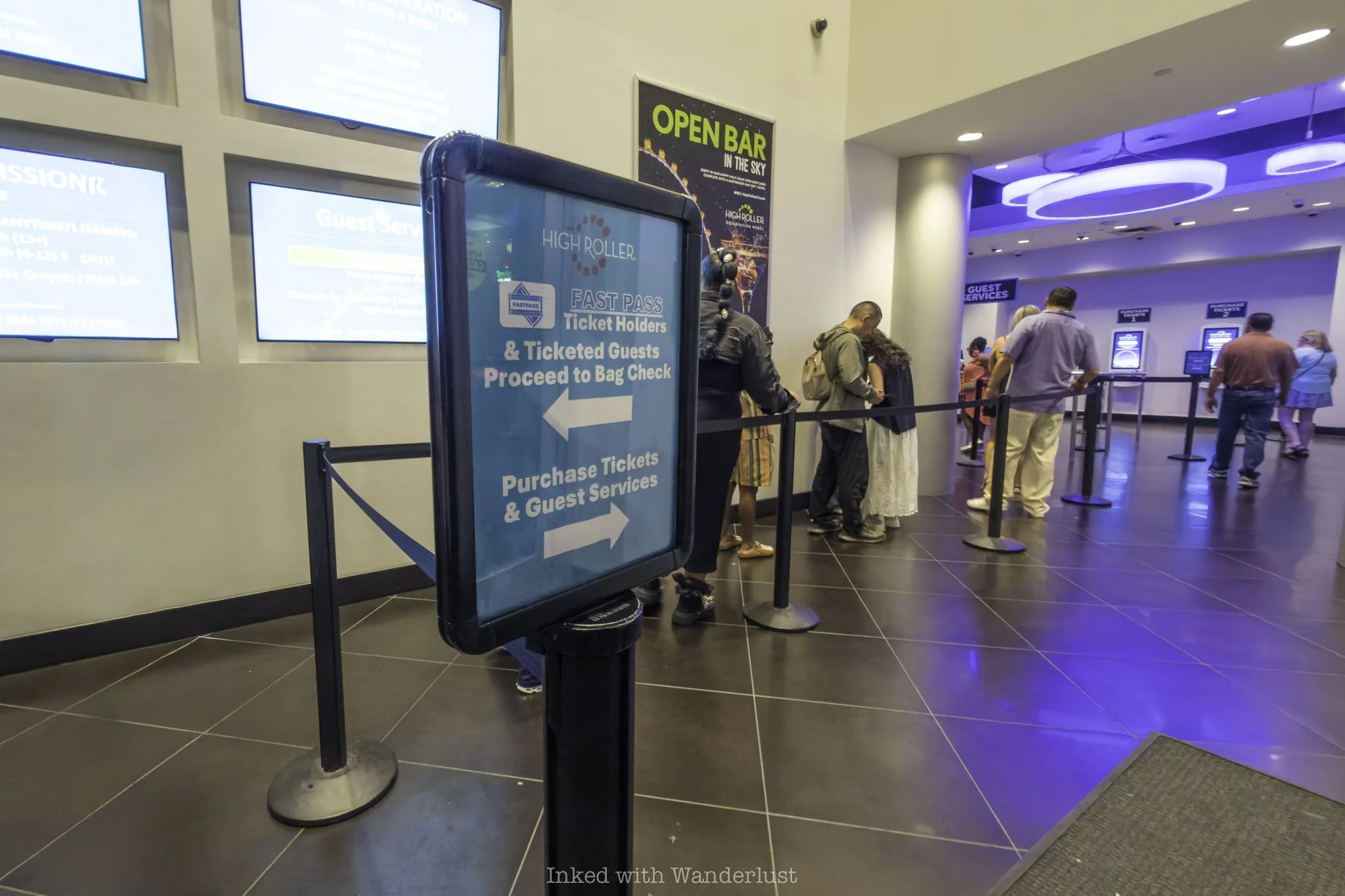
This initial queue is for security check. Here, you’ll go through a metal detector and if you have a bag it’ll be checked by security personnel. Small bags such as purses and cross-body bags are permitted. Larger bags such as backpacks and suitcases are not.
There are no on-site lockers, so it’s advisable to leave backpacks at your hotel. If you’re staying at a Caesar property that isn’t Flamingo or Linq, you can leave your bag with the front desk at either of those two hotels.
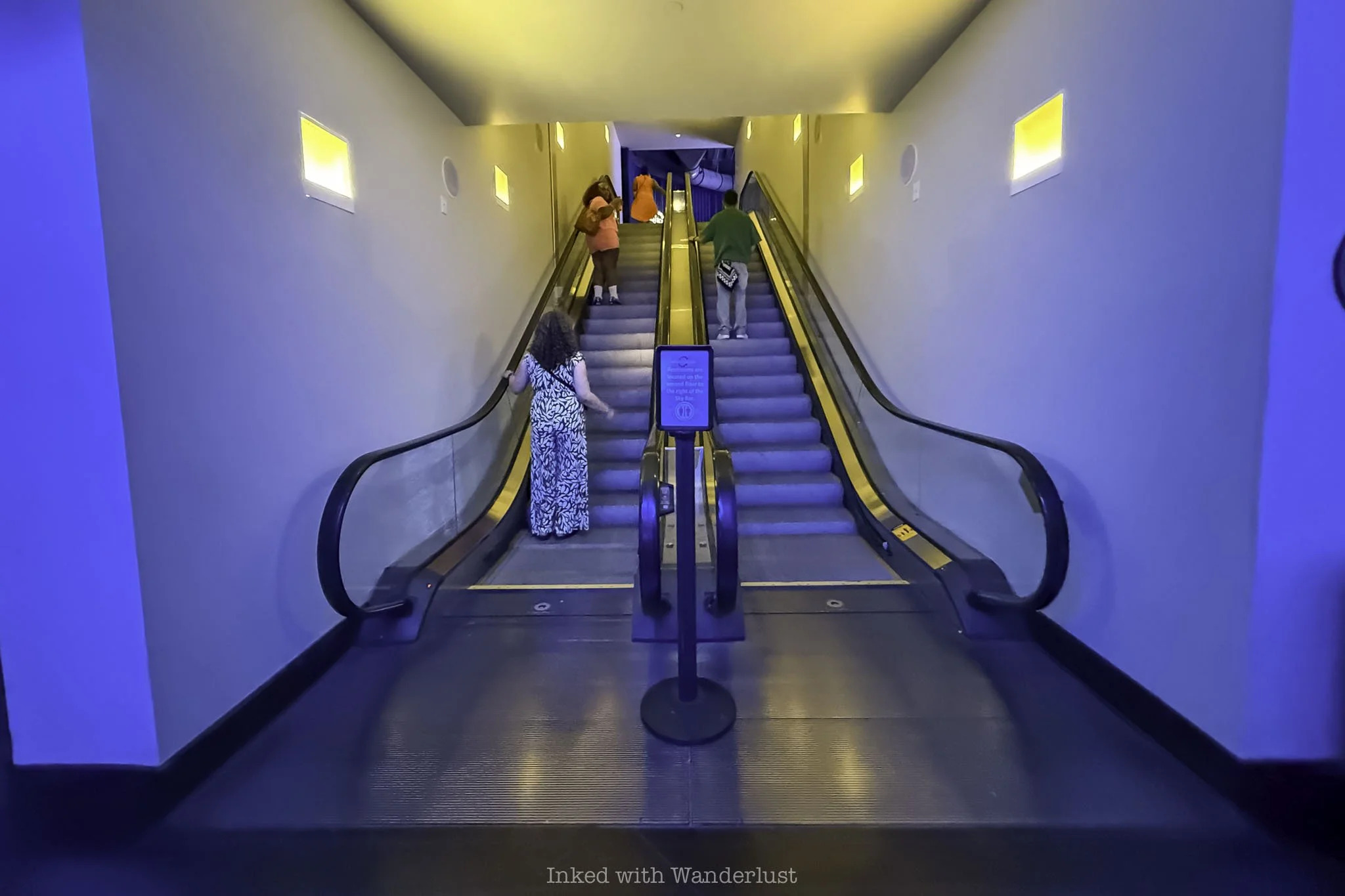
Past the security checkpoint is an escalator that will take you up to High Roller Sky Lounge. If you didn’t purchase the Happy Half Hour ticket, you can purchase a drink here and bring it with you onto High Roller.
From the sky lounge, you’ll walk into High Roller’s boarding area. Once through, you’ll enter another room where a queue may or may not have formed. If you purchased the “Fast Pass” ticket, this where you’ll cash that in.
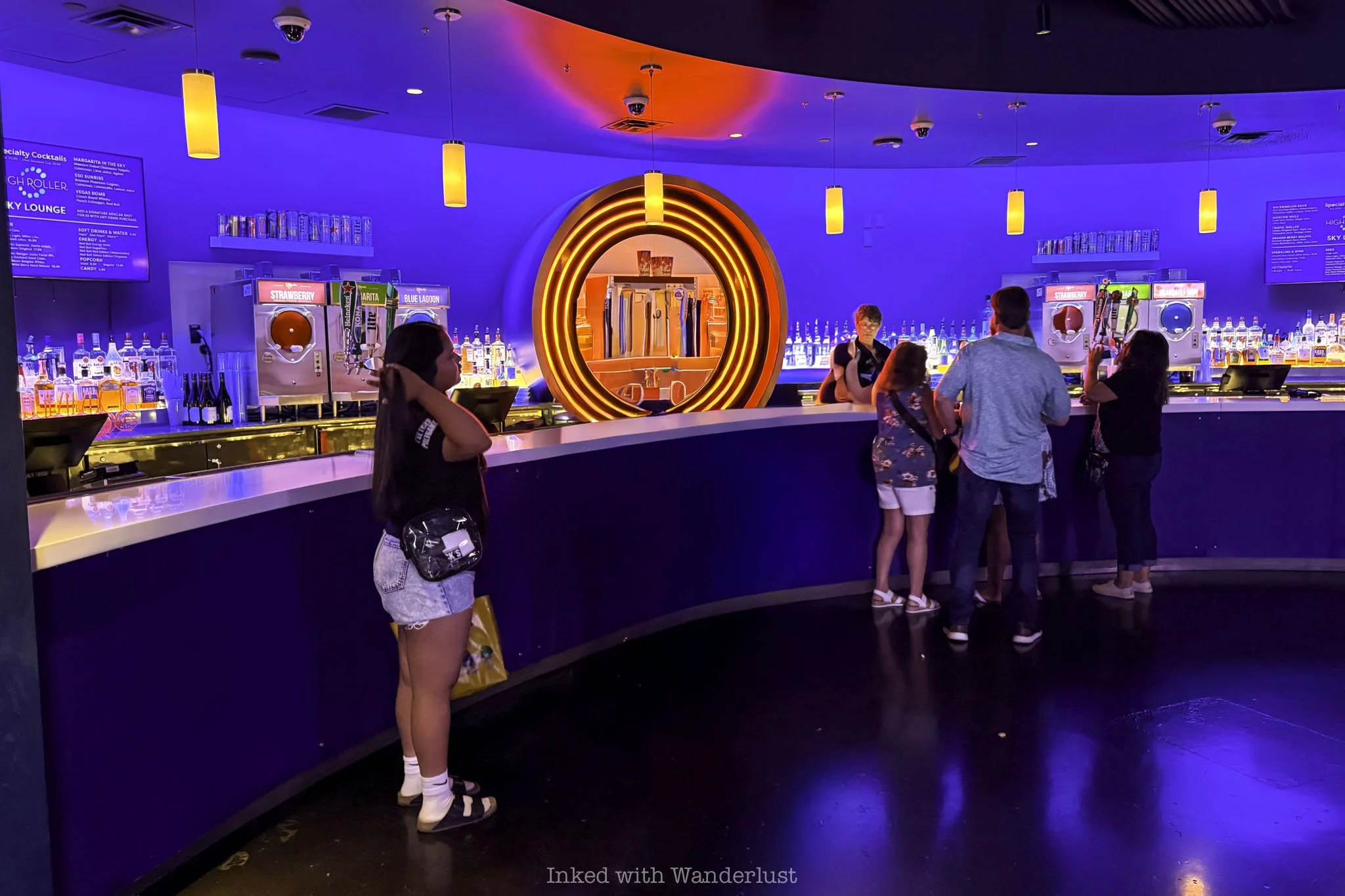
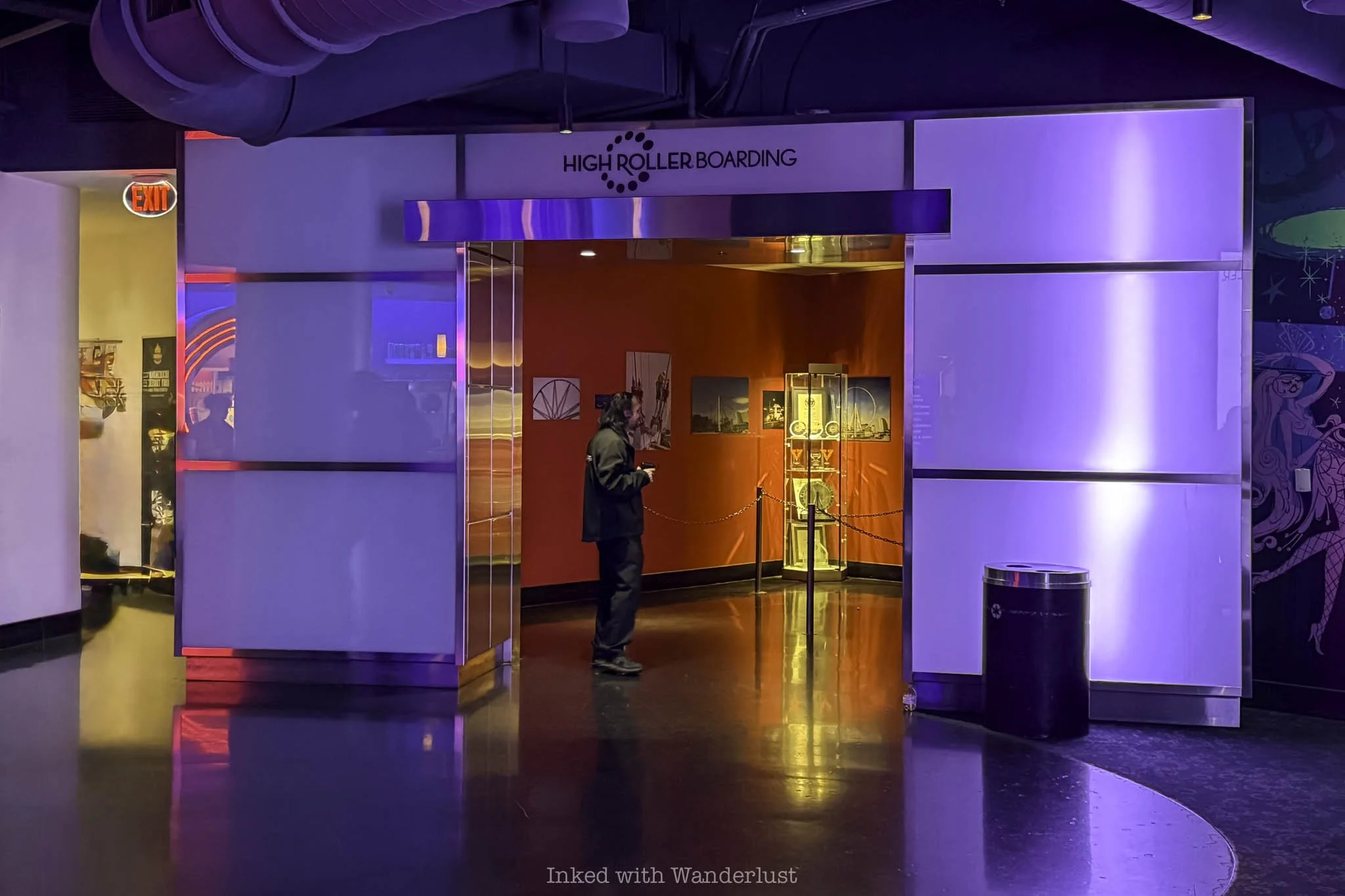
Past that room, you’ll enter yet another room, this time for the shameless touristy photo. Here, a High Roller employee takes your photo in front of a green screen with hopes to sell you said photos after your ride concludes.
If you want the photos, cool. If not, you don’t have to participate. When it’s your turn, simply inform the employee that you’re not interested and you’ll be allowed to bypass (the photo opp, NOT the queue).
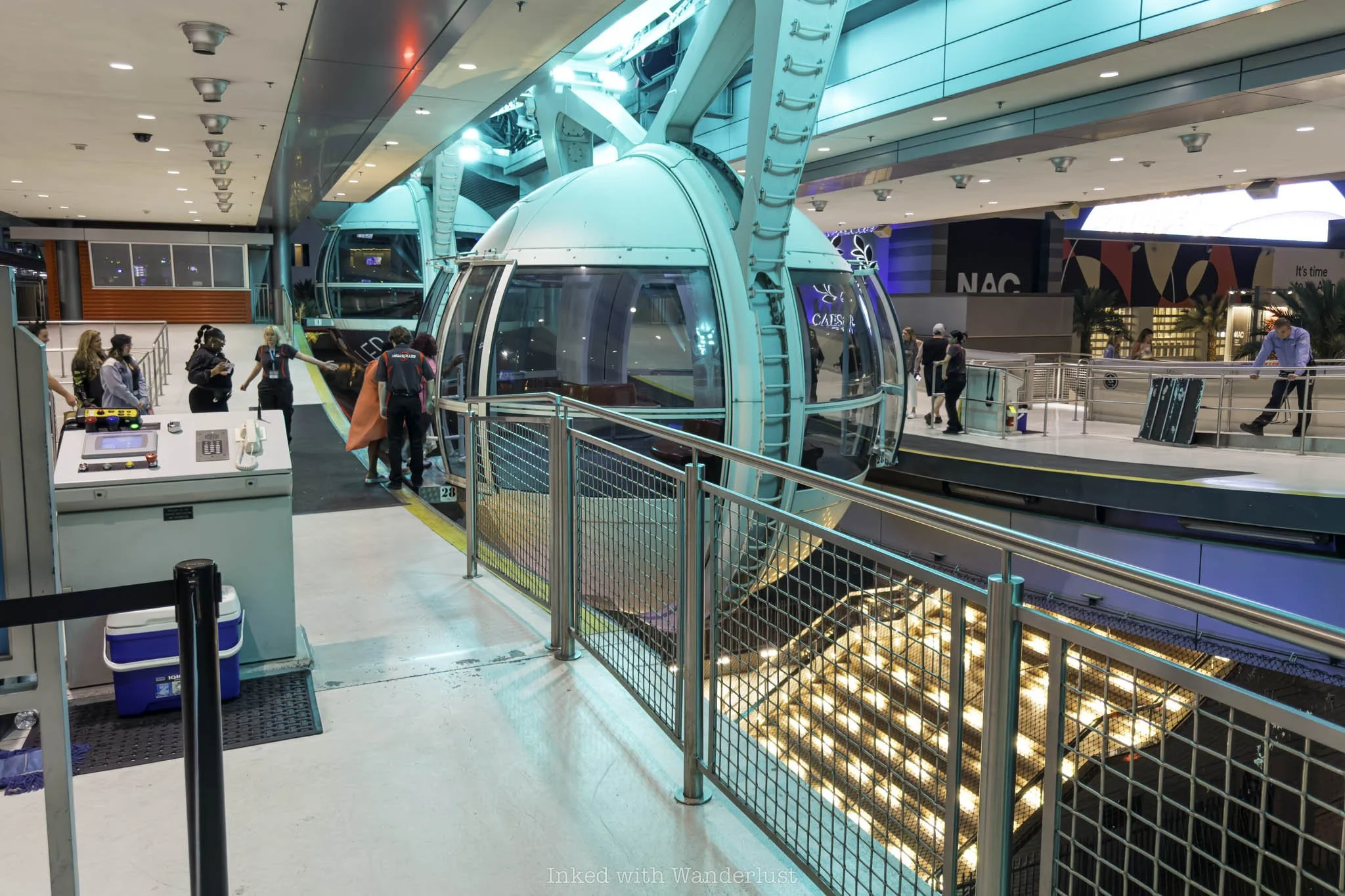
Afterwards, you’ll be asked to present your tickets. If you’re taking a normal ride you’ll be guided to the left. If you’re here for the Happy Half Hour, like my wife and I were, you’ll be guided to the queue on the right.
High Roller has 28 cabins, each capable of holding up to 25 people. However, not every cabin will have a bar inside of it, so you may have a bit of a wait. Once your cabin becomes available an employee will guide you in.
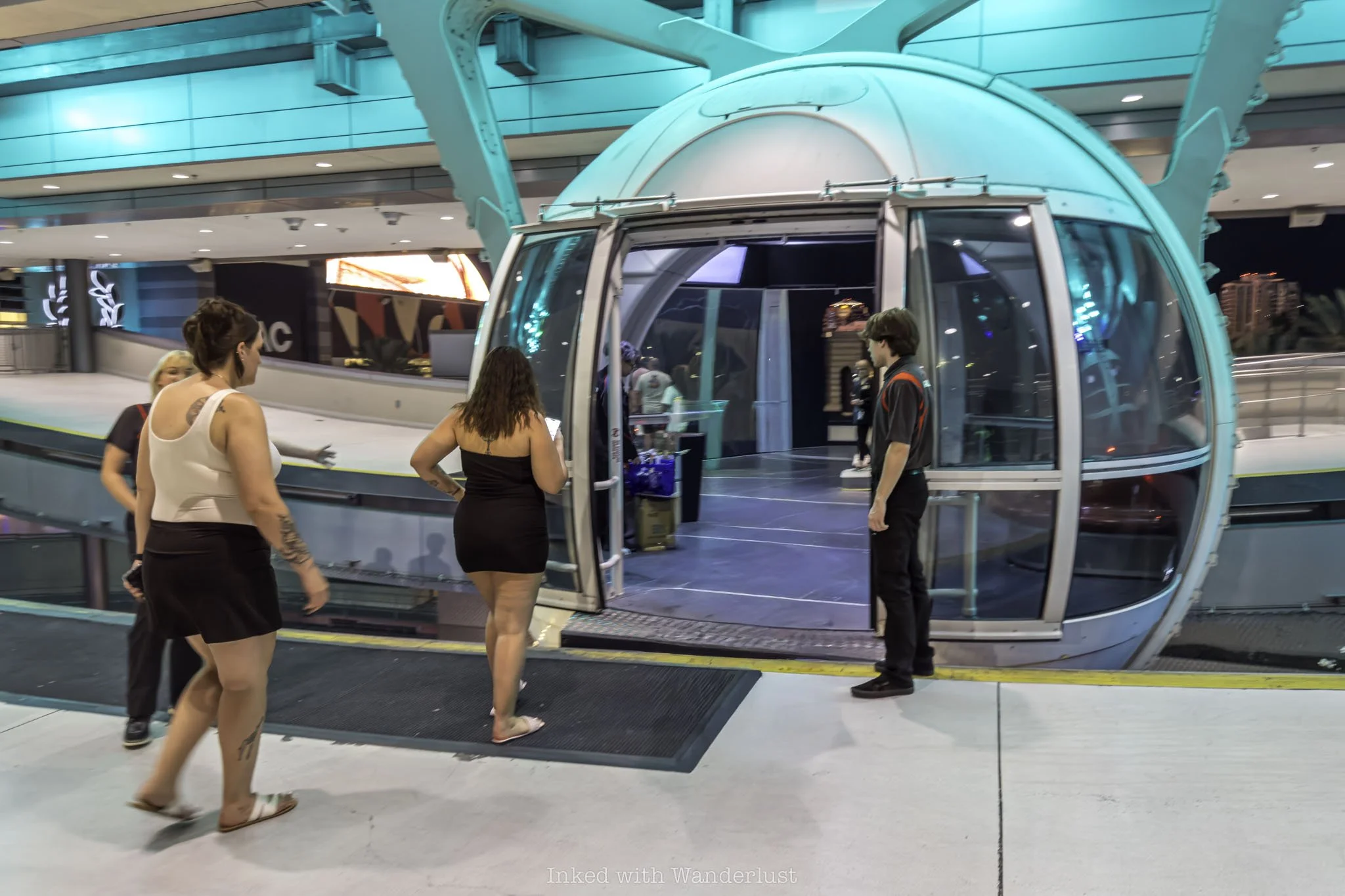
Just before walking in, your bartender will introduce themselves, go over the rules and policies, and check IDs. Everyone will file in and once the doors close a thirty-minute countdown will appear on the screens above you.
As stated above, each cabin can hold around 25 people at a time. Our cabin didn’t have that many, thankfully. I didn’t count everyone but I believe there were around ten people or so, including the bartender.
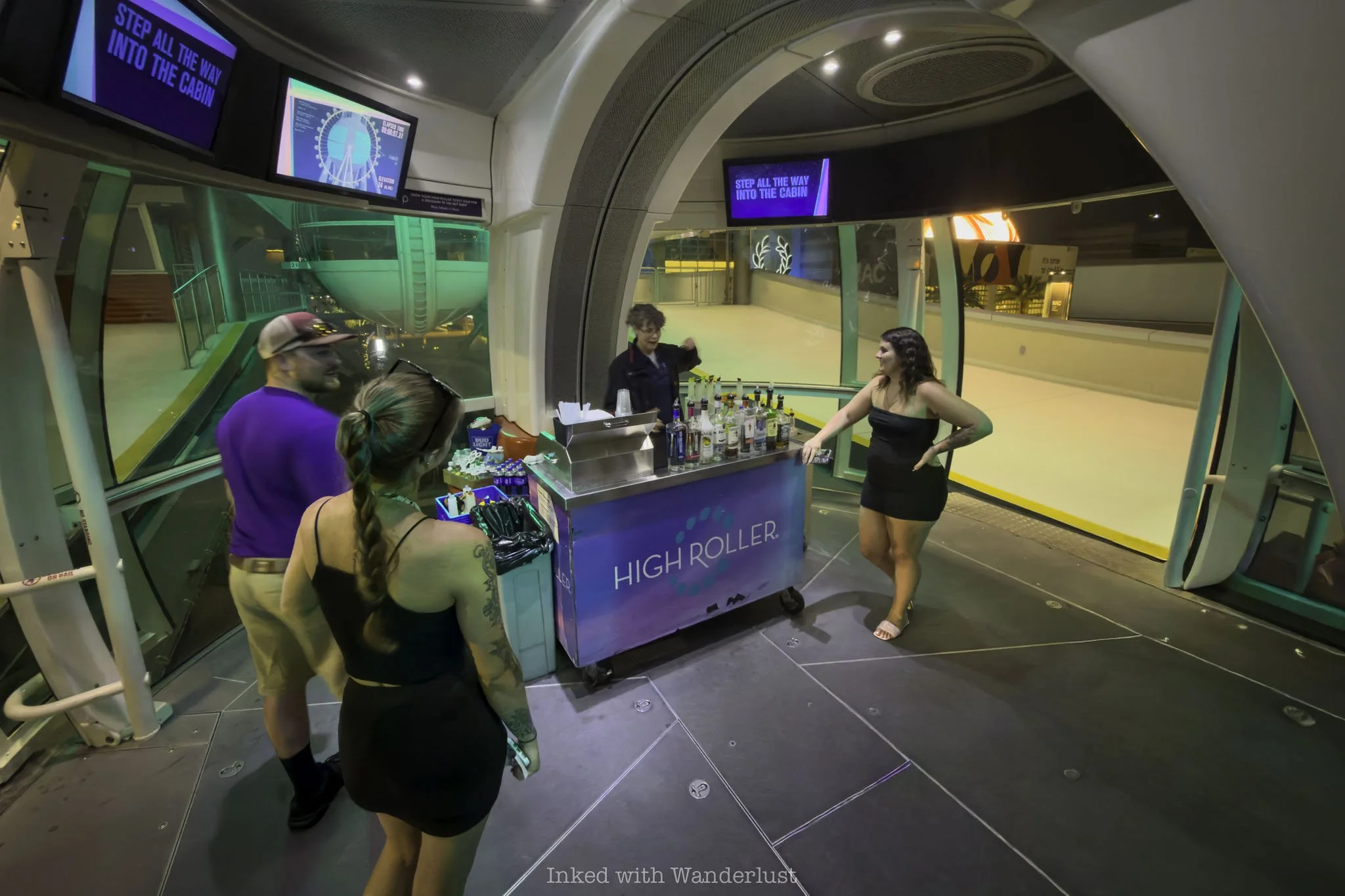
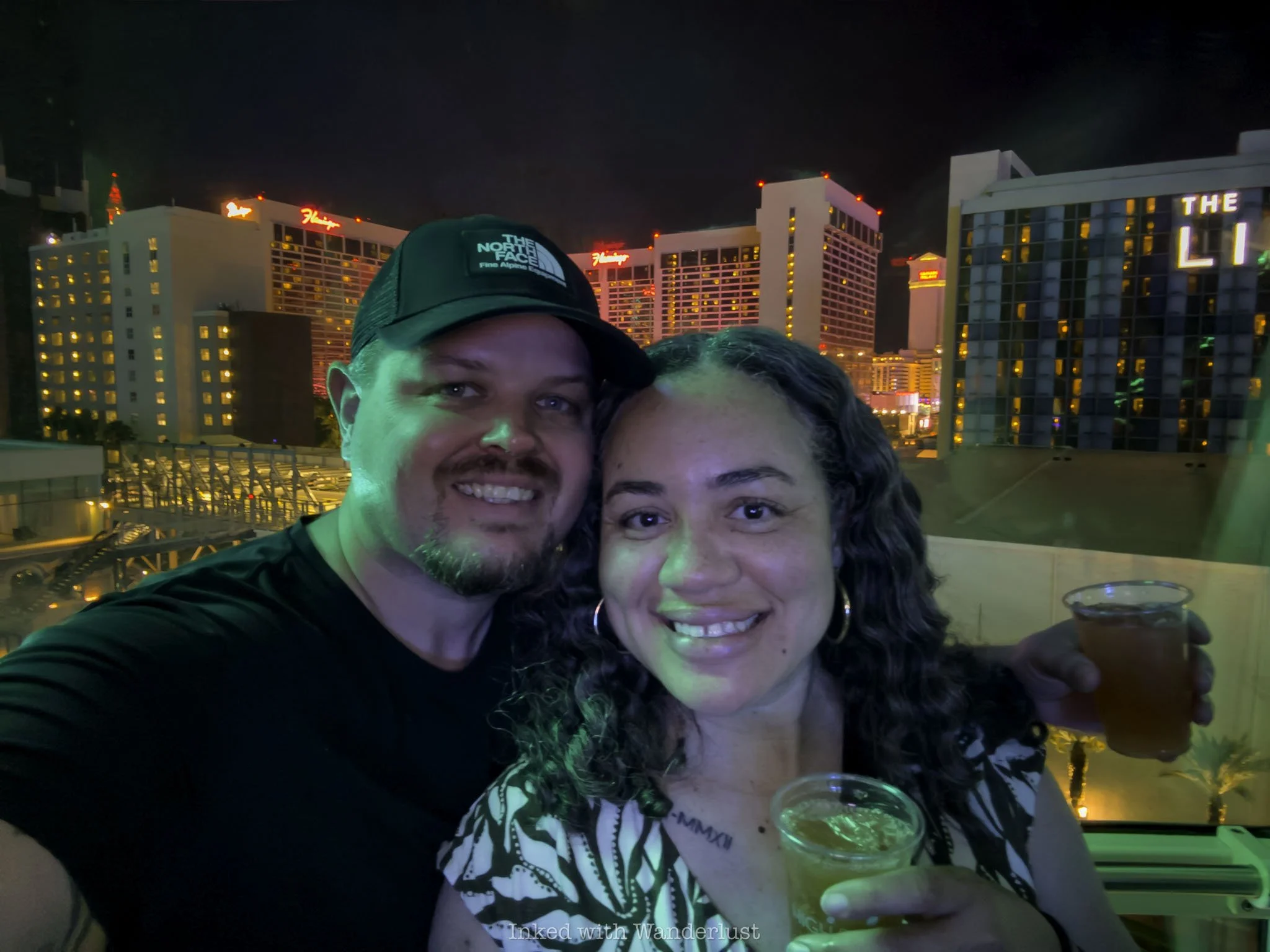
As stated above, a full rotation on High Roller takes thirty minutes. In that time, you can have as many drinks as you can handle. The drinks offered are typical fruity or citrus-based cocktails.
They’re fairly basic cocktails that wouldn’t stand out in nearly any other place in Vegas, but they’re certainly tasty. If those type of drinks aren’t your thing, your bartender will take special requests, provided it’s nothing overly complicated.
The cups are plastic and on the smaller side. Essentially, two drinks at High Roller would equate to one normal sized drink just about anywhere else but, hey, they’re included in your ticket. Also, they don’t load your cup with ice (our bartender didn’t, anyway).
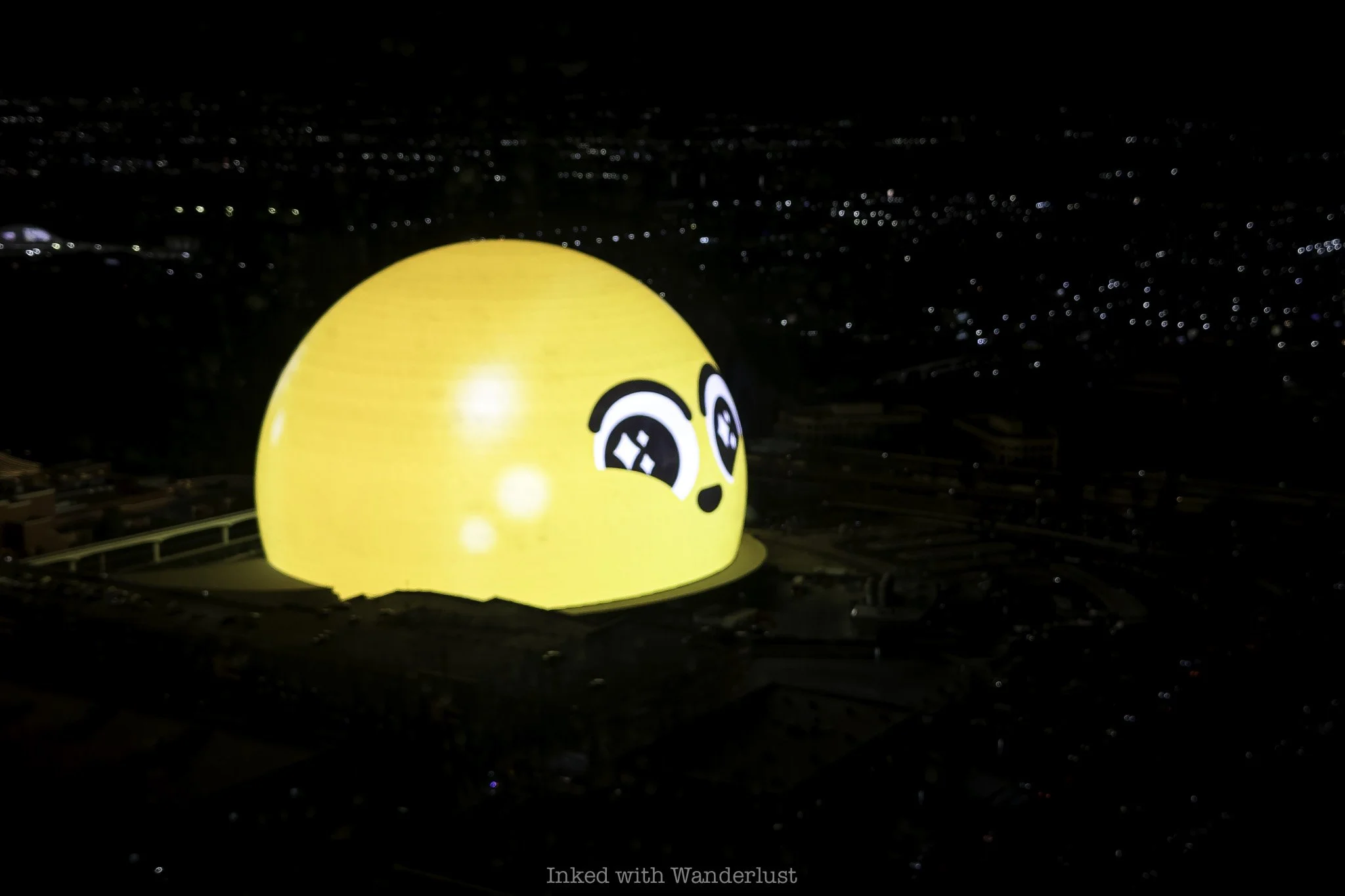
The ride on High Roller is smooth, though you can feel slight movements every so often. I don’t do well with heights and High Roller was the first attraction to test my courage since my visit to the Seattle Space Needle a few years back.
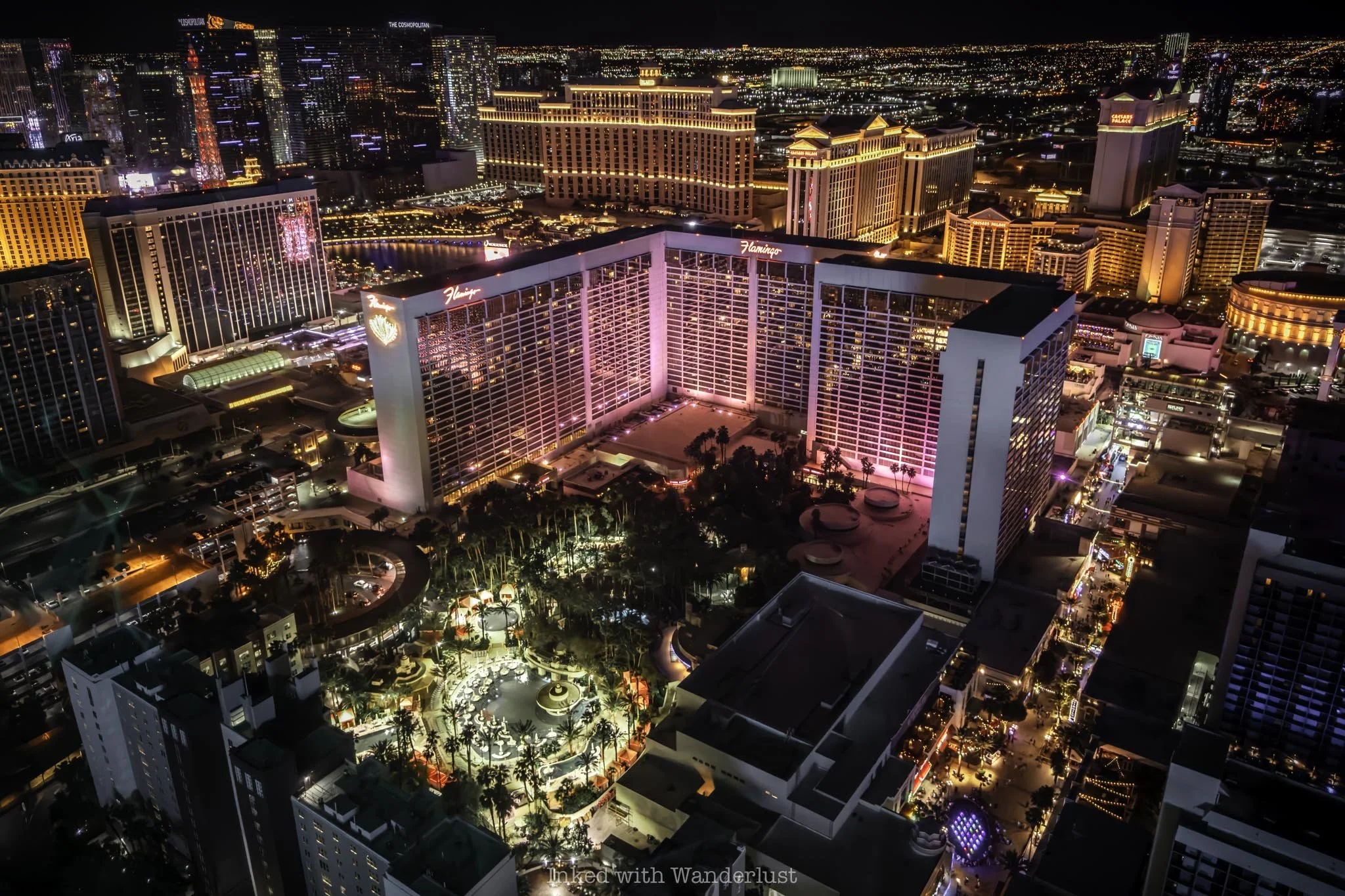
As your cabin begins to rise higher, jaw-dropping views start coming into frame all around you. To the east you’ll have a commanding view of the Las Vegas Sphere and to the west the center-portion of the strip (Flamingo, Linq, Bellagio, and Caesars) come into full view.
Look south and you’ll see the Luxor Light Beam (if riding at night) and various resorts off in the distance. Looking north will showcase the golden hues of the Venetian and Wynn Hotels. When completed, you’ll have an amazing view of the Hard Rock Guitar Hotel.
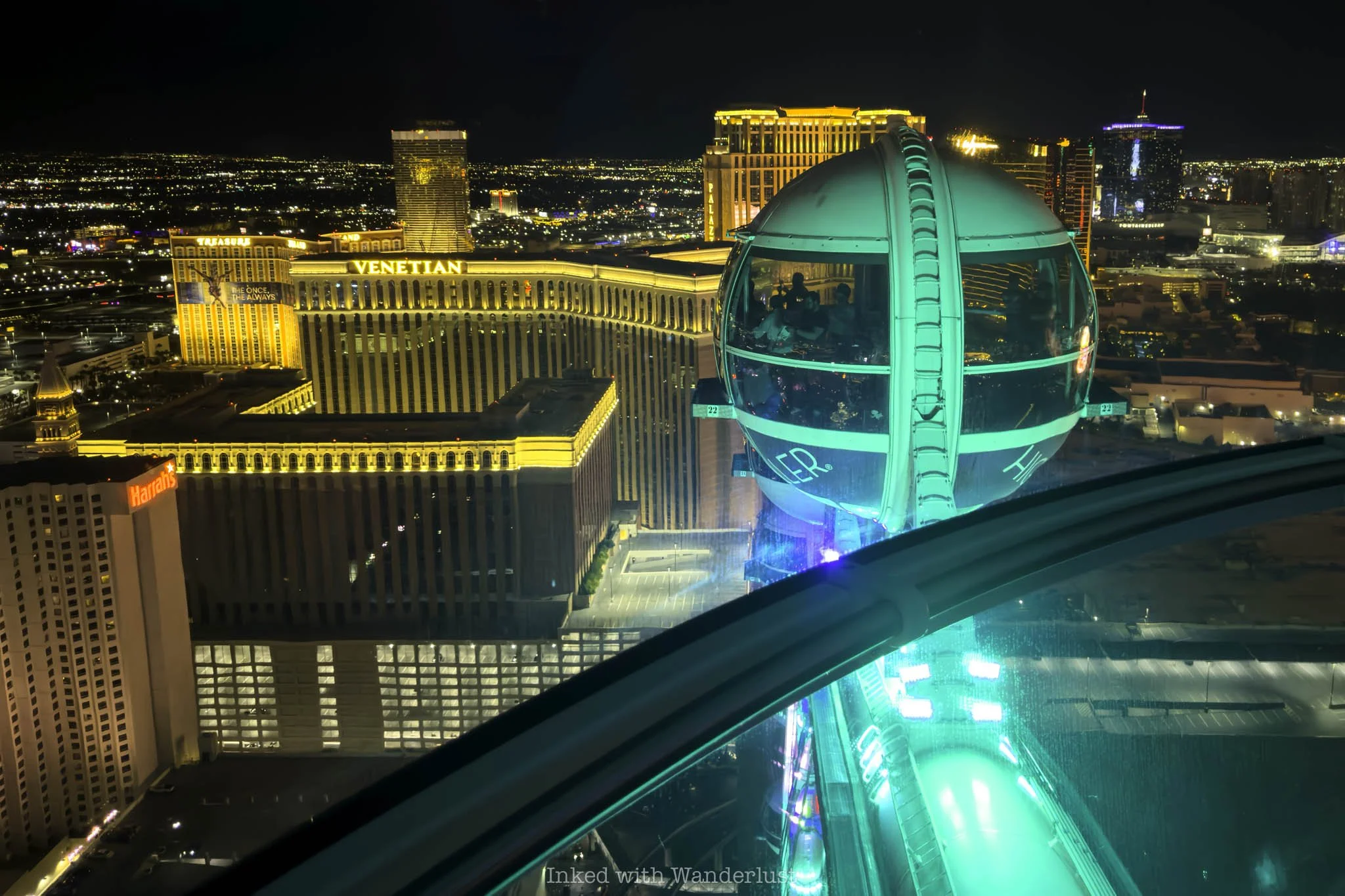
As you crest the top of the wheel, you’ve reached the official halfway mark of your ride. If you’re lucky, the ride will stop when you’re at or near the top. They sometimes do this for guest loading or unloading issues.
When your cabin begins its descent, your bartender will remind everyone they can keep ordering drinks and if they’re anything like our bartender was, they’ll offer to take photos for you. Ours was a riot and was cracking jokes with us the entire time.
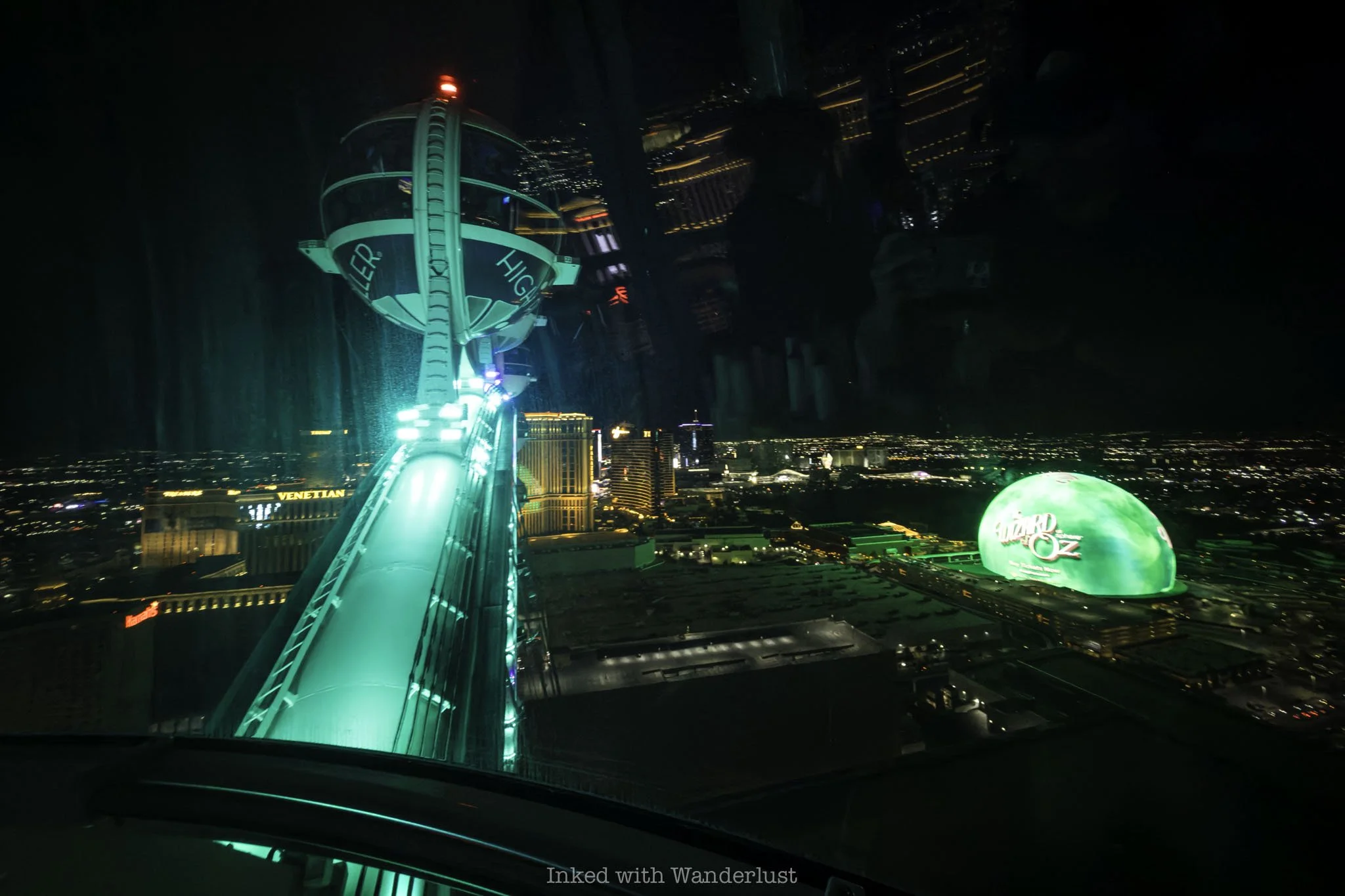
You can order drinks right up until you reach the loading area below. You won’t need to chug your drink before leaving, as they allow you to leave with it. When you do reach the bottom, you’ll exit on the opposite side from where you entered.
You’ll walk down a ramp, exit through the gift shop and arrive back at the promenade. If you’re hungry and can’t wait, I recommend Virgil’s BBQ or Chayo Mexican Kitchen. If you’re up for delicious cocktails and bomb pizza squares, walk over to the Ski Lodge speakeasy at Cosmo.
Is High Roller Happy Half Hour Worth It?
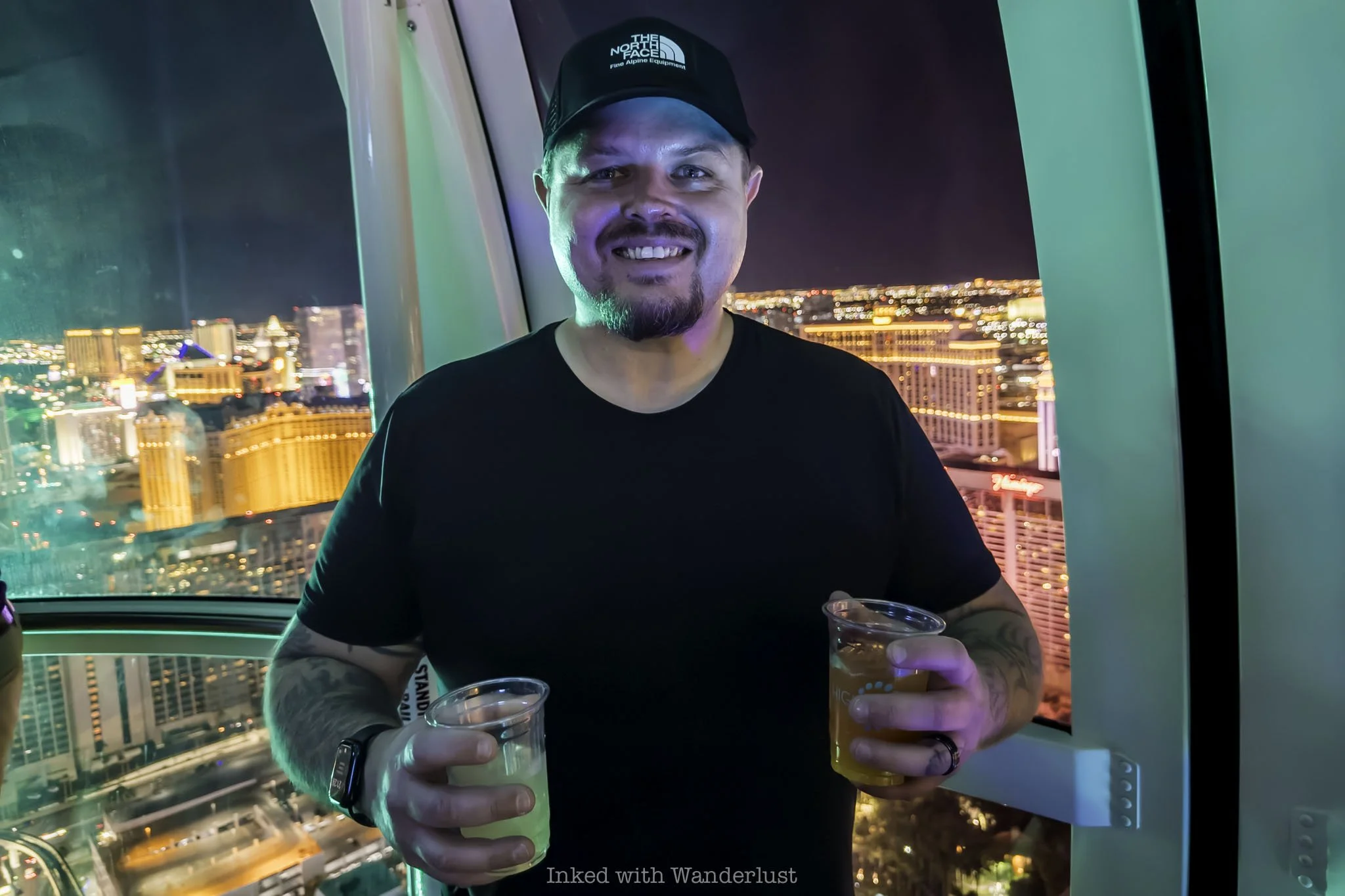
Would I say the Happy Half Hour ticket is worth it? My wife and I had a good time, so, yes, I would say it’s worth it. It’s subjective, really. Each person would need to experience it for themselves to truly determine that. However…
If enjoying unlimited (though, basic) cocktails while taking in the views of Las Vegas from up to 550 feet in the air sounds appealing to you, then I would say you’d find it worth it. Likewise if you’d prefer a kid-free experience.
Conversely, if you’re not a drinker, the only real benefit to you is the aforementioned kid-free experience. To some, that alone is worth the upgrade, while others don’t mind being around kids, rendering the extra expense unwarranted.
Additionally, if you’re being budget conscience, then the additional cost of the Happy Half Hour ticket may be prohibitive or at minimum, unappealing to you. If so, you’d be better off purchasing a standard ride and applying what you saved towards something else.
Looking for more to do? Head off-strip and test your courage at Universal Horror Unleashed at Area 15! Never been to Area 15? See my ultimate guide to the Area 15 Entertainment District here.
To save big on standard and “Anytime” High Roller tickets (and tickets to many Las Vegas attractions), purchase through my preferred partner, Viator, at this link.
You’ll save up to $15 per ticket by purchasing through Viator and by doing so, you’d be supporting Inked with Wanderlust.
How to Find Ski Lodge Speakeasy at Cosmopolitan Las Vegas (+ Review)
Requiring little more than a sense of adventure and tidbit of insider knowledge (like what you’ll get in this post), the Ski…
Disclosure: This post contains affiliate links. If you make a purchase through these links, I may earn a small commission at no additional cost to you. I only recommend products or services that I believe will add value to my readers.
Requiring little more than a sense of adventure and tidbit of insider knowledge (like what you’ll get in this post), the Ski Lodge at the Cosmopolitan in Las Vegas is a cozy, low-key cocktail lounge with a members only vibe (though everyone is welcomed).
Drawing inspiration from the coziest alpine ski bars of the world, Ski Lodge transports it guests from the blazing heat of the desert sun to a winter lodge, complete with a window overlooking a forest snowfall and crackling fire blazing.
Between the smooth and well-balanced cocktails, the flavor-packed pizza squares from neighboring restaurant, Superfrico, and self-toasted marshmallows over an open flame, Ski Lodge is unlike anything else on the strip. You just need to find it!
In this review of Ski Lodge Las Vegas, I’m going to articulate exactly how to find this speakeasy with photos and turn-by-turn directions, as well as what to expect once you’re there. Let’s get into it!
What is a Speakeasy?
As stated above, Ski Lodge is a themed speakeasy, cheekily “hidden” in a way to feel secretive and needing to be “in-the-know”. Speakeasies originated during the Prohibition era (1920 - 1933), when alcohol was deemed illegal.
Largely fueled by mob influence (and other underworld organizations), hidden bars and establishments popped up all over major cities and rural areas alike, providing spaces for folks to consume their favorite pour of choice (for a price, of course).
Since alcohol was illegal, people needed to “speak easy” when discussing these underground operations with each other to avoid unwanted attention from law enforcement. From there, the term “speakeasy” was coined to identify these establishments during conversation and reference.
With prohibition now a bygone era, modern speakeasies have been trending upwards in popularity. They aim to invoke that hidden, old school atmosphere while operating as stylish (and legal) cocktail lounges. Essentially, the term “speakeasy” is in spirit (and fun) rather than practice.
How to Find Ski Lodge Las Vegas
There are several points of entry when beginning your search for Ski Lodge. First things first, you’ll need to make your way to Cosmopolitan (Cosmo) Las Vegas, as Ski Lodge is located within it. Cosmo is located center-strip, on the west side, between Aria and Bellagio Hotels.
The Las Vegas Monorail doesn’t go to Cosmo, as the monorail is contained to the strip’s east side. However you can take the monorail to the Flamingo stop, which is the closest to Cosmo (roughly a twelve to fifteen minute walk away).
Once you’re at Cosmo, you’ll want to make your way to the second level. If you enter Cosmo walking from Flamingo you would have do so via the sky bridge over Harmon and thus, would already be on the second level. Entering from street level? Take the escalators.
Detailed Directions to Ski Lodge
You’ll want to follow signs to their restaurant row. It isn’t officially called this, but it’s where many of their eateries, such as Eggslut, are located. When you come to “Block 16” (pictured above) continue left
After turning left from Block 16, you’ll come into this long and wide hallway with colorful, patterned carpeting. Go all the way down, veering right towards the end
You’ll know you’re going in the correct direction if you see these creepy-ass dog statues. They’ll be at the end of that hallway after you veer right (There’s a rather nice bathroom here, by the way)
Facing the dog statues, look left and you’ll see yet another hallway with a directional sign hanging above pointing the way to mega-popular restaurant, “Superfrico”. Go down that hallway, keeping the dog statues on your right
At the end of said hallway, you’ll come to a set of tall, purple doors behind the check-in desk for Superfrico. This is not where you’ll check-in for Ski Lodge, though

Facing the purple doors, look left and you’ll see a mostly nondescript black door. The identifying symbol that you’re in the right spot is the golden emblem of a skier in the center of that door. Congratulations, you’ve found it!
There may or may not be a queue of people during your visit. I’ve seen both cases online. On the day of my visit there was a small line to get in. Our wait wasn’t very long, though. Maybe twenty minutes. Your milage will vary, of course
If you’re staying in Cosmopolitan’s Boulevard Tower, you’ll take the elevator to the second floor. Coming out of the elevator, continue walking straight until you see Block 16 on your right and then follow the directions listed above.
If you’re staying in their Chelsea Tower you’ll also take the elevator to the second floor but you’ll simply walk left when exiting the elevator. You’ll almost immediately see Superfrico’s check-in desk.
Now, let’s get to the experience and my review!
Ski Lodge Las Vegas Review
As stated above, we did arrive to a small queue of people excitingly waiting to be seated. To contextualize, my wife and I were here on a weeknight during the second week of May. So your experience will vary depending on day of week, season, etc.
There was a gentlemen in a suit letting groups in one at a time, presumably as availability allowed. I’ve seen clips online of people entering Ski Lodge through the black door but when our turn came, we were guided through Superfrico’s purple doors.
From there we entered an atrium with patterned marble flooring, beautifully illuminated in a blue hue and an artsy, peacock-style colored chandelier hanging above. For a moment, my decision to skip Superfrico this time around became regrettable.
If you did have a reservation for Superfrico, you would enter through one of two sets of doors on the right. For Ski Lodge, we entered through the door second to left and came into a foyer.
I was doing my best not to get left behind as we were being swiftly led through the foyer. There wasn’t much time to look around or attain many photos, unfortunately. The foyer was similarly illuminated, but with red, purple and pink hues.
It portrayed a funky vibe that, in my opinion, was more in line with that of Superfrico rather than a lodge. I momentarily wondered if the gentlemen guiding us made a mistake and was taking us to the restaurant (honestly, I wouldn’t have been upset by that).
Alas, through another door on the other side of the room, just past an old Vegas-style neon sign, we entered a dimly lit room with the heavily-recognizable “window” behind the bar, showcasing a forested winter wonderland. We officially made it to Ski Lodge.
Seating and Atmosphere
My wife and I were seated at the back corner of the bar (perfect for incognito photo gathering). Looking around, you’ll immediately take note of all the quirky and pun-filled skiing and outdoor-themed decor plastered all over the walls.
They come across as randomly placed and a bit dis-organized, but that’s part of the charm. I’ve personally never been to a mountain ski lodge but I would imagine that this speakeasy’s portrayal leans accurate, at a minimum.
Actual skis are displayed along the ceiling near the speakeasy’s entrance. Additionally, you’ll likely take notice of the dozen or so pine trees hanging upside down. This was an aesthetic choice to match the bar’s eccentric mountain vibe.
On the other side of the room from where I was sitting was a warm, crackling fire (the appearance of such, anyway). A strange feeling it was to leave the warm atmosphere of the strip and enter such a cozy, snowy vibe-filled space.
A blend of modern hits and nineties-era classics bellowed through the speakers, filling the room with feelings of nostalgia and excitement. The noise level was on the higher side, but not so high that I couldn’t hear my wife speak.
Space is a premium inside Ski Lodge, but they make good use of it. Aside from the bar, which itself is capable of seating around a dozen or so guests, there are half a dozen tables in the main room that’ll sit four to five each, in addition to several duel-seating tables.
Near the back of the room is a social space complete with couch and coffee table. Beyond that is a separate room additional tables. It appeared as though that space was mostly utilized for larger parties.
Drinks and Food
The sole food item listed on Ski Lodge’s menu is the famous pizza squares from neighboring restaurant, Superfrico. There are three variations listed - The OG (their vegetarian offering), Ultimate Pepperoni (pictured above) and one rotating (currently Pistachio Mortadella).
We had already enjoyed an early dinner at How Ya Doughin Pizza, just down the strip from Cosmo, prior to Ski Lodge but in the name of research, we decided to split the Ultimate Pepperoni. It’s essentially a Detroit-inspired-style pizza turned up a notch (or three).
A thick, airy crust with crispy, caramelized cheese along the edges serves as the pizza’s foundation. Look closely and you’ll notice the frico-style cheese baked into the crust, giving the square an extra layer of savory crispness.
The toppings, which include Superfrico’s house-made mozzarella, tomato sauce, spicy ‘nduja, ezzo pepperoni, pickled chilis, Sicilian oregano and a drizzle of honey brings an explosion of bold, yet balanced flavor.
The salty smokiness of the pepperoni, in concert with the slow-building heat of the ‘nduja and tanginess of the pickled chilis, is already indulgence at its finest. Then that drizzle of honey arrives and contributes just enough sweetness to balance the spice.
It’s stated on the menu to expect a bit of a wait, as these pizzas are made fresh to order. We ordered ours almost immediately with our cocktails and it took roughly twenty minutes to arrive. Trust when I say - even a thirty-plus minute wait would be worth it.
Of course, Ski Lodge serves a variety of craft cocktails as well. My choice was the “Niseko Old Fashioned”. Made with a legent bourbon and suntory AO whiskey blend and finished with spiced coconut, it wholly fits with Ski Lodge’s intimate atmosphere.
Rich whiskey notes lead the way, followed by subtle hints of sweetness and spice that adds depth without overwhelming the drink. It’s well-balanced, easy to sip and crafted with enough complexity to keep it interesting and pairs perfectly with the savory pizza squares.

Next up is “Slava’s Snowstorm”, my wife’s drink of choice. As one of the most popular drinks at Ski Lodge, it can be found in the “Gnar Classics” section of the menu. It’s the kind of cocktail that makes an impression even before taking your first sip.
A blanket of warm toasted coconut cardamom foam sits atop the chilled drink, creating a unique contrast that immediately sets it apart. The rich cold brew comes through first, delivering the familiar comfort of an espresso martini, while subtle notes of spice and sweetness add extra depth.
The coffee flavors are bold without being bitter, the foam adds a silky texture and the cardamom lingers pleasantly on the finish. Creative, smooth and easy to drink, Slava’s Snowstorm feels right at home in Ski Lodge’s cozy, fireside setting.
The sole dessert item on Ski Lodge’s menu is the S’mores Mountain Campfire Kit. It’s a fun addition to the Ski Lodge experience, especially if you’re leaning into the mountain-lodge vibe.
Roasting your own marshmallows at the table adds a playful, interactive element, and the finished s’mores are genuinely tasty. Gooey marshmallows, melted chocolate and crisp, penguin-shaped graham crackers come together just as you’d expect.
That said, the price feels a bit steep for what you actually receive. At $30 (at the time of this review’s publishing), it feels like you’re paying more for the experience, rather than the dessert itself. Which, to be fair, is a frequent characteristic in Las Vegas.
The quality is there and the experience is surely enjoyable, however the portion size left me questioning the value. It’s worth an order if it’s your first time and you want the full Ski Lodge experience, but it likely wouldn’t warrant an order on subsequent visits.
I didn’t do this myself, but I have been told that you can order most entrees off of Superfrico’s menu at Ski Lodge. Either use your phone to scan the menu or ask the bartender to supply you with one.
Does Ski Lodge Las Vegas Take Reservations
Unlike neighboring restaurant, Superfrico, where reservations are not only accepted but highly suggested, Ski Lodge does not accept reservations. It’s first come, first serve seating and crowds are controlled via a queue outside of the speakeasy.
Would I Recommend Ski Lodge?
In short, yes. Highly, in fact. I first heard about Ski Lodge in 2024 when my wife sent me a Tiktok about it. Since then, it’s been at the top of my must-do list for our next visit to Las Vegas. Recently, that chance came.
The excitement and anticipation of merely looking for and finding Ski Lodge, in concert with the vibe-filled experience inside made the wait worthwhile. The crafted cocktails were amazing, the pizza was succulent and the service was exceptional.
In a city densely packed with bars, lounges and speakeasies, Ski Lodge sets itself apart with its unique theme and creative menu. No matter where you’re staying on the strip (or off) you should make Ski Lodge a part of your itinerary.
If you’ll still be up for more fun, you can walk over to Flamingo Hotel and experience their Bugsy Siegel-themed speakeasy, “The Count Room”. Or walk a bit further to Linq Promenade and take a “Happy Half Hour” ride on High Roller.
If you found this review helpful, please consider leaving a tip via the “Buy me a Coffee” button below. These tips help to offset ongoing expenses related to reviews like this, such as parking and entrance fees, food, drinks, gas, and more. All tips are appreciated. Thank you!

My Review of How Ya Dough’n Pizza in Las Vegas
Nestled on the top level of the BLVD complex on the Las Vegas Strip, directly across from the soon-to-be christened…
Disclosure: This post contains affiliate links. If you make a purchase through these links, I may earn a small commission at no additional cost to you. I only recommend products or services that I believe will add value to my readers.

Nestled on the top level of the BLVD complex on the Las Vegas Strip, directly across from the soon-to-be christened three-story In and Out Burger, sits one of the strip’s newest eateries - How Ya Dough’n Pizza.
What originally began as a pandemic-era home business in a Boca Raton backyard eventually blossomed into a burgeoning family owned and operated business with several locations throughout Florida.
What sets How Ya Dough’n apart from other pizza joints (which Vegas has no shortage of) is their use of sourdough crust. Due to its long fermentation process, the crust results in a near-perfect crisp that’s packed with flavor.
In this How Ya Dough’n pizza Las Vegas review, I’ll provide details as to its location and what my experience was like when my wife and I came here for the first time on our most recent visit to the strip. Let’s get into it!
How Ya Dough’n Pizza Location
As stated above, How Ya Dough’n is located on the top level of the BLVD complex. If you don’t know what that is it’s a new, still in progress 400,000 square foot retail, dining and entertainment center in the heart of the strip.
It’s on the east side of the strip closest to the southern end (though it’s also an easy walk from many mid-strip locations). To contextualize, my wife and I stayed at the Flamingo which is practically the strip’s mid-point and we walked to How Ya Dough’n in about fifteen minutes.
Given the strip’s often disorienting complexity to newcomers, it can be challenging to pin down its location. It can be found between Planet Hollywood and the MGM Grand and across the street from Park MGM, Aria Hotel and Cosmopolitan.
When you arrive to the Adidas store at BLVD, you’ll see a green and black escalator nearby. Take it to the second level. At the top, go left and take the second escalator to the third level. When you get to the top, turn around and you’ll see How Ya Dough’n.
My Experience at How Ya Dough’n Pizza
My wife and I stopped here for dinner on the first day of our visit. We had a reserved time at Flyover and How Ya Dough’n was the perfect choice as it was on the way to Flyover and was a quick walk from our hotel.
I first heard of How Ya Dough’n through Las Vegas influencer, Vegas Starfish, on TikTok (she has fantastic content that’s worth a follow, by the way).
We arrived to an empty yet beautifully lit interior as the sun was setting. There were only two others present, so we practically had the place to ourselves. I didn’t view this as a bad thing, though, as I feel it had more to do with “the secret not yet being out” more-so than a problem.
We were greeted by friendly staff right away and were given a quick explanation of the menu. She also gave recommendations as to the most popular pizzas on the menu, as well as her personal favorites. After a quick debate, we ultimately decided on the Spicy Goose.
The Spicy Goose is topped with a blend of mozzarella, provolone and pecorino cheeses, pepperoni, soppressata, Calabrian chili, garlic and oregano. Of course, their signature sourdough crust contains it all, along with their flavorful, sweet-leaning tomato sauce.
We took a seat in their exterior space while we waited for our pizza. At this time of day, the sun had already settled behind the looming towers of the hotels across the street, providing a much needed reprieve from the Las Vegas sun.
Before long, our pizza was brought out to us. Under most circumstances I’m a straight up pepperoni pizza guy. The Spicy Goose was surely a departure from my usual, but not too much as to “shock the system”, so to speak.

The sourdough crust was the first element to stand out. They’ve perfected that fine balance of crisp edges while remaining slightly chewy, which gives the whole pie a deeper flavor than your standard slice.
The aforementioned toppings blended together to bring a slow-building heat that complimented the flavor rather than overwhelming it. While noticeable, the spice level remained well balanced thanks to the richness of the trio-blend of cheeses.
The cured meats brought a rich, salty bite with just enough grease to re-create that classic New York style slice, while the Calabrian chilies added a sharp, almost fruity heat that slowly builds the longer you chew.
The roasted garlic came through in the background, rounding everything out with a mellow and welcoming sweetness. Add to that the slightly tangy finish the fermented sourdough crust brings and that’s a recipe that kept bringing me back bite after bite.
If you’re a fan of spice, I would recommend ordering the Spicy Goose. Conversely, if you’re not, stay away. In that case, perhaps the “OG”, which is basically a Neapolitan style pizza, is more your speed. Or the “Cremini Special”, which is their veggie-forward offering.
If you find yourself on the Las Vegas Strip, definitely give How Ya Dough’n pizza an opportunity to satisfy your hunger. From here, enjoy a post-meal activity at Flyover Las Vegas just a few minute walk away.
Or, walk south a bit further to the Luxor and tour the “Titanic: The Artifact Expedition” museum. If one or two post-dinner drinks is more what you’re looking for, head north to Cosmopolitan and relax at The Chandelier or catch the vibes at the Ski Lodge speakeasy.
If you found this review helpful, please consider leaving a tip at the “Buy Me a Coffee” button below. These tips help to offset the cost of regular expenses, including parking fees, meals, gas, admission tickets, etc. Every tip is appreciated. Thank you!
My Experience at Flyover Las Vegas (Review)
In Las Vegas, a city densely packed with over-the-top-attractions, one sets itself apart from the neon lights, slot machine noise and…
Disclosure: This post contains affiliate links. If you make a purchase through these links, I may earn a small commission at no additional cost to you. I only recommend products or services that I believe will add value to my readers.
In Las Vegas, a city densely packed with over-the-top-attractions, one sets itself apart from the neon lights, slot machine noise and packed streets - Flyover Las Vegas.
This immersive flying attraction lifts you over sweeping landscapes, dramatic coastlines and iconic cities without ever leaving the strip.
With its combination of motion seating, curved screen, wind effects, mist and scent technology, it creates the feeling of true flight while only lifting you mere feet from the ground.
In this post, I’m going to detail my and my wife’s experience at Flyover during our visit. I’ll also cover topics such as location, ticket pricing, tips and more. Let’s get into it!
Location, Parking and Tickets
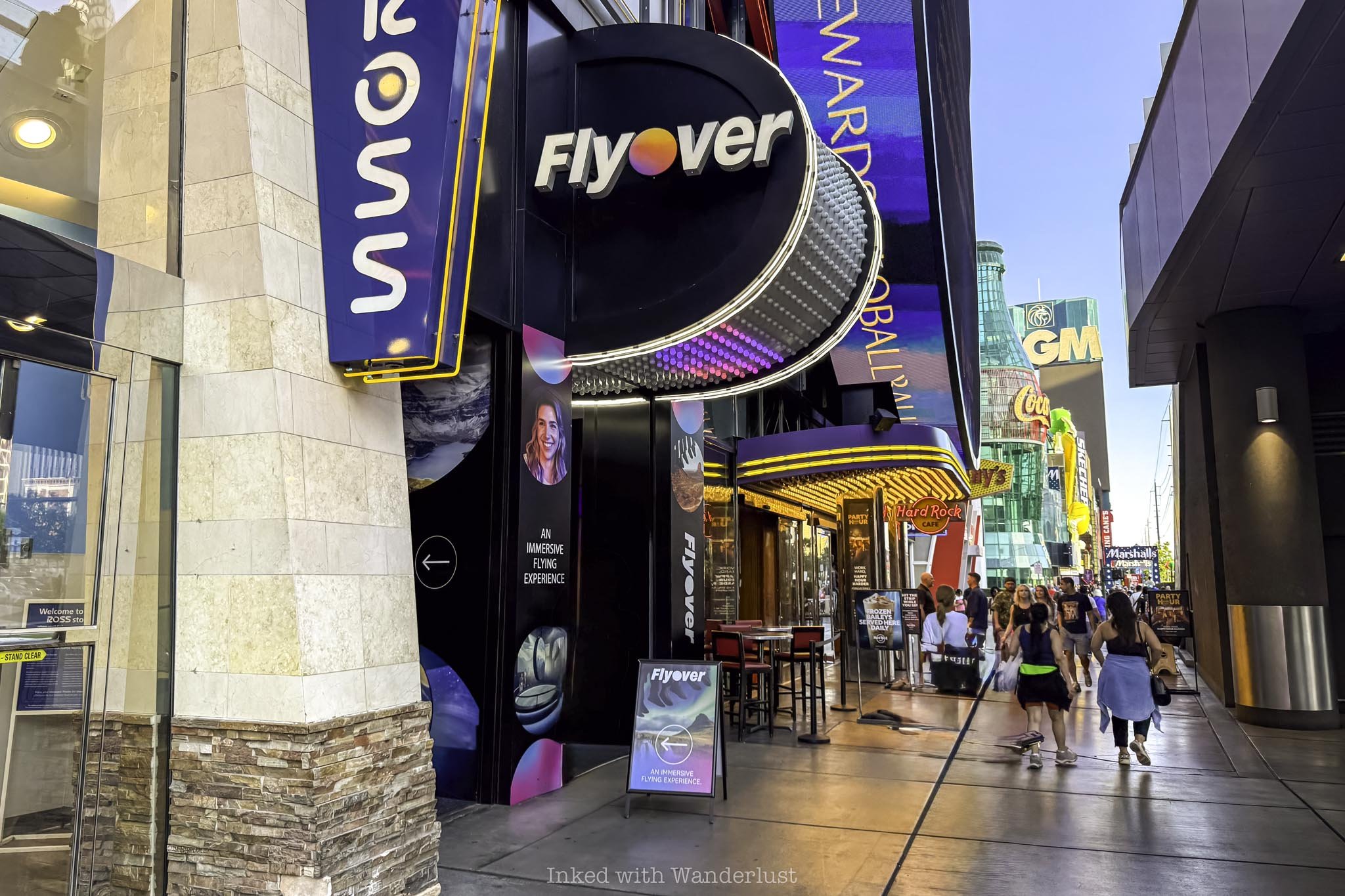
Flyover Las Vegas is located directly on the strip along its eastern side. It’s sandwiched between a Ross store and a Hard Rock Cafe, with MGM Grand being the closest resort and across the street from the New York, New York and Park MGM resorts.
This makes it closest to the southern end of the strip, but within a fairly easy walk from mid-strip. To contextualize, my wife and I were staying at the Flamingo Hotel (almost exactly at the strip’s mid-point) and it took us about twenty minutes to walk there.
From the northern end, it would be a hefty walk. If you’re staying there, I would suggest hopping on the monorail to the MGM Grand and walk from there. Of course, taxies, ride sharing, or driving and parking yourself are also options.
Parking is located in the Showcase Mall parking garage. It’s paid parking, so be prepared. Parking fees depend on several variables, including day of week, time of day, etc. Expect to pay between $15 and $23 per hour.
Tickets can be purchased through several resources, but I recommend booking directly on Flyover’s website. Unfortunately, there are several scammy sites that claim to sell legitimate tickets to many Vegas attractions but ultimately just take your money.
A few legitimate companies do sell Flyover tickets, though. A few include Viator, Vegas.com, Groupon (yes, it does still exist) and Undercover Tourist. You can purchase standalone tickets or as part of a bundle with other area attractions.
Myself, I purchased directly from Flyover and opted for their “Double Experience” ticket. There are several films to choose from and by going with this deal, you save 30%. For example, a single ride costs $39 (online) but with this ticket I paid $54 for two.
Your options for films are:
Legendary Iceland
Wonders of the American West
Believe Chicago
Call of the Canadian Rockies
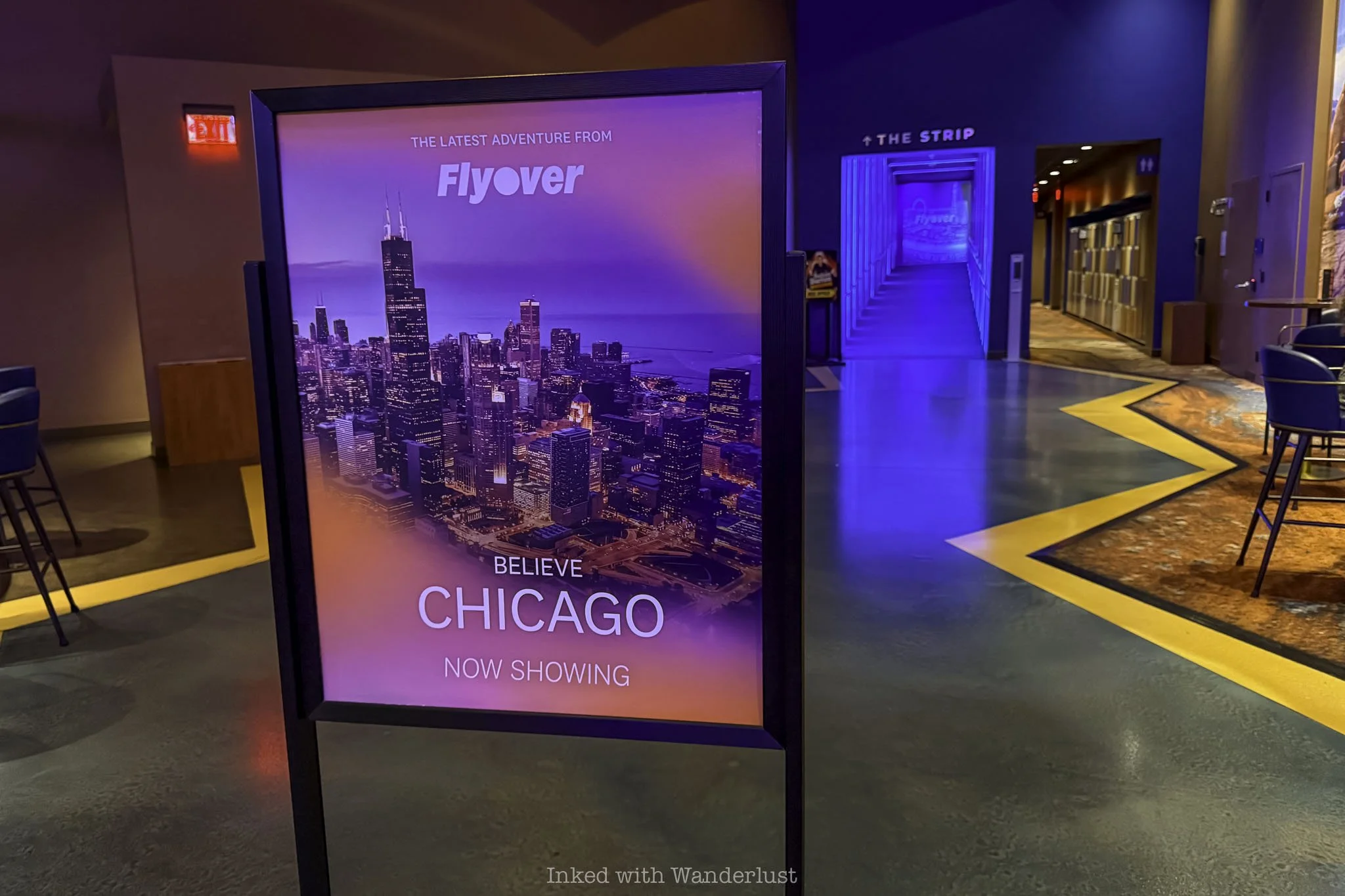
Additionally, you’ll receive an additional discount ($10 or so) by being a Nevada resident. Don’t end up paying more at the gate by taking advantage of this option and NOT being a resident. They do check identification when you check in.
Another way to pay less is to purchase your tickets online ahead of time. Flyover offers discounts to those who purchase ahead of time rather than purchasing at the gate. Additionally, you can opt for their VIP option, which also includes two rides but offers one drink and skip-the-line privileges as well.
Furthermore, when purchasing your tickets, you’ll have to select your preferred arrival time as rides only begin at certain times. Be sure you’re on time. You can always arrive early and enjoy a drink at their on-site bar.
My Experience at Flyover
My wife and I arrived about fifteen minutes before our first scheduled ride. We entered through the strip-facing entrance and walked through a series of color-illuminated hallways before coming into the building’s atrium.
The first notable feature was the on-site bar. To the left of the bar is the entrance to the ride’s queue. Just beyond the bar is the gift shop and also where you can purchase tickets, if needed. Directly to your left will be lockers where you can store your belongings (not mandatory).
If you’re driving yourself here, this is where you’ll enter via the elevator (to the right of the bar) from the parking garage. We had some time to kill before our ride so my wife and I enjoyed a drink and some hilarious conversation with the friendly bartender.
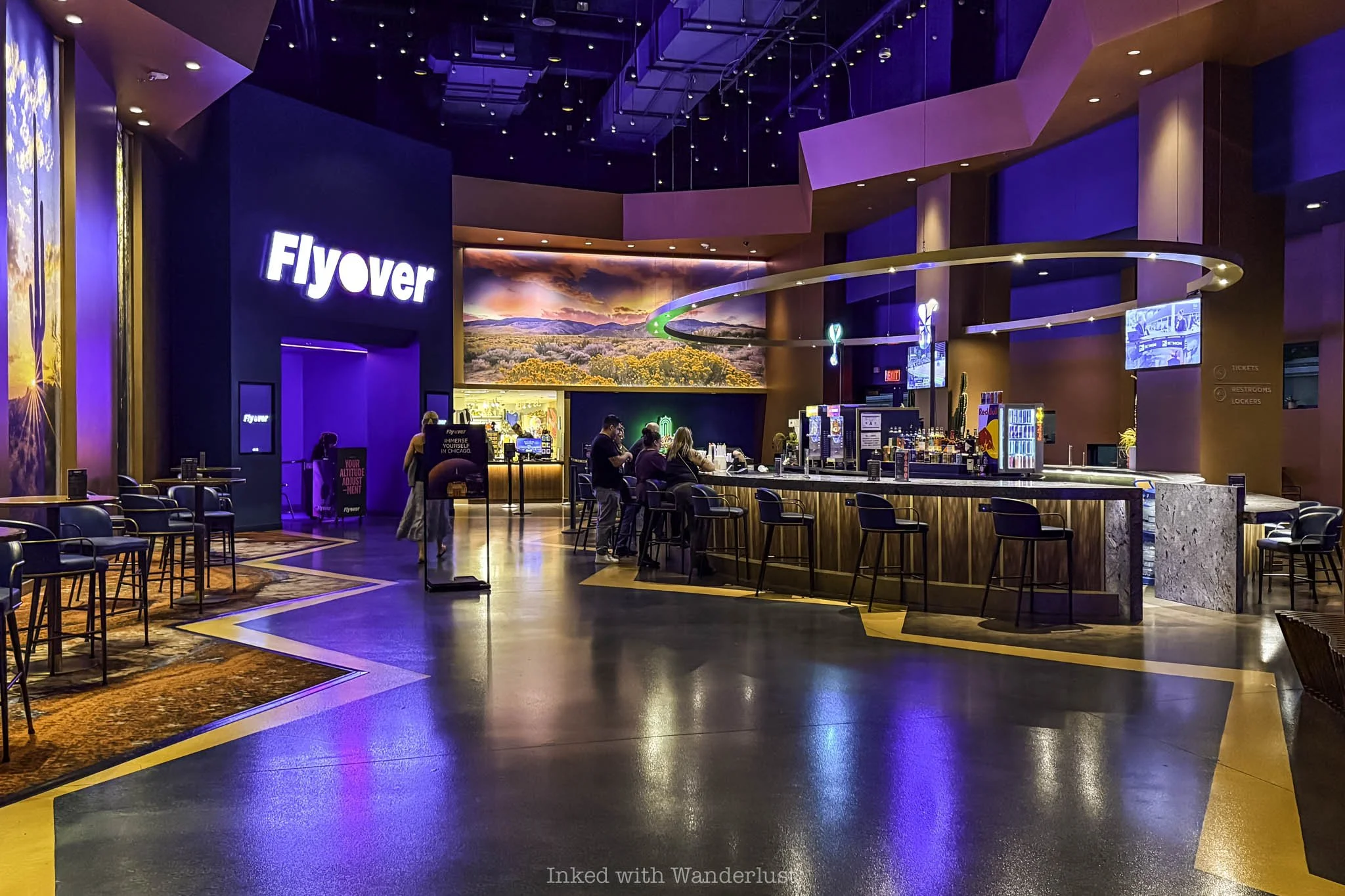
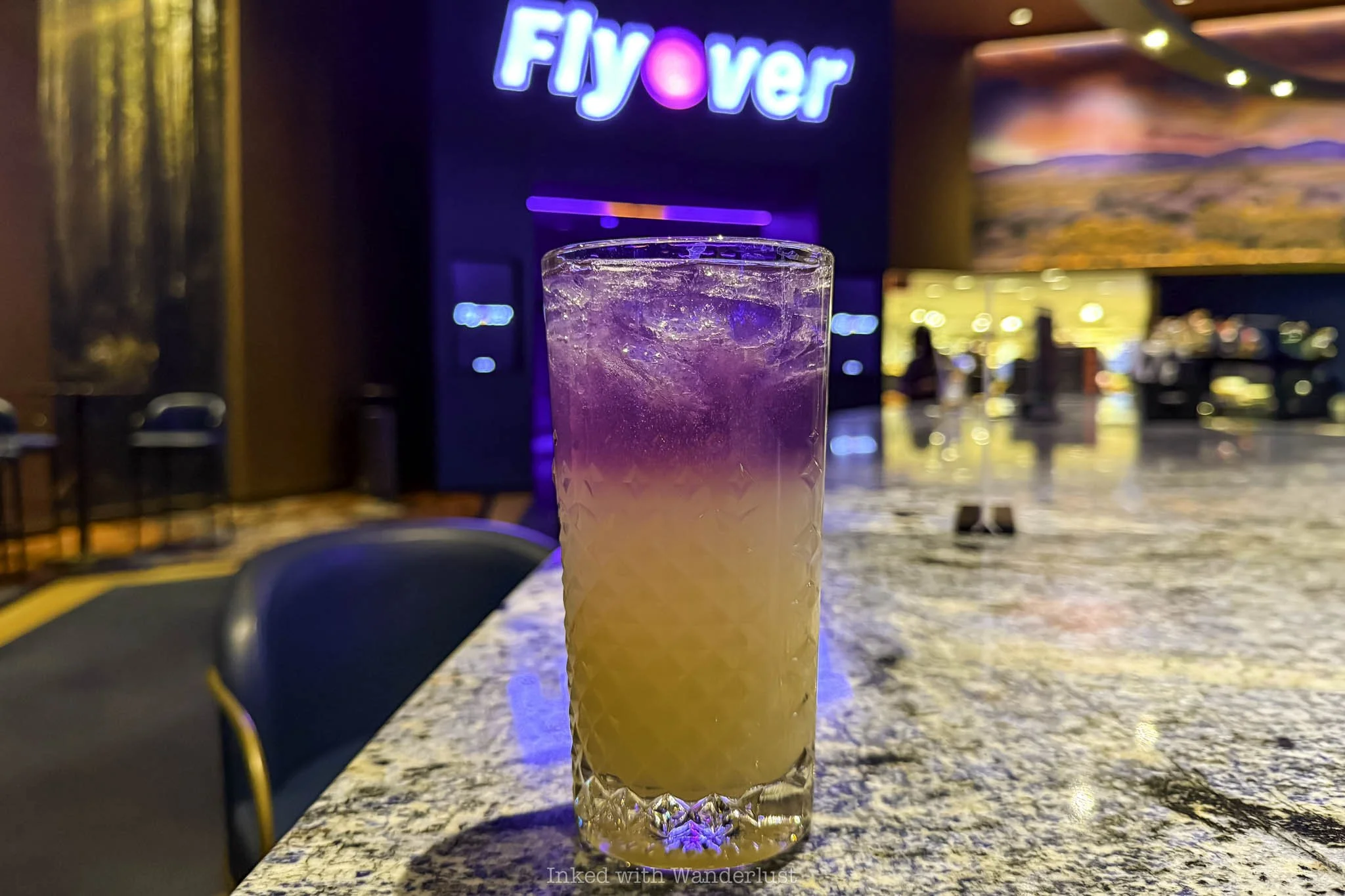
I was in Las Vegas in early May for punk band No Doubt’s residency performance at The Sphere. This time of year is a pretty good time to go, crowd and weather-wise. As a result, we were two of just half a dozen or so people at Flyover.
When it came time for our first ride, we paid our tab and headed over to the queue. There, the friendly staff member scanned our tickets and explained to us what to expect. We then began a lengthy walk through an empty queue to the first holding area.
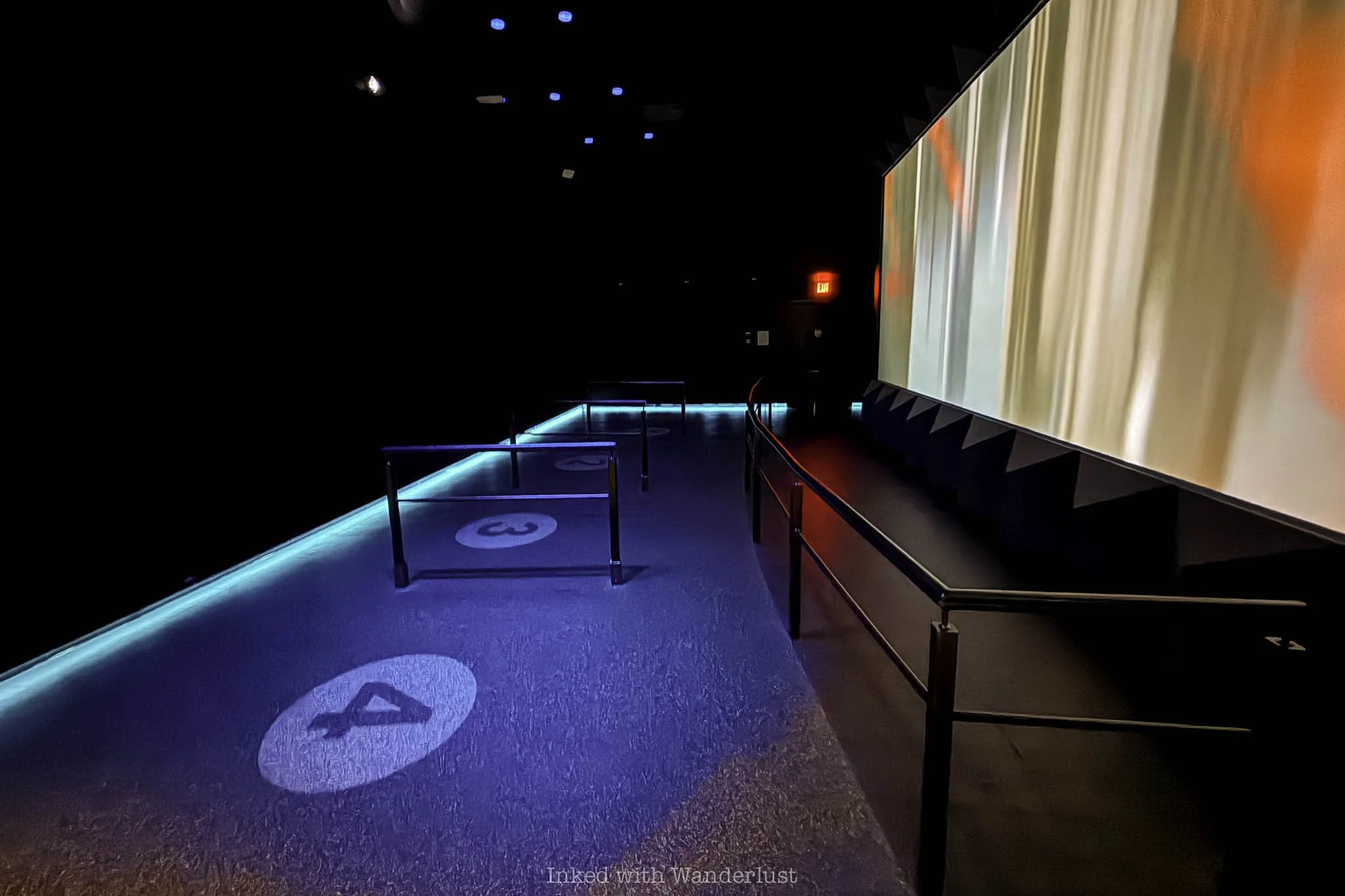
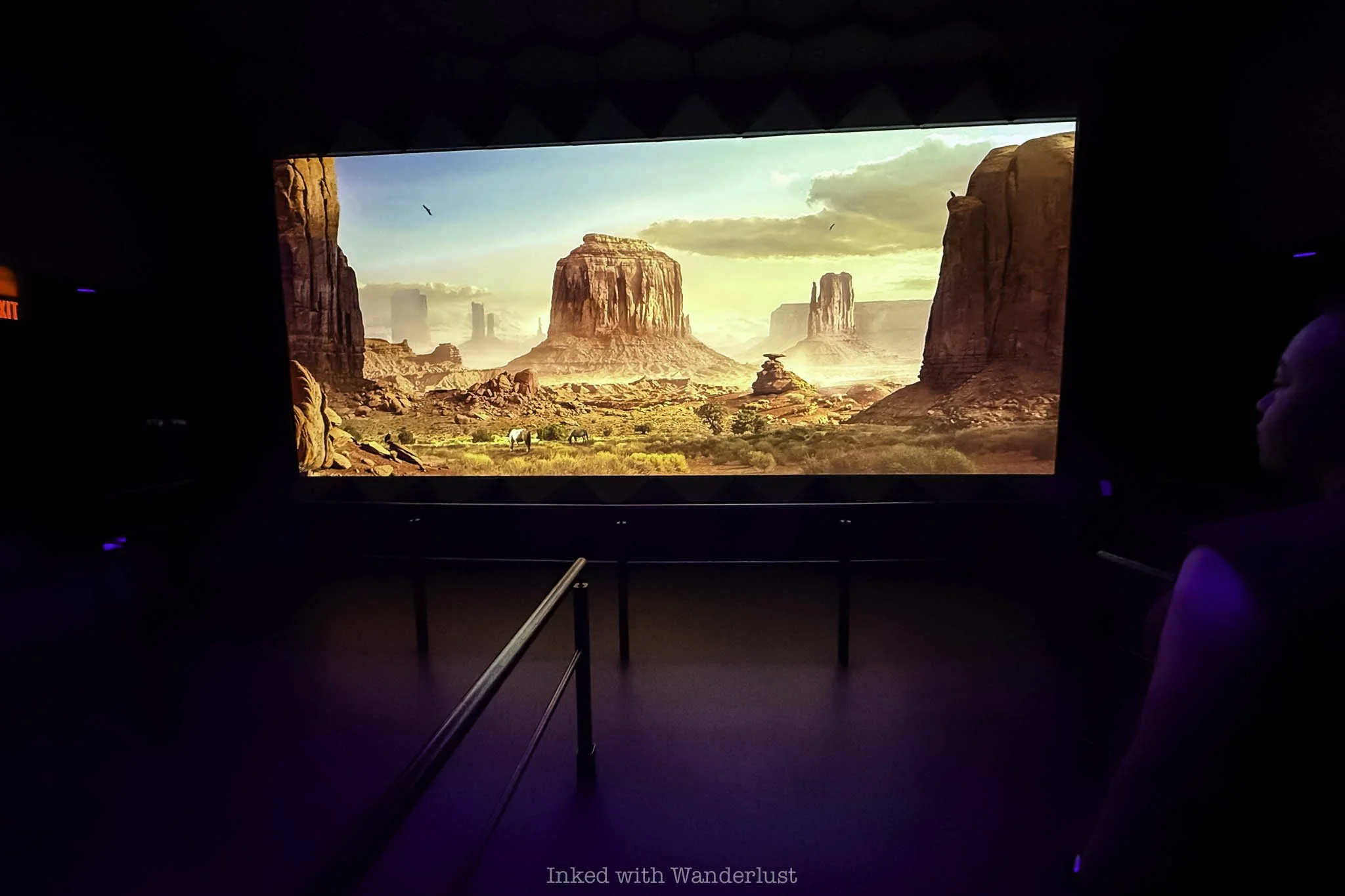
When you come into the room you’ll take notice of the numbers on the ground and rails between them. A staff member will assign you a number and you’ll then go to that space. According to our bartender, if it’s busy, they’ll put up to ten people in each space.
This is where we watched the first of two presentation videos, the content of which will depend on your choice of ride theme. For our “Double Experience” ticket, we chose “Wonders of the American West” and “Believe Chicago”.
In this case, our first ride was the former. You’ll be given basic safety instructions and be shown examples of scenes you’ll be flying through. I don’t remember the video’s exact length, but it couldn’t have been more than five minutes.
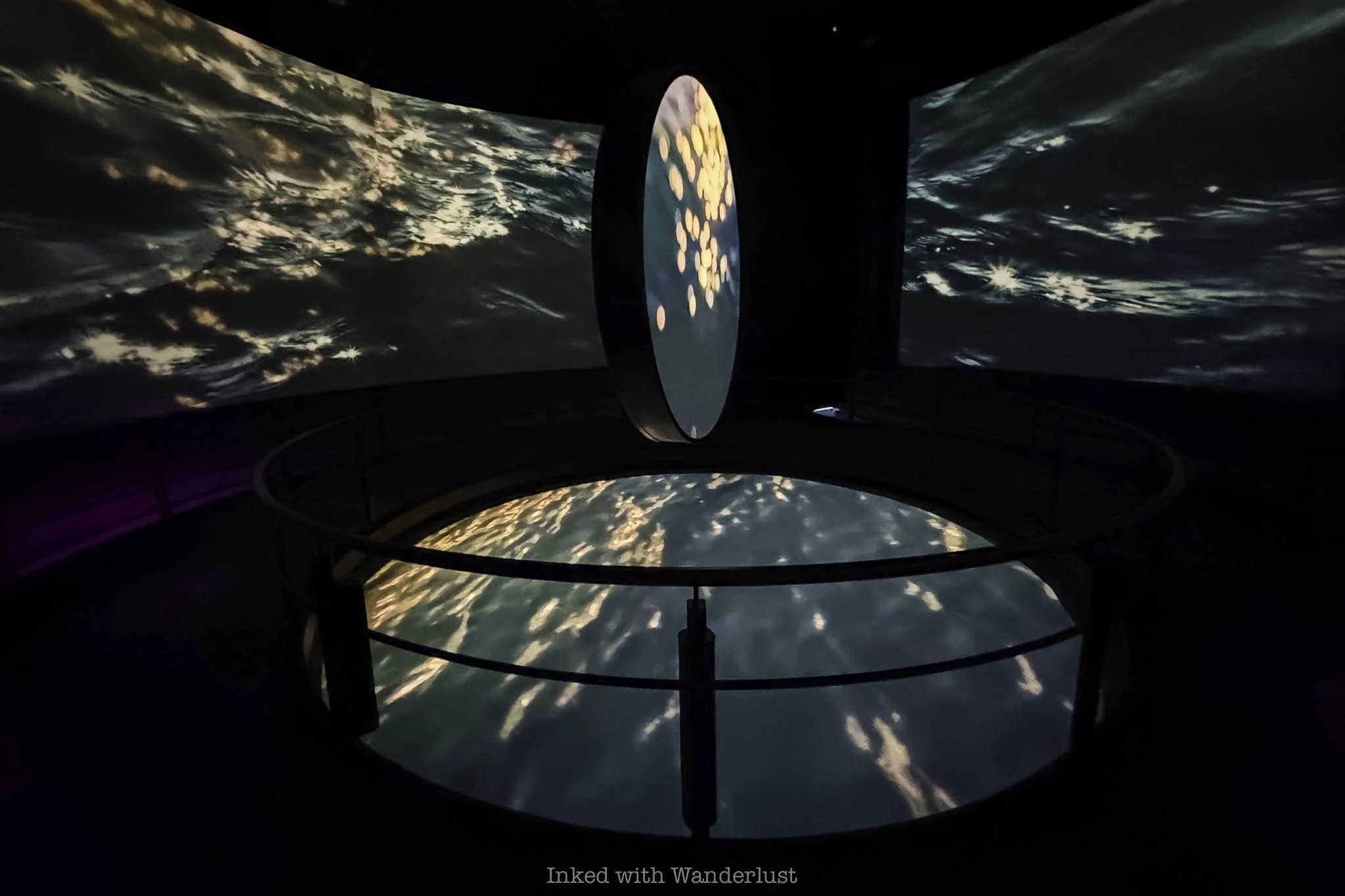
At the conclusion of the first video, we were lead into yet another showroom, this one with more screens and a central oval-shaped screen display. This video is longer (roughly ten or twelve minutes). It articulates the history, development and highlights of the theme you selected.
After a brief safety spiel by a staff member, we were then taken into the theatre where the ride vehicle is located. If you’ve ridden Disneyland’s “Soarin” attraction, you’ll undoubtedly recognize the ride vehicle as it’s virtually the same thing.
In fact, the creative director behind Flyover is former Disney imagineer Rick Rothschild, who developed the films used in the original Soarin’ attraction. Mark Sumner, who invented the ride mechanics for Soarin’ using an old Erector set, is not involved with Flyover.
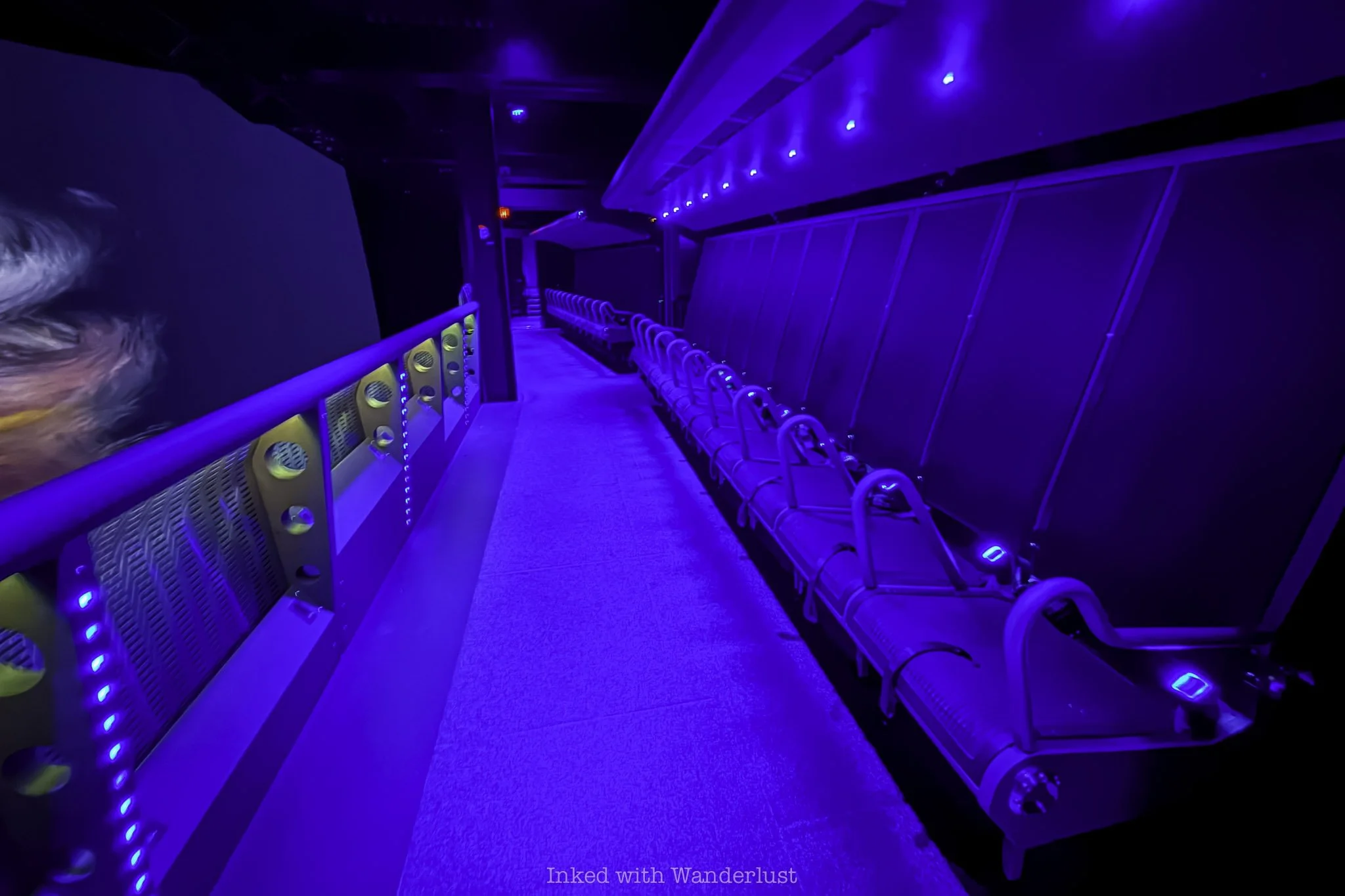
There is no recording or photos allowed while the ride is in progress, thus, I don’t have any to show you. Therefore, I’ll do my best to articulate the ride and what to expect while you’re on it. Again, if you’ve ridden Soarin’ at Disneyland or Epcot, you’ll need no help from me.
Once you’ve been strapped in and checked by a staff member, you’re lifted into the air in front of a massive spherical screen. You’re not lifted very high, maybe thirty to forty feet off the ground. However, it feels much higher once the video begins.
The ride mechanics give you a sense of gliding in the air over multiple locations using several sensory tricks. The weightless feeling comes from the motion-based mechanics above you while synchronized wind effects, misters, scents and audio complete the sensation rather convincingly.
I cannot recall, nor did I recognize, every scene we glided through. There were twenty-two scenes all together. However, a handful of a few I can recall include:
California Coast (Big Sur, Monterey, etc)
Las Vegas Strip
Bonneville Salt Flats
Grand Canyon
Zion National Park
Yellowstone National Park
Monument Valley
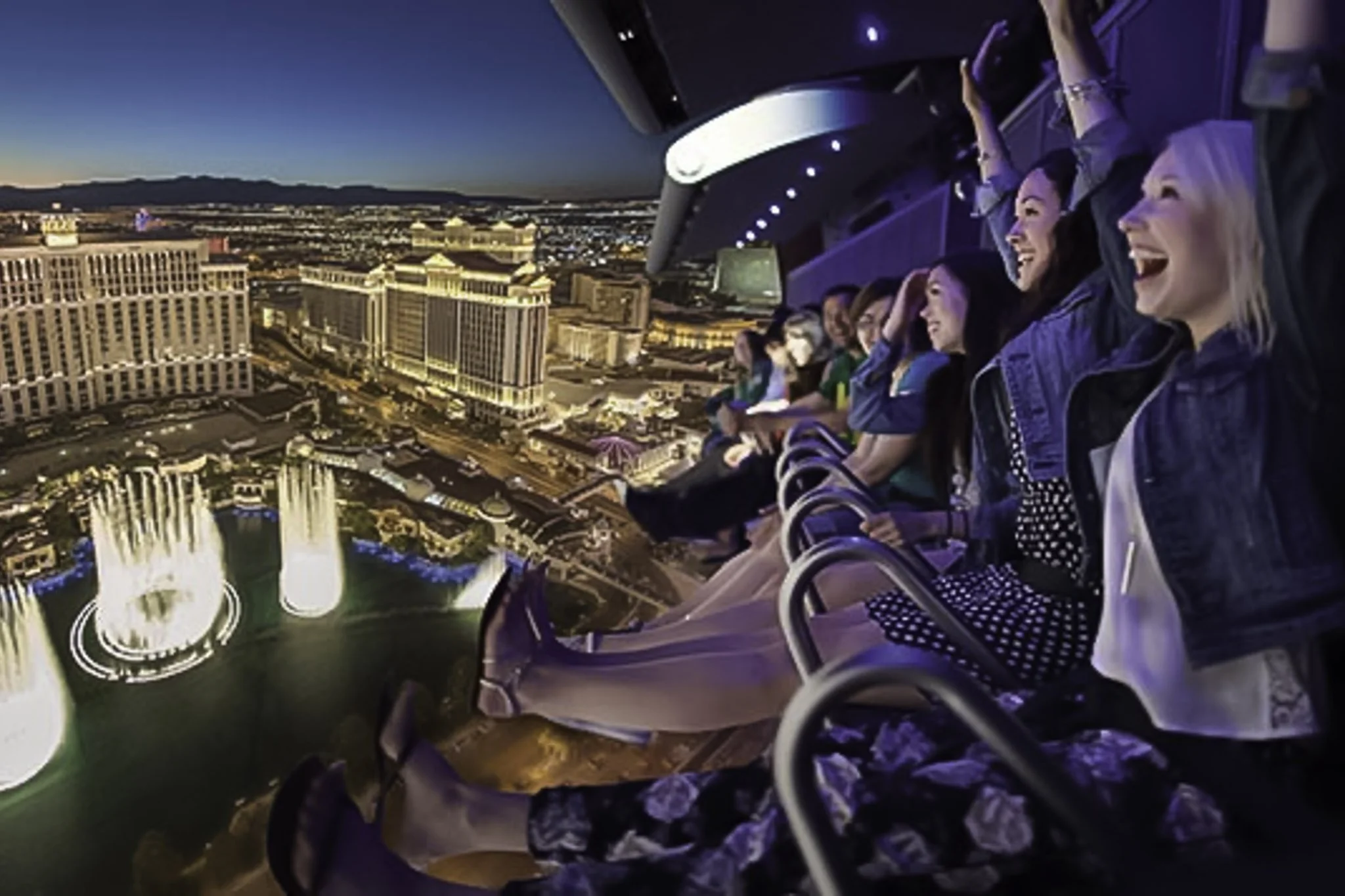
Unlike their counterpart at Disneyland, there’s a bit of a thrill element at Flyover. It’s nothing extreme, but during one scene we were “gliding” above the Nevada desert aside several military jets. When the jets began to barrel roll, we seemingly followed suit.
Now, we didn’t actually go upside down (this is a family-friendly attraction). However, using the motion platform above our chairlift-style seats and a vibration effect, as well as the video itself, we were excellently and convincingly given the feeling that we were, in fact, barrel rolling.
Both of the rides we took were between nine and ten minutes in length, nearly double that of Disney’s. When your ride is finished, you’ll simply head out the exit and through the photo station and gift shop. If you’re riding again, check with the attendant on when your ride starts.
There are many other attractions, shops, restaurants and lounges nearby if you’re looking for more to do. A short walk from Flyover is one of my favorite pizzas on the strip, “How ya Dough’n”, which is on the top level of the BLVD complex.
The M&M and Coca Cola stores are both nearby, as well as "Titanic: The Artifact Exhibition” museum at the Luxor (one of my personal favorites). Or you can take the short walk across the strip to the Cosmopolitan and enjoy a drink or two at the “Ski Lodge” speakeasy.
Is Flyover Worth it for Kids?
In short - absolutely. Flyover is one of the premiere family-friendly attractions on the Las Vegas strip. The only caveat to that is your child must be at least 40’’ tall to ride.
If their height doesn’t meet a certain benchmark on the ride vehicle, a secondary safety feature will be used to secure them. Basically, their seatbelt will need to be looped into the strap in the middle of their seat.
If they don’t meet the 40’’ height requirement, they unfortunately cannot ride. This is for safety reasons and the staff members will not bend this rule for any reason.
If they don’t meet this height requirement, head over to the Linq Promenade and take a ride on High Roller. At 550-feet, it’s the tallest in North America. Or test your courage at Universal Horror Unleashed at Area 15 or explore the wonderfully weird Meow Wolf Omega Mart.
***If you found this review helpful, please consider leaving a tip by clicking/tapping the “Buy me a Coffee” button above. These tips help to pay for expenses such as gas, food, coffee, parking fees, admission fees, etc. Thank you!

10 Must-Do Short Hikes in Valley of Fire State Park
The beautiful rock formations and colors, in addition to being packed with short day hikes, make Valley of Fire State Park a place you could easily spend a whole day (or two) exploring. Best of all, most…
Disclosure: This post contains affiliate links. If you make a purchase through these links, I may earn a small commission at no additional cost to you. I only recommend products or services that I believe will add value to my readers.
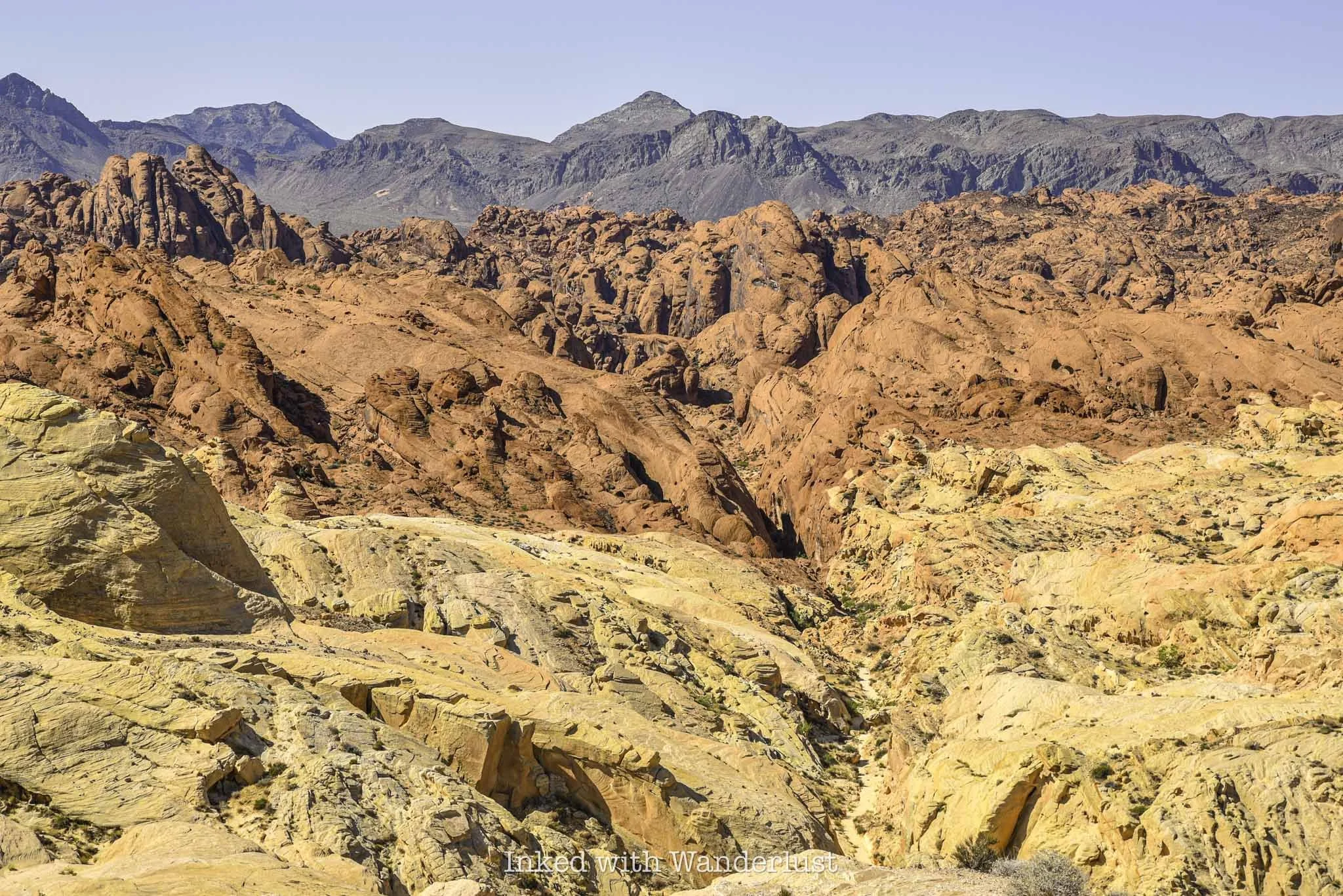
Valley of Fire became Nevada's first state park in 1934 and since then, it's developed into one of the state's most sought after destinations and is one of the best things to do when visiting Las Vegas, often rivaling nearby Red Rock Canyon.
The beautiful rock formations and colors, in addition to being packed with short day hikes, makes Valley of Fire State Park a place you could easily spend a whole day (or two) exploring. Best of all, most of the park’s most popular hikes are short and easy, making them family-friendly.
In this post, I'm going to present to you 10 must-do short hikes in Valley of Fire. If you plan correctly and not visit on a day where the heat reaches dangerous levels, it's totally possibly to do all of these in a single day visit, dependent on your conditioning.
That said, there is one caveat to this list, and that's the seasonal trail closures discussed below...
Valley of Fire Seasonal Trail Closures

While the park itself is open daily, between the months of May and September, when temperatures at Valley of Fire State Park often reach dangerous levels, park officials enact trail closures at several popular hiking trails to prevent needless deaths.
There have been quite a few exposure-related deaths over the years, including in 2023 when two hikers were found dead on the Prospect Trail on a day when high temperatures reached a scorching 118-degrees.
Unfortunately, several of the hiking trails listed below are included on the closure list. So if you're going to visit between May and September, please respect these closures and don't risk it. It isn't worth the chance of a hefty fine or even worse...death.
These are the trails affected by seasonal closures:
White Domes Loop
Fire Wave/Seven Wonders/Pastel Canyon/Pink Canyon
Pinnacles Loop
Prospect Trail
Arrowhead Trail
Natural Arch Trail (excludes Arch Rock)
Charlie's Spring

West Entrance vs. East Entrance
There are only two entrances to Valley of Fire State Park. If you’re coming from Utah, Arizona, or any state east of Nevada, you’ll likely be entering through the east entrance. If you're like most people and you're coming from the Las Vegas Strip area, you'll want to head towards the west entrance.
For some reason, Google Maps likes to take people coming from the strip to the east entrance, which is further away. It has tried doing that to me twice now. So make sure that whichever navigation system you use that you specify the west entrance.
Entrance Fees
In 2025, the fees to enter Valley of Fire are:
$15 (non-Nevada vehicles)
$10 (Nevada vehicles)
Fees are payable, at either entrance, with cash via the iron ranger/envelope or with credit cards at the self-pay digital kiosk. Note that the digital kiosk doesn't always work, so it's best to bring exact cash as a back up.
1) Atlatl Rock

SEASONAL CLOSURE: NO
TRAIL LENGTH: 0.1 MILES
Atlatl Rock is one of the most popular attractions in the entire park. It isn't much of a hiking trail, as the stairwell and rock face are located a very short distance from the parking area. Where Atlatl Rock shines is its historical significance.
At the top of the stairwell, you'll reach a platform in front of a smooth rock face. On that rock face are several old petroglyphs which are believed to be up to 4,000 years old. Atlatl Rock isn't the only spot in Valley of Fire where you can see petroglyphs, but it's the easiest (aside from the stairwell, that is).
You can read more details about Atlatl Rock in this featured post.
2) Fire Wave Trail

SEASONAL CLOSURE: YES
TRAIL LENGTH: 1.3 MILES
The Fire Wave is a stunning sandstone rock formation located at the backside of the park along White Domes Road. Over millions of years, shifting sand dunes compressed, creating the wavy swirls of red, white and pink stripes we see today.
Fire Wave is easy to get to via a short, well maintained trail that leaves from a fairly large parking area. Shortly after descending for about 6/10's of a mile, the Fire Wave will come into view. Getting there during the early morning light is good, but sunset is when Fire Wave comes to life.
3) Seven Wonders Loop

SEASONAL CLOSURE: YES
TRAIL LENGTH: 1.9 MILES
While not an official hiking trail at Valley of Fire, you can extend your hiking time by continuing past Fire Wave and see many other infamous Valley of Fire attractions. Hiking Seven Wonders will take you past Fire Wave and through pink rock formations at Pink Canyon.
You'll then cross White Domes Road and go through a stunning slot canyon, before heading onto additional sights like Crazy Hill, Fire Cave and Thunderstorm Arch. The loop will eventually take you back to where you parked for Fire Wave.
Since it's not an official trail, I suggest downloading the AllTrails map. While it isn't inherently difficult to follow, there are a few spots where the trail is easy to lose.
4) Mouse’s Tank Trail
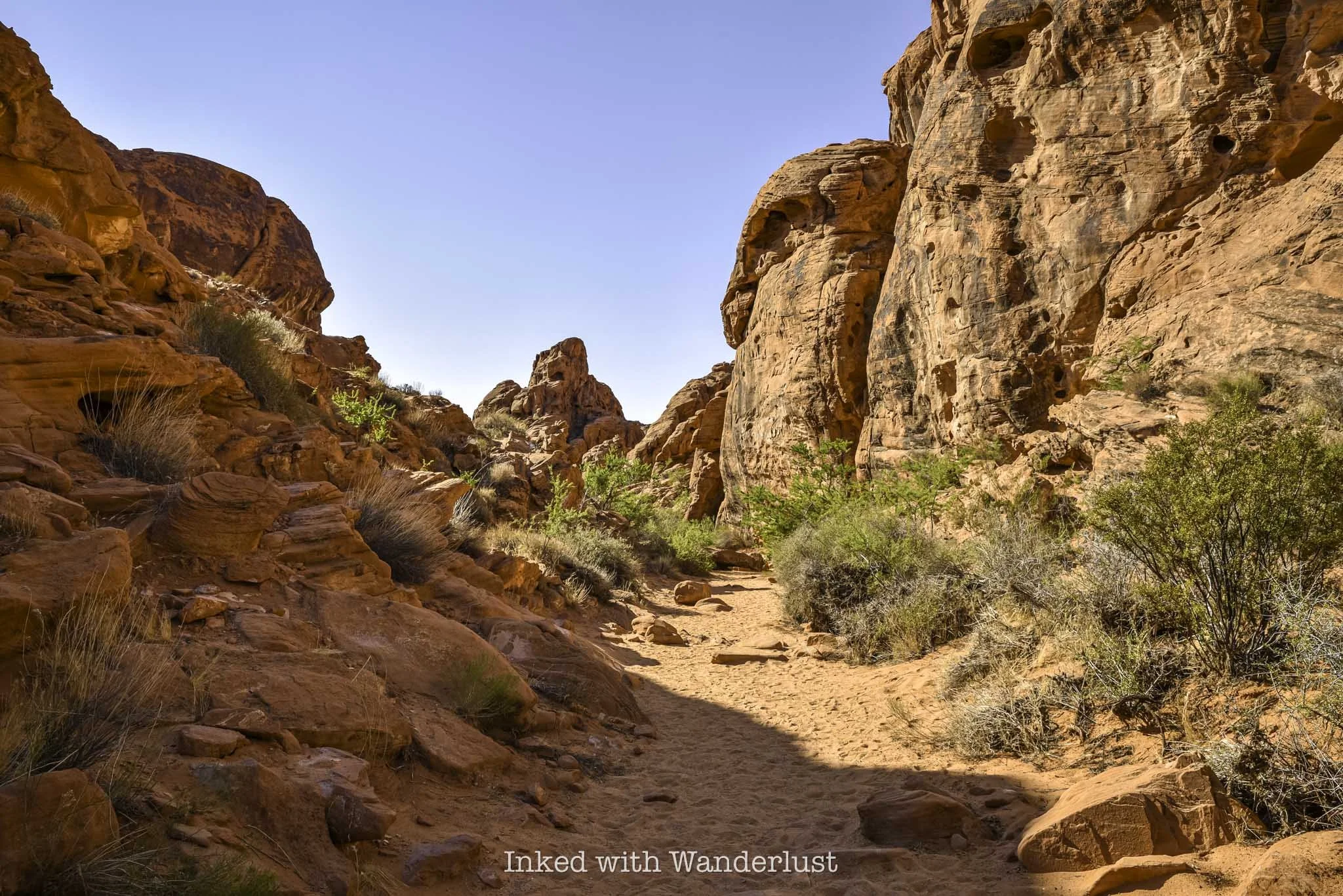
SEASONAL CLOSURE: NO
TRAIL LENGTH: 0.7 MILES
Mouse's Tank Trail is one of my favorites in the park because of the story behind it. The canyon you hike through is one of the places where a Southern Paiute Indian, named "Little Mouse", took refuge after being accused of and wanted for the murders of two prospectors (and other crimes) in the late 1800's.
Additionally, the canyon walls are littered with old petroglyphs dating back thousands of years. They're easy to miss if you're not looking for them but once you spot them, they're easy to view. At the end of the canyon, you'll come across "Mouse's Tank", a natural rock basin which collects rain water.
The whole trail is less than a mile but you'll be traversing along loose, fine sand the entire time. Still, it's one of the park's most intriguing hikes with a great backstory, tons of history, and features numerous incredible rock formations. It can be found directly off of Mouse's Tank Road.
5) Petrified Log Loop
SEASONAL CLOSURE: NO
TRAIL LENGTH: 0.3 MILES
The Petrified Log Loop is an easy 0.3-mile loop trail that passes several examples of real petrified wood logs, as well as many informative displays detailing the history of the logs and how they came to be.
If you don't know, petrified logs are fossilized tree trunks that have been replaced by minerals. The process in which this is done - petrification - is essentially the process of turning wood into stone. It's a great trail for kids, as it has educational value in combination with outstanding views.
6) Elephant Rock

SEASONAL CLOSURE: NO
TRAIL LENGTH: 0.3 MILES
The trail to Elephant Rock is also an easy, 0.3-mile walk to and from the car. There's a slight amount of elevation involved, but you'll barely notice it. The trail leads to an amazing, orange-sandstone rock formation that strikingly resembles an elephant.
If you come into the park via the east entrance, the parking lot will be on your right as soon as you drive through. You'll ascend a short walk up a small hill and when you reach the top, Elephant Rock will come into view.
Additionally, Elephant Rock is clearly visible from the Valley of Fire Scenic Drive, but you cannot stop on this road to take pictures. Elephant Rock is a mega-popular attraction in Valley of Fire, so arrive early to beat the crowds.
7) Balancing Rock Trail

SEASONAL CLOSURE: NO
TRAIL LENGTH: 0.3 MILES
There's no way to classify the path to Balancing Rock as a "hike". The pathway is located on the left side of the visitor center parking lot and it's maybe a tenth of a mile to the viewing area. However, that doesn't make Balancing Rock any less impressive and worth checking out.
Balancing Rock is a stunning red rock formation where a large rock appears to precariously balance itself on top of a smaller, thinner rock resembling a pedestal. It's a visually intriguing rock formation, and a favorite amongst photographers.
8) Silica Dome/Fire Canyon

SEASONAL CLOSURE: NO
TRAIL LENGTH: 0.9 MILES
Silica Dome is a visually striking viewpoint in the northern section of Valley of Fire, right about where Mouse's Tank Road turns into White Domes Road. In the summer, it's the final spot in this area of the park where you explore on foot, as everything north of Silica Dome is closed in the summer months.
You can choose to just walk out onto the viewing platform and gaze at the stunning contrasting colors of red, white, and brown rocks seemingly stacked on top of one another, or you can take the trail into the canyon below.
Fans of Star Trek may find Silica Dome familiar, as it's the location of Captain Kirk's gravesite from the movie, Star Trek Generations. Many "trekkies" make the pilgrimage to this sight every year. However, you don't need to be into Star Trek to appreciate the visually striking views and formations.
9) Rainbow Vista Trail
SEASONAL CLOSURE: NO
TRAIL LENGTH: 1.0 MILE
The Rainbow Vista Trail, which is also located along Mouse's Tank Road, clocks in at just over a mile in length and features some of the best views in a short hike. In fact, this area of the park is where you have the best chance of seeing herds of Bighorn Sheep, as they're often found grazing near the parking lot and along the road.
This short and easy trail is known for its colorful red rock formations, as well as stunning views of neighboring Fire Canyon from the viewpoint at which the trail ends. While it doesn't close in the warmer months, it is mostly exposed. So if you're here in the summer, I would avoid this trail mid-day.
10) White Domes Loop

SEASONAL CLOSURE: YES
TRAIL LENGTH: 1.1 MILES
White Domes Loop, located at the northernmost point you can drive in the park, is my personal favorite Valley of Fire hike. To get to it, drive north on Mouse's Tank Road from the Valley of Fire Scenic Byway. After a couple miles, the road will become White Domes Road (just past Rainbow Vista). From there, drive another four miles until you reach the road's terminus at the White Domes day-use area.
Along this 1.1-mile loop, you'll encounter a variety of red, orange, and white sandstone formations, as well as an old movie set, slot canyon, and the white dome rocks for which the trail is known. If you're up for a longer hike, you can extend it another 7-miles or so by combining it with the Prospect Trail.
White Domes Loop is one of the most popular short hikes in Valley of Fire, so arrive early to beat the crowds. Additionally, this trail is on the seasonal closure list, so you'll need to visit between the months of November and April in order to experience it. You can read my comprehensive post on White Domes Loop here.
Do you plan to visit Valley of Fire this year? If so, let me know in the comments below. If you have any questions, you can leave them there or ask me on my Facebook page.




Sorry Not Sorry Creamery in Las Vegas
With temperatures often getting close to and even into the three digits fairly often, Las Vegas is the one of the few places with an ice cream shop could flourish all year…
Disclosure: This post contains affiliate links. If you make a purchase through these links, I may earn a small commission at no additional cost to you. I only recommend products or services that I believe will add value to my readers.

With temperatures often reaching three digits fairly often, Las Vegas is the one of the few places where an ice cream shop could flourish all year long. With several locations in the area, Sorry Not Sorry Creamery had long ago earned a reputation as a shop that serves the best ice cream in Las Vegas.
Using quality ingredients, including dairy from grass-fed and hormone-free cows, Sorry Not Sorry Creamery serves several creative ice cream flavors made up of the highest percentage of butterfat legally allowed (16%).
It may not be the healthiest thing you’ll ever eat (quite the opposite, actually), but this ice cream in Vegas is not to be missed. No matter the weather, a visit to try a scoop (or several) of ice cream at Sorry Not Sorry is a must.
Sorry Not Sorry Creamery on Flamingo

The chain has several locations, but the closest to the Las Vegas Strip is their shop on Flamingo. This is the one I went to and it was about a twenty-five minute drive away. There’s a way to avoid that lengthy Uber ride, though.
Sorry Not Sorry offers delivery through app services like DoorDash and UberEats. The downside to this (aside from the inflated cost), is you can only order pints. If you had your heart set on trying multiple flavors, it could get expensive.
The other way is to go to Fremont Street to a place called We All Scream, which is an ice cream themed nightclub. There’s a Sorry Not Sorry walk up window located on the right of the club’s entrance. Otherwise, the Flamingo location is your best bet if you’d rather visit a proper shop.

The Flamingo location opens daily at noon and closes at 11pm on most days, except on Fridays and Saturdays when they close at midnight. Time your visit strategically to avoid crowds, because it isn’t unheard of for a massive line to form, causing a wait upwards of an hour to order. This is particularly true on weekends.
I came on a weekday and arrived shortly after they opened. I was able to walk right up to the counter with no wait. Fifteen minutes later, though, it started to get packed as a line began forming. So be sure to arrive early to avoid the crowds.
Sorry Not Sorry Creamery Ice Cream Flavors

Sorry Not Sorry Creamery features many unique flavors. Their menu advertises sixteen classic favorites that are always offered, in addition to four additional flavors that rotate based on season (they also vary by location as well).
In addition to the traditional dairy-based ice cream, Sorry Not Sorry also offers a handful of flavors made with an oat milk base and vegan ingredients, making them vegan friendly.
The sixteen classic flavors you can enjoy throughout the year are:
Bumbleberry Cheesecake Crumble
Campfire S’mores
Cinnamon Snikerdoodle Cookie (vegan)
Coffee and Doughnuts 2.0
Cookie Butter Swirl
Double-Stuffed Cookies n’ Cream
Honey Lavender
Milk & Cereal
Mint Chocolate Chunk
O.G Buttercake
Rocky Road (vegan)
Salted Pistachio Brittle
Sea Salt + Caramel
Strawberry Shortcake (vegan)
Triple Chocolate Chunk Brownie
Ube Honeycomb
Blackberry Basque Cake (Downtown Las Vegas location exclusive)

Their wide variety of unique, creative flavors help to maintain their status as the best ice cream in Las Vegas. Just like at other ice cream shops, you can order their flavors in single or double scoops in a freshly made cone or cup, or go with a pint size if you favor a specific flavor.
If you’re new to Sorry Not Sorry and can’t decide on a single flavor, you can order the flight and receive four scoops in any combination of the classic or seasonal flavors. This option is also good for those who came with a group and wish to split their order.


Since it was my first time at Sorry Not Sorry, I decided to go with the four scoop flight ($14). In my flight, I went with the Ube Honeycomb and Bumbleberry Cheesecake Crumble flavors (pictured above in order) and the Cream Cheese Cinnamon Roll (fall seasonal flavor) and Double-Stuffed Cookies and Cream flavors pictured below in order.


Of the four, the cinnamon roll flavor, which was a fall seasonal exclusive, was my least favorite as I found it to be way too sweet. My favorite was the Ube Honeycomb, with the Bumbleberry Cheesecake Crumble coming in at a close second.
You will definitely taste the difference. I found their ice cream to be rich, creamy, and thicker than any other ice cream I’ve ever tried. This is due to the high amount of butterfat content, which Sorry Not Sorry touts as the, “highest legally allowed”, at 16%.
If you’re looking for the best ice cream in Las Vegas, look no further than Sorry Not Sorry Creamery. It may be a lengthy Uber ride away from the strip, but you could always head to the Fremont Street pick-up window for quicker access to it. You won’t regret trying it.

My Honest Review of TownPlace Suites Hotel Near Allegiant Stadium
When searching for hotels near Allegiant Stadium, many look to the resorts located on the southern end of the strip. A few of which include…
Disclosure: This post contains affiliate links. If you make a purchase through these links, I may earn a small commission at no additional cost to you. I only recommend products or services that I believe will add value to my readers.

When searching for hotels near Allegiant Stadium, many look to the resorts located on the southern end of the strip. A few of which include the Excalibur, Mandalay Bay and Luxor. However, just as many prefer Las Vegas hotels off the strip for a variety of reasons.
Since opening in 2020, Allegiant Stadium has been the new home of the Las Vegas Raiders and has played host to a variety of events. Due to this, Allegiant Stadium attracts millions of visitors on a yearly basis.
If you’re coming to Las Vegas, primarily for an event at the stadium, and you want to avoid the chaos of the strip, there’s an off-strip hotel near Allegiant Stadium that I’ve recently stayed at and recommend. It’s within walking distance of Allegiant Stadium and the strip, and offers solid amenities. Best of all, it’s reasonably priced.
In this review, I’m going to share photos of the property and room, and discuss their various amenities. Additionally, I’ll tell you about my experience and whether or not I would book here again. For transparency purposes, I was not given anything by the property in exchange for this review.
TownePlace Suites Location, Parking, and Rates

TownPlace Suites Stadium District (mouthful, I know), is located on the corner of Dean Martin Drive and Tropicana Ave., roughly half a mile from Allegiant Stadium. Its exact address is 4920 Dean Martin Drive, Las Vegas, NV, 89118.
During my stay, there was a ton of construction happening on Dean Martin Drive and the neighboring overpass, which made it an absolute nightmare driving in and out. However, the hotel is located directly off of Interstate 15, which is the jumping off point to Valley of Fire. Once construction is complete, it’ll be a conveniently located hotel.
Across the street from the property is an In & Out Burger, Chevron gas station, and a variety of other fast food restaurants and marts. TownPlace shares the property with a neighboring Hilton, and both of these hotels share the parking structure as well.

The parking garage is four-levels, with additional parking in the small lot behind it. At TownPlace Suites, guests are charged a daily parking fee of $15. This is becoming more and more commonplace in Las Vegas, with free parking just about non-existent at this point.
Upon check-in, you’ll be given a code to get in and out of the parking garage. Additionally, there are EV charging stations on property. You’ll inquire about those with the clerk at check-in.
If you’re part of the Marriott Bonvoy program, it’s possible to obtain free parking. Not sure which tier my Dad is at but for what it’s worth, he was never charged for parking. It’s worth looking into if you’re a member.
The nightly rate varies greatly according to time of year, current events, and more. On average, you can expect to pay between $250-$350 per night. I believe we paid near the high point of that range. However, there are NO resort fees, which are commonplace for hotels on the strip.
TownPlace Suites Stadium District Amenities (Common Areas)

TownPlace Suites offers many amenities for guests, both in-room and throughout the common areas. In the exterior area just outside of the lobby are many lounge-style seating options with a propane-powered fire pit. Parts of this area are shaded, both by trees and an awning.
Inside, near the check-in desk, are additional seating areas. Some of it is for lounging or socializing, while other areas are reserved for dining during their complimentary, buffet-style breakfast. Breakfast is served:
Monday - Friday: 6:30am - 9:30am
Saturday & Sunday: 7:00am - 10:00am
The food offered at breakfast included a variety of yogurts (none of which were greek), waffles, pancakes, breakfast cereals, fruit, eggs, sausage (turkey and beef), and bacon. To be honest, it was just ok. The eggs tasted like the powdered, mix-n-go, type. But hey, it was free.

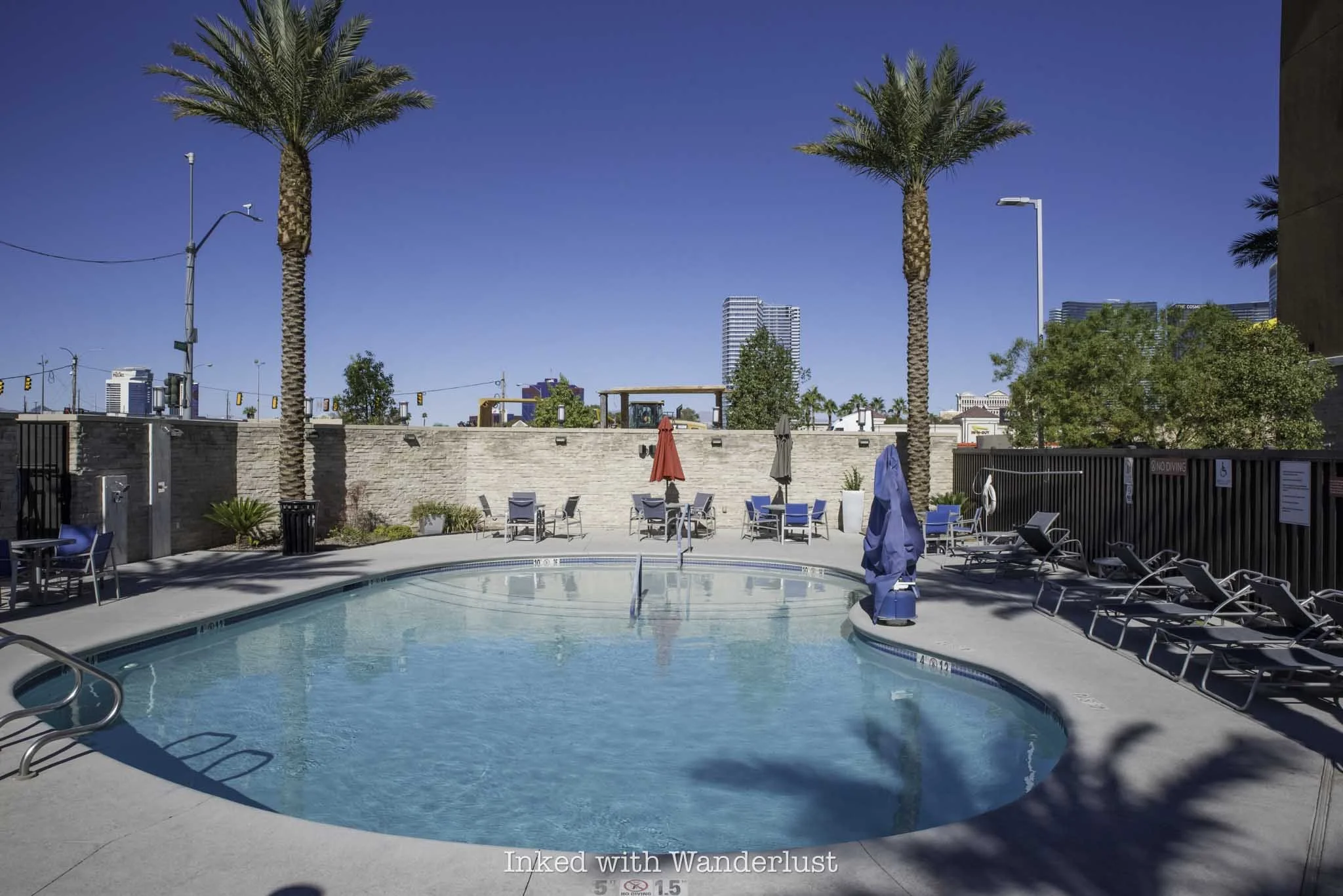
The pool is considerably small, especially given the locale they’re in. I can’t give it a proper review as it was closed during my stay for an unknown reason. The neighboring Hilton was allowing guests of TownPlace Suites to use theirs, though.
Inside the hotel, a few steps past the elevators on the right is where you’ll find the fitness center. Honestly, I was impressed with its size and amount of equipment, as many hotels of this type tend not to put a whole lot of effort into their gyms.

When you first walk in, the cardio equipment and smith-style weight machine come into view. To the right are a few benches and a dumbbell rack with weights up to 65-pounds. Additionally, there’s water bottle refill station and a plethora of towels at your disposal.
Lastly, to the left of the check-in desk, you’ll find a grab and go market where you can purchase a variety of snack foods, candy, and drinks. To be honest, there’s nothing in there you couldn’t find across the street at Chevron at much better prices.
Most of the hotels near Allegiant Stadium have similar amenities, so there isn’t much here to truly make it stand out, in my opinion. Still, considering the size of the property and price point, they make good use of the space. However, the rooms are where this property shines most.
TownPlace Suites Stadium District One Bedroom Suite

My Dad and I were in town for the Billy Joel concert at Allegiant Stadium, so we decided to book a one bedroom suite since it has a queen bed and a pull out-style couch in the living space. The room was impeccably clean, organized, and well appointed.
The main room comes with a queen-sized bed, a plethora of drawers for organization, flat screen TV, and a closet. While semi-small, it does the job just fine. My Dad reports the mattress and pillows as comfortable. However, there’s a severe lack of plugs and USB ports.

The room came with just about every kitchen amenity you could ask for, including a full-size refrigerator with top freezer, oven with stovetop, dishwasher, and microwave. In addition, you’re provided with a variety of cook and dish ware.
To be honest, we didn’t utilize any of it, with the exception of the refrigerator. That said, the set-up is fantastic. If you’re looking to save money in your food budget, you’ll have everything you’d need to make all of your meals right in your room.
Also in the kitchen is decently-sized coat closet. Inside is a stand-up ironing board, complete with iron, as well as bedding for the pull-out couch. One thing I really liked about this closet was the additional storage space.


The living space, along with the bedroom, is carpeted and comes with a couch that coverts into a bed (more on that later), plenty of drawer space, a flat screen TV, lap desk, rolling food tray and a work desk complete with lamp and a good amount of USB ports.
The couch, when utilized as such, is fine. When converted to a bed, though, it was far and away the most uncomfortable thing I’ve ever slept on. The “mattress” was so thin that I may as well have just slept straight on the metal bars underneath.
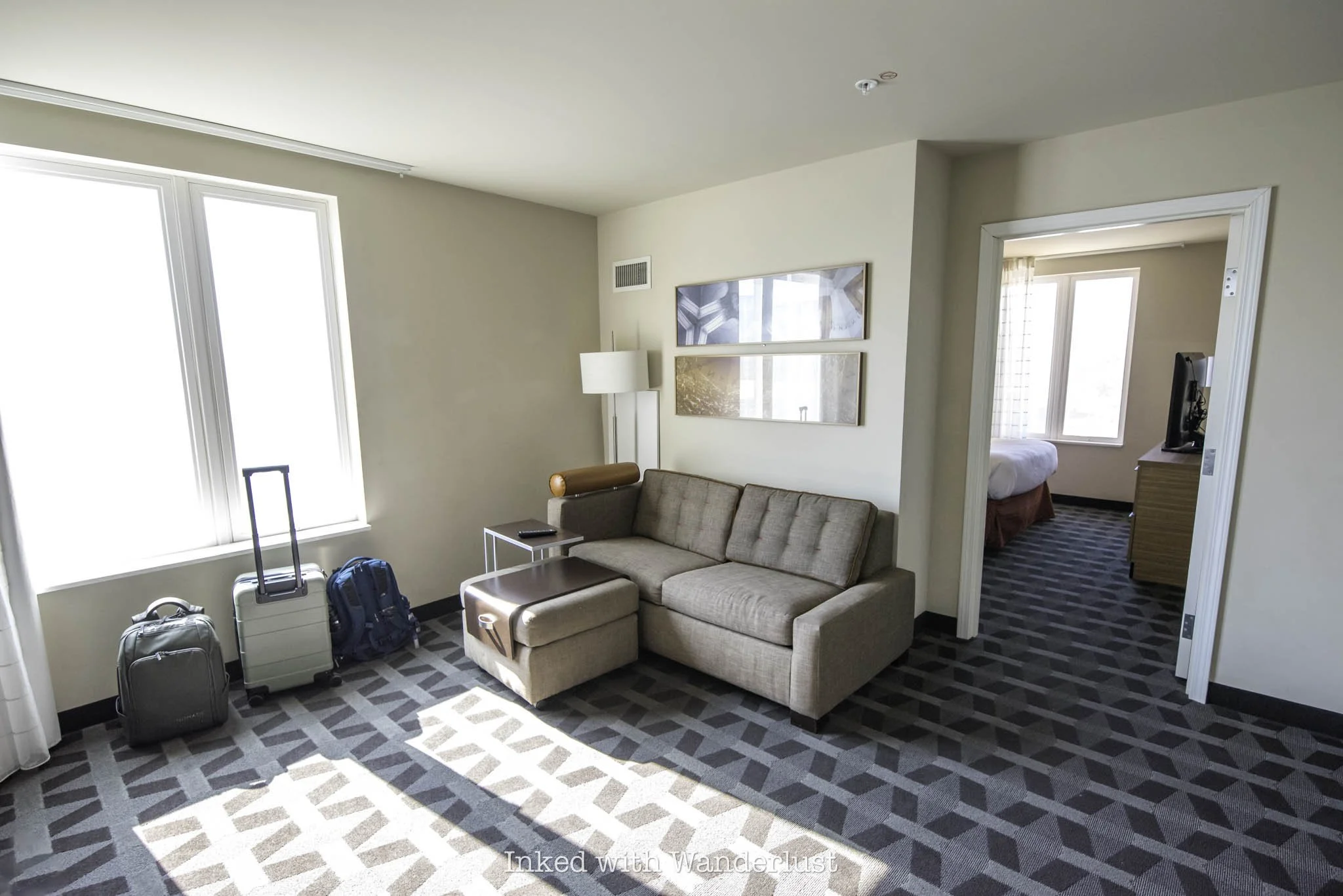


Despite this being the sole negative I experienced, it was a big one considering this was what I had to sleep on. If you decide to book this room, do yourself a favor and bring an inflatable sleeping pad, like this one, to give yourself more comfort.
Finally, the bathroom featured a walk in-style shower. These are my preference, but those with kids may prefer a tub. Going through Yelp photos, it appears as though this property doesn’t have any rooms with tubs. If that’s a deal breaker for you, you may want to call the property to verify.
Mounted on the shower wall are full-size containers of shampoo, conditioner, and body wash by Alice & Co. Botanicals. Additionally, on the sink counter are hand wash bars and tissues, as well as a blow dryer on the shelf underneath.
How Close to Allegiant Stadium is TownPlace Suites?

TownPlace Suites is one of the many hotels within walking distance of Allegiant Stadium. If you’ve ever been to an event here, you’d know how much of a hassle it is to park or worse yet, the complication of summoning an Uber when the event is over.
When my wife and I came here for a Beyonce concert, we were hit with a three figure Uber ride back to our hotel, all thanks to surge pricing. Additionally, it took close to two hours for our Uber to reach us.
This time around, I was able to save myself a lot of money and hassle by simply walking a short distance back to my hotel. From the hotel’s lobby to security check at Allegiant, TownPlace Suites was just over a half-mile (or about thirteen minute), straight-shot walk down Dean Martin Drive.
As far as safety is concerned, my Dad and I walked this street numerous times, both during the day and at night. Not once did anyone bother us. Additionally, on the night of the concert, there was a heavy police and security presence along the street.
If you’re looking for hotels near Allegiant Stadium, TownPlace Suites Stadium District is a solid option. Additionally, while it’s a hotel off the strip, it’s still close enough to the action. Nearby is the Titanic Artifact Exhibition museum in the Luxor, which is a great family-friendly activity on the strip.

Titanic: The Artifact Exhibition in Las Vegas
Located on the second level promenade of the Luxor Hotel, the Titanic museum features dozens of real artifacts recovered from the Titanic’s wreckage…
Disclosure: This post contains affiliate links. If you make a purchase through these links, I may earn a small commission at no additional cost to you. I only recommend products or services that I believe will add value to my readers.
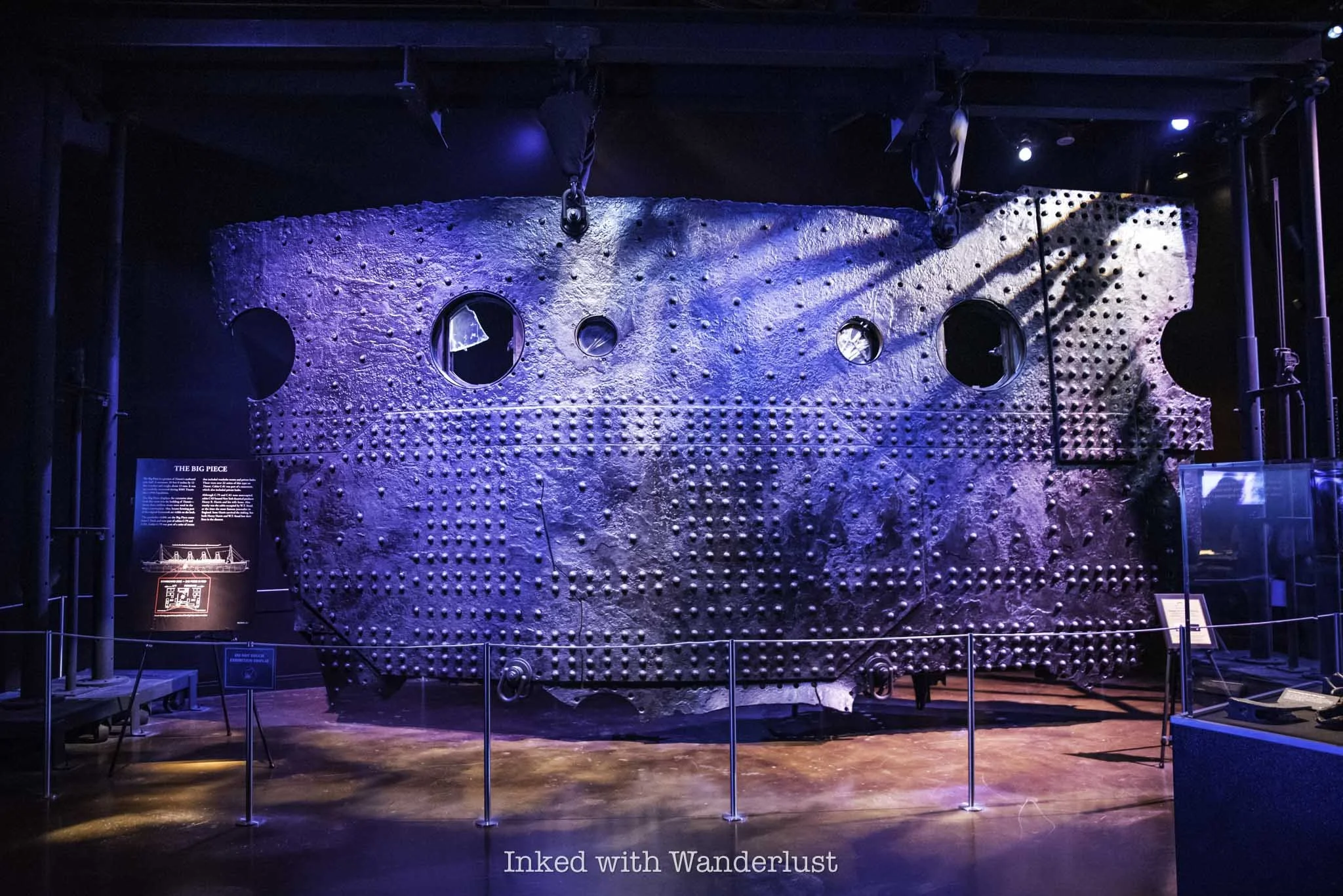
If you’re a fan of the Titanic and you’re planning a vacation to Las Vegas, you’ll want to make your way to the southern end of the strip and tour Titanic: The Artifact Exhibition.
Located on the second level promenade of the Luxor Hotel, this Las Vegas museum features dozens of real artifacts recovered from the Titanic’s wreckage site, 2.5 miles below the surface of the Atlantic Ocean.
The museum’s most famous artifact, the “Big Piece”, is an actual section of the Titanic’s hull, formally located near the center of the ocean liner. It hangs in one of the final rooms of the museum, along with several other displayed pieces.

If you’re not aware, Titanic, formally referred to as the, “Unsinkable Ship”, indeed sunk during its maiden voyage across the Atlantic after striking a rouge iceberg. More than 1500 people lost their lives either during the sinking or by freezing to death in the bitterly cold water.
As a long-time Titanic aficionado, I’ve always wanted to tour this museum and see the artifacts for myself. I did so recently, along with my Dad, and it was a somber, yet epic experience. In this post, I’ll discuss what it costs, where to find it, what to expect during the tour, the museum rules, and more.
Quick Stats
Location: Inside the Luxor Hotel in Las Vegas
Fee: $27 - $34 per person
Open: Seven days a week, even on holidays
Family Friendly: Yes
Cell Service: Yes
Restroom: Outside the museum
Parking: Paid parking at the Luxor
EV Stations: Yes
Popularity: Moderate
Features: Numerous artifacts recovered from the wreckage site
Pets: Not allowed
Cameras: Allowed, but a few off-limit areas (explanation below) and no video or live feeds
My Visit(s): November 2024
Titanic Exhibit Las Vegas Price, Location & Hours

To find the Titanic museum, you’ll need to make your way to the Luxor Hotel, which is the big black pyramid-shaped hotel on the southern end of the strip. Trust me, you can’t miss it. There’s plenty of parking available, though you’ll likely have to pay.
Current parking rates are $18 to $40, dependent on where and when you park. If you’re a Nevada resident, you can get free parking for three hours by showing the attendant your Nevada drivers license. If you’re an MGM Rewards member with a ranking of Pearl or higher, you’ll receive free self-parking. Otherwise, you’ll have to pay.
Once inside the Luxor, take the escalators to the second level promenade. This is where you’ll find the Titanic museum, Bodies exhibition, restaurants, and more. The escalators are located to the right of the giant Egyptian statues and across from the check-in desk.

When you get to the second level, you should have no problem spotting the museum’s entrance. Look to your right and you’ll spot a giant, billboard-like sign with a huge mural of the Titanic indicating the correct spot.
To the right of this sign is where the ticket booth is. If you’ve purchased your tickets online, simply get in the queue and they’ll scan your phone. If not, head to the ticket booth first. Ticket prices to the Titanic Artifact Exhibition are currently:
$34 - General Admission
$32 - Seniors (65+)
$27 - Military (w/ ID)
$27 - Nevada Residents (w/ ID)
$26 - Child (4 - 12)
$0 - Child (0 - 3)
Additionally, you can purchase combo tickets, which include access to the Titanic Artifact Exhibition and Bodies..The Exhibition. The combo tickets are only available at the booth. My Dad and I passed on “Bodies”, but if you’re interested, combo ticket prices are $44 for adults and $38 for children.
Also, you can opt for the recording device for an additional $5. It includes headphones and a narrator who guides you through the museum, explaining things along the way. It’s not a requirement, though, as there’s plenty of signage you can read in the museum.
Titanic Artifact Exhibition Photography Rules

Photo copyright - Titanic Artifact Exhibition, Las Vegas, Nevada
To answer the question on if cameras are allowed in the museum, the answer is “yes”, but with a few caveats. For starters, you are allowed to bring your cell phone and/or DSLR to capture photos of the exhibits. However, there’s no video and/or live streaming allowed.
The only area inside the museum “off-limits” to photos is the replica of the Grand Staircase. I put “off-limits” in quotations because it’s only “off-limits” to your camera. The only way to get a photo of or with the staircase is through their photographer, and you’ll have to pay for it. No, the photographer won’t take your picture with your camera.
Turning to commentary, I never participate in these, as I view them as cash grabs for something that should be included with the money you’ve already spent. Conveniently, they don’t advise you of this until after you’ve purchased your ticket. I declined the employee’s request to take my photo and continued on. If you want your photo here, though, they’ll happily oblige.
Titanic: The Artifact Exhibition in Las Vegas

After they’ve scanned your ticket, they’ll have you go through the obligatory photo opp, where one of their employees takes your photo in front of a giant green screen. At the conclusion of your tour, these photographs will be available to purchase.
Normally, when I do things like this on my own, I decline the photo and move on. However, my Dad was me and he actually had a great idea for photo of the two of us, so we opted to do it. If you don’t want to, simply advise the employee of such.

Additionally, you’ll be given a card that resembles a boarding pass. On the flip side of the pass will be the name and details of a real-life Titanic passenger. Hang on to this because at the end, you’ll discover the fate of that passenger.
The first room you’ll enter is lined with burnt-orange walls and features numerous artifacts from Titanic’s boiler room, as well as information about the doomed ship’s construction and the people who worked on it. You’ll then walk down a short hallway before turning into a re-creation of the third-class level of the ship.
Third-Class Level

Along the hallway, you’ll see signs with details on individual passengers. This will be a common theme throughout the museum that I thought was a great way to honor their memories. Learning how they ended up on the Titanic, some by pure chance, stirred up emotions at times.
At the end of the hallway, there’s a re-creation of a third-class passenger stateroom. It’s small, no bigger than a walk-in closet, and contains four bunk-style beds. It wasn’t uncommon for ships in this era to place complete strangers together in the same room.
Second-Class Level

In the next room, you’ll see recovered artifacts from the second-class level of the Titanic. The stark differences between third-class and second-class quickly becomes apparent just by looking at the dish ware. You won’t see a re-creation of any staterooms here, as they were starkly similar to first-class, which you’ll see up ahead.
One of the featured passengers you’ll learn about is the Laroche family. The Laroche’s initially booked a passage on the steamship France, however, due to that ships’ policy of not allowing children in the dining room, they were transferred to second-class accommodations on the Titanic. While his wife and children survived the sinking, unfortunately, Joseph Laroche did not.

After the second-class room, you’ll enter a white-walled hallway with a quote from the shipbuilder on the wall. At the end of this hallway through the exit on the right, you’ll come up on the museum’s replica of the grand staircase.
As mentioned above, there are no photos or video allowed here, unless their employee does it. There are also two or three artifacts on display in this room but unless you’re wanting to take the photo, bypass the queue and head straight into the first-class room.
First-Class Level

In the first-class room, opulence is the name of the game. In the re-created first-class stateroom, you’ll immediately notice the size difference from its third-class counterpart. I didn’t measure, but it appears as though you could fit three or four third-class staterooms in just one first-class room.

One of the featured artifacts in this room is a gold-plated chandelier that once hung from the ceiling of the first-class men’s Smoking Room. Additionally, there’s a wall-sized display case showcasing many of the first-class dish ware and eating utensils recovered.
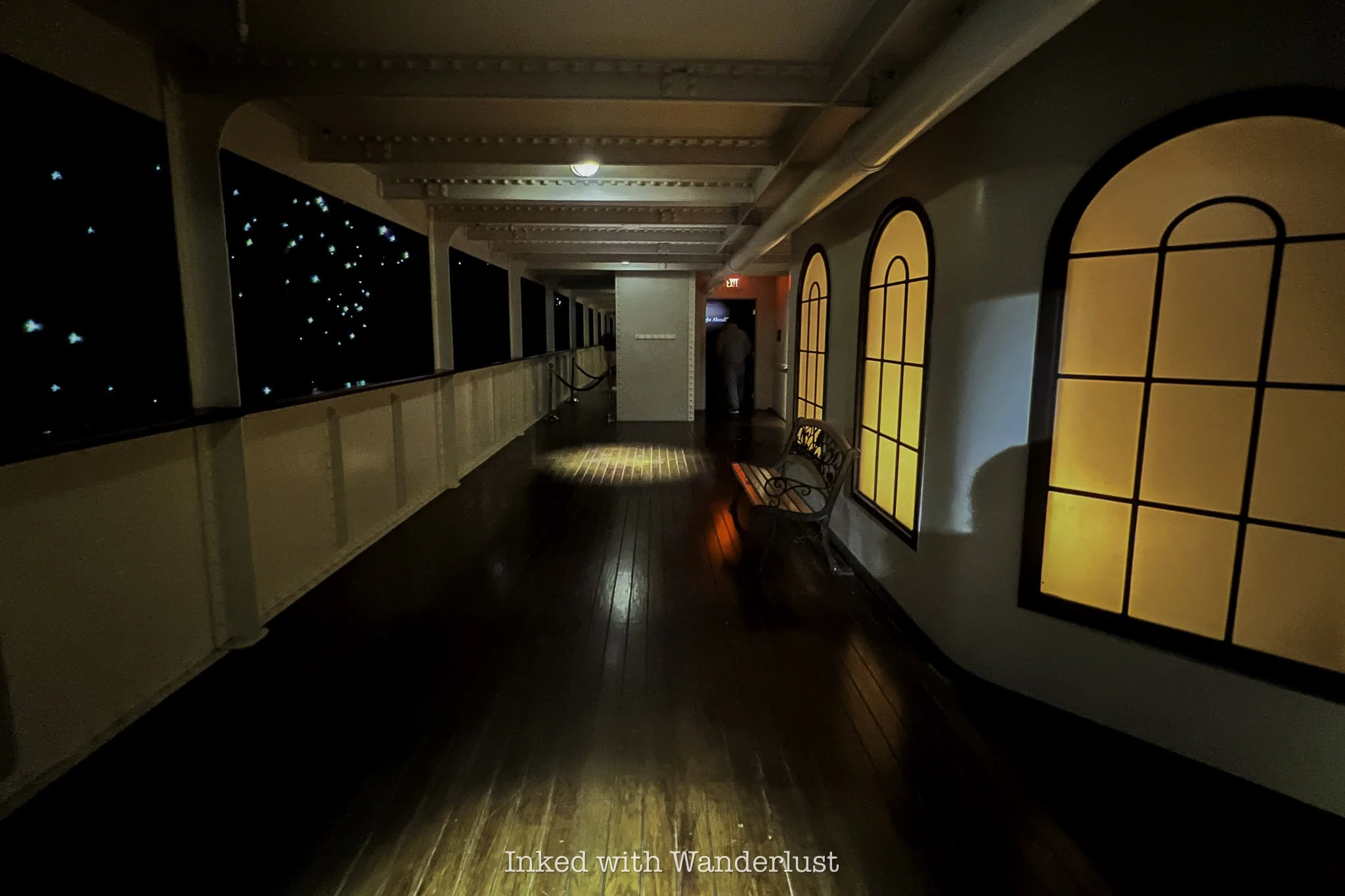
Beyond the first-class room, you’ll step out onto a re-creation of the outdoor promenade, complete with a view similar to what passengers would’ve seen that fateful night. Looking out beyond the guardrail, all passengers would’ve seen is pure darkness in the middle of the Atlantic.
After the promenade, you’ll enter a darkened, chilly room, meant to mimic the sound and feel of a windy evening on the ocean. On the wall to your immediate right are a few signs with the timestamped words of several iceberg warnings sent to the Titanic the day it sunk.
April 14, 1912 - The Fateful Day

Up to this point, you’ve been shown examples of the various levels of Titanic’s accommodations and amenities. No matter the class, the first four days of the ship’s maiden voyage had been nothing short of spectacular for her passengers. Marking what should’ve been a happy memory for all.
However, the evening of that fourth (and final) day would warp feelings of happiness and excitement into those of horror and panic. Shortly before midnight on April 14, 1912, Titanic struck an iceberg, forever changing the course of its brief history.
The next series of rooms are dedicated to the events between the collision and the ship’s eventual sinking. Despite Titanic’s false reputation as unsinkable, it took less than three hours from the time it struck the iceberg to smash into the ocean floor.
In one of the rooms, the main attraction is an example of an iceberg made of actual ice, maintained at a temperature similar to the stinging cold of the water passengers experienced when they jumped in to escape, or worse yet, unexpectedly fell into.
Unlike the other exhibits, you’re allowed to touch it. In fact, they encourage you to do so in order to get an idea of what passengers went through. It was so cold, I could only keep my hand pressed against it momentarily. Knowing the water that night was even colder than that really put things into perspective.

You’ll then walk down a dark hallway, illuminated by several display cases, each showcasing a single artifact. At the end of that hallway, you’ll enter another room. This one features several more artifacts, such as a few dozen au gratin dishes.
These dishes were discovered stacked neatly together in the sand, much like they appeared in the case. This happened when the cabinet they were stored in remained intact after hitting the ocean floor, but rotted away over the years, leaving the dishes almost perfectly in place.

Another featured display in the same room is a scale-sized model of the bow (front) half of Titanic as it appears on the ocean floor. During the sinking, Titanic was going down by the bow but before going near vertical, the stern (back) split, leaving the two halves only loosely connected.
After the split, the stern crashed back into the water, before being lifted again by the still sinking bow. This time, the ship went completely vertical. The bow, now completely submerged, broke free of the stern and began its descent. The stern would bob around momentarily before it too sunk.
This left the Titanic with two wreck sites 2,000 feet (600 meters) apart, roughly 12,500 feet (or nearly 2.5 miles) beneath the surface. At some point, a sizable chunk of the ship’s hull would break off and eventually, would go on to become the largest piece of the Titanic ever recovered.
The Big Piece
First discovered in 1994, nine years after Titanic’s wreck site was first discovered, the Big Piece was brought to the surface in 1998 after several failed attempts, with the intention of making it the centerpiece for a planned exhibition.
The piece, formally located around the mid-point of Titanic’s starboard side hull, weighs fifteen tons and is twenty-six feet, six inches across and twelve feet, six inches high. The extensiveness of the rivet work is on full display, showing a mere fraction of the three million rivets used to build the Titanic.
The portholes on the Big Piece came from C deck and were part of cabins C-79 and C-81, both of which were suites (presumably second class). Both of these suites were unoccupied but the neighboring suite, C-83, was occupied by Henry B. Harris, a famous New York theatre producer. He did not survive the sinking.
To date, the Big Piece is the largest artifact ever recovered from Titanic’s wreck site. Given the quickly deteriorating state of the ship, it’ll likely remain as such. Due to strong currents and rust-eating bacteria, it is estimated that the Titanic will completely collapse by 2030.
Titanic’s Death Toll

In the final exhibit room will be a giant wall-sized display. On this display will be the names of every Titanic passenger and crew member, separated by class and whether or not they survived. As you can see in the photo above, Titanic’s crew suffered the greatest loss with 701 perishing. Interestingly, they also had the most survivors at 209.
Of the passengers, third-class suffered the greatest loss at 529, with only 181 surviving. In stark contrast, the overwhelming majority of the Titanic’s first-class passengers survived, with about 200 surviving and 125 perishing, most of those being men. This was largely due to the “women and children first” rule of the time.
Remember the “boarding pass” you’re given at the start of your tour with a passenger’s name on it? Here is where you’ll scan the back of it to discover the fate of your passenger. Mine was a man named Johannes Joseph Van de Velde, a native of Belgium.

Not much is known about him, but we do know he did not survive. We only know this because a survivor named Theodor De Mulder visited Johannes’ family and relayed to them the final days he spent with him.
While the exact number varies, it is believed that over 1,500 passengers and crew lost their lives in the early morning hours of April 15, 1912. Many, including the ship’s captain, went down with the ship, but the vast majority was due to drowning or freezing to death in the icy Atlantic waters.
Perhaps the largest contribution to the high death toll was an insufficient amount of life boats. Titanic had only twenty, capable of holding only 1,178 of the 2,240 passengers and crew, if filled to capacity (and none of them were).
Of the 1500 victims, most were third-class passengers and/or men, as well as crew. As mentioned above, Captain Smith was thought to have given the order of “women and children” first.
It is now believed that first officers mistook this as, “no men until all women and children are off the ship”. Consequently, the lifeboats were lowered with plenty of room available, some at just half capacity.
Additionally, many third-class passengers were largely prevented access to top deck, where the lifeboats were located, to allow the wealthier passengers to board them first. This delay meant that many in third-class were doomed from the start. May they all rest in peace.
PSALM 23:3-4
Red Rock Canyon: The Ultimate Travel Guide
Red Rock Canyon is a stunning desert oasis in Southern Nevada, just 15-miles or so from the Las Vegas strip. The park’s landscape includes…
Disclosure: This post contains affiliate links. If you make a purchase through these links, I may earn a small commission at no additional cost to you. I only recommend products or services that I believe will add value to my readers.

Red Rock Canyon is a stunning desert oasis in Southern Nevada, just 15-miles or so from the Las Vegas strip. The park’s landscape includes stunning mountain peaks, maze-like canyons, sandstone ridges, an abundance of wildlife and endless recreational opportunities.
If you are traveling with small children who cannot partake in the adult-only activities on the strip, Red Rock Canyon is an excellent alternative that the entire family can enjoy together. Likewise, it’s a great way to take a break from casino hopping. Some common activities in the park include:
Hiking
Rock Climbing
Photography
Wildlife Viewing
Bike Riding
Scenic Drive
and more…
Due to this, Red Rock Canyon has become a mega-popular destination, attracting upwards of three million people annually. Before visiting, there are several things you need to know. For example, dependent upon when you’re visiting, you may need a reservation.
Additionally, there are other aspects to Red Rock you need to know, such as entry fees, parking, the unfortunate vehicle breaks-ins that occur with regularity, which hiking trails to hit and more. Don’t visit Red Rock without consulting this guide first. Let’s get into it!
Red Rock Canyon Timed Reservations

Timed reservations for Red Rock Canyon are required during the park’s peak visitation season, which for the 2023/2024 season is October 1, 2023 through May 31, 2024. Normally, peak travel season would mean the summer months, but because of the triple digit temperatures the area sees in the summer, less people visit during this time.
If you plan to visit during this timeframe, you will need a reservation. Even if it’s a fee-free day. Timed reservations can be made and purchased online through Recreation.gov in one of two booking windows. Those windows are:
Primary Booking Window: Thirty days prior to your intended visit beginning at 7am.
Secondary Booking Window: Additional reservations are made available two days in advance. For example, reservations for November 3 will be available beginning November 1 at 7am.
During the process of making your reservation, you can also pay your entry fees, including an annual pass. If you already have one, including the America the Beautiful pass, simply state so while making your reservation.

When making your reservation, you’ll need to select what time you want to enter the park from the list of available times. Be sure of your choice because they’ll only give you thirty minutes for early or late entry. Meaning, if you chose 9:00am, the earliest you could enter is 8:30am and the latest would be 9:30am.
Additionally, keep in mind that there is no re-entry during the reservation period. You can stay in the park as long as you want but if you leave, you’ll need another reservation in order to re-enter the park.
Remember, if your visit falls outside of that timeframe, you don’t need to worry about making a reservation. You’ll still need to pay entry fees, but that’s it.
Red Rock Canyon Fees and Parking

How easy or difficult parking is to come by at Red Rock Canyon depends on several aspects, such as season, day of visit, time of day, how crowded it is, etc. Visiting on the off-season, arriving to the park early and coming on a weekday nearly ensures a hassle-free experience.
I visited in August, way outside of the park’s peak season. Though I had to deal with triple digit heat, the park was a literal ghost town and I had no issue with parking at any of the trailheads or any traffic jams on the scenic drive.
The first and largest parking lot is at the visitor center just inside the entry gate. From there, there are several parking lots dotted along the scenic drive at various trailheads and viewpoints. The largest of which are at the Calico Hills and Calico Tanks trailheads.

Much like most parks in the national park system, there are entry fees associated with visiting Red Rock Canyon. The fees for 2024 are:
$20 per vehicle
$10 per motorcycle
$8 per bicyclist
$5 per pedestrian (walk-in)
$50 for the Red Rock Canyon annual pass
$80 for the ‘America the Beautiful’ annual pass (good for all national park sites)
The first four fee categories listed are for a single day. Meaning if you plan to visit on multiple days, you would need to pay the entry fee on each day. If you’re planning to visit for three or more days in a calendar year or are visiting multiple national park sites, it may make sense to purchase one of the two annual passes.
How Much Time You Need at Red Rock Canyon

The scenic drive in Red Rock Canyon is only 13-miles from beginning to end but with so much to do and see, that 13-miles could take a while to get through. If all you want to do is drive through the park and take in the sights, 45-minutes to one hour is all you would need.
My recommendation, though, is to commit to more time than that. There are so many hiking trails, viewpoints and sights to see that you could easily spend an entire day (or three) in the park.
If you’re on a time crunch, I recommend choosing one hiking trail to hike (such as Calico Tanks) and driving the scenic drive. If you choose an easy to moderate trail at a few miles or less, it shouldn’t take you longer than a few hours to do that, plus the scenic drive.
How to Get to Red Rock Canyon

If you’re like most people, you’ll be visiting Red Rock Canyon from somewhere in Las Vegas, proper. From the Las Vegas Strip, Red Rock Canyon is only about 20-30 minutes away (by car), depending on where you’re staying.
You’re in an even better position if you’re staying in Summerlin, as hotels such as JW Marriott are only 10-15 minutes away. The closest conceivable hotel to the park, Red Rock Casino Resort and Spa, is less than a two-mile drive from the gate.
While you are allowed to walk to bike into the park, I highly recommend visiting in a car. There is no public transportation going to or within the park and since cell phone signals are spotty (at best), ride sharing options aren’t reliable.
Before driving to Red Rock Canyon, make sure your gas tank is full as there are no fuel services in the park. Also, bring with you an insulated cooler and stuff it with as much water as you can fit. Dehydration is a very real threat during a visit to Red Rock Canyon. So bring more than you think you’ll need.
You’ll also want to bring food with you as there aren’t any concessionaires in the park. There are a number of restaurants within a few miles of the park and the closest grocery store, Albertsons, is less than a mile away on W Charleston blvd.
The Best Time to Visit Red Rock Canyon

With an average of 295 days of sunshine and only four inches of rain per year, there are very few bad times to visit Red Rock Canyon. Still, each season has its own positives and negatives, so it’s a good idea to know ahead of time to avoid being caught off-guard.
Red Rock Canyon in Spring
Spring time, early spring specifically, can be a great time to visit Red Rock. Daytime temperatures rarely exceed 77 degrees, but nighttime temperatures hover around 50 degrees. This makes hiking during the day quite comfortable, but it’ll be chilly at night if you’re planning to camp.
One of the downfalls to visiting in spring, though, is how windy it can get. Wind can happen anytime of year at Red Rock but in March and April, gusts have been recorded at 60+ mph. Aside from that and the chilly evenings, spring is a great time for hiking and climbing.
Red Rock Canyon in Summer
If all you’re looking to do is take a lap around the Red Rock Scenic Drive and pop out here and there to take in the views, then summer is fine. If you’re looking to hike or rock climb, however, the hot weather can make a summer visit a potentially dangerous one.
With an average daytime temperature of 93-degrees and not much shade on the park’s hiking trails, dehydration is a real concern. A concern that I, unfortunately, know all too well. I, stupidly, hiked the Calico Tanks trail on a triple digit day and despite drinking lots of water, I started feeling the effects of dehydration on my way back to the car.
If you’re key on hitting the trails, my recommendation would be to visit in the spring or fall. If you must hike in the summer, go on a day with the lowest possible temperature and get an early start so you’ll be off the trail before the mid-day heat sets in.

Red Rock Canyon in the Fall
The benefits of visiting Red Rock Canyon in the fall are:
The daytime temperatures are significantly better than they are in the summer.
The fall foliage colors in contrast to the red rock makes for a stunning sight.
One significant drawback to fall, though, is it’s when monsoon season hits. So it’s imperative to check the weather forecast before heading to Red Rock (be sure to look up the weather for Red Rock, specifically, as it can differ greatly from nearby Las Vegas, proper).
Also, ready yourself for potential seriously high winds as much like in the spring, gusts can reach 60 mph or more. However, amidst all that wind, you’ll bare witness to the leaves and other foliage changing colors, creating a beautiful contrast to the red rocks.
Winter in Red Rock Canyon
If you’re planning to visit Red Rock in the winter, prepare yourself for chilly conditions as daytime temperatures average around 57 degrees and dip down to an average of 32 degrees at night. Needless to say, bring a warm jacket and dress in layers.
The upside to this time of year are the epic sunsets you can catch from various points in the park, including and especially from the various mountain peaks. If you do decide to hike up to the peaks, keep an eye out for patches of snow and ice.
While it doesn’t snow too often, it isn’t unheard of to see accumulated snow around the scenic drive and visitor center. Additionally, it tends to rain in the winter more-so than any other time of year, so be sure to bring an umbrella and a waterproof layer of clothing.
Things to Do in Red Rock Canyon

1) Drive the Red Rock Canyon Scenic Drive
One of the most popular things to do in Red Rock Canyon is to drive the 13-mile, one-way scenic drive that winds through the park. There are pull-outs and parking lots dotted along the road at several of the park’s most popular trailheads and lookouts.
2) Hit the Hiking Trails
There are many hiking trails in Red Rock with varying levels of difficulty. A couple of the easier trails include Pine Creek Canyon and the historic Petroglyph Wall. Two of the park’s most popular trails, Calico Tanks and Icebox Canyon, fall into the moderate category. If you’re looking for more of a challenge, Turtlehead Peak and Kraft Mountain Loop offer just that.
3) Book a Horseback Riding Tour
Access areas of the park only possible on horseback by booking a horseback riding tour through Viator. This two hour tour doesn’t require any experience and allows you to experience the rugged side of the park. Pay later options are available.
4) Try Your Hand at Rock Climbing
Red Rock Canyon is a rock climber’s paradise. If you’re still learning how to climb and aren’t comfortable going out on your own, there are many tour options available. If you are experienced, though, you’ll love the free range of options and solitude Red Rock provides.
5) Stop by the Visitor Center
A visit to the park wouldn’t be complete without stopping by the visitor center. Inside, there are many artifacts found in the park and exhibits detailing the history of Red Rock.
6) Take a Shaka Tour of Red Rock Canyon
Download a Red Rock Canyon Shaka Guide. It’s like having a personal tour guide in the car with you. Packed with useful information and stories of Red Rock, you’ll follow your Shaka Guide around the park, hitting up numerous stops such as the historic Petroglyph Wall, hike the Sandstone Quarry, enjoy lunch at Willow Springs and more!
Be Sure to Hide Your Valuables

Unfortunately, Red Rock Canyon has been fraught with vehicle break-ins in recent years in areas both outside and inside of the park. What happens is the criminals wait for people to make their way down a hiking trail and then inspect their vehicle. If they see something, they’ll smash out the window and grab the item(s).
To combat this issue, the Friends of Red Rock Canyon have been raising funds to increase the amount of cameras in the park’s parking lots. Furthermore, increased patrols from park rangers have been implemented.
However, to help ensure your windows don’t get smashed out, it’s best to keep all valuables hidden in the trunk. This includes backpacks, coolers (especially Yeti branded ones), cameras, wallets, cell phones, branded clothing such as The North Face and anything else that could be perceived as valuable.
Red Rock Canyon Frequently Asked Questions
Are dogs allowed at Red Rock Canyon?
As long as they’re leashed and never left unattended, you are allowed to bring your dog(s) to Red Rock Canyon and its hiking trails.
How much time should I spend at Red Rock Canyon?
You should, at minimum, allocate two to three hours if all you want to do is the scenic drive and see the main highlights. If you want to hike multiple trails, though, I recommend setting aside two full days, at least.
Can I enter Red Rock Canyon without a reservation?
Yes and no. If you’re visiting between October and May, then yes, you’ll need a timed reservation. June through September, however, you can come and go as you please as reservations are not required during these months.
How far is Red Rock Canyon from Las Vegas?
From the Las Vegas Strip, Red Rock Canyon is around 20-miles (give or take) or a 30-minute drive away.
Which is better, Red Rock Canyon or Valley of Fire?
Both! Honestly, there’s no way to compare the two. They’re each amazing in their own right and I highly recommend visiting both. You can read my one-day at Valley of Fire itinerary here for inspiration.
Is there cell service at Red Rock Canyon?
Cell service is nearly non-existent at Red Rock Canyon.
Are there bathrooms at Red Rock Canyon?
Bathrooms are readily available at Red Rock Canyon. The visitor center has one and additionally, most of the trailhead parking lots and pull-outs have (rather clean) vaulted toilets.
Is there public transportation to Red Rock Canyon?
No. Additionally, due to limited cell service, ride sharing isn’t a viable option.
Is flying a drone allowed at Red Rock Canyon?
Yes! Flying a drone in the park for recreational purposes is allowed.
PROVERBS 3:23

See The Historic Petroglyph Wall at Red Rock Canyon
Located within Red Rock Canyon Recreation Area, not too far from the Las Vegas strip, you can find an amazing…
Disclosure: This post contains affiliate links. If you make a purchase through these links, I may earn a small commission at no additional cost to you. I only recommend products or services that I believe will add value to my readers.
Located within Red Rock Canyon Recreation Area, not too far from the Las Vegas strip, you can find an amazing example of Native America history - the Petroglyph Wall.
It’s easy to find as the road leading to it runs just off of Scenic Drive, the main road that runs through the park. Additionally, it’s easy to get to as it’s less than a quarter mile to the wall and back.
So what’s the parking situation like? How do you get to the trailhead? Are there any fees involved? I answer all of these questions, and more, in the post below. Let’s get into it.

Click ad to view offer
Trail Stats
Location: Red Rock Canyon Recreation Site, Las Vegas, NV
Fee: None for the trail, but Red Rock charges an entry fee
Open: All year
For: Everyone
Cell Service: Spotty, at best
Restroom: In the trailhead parking lot
Parking: Semi-large, unpaved lot
EV Stations: None
Difficulty: Easy
Accessibility: Not wheelchair or stroller friendly
Popularity: Medium
Mileage: Less than a quarter mile, there and back
Time: 20-30 minutes
Condition: Semi-maintained (follow trail markers)
Features: Historic petroglyphs and mountain views
Best Viewed: Any time of year
Pets: Allowed, as long as they’re leashed
Drones: Allowed for recreational purposes
Hazards: None other than usual outdoor hazards
Our Visit(s): August 2023
Petroglyph Wall Parking, Trailhead and Getting There

While there are no fees associated with Petroglyph Wall directly, there are fees you’ll need to pay to enter Red Rock Canyon and depending on the time of year you visit, reservations may be needed as well. Fees for Red Rock Canyon are as follows:
$20 per vehicle
$10 per motorcycle
$8 per bicyclist
$5 per pedestrian
$50 for a Red Rock annual pass
$80 for the ‘America the Beautiful’ pass
Additionally, between October 1 and May 31, advanced reservations are required to enter the park between the hours of 8am and 5pm. Reservations are available 30-days in advance and no re-entry is allowed. Scenic Drive is only one-way, so arrive early and have a plan in place.


To get to the parking lot and trailhead for Petroglyph Wall, simply drive for about eight miles from the Red Rock Canyon entrance. You’ll see the road ahead turning into a tight horseshoe. As the road begins to horseshoe, you’ll see Rocky Gap Road on your right. Turn there.
You’ll first come upon another parking lot for a different trail on your left, bypass this and continue until you reach the second parking lot, where the Willow Springs Picnic Area is. This is where you’ll park for Petroglyph Wall.
The trailhead is located at the north end of the lot, on the far left corner, across from Willow Springs. There’s a sign indicating you’re in the right spot (pictured above).
Trail to Petroglyph Wall

The trail from the parking lot to Petroglyph Wall, one-way, is just a tenth of a mile across a wash. The trail isn’t maintained all that well, but it’s still easy to follow as it’s dotted with the same trail markers you’ll find on most Red Rock Canyon trails.
After a short time, you’ll arrive to at Petroglyph Wall. The area surrounding the wall is small, with a couple trees providing a smidgen of shade. Near the wall, you’ll find informational signage detailing the facts of the petroglyphs.

The rock art on Petroglyph Wall is estimated to be at least 800 years old. Most of the art is found on one section of the wall (the dark part), but there are a few others scattered about.
This is far from the only examples of petroglyphs in Red Rock Canyon, but it is the easiest to access. While the trail isn’t stroller or wheelchair friendly, it’s accessible to children, the elderly and everyone in between.
Unless you’re a huge fan of petroglyphs, I don’t recommend visiting Red Rock purely to visit Petroglyph Wall considering the fees to enter the park. This is more of a bonus if you’re already planning to be here.
Where Do You Go From Here?

As stated above, Petroglyph Wall serves as an excellent bonus to your already planned visit to Red Rock. Considering that Scenic Drive and there is no re-entry during the reservation period, I recommend checking out the Calico Tanks hiking trail first, as it’s before Petroglyph Wall.
Beyond Petroglyph Wall, there’s another amazing hiking trail by the name of Icebox Canyon you should check out, as well as Pine Creek Canyon.
If you want further examples of petroglyphs, I recommend driving east to famed Valley of Fire State Park. There’s an equally easy example of rock art on Atlatl Rock, among other areas of the park. While you’re there, there are many other highlights in the park you can see in a relatively short amount of time.

Hike the Calico Tanks Trail at Red Rock Canyon
While there aren’t any fees associated with the trail itself, the trail is located inside Red Rock Canyon, which does…
Disclosure: This post contains affiliate links. If you make a purchase through these links, I may earn a small commission at no additional cost to you. I only recommend products or services that I believe will add value to my readers.
If you live in the Las Vegas area or you’re planning to visit soon and you’re in search of local hiking trails, you can’t go wrong with one of the most popular in the area - the Calico Tanks Trail.
Located in Red Rock Canyon National Conservation Area, right off the Scenic Drive, this trail takes hikers on a thrilling experience through red and white sandstone formations across rolling hills and inside the walls of a canyon, before ending at the famed Calico Tank and a jaw dropping view of the valley below.
While the trail length is moderate, coming in at only 2.4-miles, out and back, it’s far from your normal, everyday trail as there’s some mild scrambling required, increasing the time it’ll take to complete the hike.
Curious to see what the trail looks like? Want to know where the parking lot is and what, if any, fees are associated with this hike? I discuss all of that and more in the post below.

Click or tap on the ad to view offer
Trail Stats
Location: Red Rock Canyon National Recreation Area, Las Vegas, NV
Fee: Up to $20 per vehicle
Open: All year
For: Hikers
Cell Service: Spotty, at best
Restroom: At the trailhead
Parking: Large paved lot at the trailhead
EV Stations: None
Difficulty: Moderate
Popularity: High
Mileage: 2.4 miles, out and back
Elevation Gain: 440 feet
Condition: Trail is dotted with trail markers, but there isn’t much of a designated path for most of it. Bringing a map would be wise
Features: Beautiful sandstone formations, the Calico Tank and a great view of Las Vegas at the end
Accessible: Any time of year, but with the limited shade and the extreme heat, summer isn’t ideal
Pets: Not allowed
Drones: Not allowed
Hazards: Little to no shade, sandy boulders and rattlesnakes
My Visit(s): August 2023
Take a look at these products that I recommend for this hike…
Red Rock Canyon Fees and Parking

While there aren’t any fees associated with the trail itself, the trail is located inside Red Rock Canyon, which does charge a fee to enter. Fees for 2024 are as follows:
$20 per vehicle
$10 per motorcycle
$8 per bicyclist
$5 per pedestrian
Furthermore, if you’re visiting between the months of November and May, a timed reservation will be required to access the park between the hours of 8am and 5pm. An additional $2 fee will be charged by Recreation.gov for these.
If you have any variation of the America the Beautiful pass, you can use it for entry here. You will still need a reservation during the months mentioned above, though. Conversely, you can purchase a Red Rock Canyon annual pass for $50.
The parking lot for the Calico Tanks Trail is easy to find, as it’s located just off Scenic Drive on the right. It’s fairly large, capable of holding several dozen vehicles or so, and is paved.

It’s the second parking lot you’ll encounter along Scenic Drive. The first one is for the Calico Hills and Basin, so don’t confuse the two (though this area is also worthy of exploring if you have the time).
Unfortunately, Red Rock Canyon experiences vehicle break ins and thefts at the most popular parking lots, Calico Tanks being amongst them. So don’t leave valuables in plain view.
Near the entrance, I pulled over to take a photo of the welcome sign and while doing so, I witnessed a black SUV pull over. A young man jumped out, looked into my car and the car parked in front of me, looked up and saw me, jumped back in his car and took off. So definitely heed the warnings.
The Trail

The trailhead is located at the northern end of the parking lot, next to the restrooms. There’s trail signage here advising visitors of potential hazards and/or trail conditions, so be sure to give them a quick read.
The trail begins in the shade of the large canyon wall and runs straight for about 30 yards, before pivoting right towards an area of gravel wash.
This area can be easy to lose at times as the trail appears to have been washed away by reoccurring flooding events. You’ll know you’ve went the right direction when you see two giant boulders on your left (pictured below).

Past these boulders, you’ll travel along a clear pathway for a short spell before coming across an even larger gravel wash field. Throughout this stretch, it would be advisable to have a map on hand as the trail is non-existent.
If you don’t have one, just keep an eye out for the trail markers and make your way to the next one the best you can, simply repeating the process until you’re back on the path.

After a short while, the trail will become obvious again and will narrow as it aligns with the canyon walls. It is here where your adventure truly begins.
If there’s been rainfall recently, you’ll likely encounter several large puddles of water and work your way through the canyon. None of them are deep or treacherous, though.
You can easily bypass many of them by utilizing the spur trails, but there is one in particular that forces you to either scramble over the sandstone or just accept the fact that your feet are going to get wet.

You’ll soon come upon the first of many large boulders you’ll need to negotiate in order to complete the trail. None of which are difficult.
There are no ropes or chains to hoist yourself up on, nor will you need any special equipment. Be sure to bring shoes or boots with good tread, though, as the sandstone is slick and sandy in some spots.

Much like at the beginning of the trail, there are several trail markers placed along this stretch indicating the best possible path, as there is no proper trail from this point forward.
You’re never out of eye-shot of one of these markers, so as soon as you make your way to one, simply look around to find the next and make your way there, watching your steps.

Depending on the time of day, you’ll have some shade on this section of the trail, but it’s mostly in the morning. As the sun gets higher, the amount of shade dissipates, leaving you more exposed to the Las Vegas heat.
It goes without saying, but you should bring as much water your shoulders can handle on this hike. It’s always better to bring too much than not enough.

You’ll know you’re nearing the end of the trail when you reach a series of sandstone steps, coupled with a dirt path leading you upward.
At the top of those sandstone steps, you’ll notice a notch in the distance. Just beyond that notch is where the Calico Tank lies.

The water level in the tank varies throughout the year. It can be anywhere from bone dry in the summer to full and frozen over in the winter.
Either way, it makes for a great spot to sit and enjoy a snack. There are numerous rocks to sit on along the trail on the south side of the tank. Additionally, if the water level is low enough, there’s a small area on the shore where you can sit.
Just beyond the tank is an outstanding view of Las Vegas and the valley. I did not go any further as I was feeling the effects of the day’s 108 degree heat and had to turn back.
From what I was told by others on the trail that day, you’ll need to do a little more boulder hopping past the tank to reach the overlook, but it’s only a few more minutes beyond the tank.
READ NEXT: “How to Spend a Few Hours at Valley of Fire in the Summer”

My Experience at Jade Asian Kitchen & Noodles in Las Vegas
During my recent visit of Valley of Fire State Park and Red Rock Canyon, I stayed at the JW Marriott in the community of…
Disclaimer: I am not a professional restaurant critic, nor has this restaurant offered me any incentive to write this post. My opinions are my own and are based on my personal experience only.
In Las Vegas, there is no shortage of amazing places to eat. People from all over the world and all walks of life come to Vegas so thus, there are many restaurants serving a wide variety of delicacies.
While many websites focus on places to eat on or near the Las Vegas strip, I feel there isn’t enough representation of great places to our outside of the stip.
During my recent visit of Valley of Fire State Park and Red Rock Canyon, I stayed at the JW Marriott in the community of Summerlin. If you’ve ever stayed at a JW, you’ll know they’re known for being large properties with many restaurants and other offerings.
One such restaurant at the JW Las Vegas is Jade Asian Kitchen & Noodles, located behind the hotel’s palms tower, down a beautiful marble floored hallway, right across from Starbucks.
I was famished after spending half the day exploring Valley of Fire and was looking to replenish those lost calories. After a quick Yelp review search, I decided to book a table at Jade.

Click or tap on the ad to view offer
Disclaimer: I am not a professional restaurant critic, nor has this restaurant offered me any incentive to write this post. My opinions are my own and are based on my personal experience only.
Restaurant Info
Location: JW Marriott Las Vegas Resort & Spa
Address: 221 North Rampart Blvd.
Cost: $$$$
Food: Fresh sushi, Teppanyaki and other Asian dishes
Open: 5pm - 10pm (Wed, Thurs, Fri) & 4pm - 11pm (Sat & Sun). Closed Mon & Tues
Seating: Mostly indoor. Some outdoor seating on the patio
Alcohol: Full bar - extensive beer and cocktail menu
My Visit: August 2023
Rating (out of three): 👍🏼👍🏼

As stated above, Jade Asian Kitchen is located inside the JW Marriott in the Las Vegas community of Summerlin, behind the hotel’s Palms Tower.
If you’re not staying at the hotel, your best bet is to park in the self parking area of the hotel, just outside Rampart Casino. You’ll find the restaurant outside of the berm of the casino area, adjacent to Starbucks.
You can make a reservation for the regular menu at Jade through the OpenTable app, or by calling them directly. Though it isn’t required.
If you’re wanting to enjoy Teppanyaki, though (like I did), then reservations are required. When arriving, be sure to specify to the host/hostess about your Teppanyaki reservation.

The dining room is beautifully lit in a contemporary setting. There are touches of Asian culture decor mixed in as well. Jade does a great job of honoring Asian culture without coming across as cliche.
The Teppanyaki counters are located in the rear of the dining room, near the entry doors to the outdoor patio. If I remember correctly, there were four grills set up.
For those who’re unaware of what Teppanyaki is, it’s a post-World War II style of Japanese cuisine in which an iron griddle is used to cook food. The word is derived from teppan (the metal plate) and yaki, which means pan-fried, grilled or broiled.

Once everyone at your table has been seated, your chef will come out to make their introduction and explain the process to you. It’s around this time when your waiter or waitress will take your food and drink orders.
The protein options on the Teppanyaki menu include the usual that you’d find at most restaurants. These include; chicken, shrimp, salmon, filet mignon, ribeye, sea scallops, lobster, wagyu and vegetarian.
Prices range from $29 (chicken) to $136 (wagyu ribeye) and includes a soup starter and a side of fried rice. They also offer combo options where you can get two proteins if you’re having a difficult time deciding.
Your chef will leave again to obtain the necessary ingredients. When they return, they will begin cooking your food right in front of you, all while telling jokes, making quips and lighting up an enormous flame of fire (or two).


As you can see in the photo above, I went with the New York strip/chicken combo ($59), as I wanted to try both. While both were good and had great flavor, I personally enjoyed the chicken more so than the steak.
I also received a side of grilled vegetables and three difference dipping sauces. I don’t recall what the sauces were, but I do remember the only one I liked was the dark brown one in the middle.
Additionally, I ordered one of their specialty cocktails with my meal. I’m a whiskey guy, so I went with their “Jade Old Fashioned” ($25). It’s made with barrel aged Toki whiskey and angostura bitters. While it was a fine old fashioned, I felt it wasn’t special enough to warrant a $25 price tag.

All in, including tax and tip, my final bill was $108. It officially became the most expensive meal I’ve ever paid for, for just myself. Was it worth it? That all depends on perspective.
I came here because I’ve always enjoyed Teppanyaki, I was starving, it was conveniently located in my hotel and I was gathering content for this website. Would I, under normal circumstances, spend that much money for dinner on just myself? Probably not.
Looking at the regular menu, they have many entree options that I feel are reasonably priced. So if you can live without doing the Teppanyaki option, a family can dine at Jade and not spend much more than they would at most Las Vegas restaurants.
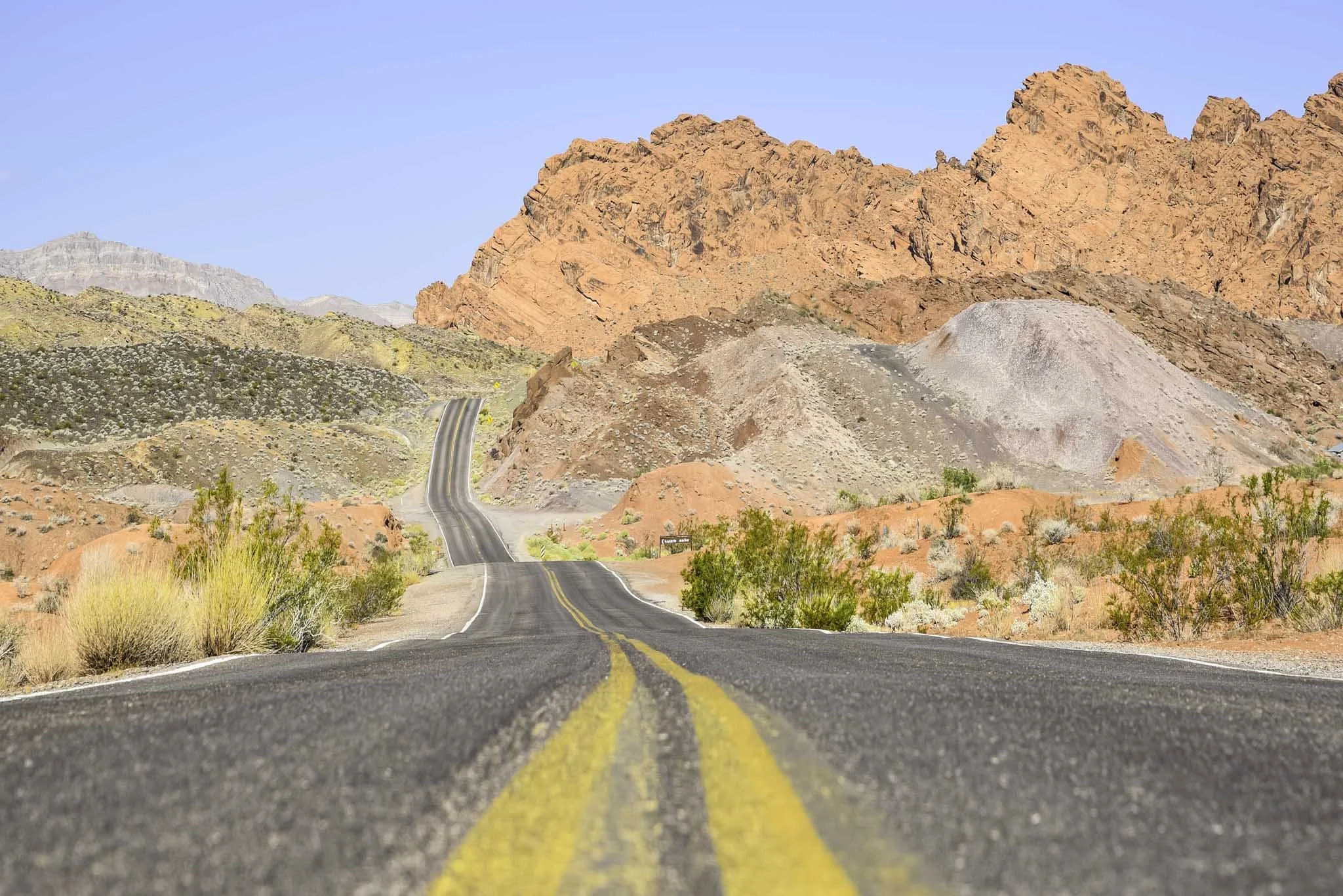
How to Spend a Few Hours at Valley of Fire in the Summer
Valley of Fire offers a variety of hiking trails, a visitor center with informative exhibits and many historical sites. There’s…
Disclosure: This post contains affiliate links. If you make a purchase through these links, I may earn a small commission at no additional cost to you. I only recommend products or services that I believe will add value to my readers.
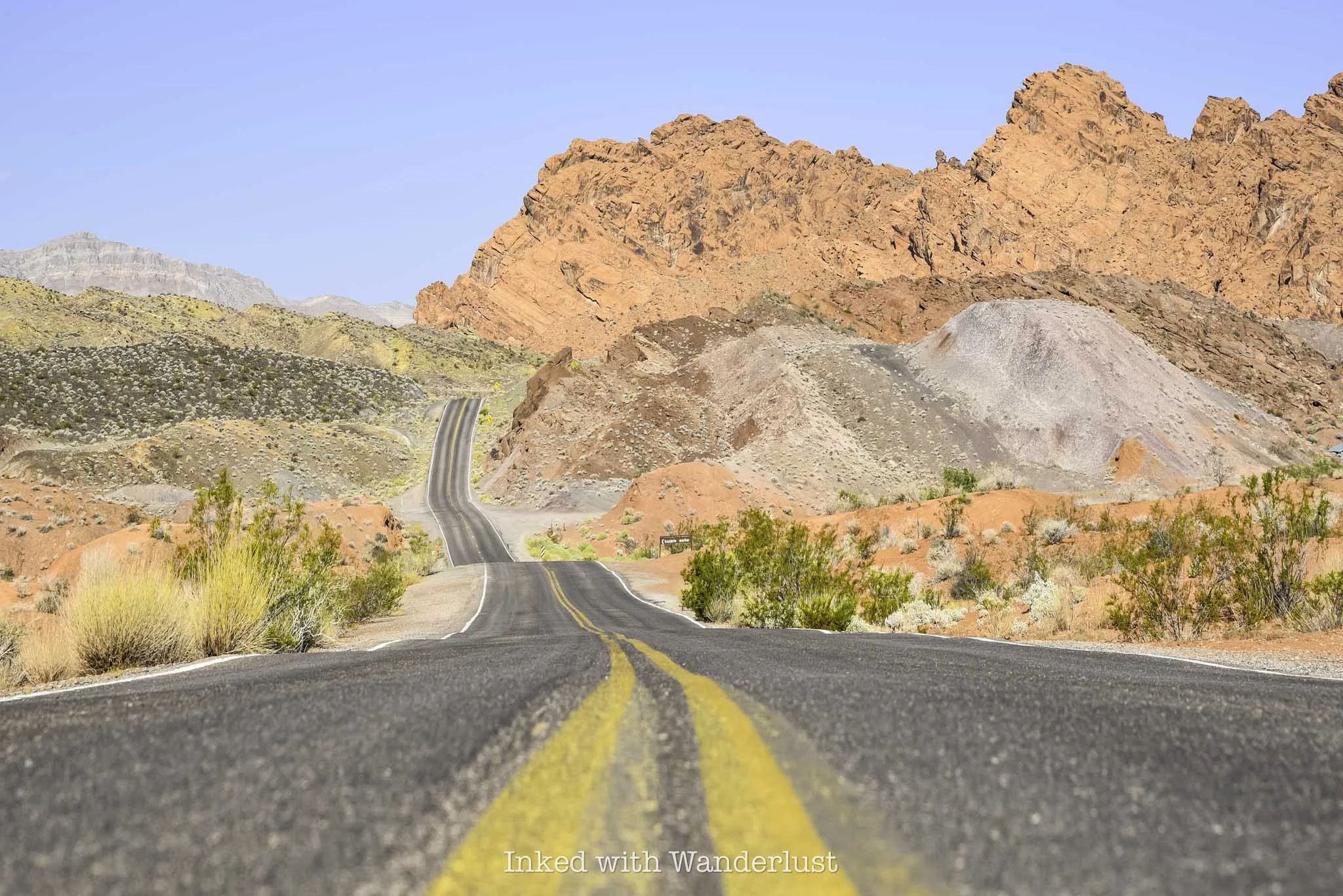
Established in 1935 as Nevada’s first state park, Valley of Fire attracts thousands of hikers, photographers and overall nature enthusiasts annually. It’s located in southern Nevada, just an hour so from the bright lights of the strip and is one of the most popular things to do near Las Vegas.
Valley of Fire offers a variety of hiking trails, a visitor center with informative exhibits and many historical sites. There’s literally something for everybody in this geological wonderland.
While I always recommend spending at least a full day at the park, the reality is, the extreme heat that Valley of Fire sees in the summer is simply too much for many people. It’s quite common to see high triple digits consistently.
Thankfully, Valley of Fire offers many attractions that are easy to see, with most only requiring a small commitment of thirty minutes or less, allowing you to see many of the highlights in a short amount of time.
So if you’re thinking about visiting Valley of Fire in the summer, but you can’t stand the heat and only have a few hours to spend, you’ve come to the right blog. Let’s get into it!
Valley of Fire Entrances, Fees & Reservations
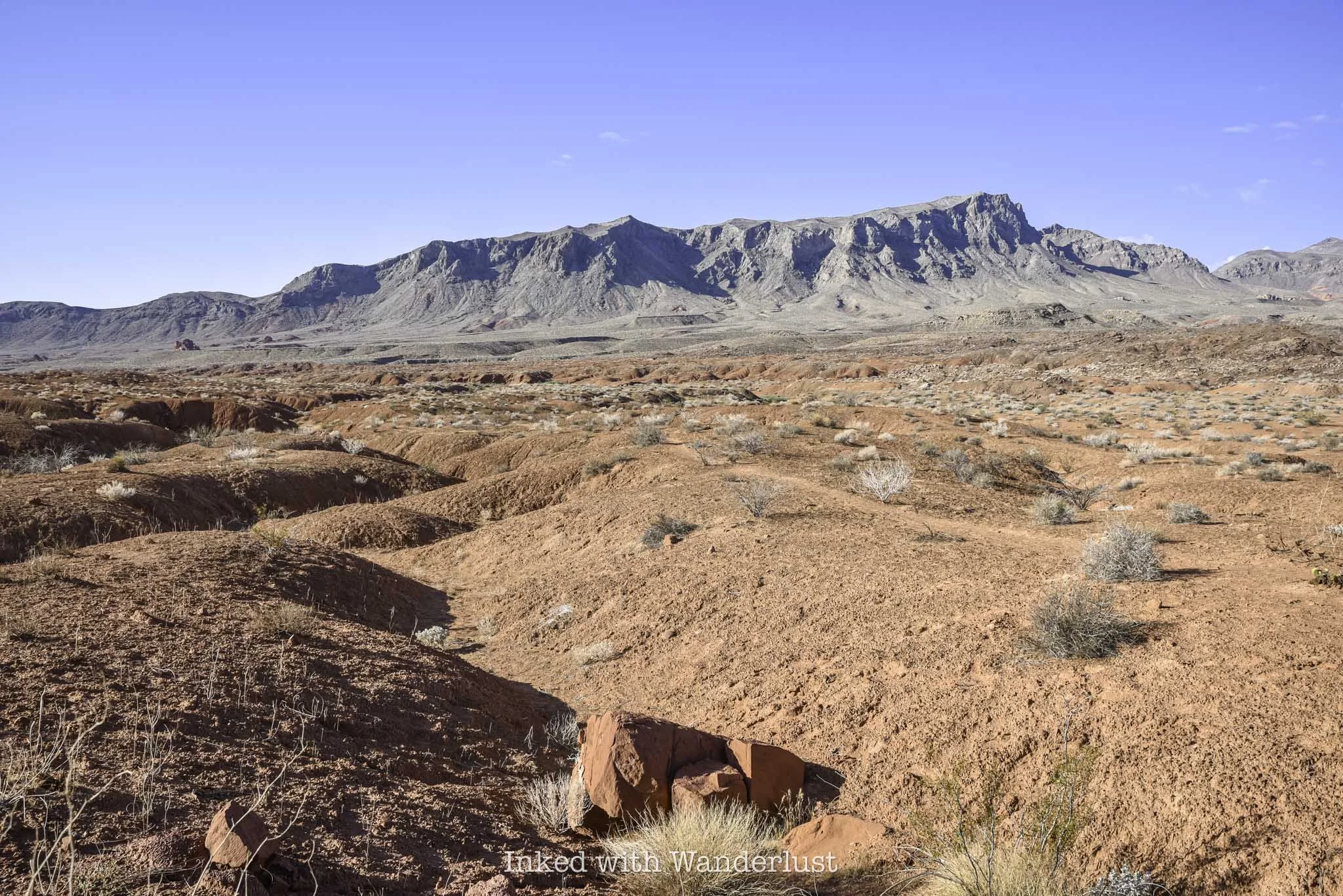
Before we get into the fun stuff, there are a few things you need to know before traveling to Valley of Fire. For starters, no, day-use reservations are NOT required at Valley of Fire at this time. However, with the recent launch of the Reserve Nevada website, I wouldn’t be surprised to see it happen eventually as it’s the most popular state park in the state.
On the flip side, yes, you will have to pay an entrance fee. Thankfully, the fees aren’t all that high and if you’re driving a car with a Nevada license plate, you’ll get a discount! As of 2024, day-use entry fees are as follows:
$15 - Non-Nevada vehicles
$10 - Nevada vehicles
You can pay with a credit/debit card or cash. If the ranger booths aren’t staffed when you arrive, simply pull into the parking lots to the right to pay. If paying with cash, insert cash into the provided envelope and slip that into the iron ranger.
Conversely, you can still pay with a credit or debit card at the digital self-pay stations. Keep in mind that there’s always a chance that those pay stations will be offline, so it’s best to bring cash with you just in case (it happens more than you think).
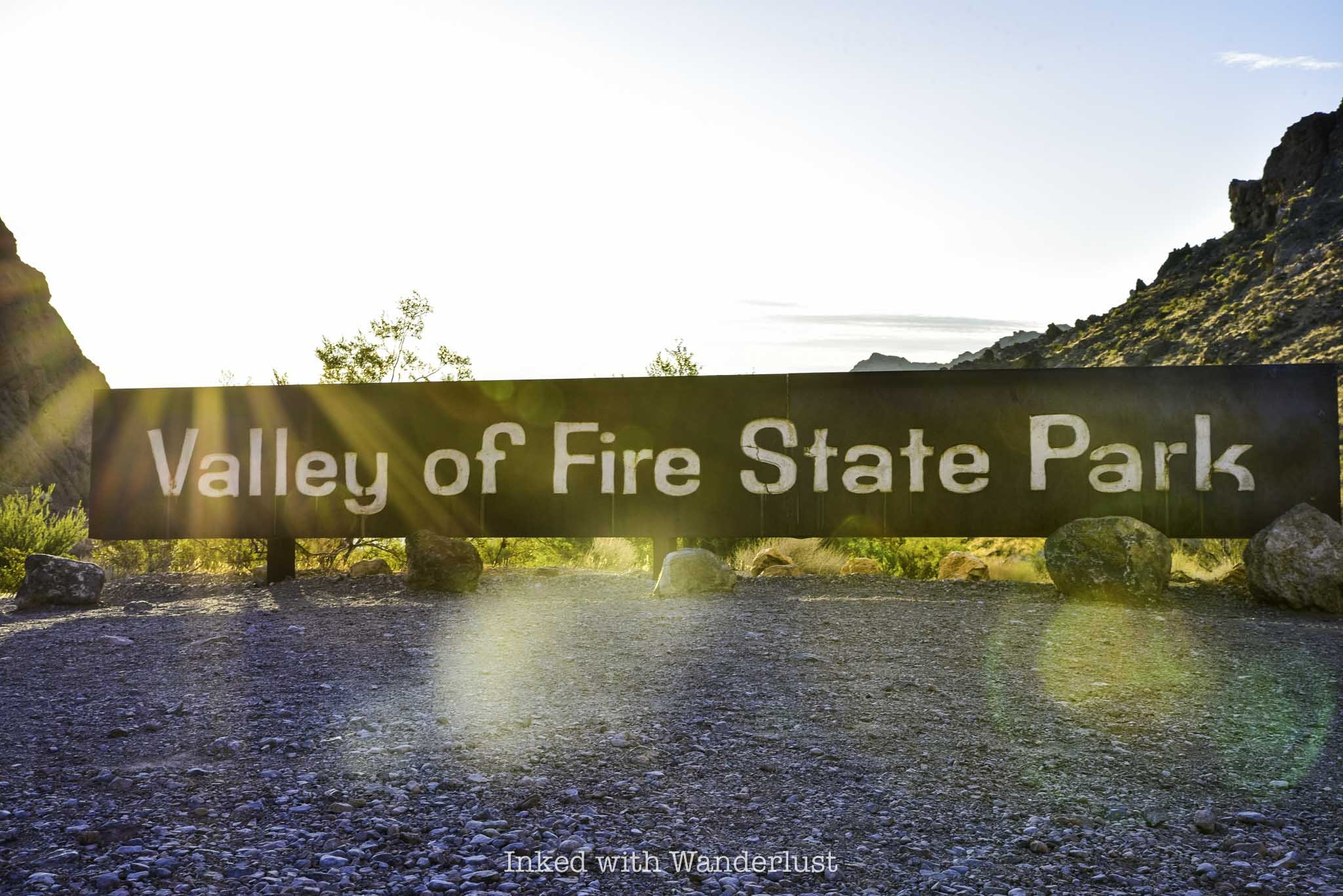
There are two entrances at Valley of Fire; the east entrance and the west entrance. If you’re coming from Las Vegas, you’ll likely drive through the west entrance. Conversely, if you’re driving from Lake Mead/Hoover Dam, Arizona or Utah, you’ll likely go through the east entrance.
Additionally, there are only two main roads in the park; the Valley of Fire Highway (or, Valley of Fire Scenic Byway) which runs east to west, and Mouse’s Tank Road (or, White Domes Road) which takes you to the northern section of the park.
Navigating the park is easy, so you don’t need to rely on GPS too much. Keep in mind that cell service in the park is spotty to non-existent in most areas of the park. There are roadside signs all along the road announcing which attractions you’re approaching, though.
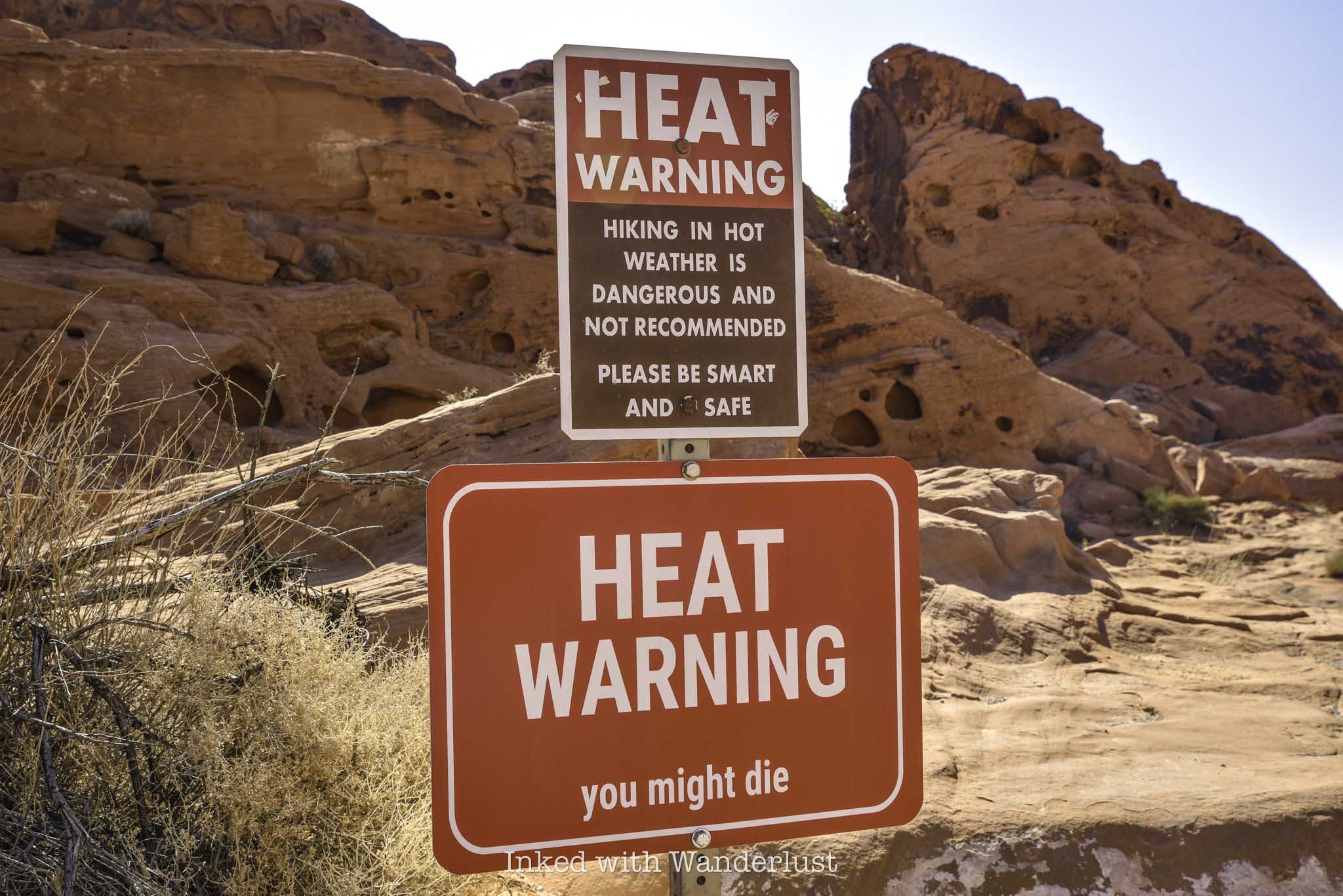
Lastly, be sure to heed the ominous signs at the park’s trailheads. They may seem dramatic, but many heat-related deaths have occurred in the park over the years. There isn’t much shade on any of the trails. I had my own scary experience while hiking in Red Rock Canyon, making me a believer.
For pleasant, somewhat cooler weather, early October to April are the best times to visit Valley of Fire. Though fall and spring sees the biggest crowds for that very reason.
If your aim is to visit with the least amount of people around as possible, then the summer months are your best bet. You will be contending with peak temperatures, though, so an early arrival is paramount to an enjoyable experience in the summer.
Here are some products that I recommend bringing to the park with you to help combat the heat:
Things to See at Valley of Fire in a Few Hours
While it would be easy to spend two or three days at this beautiful park, you can just as easily spend a few hours due to the park’s many easily accessible attractions. Below, I’m going to provide a list of things to see and do in Valley of Fire that will allow you to see many of the highlights in a relatively short amount of time.
This itinerary will list the attractions in the order that they appear in the park and will assume you’ll be driving in from Las Vegas, through the west entrance (if you’ll be driving in through the east entrance, just complete this itinerary in reverse order).
Remember, the goal is to arrive at the park as close to sunrise as possible. This will allow you to see everything listed below and be out of the park by 11am or so, when the heat and crowds are at their worst.
Keep in mind that certain trails are closed in the summer months due to extreme heat, so in respect to responsible travel, I will be omitting those from the list. For informational purposes only, the following trails are closed from mid-May to October:
Seven Wonders Loop
Pinnacles Loop
Prospect Trail
Arrowhead Trail
Natural Arch Trail (excluding Natural Arch itself)
Charlie’s Spring
The Beehives
After driving in through the west entrance, the Beehives will be the first major attraction you’ll see and the large parking lot will be on your right.
The Beehives themselves are located right off the parking lot. There’s no designated path to follow, so feel free to explore them at your leisure.
You’ll quickly realize why they were named, “Beehives”, as you’ll see many honeycomb-like formations in the sandstone rocks. I feel that they’re the perfect introduction to Valley of Fire and a great place to watch the sunrise.
Atlatl Rock
From the Beehives parking lot, drive east for a couple of miles until you see the turn-off for Campground road on your left. You can see Atlatl Rock from the highway but as you get closer, its commanding presence becomes more and more clear.
Aside from the large rock itself, the main draw to Atlatl Rock are the petroglyphs on the smooth rock face near the top. Simply take the steel staircase to the viewing deck above to see them.
The parking lot is fairly large, located just off the road, and features a restroom as well as a half a dozen or so shaded picnic tables. This makes Atlatl Rock an ideal spot for a quick break.
Atlatl Rock doesn’t take long to explore, as most of the petroglyphs are located in one central location. Though there are others scattered through the neighboring campground as well.
For more information, read my comprehensive guide on Atlatl Rock here.
Natural Arch
To see Natural Arch, turn left onto Campground road going out of the Atlatl Rock parking lot and follow it for about a mile. It’ll be on the left side of the road.
There’s no real parking lot, just a small pull-out style, dirt and gravel lot. In the morning, the view from the roadside will be dulled by the shade but if you walk behind it, you’ll discover a brilliantly lit Natural Arch in front of you.
Natural Arch isn’t the most impressive sight you’ll see at the park, but there aren’t many of them here and this one is the easiest to access. It’s small, but a sight to behold nonetheless.
To continue on your journey, simply turn back towards Atlatl Rock and the Valley of Fire Highway. If you continue down the road in the opposite direction, the road will become harder to pass as it isn’t well maintained (or even paved).
There are other formations down that road, such as Piano Rock, that are worth seeing but as stated above, the road becomes difficult (though not impossible) for those without high clearance. If you do go that way, the road will eventually loop you back to the highway, just before the Beehives. Turn left to continue.
Historic Cabins
After leaving Natural Arch, turn left to get back onto Valley of Fire Highway to continue onto next attraction; the Historic Cabins. You’ll travel another five miles or so until you reach an un-named road on your left that leads to the cabins (there will be sign indicating the cabins are down that road).
The well maintained road will terminate at an eventual dead end lot, with the cabins out in front of you. There will also be another restroom and picnic area.
The cabins were built by the Civilian Conversation Corps (C.C.C) shortly after Valley of Fire became a state park in 1935 and were made with native sandstone. Their intended use was to provide shelter to travelers.
You can explore the exterior and interior of the preserved cabins. You’ll take notice of the built-in fireplaces and windows overlooking the valley in the distance.
Elephant Rock
Elephant Rock is one of the most infamous, Instagram worthy rock formations in Valley of Fire. Seeing it in person, it won’t take you long to make out the shape of the trunk, head, body and legs.
From the cabins, turn left onto the highway and follow it for a few more miles until you see the east entrance ahead of you. The parking lot for Elephant Rock is to your left, just before the exit.
The trail to Elephant Rock is a short, 0.3-mile jaunt that leads you right up to it. From there, you can scramble your way up for a closer look (but don’t climb on it).
To read more about Elephant Rock, read my comprehensive guide here.
Visitor Center and Balanced Rock
By now, you’ve undoubtedly worked up a sweat. It’s time to get out of the sun and head to the Visitor Center. To get there, travel west from Elephant Rock (the way you came) for three and a half miles. You’ll eventually come up upon Mouse’s Tank road on your right. Turn here and keep straight at the fork to get to the parking lot.
The Visitor Center is a great way to escape the heat for a bit. While the A/C is great, the best part about it are the exhibits that detail the extensive history of Valley of Fire. From Native American artifacts and geological education, to examples of native flora and fauna, there’s much to learn here.
Once you’ve cooled off, head back outside to the short but sweet trail to Balancing Rock. Facing the Visitor Center, you’ll find the trailhead on the left side of the parking lot. As stated above, the trail is short, even more so than Elephant Rock’s trail. It’ll terminate at a small viewing area that puts you front and center to Balancing Rock.
Much like Natural Arch, Balancing Rock isn’t the most impressive thing you’ll see at Valley of Fire, but it’s so easy to see that it would be a crime not to check it out. When you’re done, head back to your car and drive north on Mouse’s Tank road.
Mouse’s Tank Trail
The trailhead for Mouse’s Tank Trail (or, Petroglyph Canyon) is located just off of Mouse’s Tank road on your right. I found more shade on this trail than any other I went on during my visit.
Mouse’s Tank Trail (along with the road) is named after, “Little Mouse”, a Southern Paiute Indian renegade who hid in areas of Valley of Fire after being accused of the murders of two prospectors (among other crimes).
The trail takes you through a canyon, with walls loaded with prehistoric petroglyphs. It terminates at Mouse’s Tank, which is a natural basin inside the rock that collects water after each rainfall.
Mouse’s Tank Trail is only half a mile, roundtrip, and if you get on the trail prior to 11am like I did, you’ll have plenty of shade throughout much of it.
The ‘Instagram View’ of Mouse’s Tank Road
Mouse’s Tank road is undoubtedly one of the most scenic roads in all of Nevada. You’ve seen it all over social media, Instagram specifically, and it’s been plastered all over ads on TV, casino wall posters, etc.
If you’re wanting to get your own photo of this magnificent sight, there’s a much simpler way to do it than what other websites specify. You won’t need coordinates or have to pull over into one of the narrow slots on the side of the road.
Simply drive along Mouse’s Tank road until you see the parking lot for the Rainbow Vista Trail on your right (you can’t miss it). Park your car here, cross the road and walk along the rock until you reach the overlook perch at the end. Voila, you’re there.
Other sites I’ve seen overcomplicate it way too much. Doing it this way is way easier and it’s mostly the exact same view, albeit a bit higher. I feel it’s superior to other angles I’ve seen,
Fire Canyon/Silica Dome Viewpoint

To get to the next stop, head north from the Rainbow Vista parking lot (turn right). Shortly thereafter, you’ll make a right turn onto Fire Canyon road and follow it to its terminus at the parking lot.
There are a number of trails that begin here but for my money, the main attraction is the view. In front of you are examples of sandstone and silica rock. The multi-layer, contrasting reds of the sandstone on top of the yellow/tan tint of silica with the browns of the mountain range in the distance make a stunning sight.
You can walk out onto the dirt path that leads to a viewing area or simply take a gander from the parking lot. Either way, it doesn’t take much time to enjoy the sights at this lookout.
Drive the Remainder of Mouse’s Tank Road and Take in the Views
To complete your visit, turn right onto Mouse’s Tank road and drive it for 4.5-miles to its terminus at the White Domes parking lot. The trails in this area of the park are closed in the summer, mind you, but you can still drive the highly scenic road.
From the road, you’ll see teasing glimpses of Pastel Canyon, White Domes and Fire Wave. You cannot park alongside of the road on this stretch, but there are multiple parking lots dotted along the road where you can stop to take pictures.
From here, simply head back towards whichever exit you need to leave from. Remember, this itinerary is assuming you’re driving in through the west. If coming in through the east, simply begin at Elephant Rock and end at The Beehives, before making your way up Mouse’s Tank road.
Conversely, if you’re driving in through the west entrance but exiting the east, simply knock out the sights along Mouse’s Tank road after visiting Natural Arch and then work your way east to the cabins and Elephant Rock.
The route above is the one I followed during my first visit. I was able to see and do everything listed above, while being out of the park by noon. Good thing, because it got up to 113 degrees that day (I went in August).
Your milage will vary depending upon how much time you spend at each site. In general, though, you shouldn’t have much of an issue. If you need to shave even more time, I recommend skipping Natural Arch, Balancing Rock and perhaps even the Visitor Center.

How to See Elephant Rock at Valley of Fire
Located on the east side of Valley of Fire State Park, just inside the entrance, sits a sandstone formation so unique…
Disclosure: This post contains affiliate links. If you make a purchase through these links, I may earn a small commission at no additional cost to you. I only recommend products or services that I believe will add value to my readers.
Located on the east side of Valley of Fire State Park, just inside the entrance, sits a sandstone formation so unique that it has become one of the most popular in the park - Elephant Rock.
From nearly any angle, you can make out the shape of the trunk, head and body of an elephant. When using your imagination, you’ll start to notice the outline of legs in the rock. It’ll make you question if you’re actually looking at a formation, or an actual mammoth encased in rock.
Elephant Rock is a must-see when visiting Valley of Fire for the first time. It’s easily accessible and something the whole family can participate in.
So how do you get to Elephant Rock? What is the trail like? What’s the parking situation? I answer all of these questions and more below. Let’s get into it.

Click/tap the ad to see offer details.
Trail Stats
Location: Valley of Fire State Park, Southern Nevada
Fee: $15 per vehicle day use fee ($10 for Nevada plates)
Permit: None
Open: All year
Cell Service: Spotty
Restroom: At the trailhead
Parking: Small, paved lot at the trailhead
EV Stations: None
Difficulty: Easy
Popularity: High
Mileage: 0.3 miles, RT
Time: 30 minutes to 1 hour
Elevation Gain: About 50 feet
Condition: Maintained
Features: Sandstone formation in the shape of an Elephanet
Best Viewed: Early morning for low crowds, late afternoon for best light
Pets: Not allowed
Drones: Not allowed
Hazards: Heat can be extreme and little-to-no shade
Our Visit(s): August 2023
Parking at Elephant Rock & Getting There
The ease of getting to Elephant Rock highly depends on which entrance you’re entering the park through. Elephant Rock is just past the east gate, on the right. So if you’re driving in on this side, you’re already there.
If you’re entering through the west gate, though, you’ll need to drive for eleven miles on the Valley of Fire Scenic Byway to the east gate, passing other attractions along the way, such as; The Beehives, Atlatl Rock and Mouse’s Tank Road.
The parking lot for Elephant Rock is fairly small and paved, capable of holding a fair amount of vehicles. When the gate is unstaffed, this lot doubles as a place to park for visitors to pay their entry fees.
When I was here in August, my vehicle was the one of only two in the lot. Due to extreme heat, summer isn’t an ideal time to visit Valley of Fire, so visitation was low on this day.
If you come during the peak season, which is October through April, that’ll likely be different. On a particularly busy day, I can see this lot filling up early and quickly. So arrive as early as possible.
To find the trailhead, simply walk between the brick structure and the Valley of Fire photo opp sign on the right. You’ll find the trail behind the structure leading towards the sandstone ridge in the distance.
The Trail to Elephant Rock
The trail is short and sweet with very little elevation gain. You’ll be walking uphill nearly the entire way but it’s nothing difficult. In fact, until you get close to Elephant Rock, it’s barely noticeable.
There’s only one trail junction. You will find it at around the halfway mark. Going right will place you on the 1.2-mile Arrowhead Trail. To keep to Elephant Rock, continue left.
Shortly after the trail junction, you’ll notice the trail is leading you back towards the road. Once you are aligned with the road, you’ve reached the end of the trail. Elephant Rock will be to the right of the road, looking up.
Do keep in mind to stay off the road. Visibility of this area from the vehicle perspective isn’t very good, as they’ll be coming up a hill towards you.
Elephant Rock

Elephant Rock is easily viewed from below, with no real reason to force yourself to climb up to it. There are a number of paths leading the way if you choose to do so, though.
There is a sign stating there’s no climbing allowed. I asked a park ranger for clarification and she advised that it is ok to go up to Elephant Rock, but NOT to actually climb on it, as it could cause irreversible damage.
As stated above, there are several paths leading towards the formation, but the one I took (and appeared to be the easiest) was the one located just to the right of the sign pictured above.
It’s a quick jaunt to the top of Elephant Rock. Once you’re up there, you will have views of the mountains and valley in the distance.

Seeing Elephant Rock from this angle made the “Elephant” formation appear more clearly to me. So if you’re having a difficult time picturing it from below, try it from up here.
When you’re done, simply head back the same way you came in on the trail. Please do not walk along the road as park rangers will cite you if you’re caught.
From here, I recommend making your way to one of the most historic locations in the park, Atlatl Rock. You can read my post about it here.
At the far southern end of Las Vegas Boulevard, placed in the Ivanpah Valley like a colorful mirage in an otherwise desolate desert, an art exhibit…